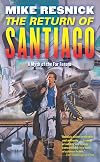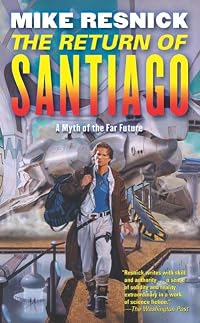
The Return of Santiago: A Myth of the Far Future
by Mike Resnick
Santiago (2), Far Future History (3), Birthright (27)
On This Page
Description
There's a new bard in the galaxy--and he's looking for a hero. The Hugo and Nebula Award-winning author returns to the frontier that spawned a legend. Danny Briggs is a simple yet conflicted thief. To successfully ply his trade, Briggs can't draw attention to himself, but he longs to do something worth remembering. Luck is on his side when he hits the mother lode: discovering the original manuscript of the balladeer who wandered the spaceways a century ago, recording the adventures of show more larger-than-life heroes, villains, and misfits--including Santiago. Briggs doesn't want to sell the manuscript, he wants to add to it. All he needs is his century's version of Santiago, a man who may be on the wrong side of the law, but the right side of justice. To find this protagonist, Briggs partners up with Santiago's last descendant, a dancer named Waltzin' Matilda. They comb through the universe's good, bad, and ugly looking for a new folk hero to inspire the masses. It's not easy, but Briggs is willing to pay the price--even though there's one on his head. "Pecos Bill and Wild Bill Hickok would feel right at home with such characters as Tyrannosaur Bailey and the One-Armed Bandit. Seekers of space-age sagebrush need look no farther." --Publishers Weekly show lessTags
Recommendations














Member Reviews
This book is full of bigger than life egocentric antiheroes but none who are admirable. The main character, Danny Briggs, is a thief who concludes that the government is too oppressive and needs to be thwarted. To do so he decides to revitalize a legendary terrorist organization and he goes in search of a leader. He finds one but when they actually begin committing acts of terrorism, he feels they have gone too far. He recruits another. By the end of the book, Danny is indirectly responsible for several deaths but seems to suffer little remorse and never questions if terrorism is the best way to enact social change.
The bad science, flawed characters and even more flawed premise make this a less than satisfying book. The reader ends up show more feeling that the government, oppressive as it is said to be, can’t be as bad as the terrorists who are supposed to be the heroes. I could find no redeeming value in either the terrorists or the government they oppose (but don’t want to overthrow) so I really didn’t care which of them ultimately triumphed. I almost walked out on this book two-thirds of the way in but mainly kept reading to see if the author had some insight to share or a point he was trying to make. There wasn’t. show less
The bad science, flawed characters and even more flawed premise make this a less than satisfying book. The reader ends up show more feeling that the government, oppressive as it is said to be, can’t be as bad as the terrorists who are supposed to be the heroes. I could find no redeeming value in either the terrorists or the government they oppose (but don’t want to overthrow) so I really didn’t care which of them ultimately triumphed. I almost walked out on this book two-thirds of the way in but mainly kept reading to see if the author had some insight to share or a point he was trying to make. There wasn’t. show less
These are the startling adventures of small time thief Danny Briggs as he attempts to succeed Black Orpheus, the famous bard of the Inner Frontier, a place where each criminal and vigilante lawman is more dangerous and infamous than the last. And in the long history of this vast interplanetary wild west there is one figure more infamous than all others combined, Santiago. A man of countless legends beyond credulity, with a record of dastardly deeds so fantastic it borders on the absurd.
As Danny Briggs reads the short poems composing this history as told by Black Orpheus he realizes that Santiago was not one man but a series of them. And as he begins to pen his own mediocre poetry he decides that each bard needs his own Santiago, and his show more mission to revive the legend is born.
What the book lacks in subtlety, and it certainly is lacking, it makes up for in pure fun. Indeed, while the larger plot holds no real surprises once the story gets rolling, the specific happenings are often unexpected and almost always entertaining.
Still, the main value of the book is in the large and varied cast of oddballs. There are cat-burglars and gunslingers, crack-shots and crackpots, countless colorful characters each one with a fascinating story of his own. And as Briggs meets each of them he composes an uninspired little poem or two recording their deeds and summing up the lives for posterity.
Supposedly this is the story of the search for Santiago, a figure needed to keep the Democracy, a.k.a. the tyrannical intergalactic government, from excessively exploiting the lawless Inner and Outer Frontiers. In truth it's the story of personal change. I know that sounds incredibly cornball, and it is. Fortunately this is an area where Mike Resnick seems capable of subtly storytelling. You don't even realize it until you've finished and put down the book, so don't let that scare you.
My advice is this, if you read solely for a fresh unexpected plot you might want gives this one a pass. But if a book can catch you by cast alone pick a copy up. I didn't regret it and I don't think will you.
p.s. The blurb on the back seems to have been written under the influence of something quite unbalancing. Ignore it completely. show less
As Danny Briggs reads the short poems composing this history as told by Black Orpheus he realizes that Santiago was not one man but a series of them. And as he begins to pen his own mediocre poetry he decides that each bard needs his own Santiago, and his show more mission to revive the legend is born.
What the book lacks in subtlety, and it certainly is lacking, it makes up for in pure fun. Indeed, while the larger plot holds no real surprises once the story gets rolling, the specific happenings are often unexpected and almost always entertaining.
Still, the main value of the book is in the large and varied cast of oddballs. There are cat-burglars and gunslingers, crack-shots and crackpots, countless colorful characters each one with a fascinating story of his own. And as Briggs meets each of them he composes an uninspired little poem or two recording their deeds and summing up the lives for posterity.
Supposedly this is the story of the search for Santiago, a figure needed to keep the Democracy, a.k.a. the tyrannical intergalactic government, from excessively exploiting the lawless Inner and Outer Frontiers. In truth it's the story of personal change. I know that sounds incredibly cornball, and it is. Fortunately this is an area where Mike Resnick seems capable of subtly storytelling. You don't even realize it until you've finished and put down the book, so don't let that scare you.
My advice is this, if you read solely for a fresh unexpected plot you might want gives this one a pass. But if a book can catch you by cast alone pick a copy up. I didn't regret it and I don't think will you.
p.s. The blurb on the back seems to have been written under the influence of something quite unbalancing. Ignore it completely. show less
slightly lighter than the original Santiago. Clean for Resnick tho
Ratings
Members
- Recently Added By
Author Information

574+ Works 14,689 Members
Mike Resnick was born on March 5, 1942. He sold his first article in 1957, his first short story in 1959, and his first book in 1962. He attended the University of Chicago from1959 through 1961. Resnick began writing stories under various pseudonyms and churned out more than 200 novels, 300 short stories and 2,000 articles, from1964 through1976. show more He edited 7 different tabloid newspapers and a pair of men's magazines, as well. Beginning with Shaggy B.E.M. Stories in 1988, Resnick has also become an anthology editor, and was nominated for a Best Editor Hugo in 1994 and 1995. His list of anthologies in print and in press totals more than 20. Since 1989, he has won four Hugo Awards, a Nebula Award, and has been nominated for 19 Hugos, eight Nebulas, a Clarke (British), and five Seiun-shos (Japanese). He has also won 10 Homer Awards, an Alexander Award, a Golden Pagoda Award, the Seiun Award (Japanese), a Hayakawa SF Award (Japanese), a Locus Award, an Ignotus Award (Spanish), a Futura Award (Croatian), the Tour Eiffel Award (French), the Prix Ozone (French), two Sfinks Awards and a Fantastyka Award (both Polish), and has topped the S. F. Chronicle Poll six times and the Asimov's Readers Poll twice. (Bowker Author Biography) show less
Some Editions
Series


Work Relationships
Is contained in
Common Knowledge
- Canonical title
- The Return of Santiago: A Myth of the Far Future
Classifications
Statistics
- Members
- 234
- Popularity
- 138,645
- Reviews
- 3
- Rating
- (3.56)
- Languages
- Czech, English
- Media
- Paper, Ebook
- ISBNs
- 4
- ASINs
- 4