On This Page
Description
Large in body and spirit, Jack Aubrey throws his heavy frame up main-masts as if he were a boy of ten. Tendentiously traditional, Aubrey spends his evenings with ship's surgeon, Stephen Maturin, a brilliant naturalist and occasional spy for the British government. In the quiet of Aubrey's cabin, the two work on their Corelli; after numerous voyages their friendship has mellowed into a touching, if occasionally tempestuous, marriage. Devotees can expect a number of spectacular battle scenes, show more ship-board jests, and the historical mimicry for which O'Brian is so famous. Maturin's efforts to persuade Peruvians to revolt against the Spanish crown will send him on a perilous journey across the Andes, while Aubrey will be reunited briefly with his illegitimate black son, and suffer dreadfully under the blustery politics of a Rousseauian. show lessTags
Recommendations

















Member Reviews
After the unusually downbeat tone of [b:Clarissa Oakes|1102150|Clarissa Oakes (Aubrey/Maturin #15)|Patrick O'Brian|https://i.gr-assets.com/images/S/compressed.photo.goodreads.com/books/1557426956l/1102150._SX50_.jpg|2773925], I found 'The Wine-Dark Sea' a return to form for the Aubrey & Maturin series. Although it is more solemn than the ebullient earlier novels, there are still joyful scenes. Moreover, it is only fitting that the narrative recognises its protagonists aging. Neither Jack nor Stephen can shrug off injuries as they used to. Their behaviour hasn't really changed to accept this, however. Stephen hits the coca leaves for energy while trying to forment revolution in Peru. Meanwhile Jack hares off in a tiny launch to try and show more save him from an inconvenient Frenchman, nearly dying in the process. Jack's mixed metaphors and Killick's general demeanour continue to provide levity. Jack and Stephen's dialogue is endearing as ever:
I also enjoyed Jack asking Stephen what twelve sixes are and receiving the reply ninety-two and their conversation about the similar structures of frigate-birds and ship's sails. There are also thrills to be had. Some very dramatic reversals of fortune take place, including an amazing chase through a field of ice. My favourite scenes took place on land, as Stephen fitted in plenty of wildlife-watching during his brief stint in Peru. His guide, a kindred spirit called Eduardo, and the various creatures he encounters are delightful and the dry, cold, dangerous Andes vividly brought to life. On board ship, I enjoyed Stephen's views on the French Revolution in general and Rousseau in particular ("that mumping villain"). The discussions of slavery and its abolition are likewise fascinating. The book ends on a philosophical note, as absolutely nothing has gone according to plan but at least our heroes are still alive, afloat, and on their way home. show less
"Are you awake?" asked Jack Aubrey in a hoarse whisper through a crack in the door.
"I am not," said Stephen. "Nor do I choose to swim; but I will take coffee with you when you return to the ship. The animal," he added to himself. "I never heard him get up." It was true. Jack weighed far too much, but he was still remarkably light on his feet.
I also enjoyed Jack asking Stephen what twelve sixes are and receiving the reply ninety-two and their conversation about the similar structures of frigate-birds and ship's sails. There are also thrills to be had. Some very dramatic reversals of fortune take place, including an amazing chase through a field of ice. My favourite scenes took place on land, as Stephen fitted in plenty of wildlife-watching during his brief stint in Peru. His guide, a kindred spirit called Eduardo, and the various creatures he encounters are delightful and the dry, cold, dangerous Andes vividly brought to life. On board ship, I enjoyed Stephen's views on the French Revolution in general and Rousseau in particular ("that mumping villain"). The discussions of slavery and its abolition are likewise fascinating. The book ends on a philosophical note, as absolutely nothing has gone according to plan but at least our heroes are still alive, afloat, and on their way home. show less
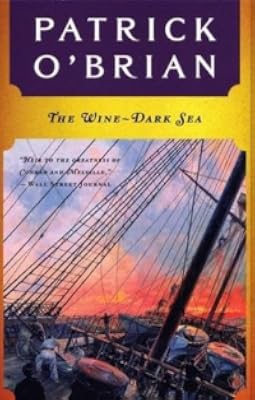
The Wine-Dark Sea, Patrick O’Brian’s sixteenth book in his Aubrey-Maturin series, picks up immediately where the previous novel, Clarissa Oakes, left off with Captain Jack Aubrey, Stephen Maturin, and Thomas Pullings aboard the Surprise chasing the American privateer Franklin, under command of French privateersmen, from Moahu where they recently thwarted French ambitions on the strategic island. Turbulent seas from an underwater volcanic eruption enable the Surprise to overtake and capture the Franklin, gaining the crew another prize.
Aboard the Franklin, Aubrey finds her owner, Jean Dutourd, who had sought to finance a utopia on Moahu by enticing one group to overthrow the monarch. Doutard sails without papers for himself, putting show more Aubrey in the awkward position of how to classify him – either a privateer or a pirate. An encounter with a whaler brings news of the Alastor, a French vessel flying the black flag of piracy, and Aubrey determines to find and take her. Once the crew of the Surprise accomplishes that, they send the Surprise and the Alastor into Callao, the port for Lima, along with Maturin who can finally begin the mission upon which he embarked in The Thirteen Gun Salute. While Stephen begins making contact with locals who might support Peruvian independence, Jack looks for further prizes in the Franklin. Unfortunately for Stephen, Doutard manages to stowaway on one of the prizes and reaches Peru, intending to send up an alarm. Though neither the French nor Spanish authorities trust Doutard – he showing an alarming lack of tact and his views on religion putting him at odds with the Spanish – his words do pose a threat to any English attempt to support Peruvian independence and Stephen must flee overland. The breeze being against them, Aubrey attempts to reach Callao by cutter, though the winds delay and batter them. Fortunately, Captain Pullings finds them struggling to enter the harbor and brings them aboard Surprise, where word of Stephen’s overland trek meets them. The Surprise sails down the coast and rendezvous with Stephen before heading to the Cape to try and take three American China ships. There they encounter further misfortune when an unexpected U.S. frigate appears, giving the Surprise a brief chase in which she suffers ice damage. The Surprise escapes, but a lightning strike further damages her mast. The novel closes with the HMS Berenice under Captain Heneage Dundas finding them and transferring provisions to repair Surprise in order that they may return home.
Like the previous nine novels, The Wine-Dark Sea exists outside the normal flow of time – this novel being the tenth of eleven to exist in what O’Brian described as an extended 1812, with these books taking place between the beginning of June 1813 and November 1813. Further, this continues the circumnavigation of the globe that began in The Thirteen Gun Salute and will end in The Commodore. The title quotes Homer’s Odyssey: “And if some god should strike me, out on the wine-dark sea, I will endure it.” O’Brian uses this novel to examine the nature of fortune, with Captain Dundas commenting on it when he finds Surprise damaged while Aubrey remarks that the failure in the mission is balanced by the joy of being alive and homeward bound. While the events of the previous nine novels would normally take several years, those looking for a perfect chronology are advised to simply enjoy the story and the way in which O’Brian perfectly recreates the world of the Napoleonic Wars, using Aubrey and Stephen’s activities to comment on the rapid changes occurring in this era and the passage of time in the series’ internal chronology. This Folio Society edition reprints the original text with insets containing historical portraits and sketches to illustrate some of the scenes. show less
Aboard the Franklin, Aubrey finds her owner, Jean Dutourd, who had sought to finance a utopia on Moahu by enticing one group to overthrow the monarch. Doutard sails without papers for himself, putting show more Aubrey in the awkward position of how to classify him – either a privateer or a pirate. An encounter with a whaler brings news of the Alastor, a French vessel flying the black flag of piracy, and Aubrey determines to find and take her. Once the crew of the Surprise accomplishes that, they send the Surprise and the Alastor into Callao, the port for Lima, along with Maturin who can finally begin the mission upon which he embarked in The Thirteen Gun Salute. While Stephen begins making contact with locals who might support Peruvian independence, Jack looks for further prizes in the Franklin. Unfortunately for Stephen, Doutard manages to stowaway on one of the prizes and reaches Peru, intending to send up an alarm. Though neither the French nor Spanish authorities trust Doutard – he showing an alarming lack of tact and his views on religion putting him at odds with the Spanish – his words do pose a threat to any English attempt to support Peruvian independence and Stephen must flee overland. The breeze being against them, Aubrey attempts to reach Callao by cutter, though the winds delay and batter them. Fortunately, Captain Pullings finds them struggling to enter the harbor and brings them aboard Surprise, where word of Stephen’s overland trek meets them. The Surprise sails down the coast and rendezvous with Stephen before heading to the Cape to try and take three American China ships. There they encounter further misfortune when an unexpected U.S. frigate appears, giving the Surprise a brief chase in which she suffers ice damage. The Surprise escapes, but a lightning strike further damages her mast. The novel closes with the HMS Berenice under Captain Heneage Dundas finding them and transferring provisions to repair Surprise in order that they may return home.
Like the previous nine novels, The Wine-Dark Sea exists outside the normal flow of time – this novel being the tenth of eleven to exist in what O’Brian described as an extended 1812, with these books taking place between the beginning of June 1813 and November 1813. Further, this continues the circumnavigation of the globe that began in The Thirteen Gun Salute and will end in The Commodore. The title quotes Homer’s Odyssey: “And if some god should strike me, out on the wine-dark sea, I will endure it.” O’Brian uses this novel to examine the nature of fortune, with Captain Dundas commenting on it when he finds Surprise damaged while Aubrey remarks that the failure in the mission is balanced by the joy of being alive and homeward bound. While the events of the previous nine novels would normally take several years, those looking for a perfect chronology are advised to simply enjoy the story and the way in which O’Brian perfectly recreates the world of the Napoleonic Wars, using Aubrey and Stephen’s activities to comment on the rapid changes occurring in this era and the passage of time in the series’ internal chronology. This Folio Society edition reprints the original text with insets containing historical portraits and sketches to illustrate some of the scenes. show less
Faultless, as ever. The plotting was, perhaps, a little thin; but when it comes as part of such beautifully written prose, and interspersed with such fantastically observed events as the emergence of a new volcanic island, or Stephen's adventures in the Andes, I really can't bring myself to care. Only four books left in the series, though! I think I shall have to slow down my pace again. I find myself wanting to really draw this series out, to make it last.
Book number 16 in Patrick O'Brian's Aubrey-Maturin series. As is typical for these books, it doesn't feel like there's an unfolding plot, so much as just a bunch of things that happen. In this case: weird weather, sea battles, injuries, Stephen being involved in an attempt to foment revolution in Peru, a trek through the Andes, and some icebergs.
It's not the best of the series and it's not the worst. Just a good, solid installment that delivers pretty much what I expect from these books: a chance to go sailing with these familiar characters and see where their journey takes them next.
It's not the best of the series and it's not the worst. Just a good, solid installment that delivers pretty much what I expect from these books: a chance to go sailing with these familiar characters and see where their journey takes them next.
Doctor Stephen Maturin, an intelligence agent of formidable powers, is dispatched to discomfit the Napoleonic French and their allies. With him comes his particular friend, naval captain Jack Aubrey. Each of them has some successes on this long voyage--Jack takes a truly ridiculous number of prizes--but are battered by their adventures and happy to head home.
I love this series so much. At this point,the continued travails of the Surprise's crew, captain, and surgeon are as comforting and interesting as hearing about my home town.
I love this series so much. At this point,the continued travails of the Surprise's crew, captain, and surgeon are as comforting and interesting as hearing about my home town.
Jack and Stephen find themselves in the middle of a Pacific volcanic eruption and the reader is treated to Stephen's trek across the Andes. These are just a few of the things that give "The Wine Dark Sea" a unique feel. Mr. O'Brian's ability to offer up something different in the midst of such familiarity is truly a gift. I was particularly taken with the descriptions of llamas - and their reactions to Stephen. Lots of humor and tragedy equally mixed.
Among the pleasures of this volume was the tour of the high altitudes of Peru and of their particular flora and fauna. Stephen Maturin examines condors first hand, and bromeliads, and three kinds of llamas. Adventures include Maturin's party being sideswiped by a sudden blizzard, and Jack Aubrey being seriously wounded in the eye and leg. Even though I barely follow the political events that inform Stephen's espionage missions, Stephen survives through his wits, and with very helpful allies, and Jack survives miraculously one injury after another. I wonder how Maturin can manage all of his various addictions. First came laudanum, now coca leaves.
I can hardly wait for the two friends to touch down on native soil so that we can hear from show more Sophie and Diana again. show less
I can hardly wait for the two friends to touch down on native soil so that we can hear from show more Sophie and Diana again. show less
Members
- Recently Added By
Lists

Top Five Books of 2014
1,064 works; 397 members

Huxley's Reading Log 2020
24 works; 1 member

Books Read in 2018
4,360 works; 110 members
Author Information

154+ Works 77,085 Members
Patrick O'Brian is the author of twenty volumes in the highly respected Aubrey/Maturin series of novels. (Publisher Provided) Patrick O'Brien was born in Ireland in 1914. His education included the Sorbonne. O'Brian has produced a variety of works, including biographies of Picasso and Sir Joseph Banks and translations of the novels and memoirs of show more Simone de Beauvoir, but he is best known for the creation of an unlikely pair of Napoleonic War-era heroes in the Aubrey-Maturin Series. British naval officer Jack Aubrey and Irish scholar and physician Stephen Maturin have been featured in more than a novels published in Great Britain (five of which have also appeared in America). He died on January 2, 2000. (Bowker Author Biography) show less
Some Editions
Series

Belongs to Publisher Series
Work Relationships
Is contained in
Common Knowledge
- Original publication date
- 1994
- People/Characters
- Jack Aubrey; Stephen Maturin; Nathaniel Martin; Tom Pullings; Preserved Killick; Barrett Bonden (show all 15); Joe Plaice; Padeen Colman; William Reade; Awkward Davies; Emily Sweeting; Sarah Sweeting; West; Heneage Dundas; Samuel Panda
- Important places
- Peru; Pacific Ocean
- Dedication
- For Richard Simon and Vivien Green
- First words
- A purple ocean, vast under the sky and devoid of all visible life apart from two minute ships racing across its immensity.
- Last words
- (Click to show. Warning: May contain spoilers.)They drank it staring at the embers in the hanging stove; and when they had settled what masts and spars the Berenice could give the Surprise, with a long aside about Dundas's tender the Baltimore clipper, picked up perfect but empty - not a soul, not a scrap of paper - in the south Pacific, and her extraordinary sailing qualities, Jack said, 'No. Harking back to this voyage, I think it was a failure upon the whole, and a costly failure; but,' he said laughing with joy at the thought, 'I am so happy to be homeward-bound, and I am so happy, so very happy, to be alive.'
- Publisher's editor
- Lawrence, Starling
Classifications
Statistics
- Members
- 2,751
- Popularity
- 6,724
- Reviews
- 27
- Rating
- (4.14)
- Languages
- 5 — English, French, German, Italian, Spanish
- Media
- Paper, Audiobook, Ebook
- ISBNs
- 51
- ASINs
- 18