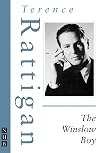
The Winslow Boy
by Terence Rattigan
On This Page
Description
Based on the real-life court case of a young naval cadet unjustly accused of stealing a five-shilling postal order and first staged in 1946, The Winslow Boy has been revived many times since, including at The Old Vic in 2013. Ronnie Winslow is expelled from naval college, having been accused of petty theft. Enraged, his father Arthur engages a lawyer to challenge the Admiralty to prove the charges in court ? but public opinion is very much against the Winslows, and each member of the show more family is suffering... This edition includes an authoritative introduction by Dan show lessTags
Recommendations




























Member Reviews
I read this first, on my own, not as an assignment, as a teenager. I think it was an old battered pupils edition of the play, from my parents bookshelves. Hard work, but an intriguing story even back then (I must have been 13 or 14).
I find that I did not understand very much back then. Back then, for me the story was about the boy, about the fight to find justice for him. Re-reading it now, I see that it is about everyone *but* the boy. There is the parents, specifically the father, putting everything (money, reputation, health) into the task of getting their boy exonerated from the accusation of being a thief. The siblings suffer for this, the older brother loses his place at Oxford because the parents cannot pay for it anymore, the show more older sister loses her fiancé due to the publicity. Even the barrister whose help they enlisted, gets himself deeply involved in a tangle of political mudfights, legal battles and last but not least his unacknowledged attraction to a lady. There is a number of subplots going on, and the end does not only see the boy exonerated but nicely ties a few of these subplots as well. There is an open ending that is just lovely and unexpected --or not, if you have been reading attentively!
There is a 1999 film version of this play by David Mamet, which is worth watching. show less
I find that I did not understand very much back then. Back then, for me the story was about the boy, about the fight to find justice for him. Re-reading it now, I see that it is about everyone *but* the boy. There is the parents, specifically the father, putting everything (money, reputation, health) into the task of getting their boy exonerated from the accusation of being a thief. The siblings suffer for this, the older brother loses his place at Oxford because the parents cannot pay for it anymore, the show more older sister loses her fiancé due to the publicity. Even the barrister whose help they enlisted, gets himself deeply involved in a tangle of political mudfights, legal battles and last but not least his unacknowledged attraction to a lady. There is a number of subplots going on, and the end does not only see the boy exonerated but nicely ties a few of these subplots as well. There is an open ending that is just lovely and unexpected --or not, if you have been reading attentively!
There is a 1999 film version of this play by David Mamet, which is worth watching. show less
Wonderful 1940's play about a middle-class father's defense of his boy, a very young military academy student, against the unthinking might of English military and judicial institutions. (I couldn't help but picture Rebecca Pidgeon as the sister - she was perfectly cast in David Mamet's movie version.)
What's left is "Masterpiece Theatre," a very clean, straightforward adaptation of a finely constructed play, faithful to every classical virtue -- harmony, proportion, balance -- if not to the director's own, more iconoclastic virtues.
Apr 3, 2025Portuguese (Brazil)
Ratings
Members
- Recently Added By
Lists

1940s
221 works; 25 members
Author Information

53+ Works 1,174 Members
Rattigan, who had been a playwright since leaving Oxford University at the age of 22, boasted of his workmanship---"I believe sloppy construction, untidy technique, and lack of craftsmanship to be great faults"---and of his ability to please the British playgoer, the archetypical "Aunt Edna," a "middle-class, middle-aged maiden lady with time on show more her hands." Not surprisingly, he fell out of favor in the Britain of the 1960s. (He had never been particularly popular in the United States, which looked on his work as inspirationally lacking.) At the time of his death, criticism, still taking him at his word, faintly praised Rattigan's expositions, his management of interleaving characters (as in Separate Tables, 1954), and his artful episodic development in Ross (1960). But Darlow and Hodson's revelations of Rattigan's tormented personal life have helped readers acknowledge that, despite imposed or sentimental endings, his plays are often full of genuine anguish---in the relations of parents and children (Man and Boy, 1963) and obsessed lovers (The Deep Blue Sea, 1952), and in recognition of weakness that vitiates heroism (Ross, 1960, which is based on the life of T. E. Lawrence. And revivals of the 1948 play The Browning Version (at the National Theatre) and of The Winslow Boy (1946) moved the critic Harold Hobson to concede that "there are many things in Rattigan that have not yet been properly perceived." (Bowker Author Biography) show less
Some Editions
Awards and Honors
Series
Belongs to Publisher Series
Work Relationships
Is contained in
Common Knowledge
- Canonical title
- The Winslow Boy
- Original publication date
- 1946
- Important places
- London, England, UK
- Related movies
- The Winslow Boy (1948 | IMDb); The Winslow Boy (1999 | IMDb)
- Original language
- English
Classifications
Statistics
- Members
- 216
- Popularity
- 151,801
- Reviews
- 3
- Rating
- (3.71)
- Languages
- English
- Media
- Paper, Audiobook, Ebook
- ISBNs
- 13
- ASINs
- 11