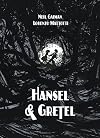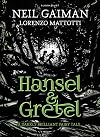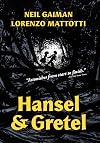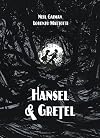
Hansel and Gretel: A Toon Graphic
by Neil Gaiman, Lorenzo Mattotti (Illustrator)
On This Page
Description
Two abandoned children come upon a gingerbread cottage inhabited by a cruel witch who wants to eat them.Tags
Recommendations


Member Reviews
When I saw Neil Gaiman had written a new version of the old fairy tale Hansel and Gretel on Netgalley, I was excited to see what he would do with. Happily, at least to me, he stays very close to the original. This is no Disneyfied version, no friendly animals or dancing candlesticks there to help the two children. Gaiman, instead, retains all the elements that gave me shivers when I read it as a child - war, famine, two children abandoned by their parents, and of course, cannibalism. Yikes!
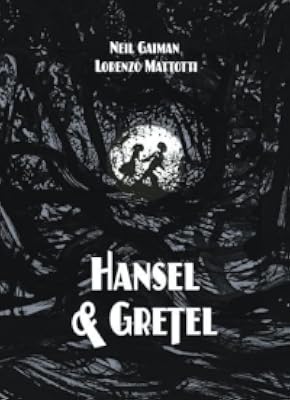
And adding to the horror of the tale are the amazing stark ink drawings by Lorenzo Mattotti, the black colouring relieved only by patches of grey and white. In the end, though, both Gaiman’s usual excellent prose and Mattotti’s drawings emphasize show more the truth of all fairy tales that no matter how dark, grim and frightening the world can become, there is always hope and the chance of a happy ending.
I received an arc of this book from Netgalley and the publishers in exchange for an honest review show less
And adding to the horror of the tale are the amazing stark ink drawings by Lorenzo Mattotti, the black colouring relieved only by patches of grey and white. In the end, though, both Gaiman’s usual excellent prose and Mattotti’s drawings emphasize show more the truth of all fairy tales that no matter how dark, grim and frightening the world can become, there is always hope and the chance of a happy ending.
I received an arc of this book from Netgalley and the publishers in exchange for an honest review show less
This originally appeared at The Irresponsible Reader.
---
WHAT'S HANSEL AND GRETEL ABOUT?
This is the story of Hansel and Gretel almost straight from the Brothers Grimm—given a quick shine by Gaiman. There's nothing particularly Gaiman-esque about the writing or the approach to the story. It's a pretty decent and straightforward approach to the story.
THE ART
In the spirit of "If you can't say anything nice....", I'm tempted to leave a few lines of blank space here and move on. I don't get it. Really. I just don't understand what Mattotti was going for here. The pictures are spread over two pages, and most of those pages are black. There are bits of white to help you get an image or the shadow of an image, but again—it's just black. The show more kind of black that would've threatened to bankrupt printers just a couple of decades ago.
Maybe a quarter to a third of each two-page spread was interesting—but the rest. Ugh.
Call me a Philistine here...but I just don't see why someone would bother.
I've looked at Mattotti's website, and I like a lot of what I saw there...but this was a swing and a miss.
SO, WHAT DID I THINK ABOUT HANSEL AND GRETEL?
So, the text was okay. The art was disappointing. Overall, I give this a "meh." If this were a person's first exposure to the story—it'd work well. And honestly, if that's what someone uses it for—I'd probably rate this higher.
But for someone wanting a little bit of that Gaiman magic applied to this familiar tale? It just doesn't deliver. show less
---
WHAT'S HANSEL AND GRETEL ABOUT?
This is the story of Hansel and Gretel almost straight from the Brothers Grimm—given a quick shine by Gaiman. There's nothing particularly Gaiman-esque about the writing or the approach to the story. It's a pretty decent and straightforward approach to the story.
THE ART
In the spirit of "If you can't say anything nice....", I'm tempted to leave a few lines of blank space here and move on. I don't get it. Really. I just don't understand what Mattotti was going for here. The pictures are spread over two pages, and most of those pages are black. There are bits of white to help you get an image or the shadow of an image, but again—it's just black. The show more kind of black that would've threatened to bankrupt printers just a couple of decades ago.
Maybe a quarter to a third of each two-page spread was interesting—but the rest. Ugh.
Call me a Philistine here...but I just don't see why someone would bother.
I've looked at Mattotti's website, and I like a lot of what I saw there...but this was a swing and a miss.
SO, WHAT DID I THINK ABOUT HANSEL AND GRETEL?
So, the text was okay. The art was disappointing. Overall, I give this a "meh." If this were a person's first exposure to the story—it'd work well. And honestly, if that's what someone uses it for—I'd probably rate this higher.
But for someone wanting a little bit of that Gaiman magic applied to this familiar tale? It just doesn't deliver. show less
Surprisingly, Gaiman does little to alter the common version of the Hansel and Gretel story. He does nothing at all to modernize it, nor to set it in a specific time period, but instead he simply gives his characters more voice. The story may be told from a relatively omniscient viewpoint, but we are given just enough of Hansel's inner dialogue and the emotional turmoil of the wood cutter to make them stand out.
What makes this book special, though, is really Mattiotti's dense illustrations. The overwhelming black tones give the story an appropriately horrifying feeling, while the perfectly placed patches of white keep the eye from being overwhelmed. This treatment not only accurately captures the quality of light (and lack-there-of) in show more the old world forest, but also serves to remind readers of the positive outcome and hope in this tale. show less
What makes this book special, though, is really Mattiotti's dense illustrations. The overwhelming black tones give the story an appropriately horrifying feeling, while the perfectly placed patches of white keep the eye from being overwhelmed. This treatment not only accurately captures the quality of light (and lack-there-of) in show more the old world forest, but also serves to remind readers of the positive outcome and hope in this tale. show less
Neil Gaiman and Lorenzo Mattotti’s version of Hansel and Gretel covers the original Grimm Brothers’ dark and eerie tale of two siblings fighting to endure the evils of the world. I loved this version of one of the most cherished tales of all time because it portrayed the truth and contained one more drop of reality than the even more famous (at least in the U.S.) Disney version of the story. Gaiman and Mattotti’s version of Hansel and Gretel portrays a tale of survival during a time of war and great famine. In this version, Hansel and Gretel’s mother chooses to leave the lives of her children up to fate in order to save enough money to merely survive with her life partner; although reluctant, the children’s father agrees with show more his wife’s truth and decides to commit to her wish. I also enjoyed reading of Hansel and Gretel’s journey into adulthood, caused by the incredible circumstances cast onto them by their beloved parents and the wicked old lady. Hansel and Gretel trick the wicked woman and eventually murder her in one of the most painful ways to die in order to solve their problems and rise to the top, regardless of their tragic past and present. In conclusion, I was intrigued to have read such a straightforward and dark, but semi-realistic tale designed for children. Instead of trying to conceal the dark reality of life, this version of the tale targets the truth and does so in a child-friendly way. I can see why some adults would be more than reluctant to introduce their child to this book, but I believe that we should not lie and pretend that the world is a perfect place. Therefore, I would recommend this book for both children and adults to read. show less
Another haunting, interesting fairy tale adaptation from the mind of Neil Gaiman
Synopsis:
The story is already one you know, two young children live with their parents in the woods, their parents are struggling to afford food and so have no choice but to send their children to fend for themselves. They encounter a house made of gingerbread and the old lady who lives there offers to take them in, but she isn’t the sweet woman they think she is, but instead an evil witch who wants to eat them.
Review:
This is going to be a fairly short review as I'm not really sure what to say about it, a difficult one to review! It’s a really enjoyable book, however I can’t help but feel a little disappointed. I read both Hansel and Gretel and The show more Sleeper and the Spindle in one sitting, (to see my review of that click here!) and The Sleeper and the Spindle to me seemed so much more fascinating. Neil Gaiman’s trademark spin that he puts on things does not seem to be in this story, comparing with his Sleeping Beauty adaptation, Hansel and Gretel sticks mainly to the original story. Despite this it’s still an enjoyable read, and if you plan on buying The Sleeper and the Spindle, then I recommend you get both because they’re a lovely set.
One thing I did rather appreciate about this version of the story was the illustrations. Dark and shadowy, Mattotti does a great job adding another layer to the story and giving it a real eerie fairy tale feel. They may not be to everyone’s taste, but I thought they were a very interesting addition to the novel.
Like The Sleeper and the Spindle, the book is packaged beautifully and is a fun, interesting read. I also found a particularly interesting little addition in the publishers timeline of Hansel and Gretel at the end of book, fascinating if you’re curious about where the story came from and how it’s changed from generation to generation.
It’s dark, fun and interesting, but if you’re no stranger to the story then don’t expect anything too different to what you've heard before, but overall a lovely, beautifully illustrated little book. show less
Synopsis:
The story is already one you know, two young children live with their parents in the woods, their parents are struggling to afford food and so have no choice but to send their children to fend for themselves. They encounter a house made of gingerbread and the old lady who lives there offers to take them in, but she isn’t the sweet woman they think she is, but instead an evil witch who wants to eat them.
Review:
This is going to be a fairly short review as I'm not really sure what to say about it, a difficult one to review! It’s a really enjoyable book, however I can’t help but feel a little disappointed. I read both Hansel and Gretel and The show more Sleeper and the Spindle in one sitting, (to see my review of that click here!) and The Sleeper and the Spindle to me seemed so much more fascinating. Neil Gaiman’s trademark spin that he puts on things does not seem to be in this story, comparing with his Sleeping Beauty adaptation, Hansel and Gretel sticks mainly to the original story. Despite this it’s still an enjoyable read, and if you plan on buying The Sleeper and the Spindle, then I recommend you get both because they’re a lovely set.
One thing I did rather appreciate about this version of the story was the illustrations. Dark and shadowy, Mattotti does a great job adding another layer to the story and giving it a real eerie fairy tale feel. They may not be to everyone’s taste, but I thought they were a very interesting addition to the novel.
Like The Sleeper and the Spindle, the book is packaged beautifully and is a fun, interesting read. I also found a particularly interesting little addition in the publishers timeline of Hansel and Gretel at the end of book, fascinating if you’re curious about where the story came from and how it’s changed from generation to generation.
It’s dark, fun and interesting, but if you’re no stranger to the story then don’t expect anything too different to what you've heard before, but overall a lovely, beautifully illustrated little book. show less
Am in two minds about this book - whilst I normally adore Neil Gaiman's style of writing (and have adored his other recent fairy tale retelling in The Sleeper and The Spindle), I cannot immediately tell which part is Gaiman and which isnt.
Meanwhile, the illustrations are fabulous, in strong black and white (it says it's ink, but I would say it was charcoal), with figures in silhouette rather than full definition. The telling is traditional, with little variation from the Grimm's fairy tale - Hansel and Gretel are left in the woods by their parents, who are running low on food after a period of war and famine. The first time, they make their way back to their home, after Hansel has the foresight to load his pockets with white stones to show more mark their way. The second time Hansel doesn't have the time to gather the stones, and his bread is eaten by the birds before they find their way home.
The siblings, already starving, find their way to a house made of gingerbread, where an old woman lives. She captures both children, locks Hansel in a cage in order to fatten him up, and chains Gretel to the table for her to do housework. The woman struggles to see, and fails to realise that Hansel is getting fatter, but uses a bone when she feels his finger to find out how fat he is getting. Gretel uses her brains, and when the witch wants to roast both of them for her dinner, Gretel pushes her into the hot oven.
The two children escape home, with lots of loot from the witch's house, and find their mother (the one who insisted they were to be "lost" in the woods) has died not long after their disappearance.
All the standards are there: the trail back home , the gingerbread house, death by roasting...is this my favourite Neil Gaiman? Not convinced. Is it a wonderful hardback addition to the collection of books-with-pictures? Oh yes indeedie show less
Meanwhile, the illustrations are fabulous, in strong black and white (it says it's ink, but I would say it was charcoal), with figures in silhouette rather than full definition. The telling is traditional, with little variation from the Grimm's fairy tale - Hansel and Gretel are left in the woods by their parents, who are running low on food after a period of war and famine. The first time, they make their way back to their home, after Hansel has the foresight to load his pockets with white stones to show more mark their way. The second time Hansel doesn't have the time to gather the stones, and his bread is eaten by the birds before they find their way home.
The siblings, already starving, find their way to a house made of gingerbread, where an old woman lives. She captures both children, locks Hansel in a cage in order to fatten him up, and chains Gretel to the table for her to do housework. The woman struggles to see, and fails to realise that Hansel is getting fatter, but uses a bone when she feels his finger to find out how fat he is getting. Gretel uses her brains, and when the witch wants to roast both of them for her dinner, Gretel pushes her into the hot oven.
The two children escape home, with lots of loot from the witch's house, and find their mother (the one who insisted they were to be "lost" in the woods) has died not long after their disappearance.
All the standards are there: the trail back home , the gingerbread house, death by roasting...is this my favourite Neil Gaiman? Not convinced. Is it a wonderful hardback addition to the collection of books-with-pictures? Oh yes indeedie show less
Dark, eerie, spooky and wonderfully told and illustrated, this is a book to recommend. The dark illustrations might be a bit too creepy for children.
In this rendition of the fairy tale, both parents are in agreement, though the father is reluctant that the children must be banished to the woods.
Also in this tale it is the biological mother, not a step mother, who is adamant that they cannot feed the children and the parents are more worthy of survival.
As a personal commentary, I'll state that I react strongly to men who are bullied by women and acquiesce. I had the same reaction when reading Ethan Fromme.
The first time they are left alone in the dark woods, they are able to find a way back home. Thus, daddy and mommy dearest make a show more conscious decision to once again take the children into the woods. It is Hansel who is smart enough to know what is occurring and poor, Gretel believes they will return.
Hungry, Hansel and Gretel find a gingerbread cottage. As they eagerly eat the house, the wicked witch takes them inside and promises food. When Hansel is locked away, he tricks the witch by allowing her to believe a skinny stick is his arm.
Ingeniously, the children find a way to kill the witch. They return home and mommy is dead. Daddy is glad to see them. Yikes, how in the world they can trust this man again is beyond my comprehension. show less
In this rendition of the fairy tale, both parents are in agreement, though the father is reluctant that the children must be banished to the woods.
Also in this tale it is the biological mother, not a step mother, who is adamant that they cannot feed the children and the parents are more worthy of survival.
As a personal commentary, I'll state that I react strongly to men who are bullied by women and acquiesce. I had the same reaction when reading Ethan Fromme.
The first time they are left alone in the dark woods, they are able to find a way back home. Thus, daddy and mommy dearest make a show more conscious decision to once again take the children into the woods. It is Hansel who is smart enough to know what is occurring and poor, Gretel believes they will return.
Hungry, Hansel and Gretel find a gingerbread cottage. As they eagerly eat the house, the wicked witch takes them inside and promises food. When Hansel is locked away, he tricks the witch by allowing her to believe a skinny stick is his arm.
Ingeniously, the children find a way to kill the witch. They return home and mommy is dead. Daddy is glad to see them. Yikes, how in the world they can trust this man again is beyond my comprehension. show less
Members
- Recently Added By
Lists

Books Read in 2015
3,299 works; 129 members
Author Information

842+ Works 449,039 Members
Neil Gaiman was born in Portchester, England on November 10, 1960. He worked as a journalist and freelance writer for a time, before deciding to try his hand at comic books. Some of his work has appeared in publications such as Time Out, The Sunday Times, Punch, and The Observer. His first comic endeavor was the graphic novel series The Sandman. show more The series has won every major industry award including nine Will Eisner Comic Industry Awards, three Harvey Awards, and the 1991 World Fantasy Award for best short story, making it the first comic ever to win a literary award. He writes both children and adult books. His adult books include The Ocean at the End of the Lane, which won a British National Book Awards, and the Locus Award for Best Fantasy Novel for 2014; Stardust, which won the Mythopoeic Award as best novel for adults in 1999; American Gods, which won the Hugo, Nebula, Bram Stoker, SFX, and Locus awards; Anansi Boys; Trigger Warning: Short Fictions and Disturbances; and The View from the Cheap Seats: Selected Nonfiction, which is a New York Times Bestseller. His children's books include The Day I Swapped My Dad for Two Goldfish; Coraline, which won the Elizabeth Burr/Worzalla, the BSFA, the Hugo, the Nebula, and the Bram Stoker awards; The Wolves in the Walls; Odd and the Frost Giants; The Graveyard Book, which won the Newbery Award in 2009 and The Sandman: Overture which won the 2016 Hugo Awards Best Graphic Story. (Bowker Author Biography) show less

Awards and Honors
Series
Belongs to Publisher Series
Toon Books (Toon Graphics)
Common Knowledge
- Canonical title
- Hansel and Gretel: A Toon Graphic
- Original title
- Hansel and Gretel: A Toon Graphic
- Original publication date
- 2014-10-28
- People/Characters
- Hansel; Gretel; Hansel and Gretel
- Important places
- Germany
- First words
- This all happened a long time ago, in your grandmother's time, or in her grandfather's.
Classifications
- Genre
- Graphic Novels & Comics
- DDC/MDS
- 741.5 — Arts & recreation Drawing & decorative arts Drawing Comic books, graphic novels, fotonovelas, cartoons, caricatures, comic strips
- LCC
- PZ7.7 .G3 .H — Language and Literature Fiction and juvenile belles lettres Fiction and juvenile belles lettres Juvenile belles lettres
- BISAC
Statistics
- Members
- 883
- Popularity
- 30,520
- Reviews
- 56
- Rating
- (3.78)
- Languages
- 7 — Danish, English, French, German, Italian, Portuguese (Brazil), Spanish
- Media
- Paper, Audiobook, Ebook
- ISBNs
- 17
- ASINs
- 6