On This Page
Description
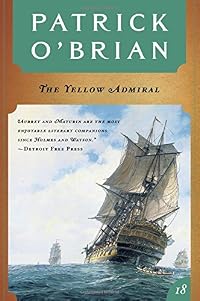
Life ashore may once again be the undoing of Jack Aubrey in The Yellow Admiral, Patrick O'Brian's best-selling novel and eighteenth volume in the Aubrey/Maturin series. Aubrey, now a considerable though impoverished landowner, has dimmed his prospects at the Admiralty by his erratic voting as a Member of Parliament; he is feuding with his neighbor, a man with strong Navy connections who wants to enclose the common land between their estates; he is on even worse terms with his wife, Sophie, show more whose mother has ferreted out a most damaging trove of old personal letters. Even Jack's exploits at sea turn sour: in the storm waters off Brest he captures a French privateer laden with gold and ivory, but this at the expense of missing a signal and deserting his post. Worst of all, in the spring of 1814, peace breaks out, and this feeds into Jack's private fears for his career. Fortunately, Jack is not left to his own devices. Stephen Maturin returns from a mission in France with the news that the Chileans, to secure their independence, require a navy, and the service of English officers. Jack is savoring this apparent reprieve for his career, as well as Sophie's forgiveness, when he receives an urgent dispatch ordering him to Gibraltar: Napoleon has escaped from Elba. show lessTags
Recommendations


















Member Reviews
I am perilously close to the end of the Aubrey and Maturin chronicles and very glad that I still have two left to enjoy. This series is such a consistent delight! There are very few naval adventures in this installment, a lot of which takes place on land. When Jack and Stephen do set sail, orders are to blockade Brest which proves an uncomfortable and largely tedious task. As usual, however, they find dealing with domestic affairs far more trying than the constant perils of sailing the high seas. Once again, both are in financial difficulties. This leads their wives and children to form a single household, which is lovely. [b:The Yellow Admiral|93204|The Yellow Admiral (Aubrey & Maturin #18)|Patrick show more O'Brian|https://i.gr-assets.com/images/S/compressed.photo.goodreads.com/books/1388192844l/93204._SY75_.jpg|216150] includes much about the legal process and inequalities of enclosure, which Jack opposes in his local area to the detriment of his career prospects. This is rather fascinating from a historical perspective. Meanwhile Stephen has some espionage successes that for once do not threaten him with death or serious injury.
I really enjoyed all the sequences in the Aubrey and Maturin household - it was wonderful to see more of Sophie, Diana, and Clarissa. Diana's obsession with driving horses to great speeds is used to excellent effect. Her Arabian horses are the early 19th century equivalent of sports cars. She drives Jack and Stephen around quite a lot and will tolerate no backseat driving from anyone:
As Jack can only steer a ship and frequently injures himself falling off horses, he certainly has no authority to advise Diana on driving. The dynamics of the Aubrey & Maturin family on land are amusing and endearing to observe. After some very rocky times, Stephen and Diana's marriage appears stable and happy. Jack and Sophie have some serious upheavals, precipitated by Sophie's unpleasant mother.This leads to an extraordinary conversation between Stephen and Diana, lying naked in the afterglow, about whether Jack and/or Sophie are bad in bed. Stephen: "[Sophie] has never taken pleasure in the act itself... And Jack is what is ordinarily called a very full-blooded man." Diana: "I have it on the best authority that Jack is no artist in these matters... In better hands [Sophie] would, I am sure, have been a very likely young woman; and oh so much happier." Diana and Clarissa subsequently counsel Sophie to be a bit more relaxed about flirtation and adultery, and also give her sex advice. Given the marital harmony reigning by the end of the book, one can only assume this was helpful!
Of course, Jack and Stephen are just as much married to each other as to their wives (if not more so - they certainly spend much more time together than with their wives). Such is Jack's fondness for Stephen that he pines sadly after Stephen left the ship less than a day prior:
Their deep friendship is of course the heart of the series. Near the end of the book, Stephen and Jack have what sounds like a truly delightful holiday in London, during which they spend the days together reading in a library, playing billiards, and window-shopping for music, then the evenings having dinner with old friends. O'Brian is endlessly brilliant at bringing charm, humour, and pathos to mundane social situations. While reading [b:The Yellow Admiral|93204|The Yellow Admiral (Aubrey & Maturin #18)|Patrick O'Brian|https://i.gr-assets.com/images/S/compressed.photo.goodreads.com/books/1388192844l/93204._SY75_.jpg|216150] I laughed many times and was now and again quite moved. The exciting twist at the end promises more action in the next book. The lack thereof in this installment really allowed his characterisation and dialogue to shine; these are what I read the series for rather than sea battles, although the battles are thrilling. I cannot think of another writer with so many novels that have brought me such joy. show less
I really enjoyed all the sequences in the Aubrey and Maturin household - it was wonderful to see more of Sophie, Diana, and Clarissa. Diana's obsession with driving horses to great speeds is used to excellent effect. Her Arabian horses are the early 19th century equivalent of sports cars. She drives Jack and Stephen around quite a lot and will tolerate no backseat driving from anyone:
"I do hope Diana don't savage Heneage on the way back," said Jack. "You might not think it, but he is a very sensitive cove, and he feels harsh words extremely. I remember when his father called him a vile concupiscent waste-thrift whoremonger he brooded over it a whole evening."
"She is not much given to moral judgement," said Stephen. "What she really dislikes is a bore, man or woman; and a want of style."
"No. I mean if he were to criticise her driving, or to suggest - even in a very round-about and subtle diplomatic manner, you know - that he might do better."
"Oh, he is wiser than that, sure. After all he knows she can put a dog-cart through the eye of a needle."
"I hope you are right," said Jack. "But she gave me a cruel bite when I happened, just happened, to throw out a remark about the bridge."
As Jack can only steer a ship and frequently injures himself falling off horses, he certainly has no authority to advise Diana on driving. The dynamics of the Aubrey & Maturin family on land are amusing and endearing to observe. After some very rocky times, Stephen and Diana's marriage appears stable and happy. Jack and Sophie have some serious upheavals, precipitated by Sophie's unpleasant mother.
Of course, Jack and Stephen are just as much married to each other as to their wives (if not more so - they certainly spend much more time together than with their wives). Such is Jack's fondness for Stephen that he pines sadly after Stephen left the ship less than a day prior:
Yet this was a lonely breakfast. Obviously, in the nature of things, a captain of a man-o-war, above all one who could not afford to keep a table (and this was Jack's case at present) must eat many and many a solitary meal; but for a great while Jack Aubrey had sailed with Stephen Maturin, and now he missed his companion quite severely - a wholly human and often contradictory companion, essentially different from the only other guests he could invite, lieutenants, master's mates or midshipmen, who were all debarred by the skipper on any point whatsoever; and who in any case could not speak until spoken to.
Their deep friendship is of course the heart of the series. Near the end of the book, Stephen and Jack have what sounds like a truly delightful holiday in London, during which they spend the days together reading in a library, playing billiards, and window-shopping for music, then the evenings having dinner with old friends. O'Brian is endlessly brilliant at bringing charm, humour, and pathos to mundane social situations. While reading [b:The Yellow Admiral|93204|The Yellow Admiral (Aubrey & Maturin #18)|Patrick O'Brian|https://i.gr-assets.com/images/S/compressed.photo.goodreads.com/books/1388192844l/93204._SY75_.jpg|216150] I laughed many times and was now and again quite moved. The exciting twist at the end promises more action in the next book. The lack thereof in this installment really allowed his characterisation and dialogue to shine; these are what I read the series for rather than sea battles, although the battles are thrilling. I cannot think of another writer with so many novels that have brought me such joy. show less
Perhaps the book in the series in which the least happens, at least in terms of naval or intelligence adventures. And yet one of my favorites. There is a lot about the politics of enclosure, the politics of the navy and of married life in early 19th-century Britain, and of life on a blockade at sea. Coming at Book 18 in the series, I think any reader would be happy to forgo the adventure to spend time in the world (or else that reader would have abandoned the series long before.)
The description of the plot on the back of my edition evidently feels the lack of action acutely, as its description of the plot is distinctly and humorously misleading.
The description of the plot on the back of my edition evidently feels the lack of action acutely, as its description of the plot is distinctly and humorously misleading.
Not the best ever but still filled with the irresistible Aubrey, Maturin, Killick, Sophie and Diana and a very curmudgeonly Admiral who makes Aubrey’s life miserable. Only two left!
The Yellow Admiral is the 18th book in a series of 20 completed books (and one incomplete tome) regaling the reader with the travails, victories and defeats of Jack Aubrey, commander, post-captain, commodore, and eventually admiral of the blue in the British navy during the Napoleonic Wars of the early 19th century. Actually, to call these volumes “books” is something of a misnomer since each is the equivalent of a 300-or-more-page chapter in an interminably long novel that we might more accurately entitle The Aubrey/Maturin Series. This being the case, the reader really should begin with the first chapter-book of the series, Master and Commander, reading each of the later installments in the proper order; to do otherwise is to show more encounter references and names, especially names of ships, which are likely to befuddle the reader since their stories appear in earlier volumes.
Although these seafaring tales reputedly enjoyed wide popularity when they were published, I remain unimpressed by author Patrick O'Brian, whose original name, by the way, was Richard Patrick Russ, and whose nationality was solidly English, not Irish. Wikipedia has a nicely detailed article on Russ which I highly recommend and which pops up in the results of an Internet search on the name Patrick O'Brian.
Russ/O'Brian exhibits one stylistic trait that drives me bananas. He has no sense of transitions that usually signal the passage of time. In one sentence, he may order a subordinate officer to send another sailor to him, and in the very next sentence he is speaking to that sailor. It is as if no time whatsoever elapses between sending for a man and then addressing the person who was sent for. After a time, the reader does become inured to this, but I found initial exposure to it to be disconcerting.
Russ/O'Brian relies entirely upon plot to spin his tale (and there is really only one tale stretched over 20 full volumes). He is no Melville, and his Aubrey/Maturin stories have not a hint of symbolism or deeper message. There is nothing to be learned from them and retained for the reader's edification. Admittedly, one is extensively exposed to the argot of the 19th century navy and to copious terms applicable to sailing ships. Whether or not such language is accurate I must leave to experts on sailing ship construction and rigging, but they do convey a feeling or impression in keeping with the story and its setting.
The name Maturin has already popped up in this commentary, and his character is generally one of the more delightful aspects of Russ/O'Brian's lengthy story. While Maturin is an exemplary physician (and sails with Aubrey as ship's surgeon), his naivety about all things nautical almost always provides a refreshing bit of humor in the story. His lack of physical dexterity where ocean water is concerned also results in humorous interludes. However, his character points up yet another weakness in Russ/O'Brian's authorial skill, for the reader learns that Maturin is also a spy for the British government, but with notably few exceptions, we are never treated to his secret exploits. Having added “spy” to Maturin's list of qualifications, Russ/O'Brian doesn't seem to know what to do with that aspect of his character.
My final substantive criticism of these books is their lack of variety. Russ/O'Brian has one formulaic theme and we read quite an exhaustive—and exhausting—series of Aubrey's adventures. I could never finish more than three chapter-books in this series at a time without a sensation of déjà vu setting in and had to take a break by reading something more substantive before returning to the next chapter-book in the series.
Having mentioned what I find to be the greatest failings of Russ/O'Brian as an author, permit me to add that, taken a few at a time, the tales of Aubrey and Maturin are entertaining and certainly provide some escapism from 21st century realities. Do not, however, buy the entire set of 20 chapter-books at one time as I did, for then you are duty-bound to read every last one of them. Read Master and Commander. If you enjoy it, buy the next chapter-book, Post Captain and so on, at least until interest wanes. On the other hand, if one is looking for a somewhat shorter seafaring saga by a more proficient writer, I recommend the tales of Horatio Hornblower by C.S. Forester. show less
Although these seafaring tales reputedly enjoyed wide popularity when they were published, I remain unimpressed by author Patrick O'Brian, whose original name, by the way, was Richard Patrick Russ, and whose nationality was solidly English, not Irish. Wikipedia has a nicely detailed article on Russ which I highly recommend and which pops up in the results of an Internet search on the name Patrick O'Brian.
Russ/O'Brian exhibits one stylistic trait that drives me bananas. He has no sense of transitions that usually signal the passage of time. In one sentence, he may order a subordinate officer to send another sailor to him, and in the very next sentence he is speaking to that sailor. It is as if no time whatsoever elapses between sending for a man and then addressing the person who was sent for. After a time, the reader does become inured to this, but I found initial exposure to it to be disconcerting.
Russ/O'Brian relies entirely upon plot to spin his tale (and there is really only one tale stretched over 20 full volumes). He is no Melville, and his Aubrey/Maturin stories have not a hint of symbolism or deeper message. There is nothing to be learned from them and retained for the reader's edification. Admittedly, one is extensively exposed to the argot of the 19th century navy and to copious terms applicable to sailing ships. Whether or not such language is accurate I must leave to experts on sailing ship construction and rigging, but they do convey a feeling or impression in keeping with the story and its setting.
The name Maturin has already popped up in this commentary, and his character is generally one of the more delightful aspects of Russ/O'Brian's lengthy story. While Maturin is an exemplary physician (and sails with Aubrey as ship's surgeon), his naivety about all things nautical almost always provides a refreshing bit of humor in the story. His lack of physical dexterity where ocean water is concerned also results in humorous interludes. However, his character points up yet another weakness in Russ/O'Brian's authorial skill, for the reader learns that Maturin is also a spy for the British government, but with notably few exceptions, we are never treated to his secret exploits. Having added “spy” to Maturin's list of qualifications, Russ/O'Brian doesn't seem to know what to do with that aspect of his character.
My final substantive criticism of these books is their lack of variety. Russ/O'Brian has one formulaic theme and we read quite an exhaustive—and exhausting—series of Aubrey's adventures. I could never finish more than three chapter-books in this series at a time without a sensation of déjà vu setting in and had to take a break by reading something more substantive before returning to the next chapter-book in the series.
Having mentioned what I find to be the greatest failings of Russ/O'Brian as an author, permit me to add that, taken a few at a time, the tales of Aubrey and Maturin are entertaining and certainly provide some escapism from 21st century realities. Do not, however, buy the entire set of 20 chapter-books at one time as I did, for then you are duty-bound to read every last one of them. Read Master and Commander. If you enjoy it, buy the next chapter-book, Post Captain and so on, at least until interest wanes. On the other hand, if one is looking for a somewhat shorter seafaring saga by a more proficient writer, I recommend the tales of Horatio Hornblower by C.S. Forester. show less
As ever, reading O'Brian is like meeting up with an old friend. In this one, the unfolding of the plot is slow and somewhat predictable—it's more like talking with an old friend solely of the past, reliving old memories and not learning anything new about one another. There are none of the fireworks of the earlier books, no huge twists or turns. That's not necessarily a flaw, though; the prose, as ever, soothes and comforts, and the rendering of Jack and Stephen and the numerous supporting cast is as sympathetic yet unflinching as ever. Only two books left in the series, though, which makes me sad—I want to read them, and yet I don't.
I particularly liked all the scenes of Jack & Stephen's families. There are some lovely scenes - Mr. O'Brian has a gift for sketching the essentials in a sentence or two. I especially enjoyed the ending, when the two families were traveling to Madeira. And the scene where Diana tells Stephen that she and Clarissa have been working on Sophie - priceless!
The Yellow Admiral, Patrick O’Brian’s eighteenth book in his Aubrey-Maturin series, picks up shortly after the events of The Commodore, with Captain Jack Aubrey and Stephen Maturin having returned from disrupting the slave trade off the Ivory coast and now taking part in the Brest blockade to prevent Napoleon’s naval forces from rallying while Napoleon’s fortunes falter at land. Like many of O’Brian’s novels, the story shows the fickle nature of fortune, with Jack stuck in legal proceedings concerning some of the prizes he took off Africa. He also worries about the possibility of being yellowed. That is, promoted to flag rank but without a squadron. It remains a possibility because of politics and a dispute regarding show more enclosure with a neighbor, the heir of one of the admirals.
While on the Brest blockade aboard the HMS Bellona, Jack receives worse news that his mother-in-law found papers from an indiscreet affair he had in Canada during book seven, The Surgeon’s Mate. She gave these letters to Sophie, his wife, who is enraged and plans to leave him. Stephen also worries about his fortune, as the Spanish authorities seek to confiscate it for his part in supporting Peruvian independence during The Wine-Dark Sea, which leaves he and his wife, Diana, in dire straits. Fortunately, events begin to change when Diana and Clarissa Oakes intervene with Sophie. Stephen receives word that his fortune is preserved and, though connections with Sir Joseph Blaine, arranges a way for Jack to distinguish himself should peace break out, thereby making it possible for him to advance without being yellowed. As the novel nears its end, Napoleon is defeated and exiled to Elba. The Brest blockade returns to port for paying off and Stephen helps Jack to secure a new position doing hydrographical work while also advancing the cause of independence in Chile. They ready the Surprise, bringing their families for a cruise to Madeira where they will meet the Chilean operatives. While enjoying a brief vacation, Jack receives word that Napoleon has escaped and that he has been reinstated to blockade the Straits of Gibraltar.
At times, The Yellow Admiral feels very much like an interim novel, but it does have some great character development which is one of O’Brian’s strengths, particularly as readers are devoted to these characters by this point. The focus on fortune’s fickle nature is a recurrent theme in the series and works well here, with a midshipman’s death perfectly demonstrating its power for sailors. O’Brian also does a good job capturing the changing times, with enclosure altering the countryside and the commons. Fans who have made it this far will find the material they expect from O’Brian, including some nice puns. This Folio Society edition reprints the original text with insets containing historical portraits and sketches to illustrate some of the scenes and maps on the endpapers to help readers visualize the geography of the Brest coastline. show less
While on the Brest blockade aboard the HMS Bellona, Jack receives worse news that his mother-in-law found papers from an indiscreet affair he had in Canada during book seven, The Surgeon’s Mate. She gave these letters to Sophie, his wife, who is enraged and plans to leave him. Stephen also worries about his fortune, as the Spanish authorities seek to confiscate it for his part in supporting Peruvian independence during The Wine-Dark Sea, which leaves he and his wife, Diana, in dire straits. Fortunately, events begin to change when Diana and Clarissa Oakes intervene with Sophie. Stephen receives word that his fortune is preserved and, though connections with Sir Joseph Blaine, arranges a way for Jack to distinguish himself should peace break out, thereby making it possible for him to advance without being yellowed. As the novel nears its end, Napoleon is defeated and exiled to Elba. The Brest blockade returns to port for paying off and Stephen helps Jack to secure a new position doing hydrographical work while also advancing the cause of independence in Chile. They ready the Surprise, bringing their families for a cruise to Madeira where they will meet the Chilean operatives. While enjoying a brief vacation, Jack receives word that Napoleon has escaped and that he has been reinstated to blockade the Straits of Gibraltar.
At times, The Yellow Admiral feels very much like an interim novel, but it does have some great character development which is one of O’Brian’s strengths, particularly as readers are devoted to these characters by this point. The focus on fortune’s fickle nature is a recurrent theme in the series and works well here, with a midshipman’s death perfectly demonstrating its power for sailors. O’Brian also does a good job capturing the changing times, with enclosure altering the countryside and the commons. Fans who have made it this far will find the material they expect from O’Brian, including some nice puns. This Folio Society edition reprints the original text with insets containing historical portraits and sketches to illustrate some of the scenes and maps on the endpapers to help readers visualize the geography of the Brest coastline. show less
Members
- Recently Added By
Lists

A Rainbow of Books: Colors in the Title
570 works; 24 members

Books Read in 2018
4,360 works; 110 members
Author Information

Patrick O'Brian is the author of twenty volumes in the highly respected Aubrey/Maturin series of novels. (Publisher Provided) Patrick O'Brien was born in Ireland in 1914. His education included the Sorbonne. O'Brian has produced a variety of works, including biographies of Picasso and Sir Joseph Banks and translations of the novels and memoirs of show more Simone de Beauvoir, but he is best known for the creation of an unlikely pair of Napoleonic War-era heroes in the Aubrey-Maturin Series. British naval officer Jack Aubrey and Irish scholar and physician Stephen Maturin have been featured in more than a novels published in Great Britain (five of which have also appeared in America). He died on January 2, 2000. (Bowker Author Biography) show less
Some Editions
Awards and Honors
Distinctions
Series

Work Relationships
Common Knowledge
- Original publication date
- 1996
- People/Characters
- Jack Aubrey; Stephen Maturin; Sophie Aubrey; Diana Villiers; Clarissa Oakes; Padeen Colman (show all 20); Preserved Killick; Barrett Bonden; Brigid Maturin; Emily Sweeting; Sarah Sweeting; Joe Plaice; Mrs. Williams; Charlotte Aubrey; Fanny Aubrey; George Aubrey; Philip Aubrey; Heneage Dundas; Sir Joseph Blaine; William Reade
- Important events
- Age of Sail; Napoleonic Wars
- Epigraph
- [None]
- Dedication
- For Mary, with love
- First words
- Sir Joseph Blaine, a heavy, yellow-faced man in a suit of grey clothes and a flannel waist-coat, walked down St James's Street, across the park, and so to the Admiralty, which he entered from behind, opening the private door ... (show all)with a key and making his way to the large, shabby room in which he had his official being.
Chapter one.
We have gathered here together, thanks to the splendid initiative of Max Hastings and the Evening Standard, to celebrate and to honour one of the greatest storytellers in the English language.
'Speech at the ... (show all)Painted Hall, Greenwich' by William Waldegrave. - Last words
- (Click to show. Warning: May contain spoilers.)At the bottom of a familiar hand had written Dearest Jack - I am so happy for you - love - Queenie.
- Publisher's editor
- Lawrence, Starling
- Blurbers
- Teacher, James; Myers, Kevin; Binyon, T.J.; Waldegrave, William
- Original language
- English
Classifications
Statistics
- Members
- 2,637
- Popularity
- 7,058
- Reviews
- 26
- Rating
- (4.08)
- Languages
- 5 — English, French, German, Italian, Spanish
- Media
- Paper, Audiobook, Ebook
- ISBNs
- 49
- ASINs
- 27