
The Echo Maker
by Richard Powers
On This Page
Description
On a winter night on a remote Nebraska road, twenty-seven year old Mark Schluter flips his truck in a near fatal accident. His older sister, Karin, returns to nurse Mark back from a traumatic head injury. But when he emerges from a coma, Mark believes that this woman is really an impostor who looks just like his sister. Shattered, Karin contacts the cognitive neurologist Gerald Weber, who eagerly investigates. What he discovers in Mark slowly undermines even his own sense of being. show more Meanwhile, Mark attempts to learn what happened the night of his inexplicable accident-armed only with a note left by an anonymous witness. show lessTags
Recommendations





















Member Recommendations

Member Reviews
Near the site of the annual migration of half a million sandhill cranes to the Platte River in Kearney, Nebraska, Mark Schluter is almost killed in a truck accident on a late wintery night. His brain injury results in Capgras Delusion, a real and rare syndrome also called The Illusion of Doubles, which causes him to believe that those close to him have been replaced by identical looking imposters. Mark's sister Karin (whom Mark calls Karin II) returns to Kearney to care for him, and she also summons a famous Oliver-Sacks-like doctor, Gerald Weber, to aid in treatment. Karin reconnects with old lovers: Daniel who works on sandhill crane preservation, and Robert, a developer who has his eye on migratory territory. Meanwhile, all show more characters seem fascinated with Barbara Gillespie, one of Mark's caretakers whom nobody can figure out. Capgras serves Powers as a metaphor for the inability to know others, or even know ourselves. Karin even feels the whole human race suffers from Capgras in our inability to recognize other species as our next of kin. If we did, would we be so cavalier in our disregard for them?
The protagonists are constantly agonizing: who am I really? who is that other person? Mark, injured into honesty, is the only one who tells it like it is: you and you and you are no one but imposters. The self, Powers writes, is an ongoing composition made from chemical media: glutamate, magnesium, calcium constantly making adjustments to the picture. [Joan Didion, "On Keeping a Notebook," : "I have already lost touch with a couple of people I used to be."]
The characters in "The Echo Maker" have some similarities to those in "The Gold Bug Variations": they refer to each other as "woman" or "man"; names are familiarized in the same ways: Mark becomes Marker, just as Frank became Franker in "Gold Bug." The women are generally on the attack, and the men blithely unaware. A younger couple's relationship is "echoed" and intwined with an older couple's.
The differences from "Gold Bug" are heartbreaking. Whereas "Gold Bug" was an elaborate, even breathtaking fugue of intellectual ebulliance, "The Echo Maker" seems more like "Richard Powers For Dummies." The characters are mostly concerned with their own weaknesses and failures. Elevated prose is in short supply. Yet a plot centered on the brain is rife with possibilities. One thinks wistfully of Powers' exploration of conscious thought explored in "Galatea 2.2," or the paean to emergence in "Gold Bug."
Although "The Echo Maker" won The National Book Award, I was disappointed with this book. I wondered if Powers were feeling affinity with his character Gerald Weber, who worries incessantly about being past his greatest work and "on the back nine" so to speak. But perhaps one expects more of Richard Powers than of other writers. (JAF) show less
The protagonists are constantly agonizing: who am I really? who is that other person? Mark, injured into honesty, is the only one who tells it like it is: you and you and you are no one but imposters. The self, Powers writes, is an ongoing composition made from chemical media: glutamate, magnesium, calcium constantly making adjustments to the picture. [Joan Didion, "On Keeping a Notebook," : "I have already lost touch with a couple of people I used to be."]
The characters in "The Echo Maker" have some similarities to those in "The Gold Bug Variations": they refer to each other as "woman" or "man"; names are familiarized in the same ways: Mark becomes Marker, just as Frank became Franker in "Gold Bug." The women are generally on the attack, and the men blithely unaware. A younger couple's relationship is "echoed" and intwined with an older couple's.
The differences from "Gold Bug" are heartbreaking. Whereas "Gold Bug" was an elaborate, even breathtaking fugue of intellectual ebulliance, "The Echo Maker" seems more like "Richard Powers For Dummies." The characters are mostly concerned with their own weaknesses and failures. Elevated prose is in short supply. Yet a plot centered on the brain is rife with possibilities. One thinks wistfully of Powers' exploration of conscious thought explored in "Galatea 2.2," or the paean to emergence in "Gold Bug."
Although "The Echo Maker" won The National Book Award, I was disappointed with this book. I wondered if Powers were feeling affinity with his character Gerald Weber, who worries incessantly about being past his greatest work and "on the back nine" so to speak. But perhaps one expects more of Richard Powers than of other writers. (JAF) show less
"The self [is] a mob, a drifting, improvised posse....No self without self-delusion." Can't begin to approach this intricate novel of ideas in one read, one summary, but... Plot-wise, 27-year-old Mark Schluter--a sweet, though volatile, underachieving "boy-man" content to live in his hometown of Kearney, Nebraska, and work as a machinist in the local slaughterhouse--suffers a horrible, inexplicable accident one February night on a straight, lonely stretch of road. He flips his truck and hangs trapped for hours. He's in bad shape but still lucid when, at the hospital, his brain swells and he's left comatose for 2 weeks. When he wakes, he remembers nothing of the accident and believes the people around him--most painfully his only show more relative, his sister Karin--are replicants, that there's a plot against him as big as he can imagine in his desperately improvising, fragile mind. Karin, who's rejected her past and moved off to try to "make something" of herself, returns to try to help, though he rejects her as an imposter. She lives up to this in many ways, as she has always tried to become whatever anyone wanted her to be, endlessly seeking approval. Even now, she's just picked up where she left off (same triangulation) in high school, simultaneously living with Mark's dear childhood friend Daniel (environmentalist with a Refuge trying to save the Platte River and with it the sandhill cranes) while having an affair with Robert Karsh, the local hotshot developer who wants to open a vacation compound for the "peepers" who come to see the spectacular crane migration every year (AND, it turns out, a zoo for the off-season, and a water themepark with nature-themed fountains, etc--thematic doubling, as Mark sees symbols of people, fakes, so humankind chooses symbolic nature over the real thing, destoying the real to create the symbolic) which will use up much of the precious little water remaining to draw the cranes in the first place. Add to the mix the neuroscientist Weber, whose folksy case studies make him hopelessly outdated and accused of exploitation--bad reviews of his latest book helping to reveal himself to himself: Famous Weber is a fraud, so, who is Weber now?--the renowned brain doc that Karin persuades to come to Nebraska to look at/help Mark (Weber looks at him, does not see, does not help--plans to write about him. Mark's "case" will be Weber's redemption). Weber's 3 trips back and forth from home to Nebraska, home-Nebraska-home-Nebraska-home, mirror the relentless, instinctive migrations of the cranes. And then there's Barbara, the mysterious nurses' aide at the home where Mark is placed, who continues to visit him when he's sent home. Everyone can see that she's more than her outward life explains--she's ALL symbol. Karin wants to be her--her easy, comforting way with Mark--she's playing the role Karin should be inhabiting as his sister (she and Weber, both apparently post-accident acquaintances, are the only "real" people he sees). Weber's in love with her, he thinks, will leave his wife for her, is ping-ponging between them. Meanwhile, Mark is obsessed with finding his rescuer, the mysterious person who left a scrawled note by his bed:
"I am No One
but Tonight on North Line Road
GOD led me to you
so You could Live
and bring back someone else."
He needs to know the identity of this guardian angel as much as he is bedeviled by the responsibility laid at his feet to "bring back someone else," as much as he is bedeviled by the God-obsession of his dead mother here (as much as is humankind--along with the terrifying scientific discovery that devastates his religious girlfriend Bonnie, that a God-sense can be induced in someone by electrical stimulation of an area of the brain. Is that all it is?). He thinks he saw a white column in front of the truck just before...
Barbara, it turns out, is a refugee from a high-powered investigative reporter position, reduced to being sent out to cover a nature story (eventually burrowing in, for her own aggrandisement, to the Refuge vs development mess: it will be her big comeback story). So she's off her anti-depressants, spiraling out amid the shambles of her life, parked on the side of the road on a bone-chilling night in February, and as providence would have it, sees headlights fast approaching, and...
She steps out in front of the on-coming truck to end it all. Mark swerves to avoid her, flips the truck.... Hours later, she goes to see him in the hospital. He's in terrible shape, but still lucid. She's apologizing over and over, explaining what she did, he tries to speak, can't, she hands him a piece of paper, and he scrawls...
Eventually, a low dose of a pill cures Mark's delusional state--a cure Weber could've found a year before if he'd been seriously looking. The proposed pill also has to get past Karin, who, incredibly, is so dependant on the good opinion of others to form her own identity, has come to enjoy the sainted version of herself that Mark believes has been abducted/disappeared. If he comes back to himself, he'll remember her as she really is. So she delays his cure, fully aware of why she's doing it.
If there's a weakness in the narrative, it's that so much time is alotted to its least interesting character--Weber. But he's the bearer of the burden of information, too, and puts meat on the bones of much of the theory and symbolism in play (he's identity lost, reformed, finding itself again, but in an analytical way that can plod a little). Mark simply lives it--mutable as river water, struggling to create his world every minute of every day as he clings to a notion of self. And Karin lives it--her sense of self entirely dependent on the currents that surround her.
And the cranes are the living symbol of it all, even as they live by their own mysterious symbology (it's time--again) and live their lives from antiquity to extinction by the remembered land map of their endless migrations: the man/bird of myth, great orator, ruler of words and thought--the echo maker. The crane was the animal form of Apollo. As a foreteller of death, it also carried the soul to heaven. Or cranes are human souls. "Something in the crane is trapped halfway....When animals and people all spoke the same language, crane calls said exactly what they meant. Now we live in unclear echoes." The god-bird symbol of the god-man, endlessly creating its world and embodying itself, yet fated, enslaved to creation... show less
"I am No One
but Tonight on North Line Road
GOD led me to you
so You could Live
and bring back someone else."
He needs to know the identity of this guardian angel as much as he is bedeviled by the responsibility laid at his feet to "bring back someone else," as much as he is bedeviled by the God-obsession of his dead mother here (as much as is humankind--along with the terrifying scientific discovery that devastates his religious girlfriend Bonnie, that a God-sense can be induced in someone by electrical stimulation of an area of the brain. Is that all it is?). He thinks he saw a white column in front of the truck just before...
Barbara, it turns out, is a refugee from a high-powered investigative reporter position, reduced to being sent out to cover a nature story (eventually burrowing in, for her own aggrandisement, to the Refuge vs development mess: it will be her big comeback story). So she's off her anti-depressants, spiraling out amid the shambles of her life, parked on the side of the road on a bone-chilling night in February, and as providence would have it, sees headlights fast approaching, and...
She steps out in front of the on-coming truck to end it all. Mark swerves to avoid her, flips the truck.... Hours later, she goes to see him in the hospital. He's in terrible shape, but still lucid. She's apologizing over and over, explaining what she did, he tries to speak, can't, she hands him a piece of paper, and he scrawls...
Eventually, a low dose of a pill cures Mark's delusional state--a cure Weber could've found a year before if he'd been seriously looking. The proposed pill also has to get past Karin, who, incredibly, is so dependant on the good opinion of others to form her own identity, has come to enjoy the sainted version of herself that Mark believes has been abducted/disappeared. If he comes back to himself, he'll remember her as she really is. So she delays his cure, fully aware of why she's doing it.
If there's a weakness in the narrative, it's that so much time is alotted to its least interesting character--Weber. But he's the bearer of the burden of information, too, and puts meat on the bones of much of the theory and symbolism in play (he's identity lost, reformed, finding itself again, but in an analytical way that can plod a little). Mark simply lives it--mutable as river water, struggling to create his world every minute of every day as he clings to a notion of self. And Karin lives it--her sense of self entirely dependent on the currents that surround her.
And the cranes are the living symbol of it all, even as they live by their own mysterious symbology (it's time--again) and live their lives from antiquity to extinction by the remembered land map of their endless migrations: the man/bird of myth, great orator, ruler of words and thought--the echo maker. The crane was the animal form of Apollo. As a foreteller of death, it also carried the soul to heaven. Or cranes are human souls. "Something in the crane is trapped halfway....When animals and people all spoke the same language, crane calls said exactly what they meant. Now we live in unclear echoes." The god-bird symbol of the god-man, endlessly creating its world and embodying itself, yet fated, enslaved to creation... show less
I knew nothing about The Echo Maker going in, save what I'd read on the back cover: near-fatal car accident...traumatic head injury...coma...Mark emerges and believes his sister is an imposter...famous cognitive neurologist diagnoses him with some sort of syndrome...mysterious disease combined with strange circumstances surrounding the accident threaten to change all of their lives beyond recognition. Wow, sounds like a soap opera, a cheap thriller at best. And yet the "National Book Award Winner" stamp on the front cover suggested the exact opposite.
I normally avoid much (if not all) forewarning and inside information about a book before I start reading, but this time I googled/searched for some reviews, quickly found Margaret Atwood's show more glowing/gushing review in the NY Review of Books, skimmed the first few paragraphs, got to some claptrap comparing this novel to The Wizard of Oz, figured it would be best to just dive in, and so I dove in.
I'm often amazed (amused?) at how expectations going into reading a novel can unrealistically set a tone to the benefit/detriment of the reader. E.g., the last book you read by an author sets your expectation for the next one, which you assume will be of a similar vein, and if it is/isn't you are pleased/disappointed, depending on what you were anticipating. (See my disappointment around The Prague Cemetery.) Similarly, the "blurb" on the back of the book may help sell more copies, if worded in such a way to make a potential reader think he is picking up a quick thriller, if such a reader is looking for a quick thriller, but the book will ultimately be a disappointment when he figures out it is, in fact, a slow psychological drama that unfolds at a painstakingly deliberate pace. I, on the other hand, was simply reading this book based on a recommendation and would otherwise have avoided it based on the "cheap thriller" denouncement via the back blurb and was therefore pleasantly surprised that what I got, instead, was a brilliantly crafted psychological puzzle laid out in pieces, one page at a time, until they all merged together to create an entire picture at the book's end.
Not much of a review so far, I realize, rather an explanation of how I got here, to this point, where I, too, am thinking of writing my own glowing/gushing praises for this book. But I think I won't. I've gone back and read what Atwood said, and she sums it up pretty nicely (except for the Oz stuff, which is still under jury deliberation in my own mind). Instead, let me share a few of my thoughts randomly:
1. Some novelists are great writers (i.e., they can string together an impressive set of words) while others are great story-tellers (i.e., this one should be self explanatory) but Richard Powers is* a rare blend of both. If you're looking for a novel that is pure lyrical poetry, go check out Proust. If you're looking for purely plot driven novel, you probably already know which section of the bookstore you should be shopping in. But, if you're like me, and constantly on the lookout for a complimentary blend of both worlds, here is a great example.
* I say "is" based on this one book, which I acknowledge could technically be a one-off, but let's trust (for now) that the National Book Foundation wouldn't award Powers their highest honor if his preceding catalog read like the mindless blather of a madman.
2. That said, and know how difficult it is to find such a blend, I'm very happy to see the National Book Foundation recognizing this effort, this talent.
3. If you read this, be aware of tense shifts across different POV's. This is not so much important to the story as it is a clever way to distinguish differences in states of mind. As a literary device, I've seen this before, but in Powers' hands and in the framework of this story, I'm not sure I've ever seen it better utilized.
4. To the naysayers who suggest this novel could have been trimmed back, especially in the technical/scientific/medical discussions around various brain injuries/illnesses and their subsequent effects on those suffering from them, I think you missed the point. This story is told from three main character's POV's, alternating, and each three sees things from his/her own perspective. So ask yourself this: if you were a "famous cognitive neurologist" who writes books about the various test subjects you've encountered over the years, wouldn't those be the ruby-colored lenses through which you see the entire world? And if your own world view was crumbling around you, wouldn't those lenses get darker and darker?
5. And how brilliant was it when Weber inserts himself into his own ongoing litanies of case studies at the end of the novel?
Wow, I cannot say enough good things about this book, so instead I will just warn those who are looking for a cheap/quick thriller: this isn't. But if you're looking for something else, something well written, something rewarding, especially if you like to think about what you're reading while you're reading it and make it all the way to the end and then keep thinking about it for a while longer before you drop your final judgement: this is. show less
I normally avoid much (if not all) forewarning and inside information about a book before I start reading, but this time I googled/searched for some reviews, quickly found Margaret Atwood's show more glowing/gushing review in the NY Review of Books, skimmed the first few paragraphs, got to some claptrap comparing this novel to The Wizard of Oz, figured it would be best to just dive in, and so I dove in.
I'm often amazed (amused?) at how expectations going into reading a novel can unrealistically set a tone to the benefit/detriment of the reader. E.g., the last book you read by an author sets your expectation for the next one, which you assume will be of a similar vein, and if it is/isn't you are pleased/disappointed, depending on what you were anticipating. (See my disappointment around The Prague Cemetery.) Similarly, the "blurb" on the back of the book may help sell more copies, if worded in such a way to make a potential reader think he is picking up a quick thriller, if such a reader is looking for a quick thriller, but the book will ultimately be a disappointment when he figures out it is, in fact, a slow psychological drama that unfolds at a painstakingly deliberate pace. I, on the other hand, was simply reading this book based on a recommendation and would otherwise have avoided it based on the "cheap thriller" denouncement via the back blurb and was therefore pleasantly surprised that what I got, instead, was a brilliantly crafted psychological puzzle laid out in pieces, one page at a time, until they all merged together to create an entire picture at the book's end.
Not much of a review so far, I realize, rather an explanation of how I got here, to this point, where I, too, am thinking of writing my own glowing/gushing praises for this book. But I think I won't. I've gone back and read what Atwood said, and she sums it up pretty nicely (except for the Oz stuff, which is still under jury deliberation in my own mind). Instead, let me share a few of my thoughts randomly:
1. Some novelists are great writers (i.e., they can string together an impressive set of words) while others are great story-tellers (i.e., this one should be self explanatory) but Richard Powers is* a rare blend of both. If you're looking for a novel that is pure lyrical poetry, go check out Proust. If you're looking for purely plot driven novel, you probably already know which section of the bookstore you should be shopping in. But, if you're like me, and constantly on the lookout for a complimentary blend of both worlds, here is a great example.
* I say "is" based on this one book, which I acknowledge could technically be a one-off, but let's trust (for now) that the National Book Foundation wouldn't award Powers their highest honor if his preceding catalog read like the mindless blather of a madman.
2. That said, and know how difficult it is to find such a blend, I'm very happy to see the National Book Foundation recognizing this effort, this talent.
3. If you read this, be aware of tense shifts across different POV's. This is not so much important to the story as it is a clever way to distinguish differences in states of mind. As a literary device, I've seen this before, but in Powers' hands and in the framework of this story, I'm not sure I've ever seen it better utilized.
4. To the naysayers who suggest this novel could have been trimmed back, especially in the technical/scientific/medical discussions around various brain injuries/illnesses and their subsequent effects on those suffering from them, I think you missed the point. This story is told from three main character's POV's, alternating, and each three sees things from his/her own perspective. So ask yourself this: if you were a "famous cognitive neurologist" who writes books about the various test subjects you've encountered over the years, wouldn't those be the ruby-colored lenses through which you see the entire world? And if your own world view was crumbling around you, wouldn't those lenses get darker and darker?
5. And how brilliant was it when Weber inserts himself into his own ongoing litanies of case studies at the end of the novel?
Wow, I cannot say enough good things about this book, so instead I will just warn those who are looking for a cheap/quick thriller: this isn't. But if you're looking for something else, something well written, something rewarding, especially if you like to think about what you're reading while you're reading it and make it all the way to the end and then keep thinking about it for a while longer before you drop your final judgement: this is. show less
The most remarkable thing about this complex, satisfying, hopeful but for the right reasons story is the way that themes move through the portions by each narrator in migration patters mimicking that of the sandhill cranes passing through the landscape in which the story takes place. Responsibility for family versus personal desires and attractions, identity conflicts versus volition, ecology versus development, public identity versus private - the novel can be read, enjoyably, along each of these lines or simply as a story about family, its habits and its loves - all circle, all converge, all relate to the circumstances of tragedy (car accident, water supply deficits, the September 11 attacks) but all, in the end, come back to love.
I'm show more still unpacking all the many aspects of the novel, but I'm trying to think of each one in terms of the title. It's such a strange phrase: Echo Maker. Not sound maker, not music maker, not noise maker, not maker of something others can see or echo of something in particular. Why Echo Maker? I can't tell you the most obvious reason without spoiling the thread of mystery that begins with a note found in a hospital room, but I can tell you that, as the responsible yet unconfident sister, the head-injured brother, the neurologist observing him, and the cranes themselves narrate portions of the story, each is trying not so much to make a sound as to create an answer. The sister wants affirmation, the brother an answer to what has happened and why things seem off, wrong somehow; the neurologist wants his work to be understood for what it is rather than strictly as science or strictly as publishable narratives, and the cranes, most mysterious of all, seek the memory of places as they flow from north to south and back again, echoes left by genetics and behavior over thousands of years. It's a powerful image, the Echo Maker, and it circles through each narrative in migration patterns of its own.
In the end, the story shows us that all life, all mind, is echo making. Identity itself is little more than the received impression we interpret after acting, communicating, thinking, and doing over a lifetime. And yet, identity is no small thing; it is a beautiful thing; it is the thing we can best create, and the thing we must strive to create. It may seem hopeless. The cranes don't understand that the stress they feel, cramming themselves into what little space humans have left them, will eventually hurt their whole species, just as humans, specifically in this story and generally in the world, seldom see the entire interconnected picture of causes and effects, habits and leaps. But in the end, the cranes will adapt, or something will, and in the end so will we, somehow overcoming the stress that causes us to commit horrors in the world quickly or slowly, somehow adapting to the asynchronous, discontinuous facts of our neurology and our quotidian existence, somehow creating a pattern that has meaning and beauty.
The echoes this book has left with me haunt me, like strains from an intricate symphony still recalled, still elaborated, still reverberating. I can't imagine a reader passing through this book unchanged - or uninspired. show less
I'm show more still unpacking all the many aspects of the novel, but I'm trying to think of each one in terms of the title. It's such a strange phrase: Echo Maker. Not sound maker, not music maker, not noise maker, not maker of something others can see or echo of something in particular. Why Echo Maker? I can't tell you the most obvious reason without spoiling the thread of mystery that begins with a note found in a hospital room, but I can tell you that, as the responsible yet unconfident sister, the head-injured brother, the neurologist observing him, and the cranes themselves narrate portions of the story, each is trying not so much to make a sound as to create an answer. The sister wants affirmation, the brother an answer to what has happened and why things seem off, wrong somehow; the neurologist wants his work to be understood for what it is rather than strictly as science or strictly as publishable narratives, and the cranes, most mysterious of all, seek the memory of places as they flow from north to south and back again, echoes left by genetics and behavior over thousands of years. It's a powerful image, the Echo Maker, and it circles through each narrative in migration patterns of its own.
In the end, the story shows us that all life, all mind, is echo making. Identity itself is little more than the received impression we interpret after acting, communicating, thinking, and doing over a lifetime. And yet, identity is no small thing; it is a beautiful thing; it is the thing we can best create, and the thing we must strive to create. It may seem hopeless. The cranes don't understand that the stress they feel, cramming themselves into what little space humans have left them, will eventually hurt their whole species, just as humans, specifically in this story and generally in the world, seldom see the entire interconnected picture of causes and effects, habits and leaps. But in the end, the cranes will adapt, or something will, and in the end so will we, somehow overcoming the stress that causes us to commit horrors in the world quickly or slowly, somehow adapting to the asynchronous, discontinuous facts of our neurology and our quotidian existence, somehow creating a pattern that has meaning and beauty.
The echoes this book has left with me haunt me, like strains from an intricate symphony still recalled, still elaborated, still reverberating. I can't imagine a reader passing through this book unchanged - or uninspired. show less
Only the migrating cranes seemed to witness the devastating car accident that caused Mark Schulter to suffer traumatic brain injury. As he comes to, he is unable to recognize his sister, Karin, believing that she has been replaced by a remarkably close lookalike. Karin arranges for Gerald Weber, an Oliver Sacks-like popular neurologist, to observe Mark with the hopes of a cure.
These are the characters in The Echo Maker, an exploration of the brain, the mind, the self, and the mental ties that keep us coherent human beings. Mark suffers from Capgras syndrome, a rare delusion which leads the person to believe that a close relative is replaced by an imposter. His sister, his dog, and even his home are all imposters in his world. His show more sister, Karin, finds herself drawn back to the small town she thought she had successfully escaped, and makes many of the same mistakes she had in the past. Weber finds that this third book is not critically praised, and begins to question whether any of his work was more meaningful than an exploitative opportunity.
The novel’s strengths lie in the character sketches of Mark and Karin. Karin, especially, is a drab, unhappy, passive character, whereas Mark is full of bluster, rage, and energy. Mark fairly leaps off the page. Weber, on the other hand, is a muddle in his mid-life crisis, depression, and self-revulsion. I wondered, wrongly, at times if he was having a stroke. The novel is far more of a character study, but there is a mystery that provides some satisfaction in its resolution. show less
These are the characters in The Echo Maker, an exploration of the brain, the mind, the self, and the mental ties that keep us coherent human beings. Mark suffers from Capgras syndrome, a rare delusion which leads the person to believe that a close relative is replaced by an imposter. His sister, his dog, and even his home are all imposters in his world. His show more sister, Karin, finds herself drawn back to the small town she thought she had successfully escaped, and makes many of the same mistakes she had in the past. Weber finds that this third book is not critically praised, and begins to question whether any of his work was more meaningful than an exploitative opportunity.
The novel’s strengths lie in the character sketches of Mark and Karin. Karin, especially, is a drab, unhappy, passive character, whereas Mark is full of bluster, rage, and energy. Mark fairly leaps off the page. Weber, on the other hand, is a muddle in his mid-life crisis, depression, and self-revulsion. I wondered, wrongly, at times if he was having a stroke. The novel is far more of a character study, but there is a mystery that provides some satisfaction in its resolution. show less
This is a rambling, overly long book that examines the concept of self, how it shapes our perception of those around us and how they, in turn, reshape our own sense of self. Synopsis: The thread that holds it together is the story of a man convalescing from the trauma of a near-fatal accident. His grasp of reality is shattered and his sister, whom he sees as an imposter, has appealed to a famous cognitive neurologist for help. From there it becomes a case of ‘Physician, heal thyself’ as the good doctor suffers an identity crisis of his own – is he someone with a genuine interest in his patients' welfare or is he just mining them for case histories to pump up his book sales, as his critics suggest? Even knowing the twist at the show more end, I still found this to be fascinating on a second reading because of the way it explores the brain/mind connection and humakind’s impact on the balances in the natural world as a whole. show less
I love Richard Powers's writing more than I can say, but I love some of his books more than others, and this is one that I love less. I rank it on a par with Gain. It's a good story, well told, but Powers makes me hungry for a narrative that makes me more human and more complete than I was before I read the book at hand. That is certainly the case with some of his books (notably The Gold Bug Variations, Plowing The Dark, and Three Farmers on Their Way to a Dance), but not this one.
Members
- Recently Added By
Published Reviews
ThingScore 100
Powers does a beautiful job with these characters, as we see each of them navigate through their self-preoccupations, their histories (shared and not) and where their own needs intersect with others.
added by Shortride
Lists

Favourite Books
1,819 works; 316 members

Pulitzer Prize for Fiction - Finalists
88 works; 9 members

National Book Award - Fiction
78 works; 10 members
Page Turners
185 works; 11 members

Library TBR
64 works; 1 member
Author Information

21+ Works 22,459 Members
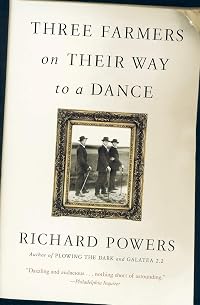
Richard Powers was born on June 18, 1957 in Evanston, Illinois. He received bachelor's and master's degrees in English from the University of Illinois at Urbana-Champaign. After graduation, he moved to Boston, Massachusetts and worked as a computer programmer and freelance data processor. One day he saw August Sander's 1914 black-and-white show more photograph of three Westerwald farm boys heading to a dance at the Museum of Fine Arts. This photograph inspired Powers to quit his job and try writing a novel. Three Farmers on Their Way to a Dance was published in 1985. His other works include Prisoner's Dilemma, The Gold Bug Variations, Operation Wandering Soul, Galatea 2.2, Plowing the Dark, The Time of Our Singing, and Generosity: An Enhancement. He received numerous awards including the James Fenimore Cooper Prize for Best Historical Fiction for Gain, the National Book Award for The Echo Maker, and Pulitzer Prize in fiction for The Overstory: A Novel. (Bowker Author Biography) show less
Some Editions
Awards and Honors
Awards
Distinctions
Notable Lists
Series
Belongs to Publisher Series
Fischer Taschenbuch (17457)
Common Knowledge
- Canonical title
- The Echo Maker
- Original title
- The Echo Maker
- Original publication date
- 2006
- People/Characters
- Mark Schluter; Karin Schluter; Gerald Weber
- Important places
- Dedham Glen Nursing and Rehabilitation Center, Nebraska, USA; Kearney, Nebraska, USA; North Line Road, Nebraska, USA
- Epigraph
- To find the soul it is necessary to lose it.
- A. R. Luria
Part One:
We are all potential fossils still carrying within our bodies the crudities of former existences, the marks of a world in which living creatures flow with little more consistency than clouds from age to age.... (show all)
- Loren Eiseley, The Immense Journey, "The Slit"
Part Two:
I know a painting so evanescent that it is seldom viewed at all.
- Aldo Leopold, A Sand County Almanac
Part Three:
I once saw, on a flowerpot in my own living room, the efforts of a field mouse to build a remembered field. I have lived to see this episode repeated in a thousand guises, and since I have spent a large po... (show all)rtion of my life in the shade of a non-existent tree, i think I am entitled to speak for the field mouse.
- Loren Eiseley, The Night Country, "The Brown Wasps"
Part Four:
What was full was not my creel, but my memory. Like the white-throats, I had forgotten it would ever again be aught but morning on the Fork.
- Aldo Leopold, A Sand County Almanac
Part Five:
As for men, those myriad little detached ponds with their own swarming corpuscular life, what were they but a way that water has of going about beyond the reach of rivers?
- Loren Eiseley, The Immense Jo... (show all)urney, "The Flow of the River"
Time didn’t age you; memory did. - First words
- Cranes keep landing as night falls.
- Quotations
- His father is hit. He sees his parent sprayed across the nearby earth. Birds scream into the shattered air, their brain stems pumping panic. This chaos, too, lays down a permanent trace, remembered forever: open season... (show all).
“I do still believe that Mark is in no danger of harming anyone.” (Dr. Robert Weber)
The blessing of endless information: the Internet, democratizing even health care. Suppose we have all pharmaceuticals an Amazon rating. The wisdom of crowds. Do away with experts all together.
She’d have diagnosed herself with seasonal affective order, but she refused to believe in recently invented diseases. Riegel tried to get her to sit under his plant grow lights.
But something in the neuroscientist now sees: responsibility has no limits. The case historíes you appropriate are yours. - Last words
- (Click to show. Warning: May contain spoilers.)She will be the one holding it, and that is how he must find her.
- Blurbers
- Atwood, Margaret; Faulks, Sebastian; Whitehead, Colson
- Original language*
- Amerikanisch
- Canonical DDC/MDS
- 813.54
- Canonical LCC
- PS3566.O92
*Some information comes from Common Knowledge in other languages. Click "Edit" for more information.
Classifications
Statistics
- Members
- 2,804
- Popularity
- 6,498
- Reviews
- 112
- Rating
- (3.54)
- Languages
- 10 — Czech, Danish, Dutch, English, Finnish, French, German, Italian, Spanish, Swedish
- Media
- Paper, Audiobook, Ebook
- ISBNs
- 37
- ASINs
- 16