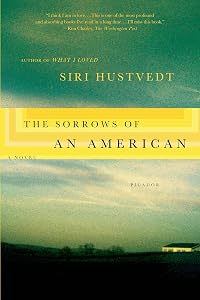
The Sorrows of an American
by Siri Hustvedt
On This Page
Description
When Erik Davidsen and his sister, Inga, find a disturbing note from an unknown woman among their dead father's papers, they believe he may be implicated in a mysterious death. The Sorrows of an American tells the story of the Davidsen family as brother and sister uncover its secrets and unbandage its wounds in the year following their father's funeral.Tags
Recommendations










Member Recommendations

Member Reviews
This is a satisfyingly complex novel, tossing all sorts of interesting ideas around and avoiding predictable resolutions. Hustvedt draws partly on her late father's reminiscences of rural poverty in thirties Minnesota and military service in the Pacific, partly on her own New York circle of philosophers, psychotherapists, artists and Great Writers for a set of characters who seem to be there, inter alia, to make us question the importance we attach to secrets and their resolution in narrative processes like fiction, biography and psychoanalysis. Most people's lives, she seems to be arguing, are determined by the big, obvious things: war and poverty, accident and illness, the time, place and social class into which they are born. In show more comparison with these, the intriguing mysteries of adultery, paternity, secret loves or repressed childhood memories usually fade into insignificance. show less
I believe this is close to a masterpiece and my only real criticism is that it is sometimes too clever for its own good. Hustvedt lets us get under her characters' skin in a way that make them close family while you read. The novel has a slow start, and it continues to thread forward slowly, but after the first third you get used to it and want it no other way. Again she has chosen a male character as her main character, and as a man I am in awe of how well Hustvedt understands us. She seems to say that everything is connected to everything, both in space and in time. At the very end she gives us the clue to the book, what we have known all along, that it is about reincarnation, "not after death, but here when we're alive." Along the show more way she presents us with a brilliantly researched book about psychoanalysis, Norwegian-Americans, father-son relationships, Jamaica, lovers vs. fuck buddies, rural America vs New York. show less
El nombre de Siri Hustvedt siempre va acompañado de la coletilla "mujer de Paul Auster", algo que me molesta y de lo que desconfiaba. Tras leer 'Elegía para un americano', lo primero que leo de esta escritora, he descubierto que Siri es una autora con personalidad propia y tiene derecho a ser reconocida por quien es y por lo que escribe, y no por con quien está casada.
Este libro habla de la memoria y de los recuerdos, de los secretos del pasado y de la melancolía del presente. Dos hermanos, Inga (escritora) y Erik (psiquiatra), descubren, entre los papeles de su padre recientemente fallecido, una misteriosa carta de una tal Lisa que habla sobre algo acaecido en 1937. La novela, narrada en primera persona por Erik (y aquí hago un show more inciso para alabar el gran trabajo de Siri al meterse en la piel de un hombre), trata sobre la investigación de este hecho, pero también sobre la fascinación que ejercen en él sus nuevas inquilinas, Miranda, una joven negra, y su hija de cinco años. Todo esto, más el acoso que sufren Inga y su hija adolescente por unas revelaciones sobre su difunto marido, un escritor de éxito, hacen que la historia no decaiga en ningún momento. Quedas atrapado desde la primera página, por la trama y por los personajes. Es un novela excepcional de una escritora con mucho talento, con una lectura a muchos niveles, inteligente, con corazón y muy bien narrada, que recomiendo fervientemente a todos aquellos que amen la buenas historias. show less
Este libro habla de la memoria y de los recuerdos, de los secretos del pasado y de la melancolía del presente. Dos hermanos, Inga (escritora) y Erik (psiquiatra), descubren, entre los papeles de su padre recientemente fallecido, una misteriosa carta de una tal Lisa que habla sobre algo acaecido en 1937. La novela, narrada en primera persona por Erik (y aquí hago un show more inciso para alabar el gran trabajo de Siri al meterse en la piel de un hombre), trata sobre la investigación de este hecho, pero también sobre la fascinación que ejercen en él sus nuevas inquilinas, Miranda, una joven negra, y su hija de cinco años. Todo esto, más el acoso que sufren Inga y su hija adolescente por unas revelaciones sobre su difunto marido, un escritor de éxito, hacen que la historia no decaiga en ningún momento. Quedas atrapado desde la primera página, por la trama y por los personajes. Es un novela excepcional de una escritora con mucho talento, con una lectura a muchos niveles, inteligente, con corazón y muy bien narrada, que recomiendo fervientemente a todos aquellos que amen la buenas historias. show less
Now the ravens nest in the rotted roof of Chenoweth's old place
And no one's asking Cal about that scar upon his face
'Cause there's nothin' strange about an axe with bloodstains in the barn,
There's always some killin' you got to do around the farm
Murder in the red barn
Murder in the red barn
- Tom Waits
That song keeps playing in my head throughout The Sorrows Of An American - even though it's long unclear whether there's a murder in it at all. Apart from that one September, 2001 mass-murder that turns up as a (mostly, though not completely, unspoken) background for every mid-2000s New York novel, that is. There's a barn, though.
There's death, though. Three of them, to be precise... OK, a few more, but three that start the various plot show more lines of the story. Our narrator, Erik, has just buried his father (natural causes, old age). While he and his recently widowed (natural causes, cancer) sister clean out their father's papers, they find a note:
June 27, 1937
Dear Lars,
I know you will never ever say nothing about what happened. We swore it on the BIBLE. It can't matter now she's in heaven or to those here on earth. I believe in your promise.
Lisa.
So there's secrets too. Was his father involved in a murder? (Well, OK, as a WWII vet he'd have been involved in quite a few deaths, but those aren't murders, are they?) What are the things we don't tell anyone, and nobody wants to ask about, while we're alive (especially if we, like Erik's family, are of hard-working grimly quiet Scandinavian stock and there are Things We Don't Talk About), but which people think they need to know about us after we're gone?
Tied into this is the sister's dead husband, a famous writer (not entirely dissimilar to a certain black-wearing postmodern author close to Hustvedt) whose life and wife is now fair game for the journalists; the mysterious beautiful single mother who just rented the flat below Erik and may be stalked by her ex; and Erik's own issues - including potential violent tendencies - which he is all too aware of.
I remember reading Hustvedt's previous novel, What I Loved, and coming away from it raving that not only was Paul Auster not the greatest novelist in the US, he wasn't even the greatest novelist in his own flat. I rated it a very solid . A couple of years later I can't really remember what specifically about it made me say that, which may be more my fault than Hustvedt's. But much like What I Loved, The Sorrows is basically everything you'd expect of a good (post)modern New York novel; middle-class white people in a suitably upgraded Brooklyn neighbourhood with artists lurking around every corner, dealing with their internal and external problems against a backstory leading back to the Old Country (in this case only a couple of generations, as evidenced by the family members occasionally slipping in the odd Norwegian word) and tackling the Big Questions of life and death and love and sex along the way. Franzen, Foer, all that lot.
Which is bit unfair against The Sorrows (and against Franzen and Foer) as it's really a rather good novel; it's just not a very surprising one. Along the way Hustvedt deals subtly, if somewhat conveniently at times, with the way life messes us up (as a psychoanalyst, Erik keeps coming back to the word "trauma"), the way we try to know each other and ourselves, the way honesty may be the most deceptive thing of all; does knowing The Truth about someone actually tell you the truth of who they are?
I miss the patients. It's hard to describe, but when people are in desperate need, something falls away. The posing that's part of the ordinary world vanishes, that How-are-you?-I'm-fine falseness. The patients might be raving or mute or even violent, but there's an existential urgency to them that's invigorating.
But still, seeing someone sick gives you one picture of who that person is. The book's villain, or as close as it comes to having a villain, runs around with a camera capturing supposedly authentic pictures of people; pictures don't lie (or well, he knows Photoshop) but the shutter speed is only a fraction of a second, yet that one picture overrules all the other fractions of a second that makes up a life. For deeper understanding of others and ourselves, we have stories; the narrative that shows us progression, facets, development, even if each chapter in the story is not the complete truth.
Trauma isn't part of a story; it is outside story. It is what we refuse to make part of our story.
Stories like, I suppose, this one. The Sorrows Of An American is a fine piece of fiction and it's very hard to find fault with it - OK, maybe the ending leaves a bit to be desired. But Hustvedt manages to make what could have been a very depressing novel into something life-affirming and even bleakly funny, with well-done characters and an excellent ear for dialogue. If you have to make the comparison (which isn't as unfair as it may seem, as they really do have a lot in common) I suppose one could argue that she and her husband mirror each other; he starts with the ideas and builds his stories on them, she starts with the story and digs until she finds the ideas - and unlike Auster's latest novels, her characters and their stories feel more genuine and less like author avatars. She hides her work, and she hides it behind a simple but effective prose that, like a good Scandinavian American should, says things without necessarily spelling them out.
It's not essential, it won't save or change your life, and if your taste is anything like mine you've probably read similar stories before. But who says every new novel has to reinvent the genre? Stories need to be told in order to exist, and this one deserves to live. show less
And no one's asking Cal about that scar upon his face
'Cause there's nothin' strange about an axe with bloodstains in the barn,
There's always some killin' you got to do around the farm
Murder in the red barn
Murder in the red barn
- Tom Waits
That song keeps playing in my head throughout The Sorrows Of An American - even though it's long unclear whether there's a murder in it at all. Apart from that one September, 2001 mass-murder that turns up as a (mostly, though not completely, unspoken) background for every mid-2000s New York novel, that is. There's a barn, though.
There's death, though. Three of them, to be precise... OK, a few more, but three that start the various plot show more lines of the story. Our narrator, Erik, has just buried his father (natural causes, old age). While he and his recently widowed (natural causes, cancer) sister clean out their father's papers, they find a note:
June 27, 1937
Dear Lars,
I know you will never ever say nothing about what happened. We swore it on the BIBLE. It can't matter now she's in heaven or to those here on earth. I believe in your promise.
Lisa.
So there's secrets too. Was his father involved in a murder? (Well, OK, as a WWII vet he'd have been involved in quite a few deaths, but those aren't murders, are they?) What are the things we don't tell anyone, and nobody wants to ask about, while we're alive (especially if we, like Erik's family, are of hard-working grimly quiet Scandinavian stock and there are Things We Don't Talk About), but which people think they need to know about us after we're gone?
Tied into this is the sister's dead husband, a famous writer (not entirely dissimilar to a certain black-wearing postmodern author close to Hustvedt) whose life and wife is now fair game for the journalists; the mysterious beautiful single mother who just rented the flat below Erik and may be stalked by her ex; and Erik's own issues - including potential violent tendencies - which he is all too aware of.
I remember reading Hustvedt's previous novel, What I Loved, and coming away from it raving that not only was Paul Auster not the greatest novelist in the US, he wasn't even the greatest novelist in his own flat. I rated it a very solid . A couple of years later I can't really remember what specifically about it made me say that, which may be more my fault than Hustvedt's. But much like What I Loved, The Sorrows is basically everything you'd expect of a good (post)modern New York novel; middle-class white people in a suitably upgraded Brooklyn neighbourhood with artists lurking around every corner, dealing with their internal and external problems against a backstory leading back to the Old Country (in this case only a couple of generations, as evidenced by the family members occasionally slipping in the odd Norwegian word) and tackling the Big Questions of life and death and love and sex along the way. Franzen, Foer, all that lot.
Which is bit unfair against The Sorrows (and against Franzen and Foer) as it's really a rather good novel; it's just not a very surprising one. Along the way Hustvedt deals subtly, if somewhat conveniently at times, with the way life messes us up (as a psychoanalyst, Erik keeps coming back to the word "trauma"), the way we try to know each other and ourselves, the way honesty may be the most deceptive thing of all; does knowing The Truth about someone actually tell you the truth of who they are?
I miss the patients. It's hard to describe, but when people are in desperate need, something falls away. The posing that's part of the ordinary world vanishes, that How-are-you?-I'm-fine falseness. The patients might be raving or mute or even violent, but there's an existential urgency to them that's invigorating.
But still, seeing someone sick gives you one picture of who that person is. The book's villain, or as close as it comes to having a villain, runs around with a camera capturing supposedly authentic pictures of people; pictures don't lie (or well, he knows Photoshop) but the shutter speed is only a fraction of a second, yet that one picture overrules all the other fractions of a second that makes up a life. For deeper understanding of others and ourselves, we have stories; the narrative that shows us progression, facets, development, even if each chapter in the story is not the complete truth.
Trauma isn't part of a story; it is outside story. It is what we refuse to make part of our story.
Stories like, I suppose, this one. The Sorrows Of An American is a fine piece of fiction and it's very hard to find fault with it - OK, maybe the ending leaves a bit to be desired. But Hustvedt manages to make what could have been a very depressing novel into something life-affirming and even bleakly funny, with well-done characters and an excellent ear for dialogue. If you have to make the comparison (which isn't as unfair as it may seem, as they really do have a lot in common) I suppose one could argue that she and her husband mirror each other; he starts with the ideas and builds his stories on them, she starts with the story and digs until she finds the ideas - and unlike Auster's latest novels, her characters and their stories feel more genuine and less like author avatars. She hides her work, and she hides it behind a simple but effective prose that, like a good Scandinavian American should, says things without necessarily spelling them out.
It's not essential, it won't save or change your life, and if your taste is anything like mine you've probably read similar stories before. But who says every new novel has to reinvent the genre? Stories need to be told in order to exist, and this one deserves to live. show less
This book has further cemented Siri Hustvedt's place as one of my favourite writers, and this book is one of her best.
Part of the story is based on, and quotes, her father's memoirs of life among Norwegian immigrants in rural Minnesota and his experiences in the war - this is interwoven with a complex modern story centred on the narrator, a psychotherapist in New York. Hustvedt's characters are fully realised, flawed and human. The book is largely concerned with loss, memory and how perceptions of even the closest family and friends can be affected by secrets.
As in several of her other books (notably What I Loved and The Blazing World), her interest in psychology, philosophy, literature and art shine through, and it is compulsive, show more readable, moving and thought provoking. To finish with a quote: "There is music in dialogue, mysterious harmonies and dissonances that vibrate in the body like a tuning fork". show less
Part of the story is based on, and quotes, her father's memoirs of life among Norwegian immigrants in rural Minnesota and his experiences in the war - this is interwoven with a complex modern story centred on the narrator, a psychotherapist in New York. Hustvedt's characters are fully realised, flawed and human. The book is largely concerned with loss, memory and how perceptions of even the closest family and friends can be affected by secrets.
As in several of her other books (notably What I Loved and The Blazing World), her interest in psychology, philosophy, literature and art shine through, and it is compulsive, show more readable, moving and thought provoking. To finish with a quote: "There is music in dialogue, mysterious harmonies and dissonances that vibrate in the body like a tuning fork". show less
I found this a difficult book to read. I went in expecting a tale of a son exploring his father's youth, and to be sure there is that element to the book. What I did not expect is that that exploration would be only the backdrop for several other plots which all seemed to involve emotional trauma and mental instability, including the protagonist's entanglement with his boarder's ex, which leads him at points to question his own stability. It is, without a doubt, a well-written book, and one worth reading again. But it is not a comfortable book, and thus far I have been unable to brave that re-reading.
 This review was written for LibraryThing Early Reviewers.
This story works on so many levels that I found myself wondering about it even when I wasn't reading.
She touches on so many variants on the theme of loss in this book: the loss of the narrator's father is the backdrop but there is also loss of memory through old age and mental illness, loss of social status, financial loss, even loss of consciousness. With such a focus it could have been a very bleak book indeed, (the delightful Eggy offers much needed light amid the shade) but Hustvedt creates something wonderfully positive here, as her narrator grieves, stumbles and recovers his emotional balance. There is much more here to enjoy, I could go on, but instead I will simply urge you to discover this book for yourself.
She touches on so many variants on the theme of loss in this book: the loss of the narrator's father is the backdrop but there is also loss of memory through old age and mental illness, loss of social status, financial loss, even loss of consciousness. With such a focus it could have been a very bleak book indeed, (the delightful Eggy offers much needed light amid the shade) but Hustvedt creates something wonderfully positive here, as her narrator grieves, stumbles and recovers his emotional balance. There is much more here to enjoy, I could go on, but instead I will simply urge you to discover this book for yourself.
Members
- Recently Added By
Published Reviews
ThingScore 50
The Sorrows of an American is Siri Hustvedt's fourth novel. It was first published in 2008 and is about a Norwegian American family and their troubles. The novel is partly autobiographical in that Hustvedt herself is of Norwegian descent and in that passages from her own deceased father's journal about the Depression in America and the Pacific theatre of war during World War II are scattered show more through the book.
The Sorrows of an American operates on several time levels and depicts the difficult times of four generations of the fictional Davidsen family. At the core of the novel lies a long-kept family secret which the first person narrator, a middle-aged psychiatrist called Erik Davidsen who lives and works in New York, sets out to unearth together with his sister. However, the novel abounds in subplots which focus on the present rather than the past. show less
The Sorrows of an American operates on several time levels and depicts the difficult times of four generations of the fictional Davidsen family. At the core of the novel lies a long-kept family secret which the first person narrator, a middle-aged psychiatrist called Erik Davidsen who lives and works in New York, sets out to unearth together with his sister. However, the novel abounds in subplots which focus on the present rather than the past. show less
added by laurieblum
Lists

Llibres que he llegit el 2013
47 works; 1 member

Llibres que he llegit el 2018
46 works; 1 member
Author Information

35+ Works 9,691 Members
Siri Hustvedt is the author of seven novels, four collections of essays, and two works of nonfiction. She has a PhD from Columbia University in English literature and is a lecturer in psychiatry at Weill Cornell Medical College. She is the recipient of numerous awards, including the International Gabbaron Prize for Thought and Humanities (2012). show more Her novel The Blazing World was nominated for the Booker Prize and won the Los Angeles Times Book Prize for Fiction (2014). In 2019, she received an American Academy of Arts and Letters Award for Literature; the European Essay Prize for "The Delusions of Certainty," a work on the mind-body problem; and the Princess of Asturias Award for Literature. Her work has been translated into more than thirty languages. She lives in Brooklyn, New York. show less
Awards and Honors
Awards
Distinctions
Series
Belongs to Publisher Series
Common Knowledge
- Canonical title
- The Sorrows of an American
- Original title
- The Sorrows of an American
- Original publication date
- 2008
- People/Characters
- Erik Davidsen; Inga Davidsen; Lars Davidsen
- Important places
- New York, USA
- Important events
- September 11 Attacks (2001-09-11)
- Epigraph*
- Ne te détourne pas.
Ne cesse pas de regarder l'endroit qu'on a pansé.
C'est par là que la lumière entre en toi.
Rûmî - Dedication
- For my daughter, Sophie Hustvedt Auster
- First words
- My sister called it "the year of secrets", but when I look back on it now, I've come to understand that it was a time not of what was there, but of what wasn't.
- Last words
- (Click to show. Warning: May contain spoilers.)"I will miss you, too."
- Publisher's editor*
- Actes Sud
- Original language*
- Amerikanisch
*Some information comes from Common Knowledge in other languages. Click "Edit" for more information.
Classifications
Statistics
- Members
- 1,193
- Popularity
- 20,867
- Reviews
- 49
- Rating
- (3.56)
- Languages
- 13 — Catalan, Danish, Dutch, English, Finnish, French, German, Italian, Norwegian (Bokmål), Portuguese, Russian, Spanish, Swedish
- Media
- Paper, Audiobook, Ebook
- ISBNs
- 44
- ASINs
- 9
