Manga! Manga!: The World of Japanese Comics
by Frederik L. Schodt 
On This Page
Description
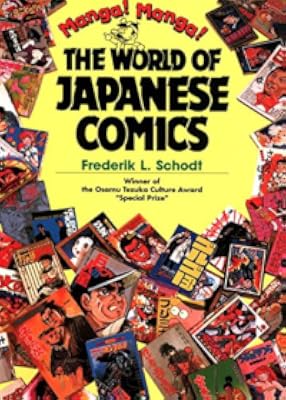
Since first published in 1983, Manga! Manga!: The World of Japanese Comics has been the book to read for all those interested in Japanese comics. It is virtually the bible' from which all studies and appreciation of manga begins. More than that, given the influence of Japanese manga on animation and on American-produced comics as well, Manga! Manga! provides the background against which these other arts can be understood. The book includes 96 pages from Osamu Tezuka's Phoenix, Reiji show more Matsumoto's Ghost Warrior, Riyoko Ikeda's The Rose of Versailles, and Keiji Nakazawa's BarefootGen.' show lessTags
Recommendations































Member Reviews
Initially released in 1983 and then again in 1986 in a slightly updated and revised edition, Frederik L. Schodt's groundbreaking Manga! Manga!: The World of Japanese Comics was one of the first, and remains one of the best, surveys of the history of manga and the manga industry available in English. Written and published at a time when manga was virtually unknown to the average comics reader in the West and when only a very few examples of manga had been translated, Schodt was hoping to provide an introduction to the art form, garner interest in manga, and share his love and excitement for the medium. Manga! Manga! was received very well both in Japan where it earned special recognition from the Japan Cartoonists Association as well as show more in markets focused on English-reading audiences. Although Schodt would follow up Manga! Manga! with his work Dreamland Japan: Writings on Modern Manga in 1996, his initial foray is considered a classic in its subject area and is still well worth reading.
Manga! Manga! opens with a forward by Osamu Tezuka, who Schodt personally knew and worked with. From there Schodt takes over with the first chapter "A Thousand Million Manga," providing an overview of manga and its readership in Japan. "A Thousand Years of Manga" addresses the history of manga, tracing its origins and development from 12th-century narrative art traditions through its more contemporary influences. "The Spirit of Japan" looks at the portrayal of the bushidō ethic in manga, ranging from historical fiction to the yakuza and sports genres, while "Flowers and Dreams" reveals the significance of comics created for and by girls and women. Other genres, such as salaryman, specialty career-oriented manga, and mahjong manga are explored in the chapter "The Economic Animal at Work and at Play." Subjects like censorship, violence, and eroticism are the focus of "Regulations versus Fantasy." Schodt closes his research with a chapters specifically devoted "The Comic Industry" and "The Future." (Granted, that future is now in many cases the past, but the chapter is still illuminating.)
The editions of Manga! Manga! printed after 1997 also have a short introduction by Schodt but otherwise are nearly identical content-wise to those that were published earlier. In addition to Schodt's main text, Manga! Manga! also includes an index divided by general subject, creators, and title as well as a bibliography of both English-language and Japanese-language resources. As is appropriate for a work about manga, Schodt incorporates artwork and photographs throughout the volume--rare is the page which isn't accompanied by some sort of visual component. Particularly noteworthy is the inclusion of translated excerpts selected from four manga: Osamu Tezuka's Phoenix, Reiji Matsumoto's Ghost Warrior, Riyoko Ikeda's The Rose of Versailles, and Keiji Nakazawa's Barefoot Gen. These examples are among some of the earliest manga in translation readily available to a general English-language audience. Brief biographies of the four mangaka are provided as well.
Manga! Manga! is a fantastic work. Even decades after it was first published it remains an informative and valuable study. And, as I have come to expect, Schodt's writing is very approachable and easy to read. Manga! Manga! explores the history of manga within the context of Japanese culture and history, ultimately showing that the two cannot be completely separated. Manga and its development reflect, is influenced by, and emphasizes the changing state of Japanese culture, politics, and social mores. It is an art form and a source of entertainment, but it can also be used for educational and informational purposes and even as propaganda. Schodt outlines the importance of manga in Manga! Manga!, both culturally and historically, and what it has to offer to Japan and to the world at large. Manga! Manga! is very highly recommended to anyone interested in learning more about manga, its history, its creators, or the manga industry as a whole.
Experiments in Manga show less
Manga! Manga! opens with a forward by Osamu Tezuka, who Schodt personally knew and worked with. From there Schodt takes over with the first chapter "A Thousand Million Manga," providing an overview of manga and its readership in Japan. "A Thousand Years of Manga" addresses the history of manga, tracing its origins and development from 12th-century narrative art traditions through its more contemporary influences. "The Spirit of Japan" looks at the portrayal of the bushidō ethic in manga, ranging from historical fiction to the yakuza and sports genres, while "Flowers and Dreams" reveals the significance of comics created for and by girls and women. Other genres, such as salaryman, specialty career-oriented manga, and mahjong manga are explored in the chapter "The Economic Animal at Work and at Play." Subjects like censorship, violence, and eroticism are the focus of "Regulations versus Fantasy." Schodt closes his research with a chapters specifically devoted "The Comic Industry" and "The Future." (Granted, that future is now in many cases the past, but the chapter is still illuminating.)
The editions of Manga! Manga! printed after 1997 also have a short introduction by Schodt but otherwise are nearly identical content-wise to those that were published earlier. In addition to Schodt's main text, Manga! Manga! also includes an index divided by general subject, creators, and title as well as a bibliography of both English-language and Japanese-language resources. As is appropriate for a work about manga, Schodt incorporates artwork and photographs throughout the volume--rare is the page which isn't accompanied by some sort of visual component. Particularly noteworthy is the inclusion of translated excerpts selected from four manga: Osamu Tezuka's Phoenix, Reiji Matsumoto's Ghost Warrior, Riyoko Ikeda's The Rose of Versailles, and Keiji Nakazawa's Barefoot Gen. These examples are among some of the earliest manga in translation readily available to a general English-language audience. Brief biographies of the four mangaka are provided as well.
Manga! Manga! is a fantastic work. Even decades after it was first published it remains an informative and valuable study. And, as I have come to expect, Schodt's writing is very approachable and easy to read. Manga! Manga! explores the history of manga within the context of Japanese culture and history, ultimately showing that the two cannot be completely separated. Manga and its development reflect, is influenced by, and emphasizes the changing state of Japanese culture, politics, and social mores. It is an art form and a source of entertainment, but it can also be used for educational and informational purposes and even as propaganda. Schodt outlines the importance of manga in Manga! Manga!, both culturally and historically, and what it has to offer to Japan and to the world at large. Manga! Manga! is very highly recommended to anyone interested in learning more about manga, its history, its creators, or the manga industry as a whole.
Experiments in Manga show less
Still the best guide into the world of Manga. This is a must for any manga enthusiast!
Ratings
Members
- Recently Added By
Lists

Anime/Manga Studies
111 works; 3 members
Author Information

Frederik L. Schodt is a San Francisco-based interpreter, translator, and writer. Fluent in Japanese, he is the author of many works about Japan, including Manga! Manga! The World of Japanese Comics; Inside the Robot Kingdom: Japan, Mechatronics, and the Coming Robotopia; and The Astro Boy Essays: Osamu Tezuka, Mighty Atom, and the Manga/Anime show more Revolution. In 2009 he was granted the Order of the Rising Sun, Gold Rays with Rosette, for contributing to the introduction and promotion of Japanese contemporary popular culture in the United States. show less
Frederik L. Schodt is a LibraryThing Author, an author who lists their personal library on LibraryThing.
Some Editions
Common Knowledge
- Original publication date
- 1983
- Important places
- Japan
- First words
- Over 4.3 billion books and magazines were produced in Japan in 1980, making it one of the world's most print-saturated nations.
- Last words
- (Click to show. Warning: May contain spoilers.)And this watered-down, internationalized format will be only a shadow of what in Japan in actually the visual generation's new visual culture.
- Blurbers
- Lee, Stan
Classifications
Statistics
- Members
- 306
- Popularity
- 104,937
- Reviews
- 2
- Rating
- (4.13)
- Languages
- English, Japanese
- Media
- Paper
- ISBNs
- 6