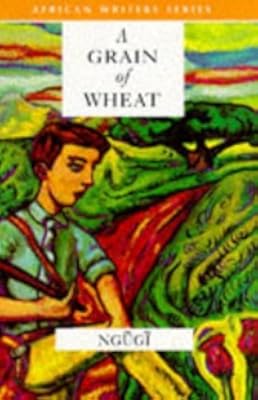
A Grain of Wheat
by Ngũgĩ wa Thiong'o
On This Page
Description
Set in the wake of the Mau Mau rebellion and on the cusp of Kenya's independence from Britain, A Grain of Wheat follows a group of villagers whose lives have been transformed by the 1952-1960 Emergency. At the center of it all is the reticent Mugo, the village's chosen hero and a man haunted by a terrible secret. As we learn of the villagers' tangled histories in a narrative interwoven with myth and peppered with allusions to real-life leaders, including Jomo Kenyatta, a masterly story show more unfolds in which compromises are forced, friendships are betrayed, and loves are tested. show lessTags
Recommendations






Member Reviews
Set on the eve of Kenyan independence, this covers events going back up to 15 years, to the aftermath of WW2 and the Mau Mau rebellion. It is set in and a round a cluster of villages and has a mostly black cast. They have varied experiences of the uprising and vastly different expectations of the outcome of independence. Some of the characters we meet have been involved in the independence struggle, others have been on the side of the whites. Some have spent time in detention camps and their actions have become mythologised over time. It felt that there were almost no characters who did not have at least some kind of mixed feelings of actions on their past that impacted on their current state. The rally for independence and the outcome show more of that reveals a truth that had been hidden for years, about the betrayal of a former freedom fighter. Who betrayed him is not what those involved expected and the outcome is worryingly left opaque. It seems that independence is not a wiping clean of the slate and that the same people now have to renegotiate their future while accepting their varied pasts. It didn't feel that the future was going to be plain sailing.
It is well written and the characters are fleshed out and feel real in both the present and the past. In several cases their lives have not turned out how they thought they would but they are doing what humans do, living one day at a time. show less
It is well written and the characters are fleshed out and feel real in both the present and the past. In several cases their lives have not turned out how they thought they would but they are doing what humans do, living one day at a time. show less
I am happy to say that I have finally found the first book by Ngugi that I liked and that impressed me as a literary work. It is either the third or fourth book of his that I have read and I have always found his novels problematic, not only because the narratives seem strained or simplistic and his characters under- (or even un-) developed. He has always had an important message to convey but this is really the first novel of his that I have read that succeeds as a novel instead of a vehicle for his thoughts. The story concerns a group of villagers caught up in the Mau Mau rebellion and the British Emergency of 1952-60 in Kenya. Though he criticizes the British, Ngugi’s focus is Mugo, alone and alienated after returning to the show more village following his imprisonment and maltreatment by the British for his role in the uprising. Considered by nearly everyone to be a role model, he has a secret which is at the heart of the book. As Ngugi relates his story, other narratives about other villagers—none of whom is blameless—are unfolding. The story centers around a proverb: “That which bites you is in your own clothing.” No one is a hero, no one can escape his (or her) past or his acts—both on a personal level and on the larger political stage. Mugo is beautifully drawn, as are most of the other major characters and, for the first time in my experience of Ngugi’s book, I found myself believing that these were real people. show less
I found this book difficult to get into/get used to at first, but after clearing the hurdle of remembering the abundance of unfamiliar sounding character names (at least 35 separate characters who have some degree of significance to the plot! I suggest, if you have similar such trouble upon cracking open this egg, reading in front of a computer and keeping a Word document open to alphabetically list names-of plus corresponding descriptions-of characters, so that you can refer to it as needed), I found it much easier to get involved in the story.
The plot is centered around the celebration of the independence of Kenya. The story is not told in a linear manner, so events are revealed in pieces, backwards and forwards. Structurally, it's show more pretty genius -- everything fits together. I found it to be an incredibly moving examination (and ultimate debunking, in a way) about the problematic nature of heroism, the cost of history. It refuses easy resolutions, in a genuinely truthful way.
I'm being vague, because one of the ways the book involved me this first time around was how it peeled stuff back bit by bit. Anyway, it's still haunting me; definitely a book to revisit. show less
The plot is centered around the celebration of the independence of Kenya. The story is not told in a linear manner, so events are revealed in pieces, backwards and forwards. Structurally, it's show more pretty genius -- everything fits together. I found it to be an incredibly moving examination (and ultimate debunking, in a way) about the problematic nature of heroism, the cost of history. It refuses easy resolutions, in a genuinely truthful way.
I'm being vague, because one of the ways the book involved me this first time around was how it peeled stuff back bit by bit. Anyway, it's still haunting me; definitely a book to revisit. show less
Unlike a novel where historic events provide a backdrop for the characters’ lives, here we are invited to understand Kenyan Uhuru, already in crisis three years later, as the product of the flawed human beings, (not the specific historical characters, but any human beings), that have brought it to birth. Biblical ideas around Original Sin, as suggested by the book’s title, and notions of generational conflict/sexual rivalry popularised by Freud seem to dictate the author’s focus on the lives of a few members of a rural community, mostly told in flashback. Given the author’s premise we cannot expect any real resolution. I enjoyed this mostly as a glimpse into events I’m afraid I knew only by a reference in Beyond the Fringe.
I have been wanting to read more of Ngũgĩ's work since reading his late magic realist epic [b:Wizard of the Crow|57485|Wizard of the Crow|Ngũgĩ wa Thiong'o|https://i.gr-assets.com/images/S/compressed.photo.goodreads.com/books/1421903577l/57485._SY75_.jpg|848502] a couple of years ago. I have also read [b:The River Between|152642|The River Between|Ngũgĩ wa Thiong'o|https://i.gr-assets.com/images/S/compressed.photo.goodreads.com/books/1348355292l/152642._SY75_.jpg|478785], but that was before I was reviewing anything. This book, which dates from fairly early in his career in 1967 but was revised in 1986, is a much straighter narrative and is no less powerful. It is something of a slow burner, as the scene setting and establishment show more of the main characters is a little slow, but much of the second half is riveting and very moving.
The setting is in Kenya, in the lead-up to and immediately after its independence (Uhuru) in 1963. The way Ngũgĩ sets up his tangled web of personal loyalties and betrayals is masterful, even if few of the characters emerge unstained. show less
The setting is in Kenya, in the lead-up to and immediately after its independence (Uhuru) in 1963. The way Ngũgĩ sets up his tangled web of personal loyalties and betrayals is masterful, even if few of the characters emerge unstained. show less
A Grain of Wheat takes us to a time in Kenya to the days just before and including independence in 1963 from the British. This was to be a time for celebration but is severely subdued by the remembrance of those fellow Kenyans who took the path of collaborating with the oppressive white colonial rule and by what to do with them. This is a various, multi layered and complicated political and moral story and Ngugo Wa Thiong'o guides us through with feeling, competence and clarity. Mugo with his incredible strengths and damming failures and his aloneness should stand as one of the great character creations in literature. Mugo is one among many strong individual portrayals and together an insightful comprehension is gained in aggregate of show more that generation of Kenyans. In the introduction we are told there were revisions to this novel and this being the last and the only one read is masterful. Thanks to Millsboro Public Library for holding this copy.
Quotes: (page 10) “Nearly everybody was a member of the Movement, but nobody could say with any accuracy when it was born: to most people, especially those of the younger generation, it had always been there, a rallying center for action. It changed names, leaders came and went, but the Movement remained, opening new visions, gathering greater and greater strength, till on the eve of Uhuru, its influence stretched from one horizon touching the sea to the other resting on the great Lake.”
(page 24) “Mugo stared at a pole opposite; he tried to grasp the sense of what Gikonyo had said. He always found it difficult to make decisions. Recoiling as if by instinct from setting in motion a course of action whose consequences he could not determine before the start, he allowed himself to drift into things or to be pushed into them by an uncanny demon; he rode on the wave of circumstances and lay against the crest, fearing but fascinated by fate.”
(page 105) “Gatu knew about political parties and freedom movements in other countries. He often delighted the other detainees with stories of India and the trials of Nehru and Gandhi. He also told them about the American War of Independence and how Abraham Lincoln had been executed by the British for leading the black folk in America to revolt. Napoleon had been a warrior, in fact one of the biggest warriors in history. His voice alone made the British urinate and shit on their calves inside their houses. These stories cheered them. They felt Gandhi, Napolean, Lincoln were watching the black folk of Kenya in their struggle to be free.”
(page 243) “She considered this for a while, her head turned aside. Then she looked at him, directly, in the eyes.
'No, Gikonyo. People try to rub out things, but they cannot. Things are not so easy. What has passed between us is too much to be passed over in a sentence. We need to talk, to open our hearts to one another, examine them, and then together plan the future we want. But now I must go, for the child is ill.”
ISBN 978-0-14-310676-0 show less
Quotes: (page 10) “Nearly everybody was a member of the Movement, but nobody could say with any accuracy when it was born: to most people, especially those of the younger generation, it had always been there, a rallying center for action. It changed names, leaders came and went, but the Movement remained, opening new visions, gathering greater and greater strength, till on the eve of Uhuru, its influence stretched from one horizon touching the sea to the other resting on the great Lake.”
(page 24) “Mugo stared at a pole opposite; he tried to grasp the sense of what Gikonyo had said. He always found it difficult to make decisions. Recoiling as if by instinct from setting in motion a course of action whose consequences he could not determine before the start, he allowed himself to drift into things or to be pushed into them by an uncanny demon; he rode on the wave of circumstances and lay against the crest, fearing but fascinated by fate.”
(page 105) “Gatu knew about political parties and freedom movements in other countries. He often delighted the other detainees with stories of India and the trials of Nehru and Gandhi. He also told them about the American War of Independence and how Abraham Lincoln had been executed by the British for leading the black folk in America to revolt. Napoleon had been a warrior, in fact one of the biggest warriors in history. His voice alone made the British urinate and shit on their calves inside their houses. These stories cheered them. They felt Gandhi, Napolean, Lincoln were watching the black folk of Kenya in their struggle to be free.”
(page 243) “She considered this for a while, her head turned aside. Then she looked at him, directly, in the eyes.
'No, Gikonyo. People try to rub out things, but they cannot. Things are not so easy. What has passed between us is too much to be passed over in a sentence. We need to talk, to open our hearts to one another, examine them, and then together plan the future we want. But now I must go, for the child is ill.”
ISBN 978-0-14-310676-0 show less
This stunning and searing novel, which was written by Mr Thiong'o in 1967, is set in a village in Kenya just prior to the country's independence from Britain in 1963. However, much of the story takes place during the Emergency (referred to by the British as the Mau Mau Uprising) that took place from 1952-1960, which led to the deaths of a few dozen settlers and tens of thousands of Kenyans, and caused the destruction of numerous villages and the breakdown of Kenyan social and economic society. The main characters in this story were all caught up in the retribution that took place after a freedom fighter from the village kills a particularly violent District Officer, and each of them betrays someone dear to them or to the movement, with show more devastating results. I was unaware of how horrible the Emergency was, but Mr Thiong'o gives us an unforgettable view of colonial Kenya. show less
Members
- Recently Added By
Lists

Best African Books
126 works; 46 members

Canon de la narrativa universal del siglo XX
254 works; 6 members

Books recommended by Barack Obama
295 works; 28 members

Harold Bloom - The Western Canon: D. The Chaotic Age
833 works; 24 members

Big Jubilee List
70 works; 3 members

1960s
281 works; 16 members

This is the Canon: Decolonize Your Bookshelf in 50 Books
51 works; 5 members

Africa
109 works; 8 members

TML 200 Best Books 1950-1999
202 works; 10 members

Books Set In Africa
81 works; 4 members

Revolutions
72 works; 5 members

Obama Reads
181 works; 3 members
Reading Globally
136 works; 16 members

Literary Works Read in College
316 works; 15 members

Books Read in 2013
1,630 works; 51 members

Books You Read For University
184 works; 3 members

Barack Obama's Favorite Books of 2018
29 works; 2 members

BBC World Book Club
265 works; 5 members

Canon de la narrativa universal del s. XX (cicutadry)
499 works; 3 members

"We" narration
49 works; 2 members

The Modern Library (The Two Hundred Best Novels....
202 works; 1 member

World Book Club (BBC World Service)
212 works; 1 member
Author Information

71+ Works 7,483 Members
Novelist, playwright, and essayist, Ngugi wa Thiong'o was born in Kenya on January 5, 1938. He received a B.A. in English from Makerere University College in Kampala, Uganda in 1963. He is Kenya's best-known writer and one of East Africa's most outspoken social critics. His first novel, Weep Not, Child (1964), was a penetrating account of the Mau show more Mau uprising (a tribal revolt that occurred in colonial Kenya) and was the first English-language novel by an East African. Two subsequent works, The River Between (1965) and A Grain of Wheat (1967), are sensitive novels about the Kikuyu people caught between the old and the new Africa. One of his major concerns has been the lack of reading materials in native African languages. In an attempt to bring literature to African peasants and workers, he wrote and produced the play I Will Marry When I Want (1977) in his native Kikuyu language. The play, which shows the exploitation of Kikuyu workers and peasants, attracted a large audience of poor Kenyans. It also led to Ngugi's arrest and imprisonment. After his release from prison, he went into exile and is currently living in the United States. His other works include Detained (1981); Decolonising the Mind: The Politics of Language in African Literature (1986); and Matigari (1987). He received the 2001 Nonino International Prize for Literature. In 2006, Random House published his first new novel in nearly two decades, Wizard of the Crow. (Bowker Author Biography) show less
Some Editions
Awards and Honors
Notable Lists
Series
Belongs to Publisher Series
Common Knowledge
- Canonical title
- A Grain of Wheat
- Original title
- A Grain of Wheat
- Alternate titles*
- Slechts een korrel graan
- Original publication date
- 1967
- Important places
- Africa; East Africa; Kenya
- Important events
- Mau Mau Uprising (1952 | 1960)
- Dedication
- for dorothy
- First words*
- Mugo was gespannen.
- Last words*
- (Click to show. Warning: May contain spoilers.)Het wordt een dikke vrouw - dik omdat ze zwanger is.
- Blurbers*
- Adichie, Chimamanda Ngozi
- Original language*
- Engels
*Some information comes from Common Knowledge in other languages. Click "Edit" for more information.
Classifications
- Genres
- General Fiction, Fiction and Literature, Historical Fiction
- DDC/MDS
- 823.914 — Literature & rhetoric English & Old English literatures English fiction 1900- 1901-1999 1945-1999
- LCC
- PR9381.9 .N45 .G73 — Language and Literature English English Literature English literature: Provincial, local, etc.
- BISAC
Statistics
- Members
- 1,127
- Popularity
- 22,476
- Reviews
- 26
- Rating
- (3.71)
- Languages
- 11 — Catalan, Czech, Dutch, English, Finnish, German, Hungarian, Italian, Portuguese, Spanish, Swedish
- Media
- Paper, Audiobook, Ebook
- ISBNs
- 34
- ASINs
- 11