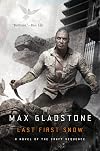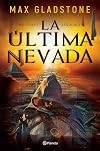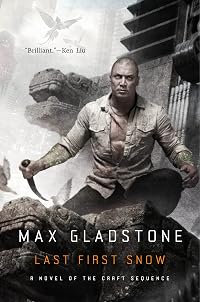
Last First Snow
by Max Gladstone
Craft Sequence: Chronological Order (1), Craft Sequence: Publication Order (4)
On This Page
Description
"Forty years after the God Wars, Dresediel Lex bears the scars of liberation--especially in the Skittersill, a poor district still bound by the fallen gods' decaying edicts. As long as the gods' wards last, they strangle development; when they fail, demons will be loosed upon the city. The King in Red hires Elayne Kevarian of the Craft firm Kelethres, Albrecht, and Ao to fix the wards, but the Skittersill's people have their own ideas. A protest rises against Elayne's work, led by Temoc, a show more warrior-priest turned community organizer who wants to build a peaceful future for his city, his wife, and his young son. As Elayne drags Temoc and the King in Red to the bargaining table, old wounds reopen, old gods stir in their graves, civil blood breaks to new mutiny, and profiteers circle in the desert sky. Elayne and Temoc must fight conspiracy, dark magic, and their own demons to save the peace--or failing that, to save as many people as they can"-- show lessTags
Recommendations






Member Reviews
It’s not a kissing book.
I feel I have to mention that because both people who saw me reading it at work said the title sounded like a romance. Since one was reading A Game of Thrones, I was a bit surprised at her lack of knowledge about Gladstone’s standout fantasy series, The Craft Sequence. It deserves far more recognition among fantasy and sci-fi fans than it currently receives. My best guess is that Gladstone is such an unusual writer, he travels above and below the average radar. The series has a setting that feels vaguely urban fantasy, language that reminds me of Kay, and complicated concepts found more often in conceptual science fiction. Honestly, his writing hits so many of my satisfaction points that I’m resisting show more skipping my review in favor of starting a series re-read.
“There would always be a spider who bargained with a fly, there would always be two sisters who played ball with demons, there would always be monsters who tried to eat the sun, even if marrow and majesty seeped out from the myths.“
It is a book about relationships in the most philosophical sense of the word, the ways of faith, money, fidelity and love and the agreements made between them. Oh, and a bit of revolution, urban decay, gentrification and the aftermath of war. One of the main characters is Temoc, warrior high priest of a god banished from the city during the god wars forty years ago. Without sacrifice and followers–a contract of belief, if you will–the gods lie dormant, and weak. Temoc has been practicing a peaceful way of life, living in the Skittersill district with his academic wife and his pre-teen son Caleb. It also follows Elayne, a Craftswoman, magically skilled in a secular form of power that has risen to prominence after the god wars.
In the poor district of the city, the Skittersill, god-created protections are decaying, leaving the district vulnerable from fire, pestilence and disease. Elayne is trying to negotiate an acceptable contract between the Red King Consolidated and the merchants that want to buy and raze the Skittersill. Elayne has a eye out for trouble and tries to warn both parties: “‘You’ve not accounted for all the factors.’ ‘Between the King in Red and Tan Batac’s merchant collective, we control property use rights in the Skittersill. Who else is there?’” How about the residents who want to prevent their homes from becoming unaffordable? Temoc becomes involved by believers in the district, and by his old enmity with the Red King. The powers that come from his belief could be all that stands against a successful resolution–or that creates one.
If you’ve been following the series to this point, you’ll recognize both Temoc and Caleb, a good ten years earlier than the events in Two Serpents Rise, (my review) and Elayne from Three Parts Dead (my review). It is worth taking a moment to admire Gladstone’s writing genius. These people are going to survive, because we’ve seen them in their future, yet the certainty does not lessen the tension of Last First Snow. I’d compare it to hearing a story from my father about Vietnam: I know the ending–I know he’s here, and the general kind of person he is now, but that doesn’t make hearing about the experience less tense or less interesting (insert carol’s rant about the concept of spoilers).
Narrative is third person omniscient focused on a handful of characters; Temoc, the priest; Elayne, the Craftswoman; Chel, a dockhand in the Skittersill, with the occasional thoughts from a few others. Elayne is particularly admirable as she tried to find the balance between legal responsibilities and ethical principles. As a Craftswoman, she’s destined for existence beyond the flesh, but instead of giving her arrogance, it leaves her grasping at compassion: “Elayne was still human enough to give the other woman space, to let her stand and watch the blood and read the letter with her hand clenched around the railing. Elayne was still human enough to leave.”
Both Elayne and Temoc fought in the wars forty years ago, and both reflect on their reactions now versus their actions then. In some ways, it is a book grounded on the dilemmas that come with maturity; once you have lost the righteousness of youthful activism, how do you navigate the obligations of real life–family, profession–with passion, belief and ethics? Temoc, technically part of the ‘losing’ side of the war, recognizes that the history of a place he has known intimately has grown into a modern presence: “Temoc had not left his city. His city left him, replaced by another. He been born scant miles from the spot, yet felt a half a world away from everything he knew.”
When the scale is a revolution, it’s easy to lose humanity, and perspective. A little judicious humor occasionally lightens the mood:
“Air filters be damned: in Dresediel Lex, to run was to invite the city into your lungs, and the city was a drunken guest who like to trash the place.”
“Elayne briefly considered gutting the man, and decided against it. In her experience spraying a Court hallway with blood and other humors was rarely a good idea. That one time in Iskar had been a special case.”
There are a few shortcomings, but honestly, I think that’s because I’m comparing Gladstone to the greats in literary fantasy. No mere beach read, this one engaged my brain as much as my heart, and I was vaguely anxious as the events cascaded.
Immensely engrossing, what I really wanted after finishing was to go home and read the series from the beginning again, just so I could see the echos from Temoc, Elayne and the events of the Skittersill reverberate through the earlier books. At least my Game of Thrones friend related to that feeling. show less
I feel I have to mention that because both people who saw me reading it at work said the title sounded like a romance. Since one was reading A Game of Thrones, I was a bit surprised at her lack of knowledge about Gladstone’s standout fantasy series, The Craft Sequence. It deserves far more recognition among fantasy and sci-fi fans than it currently receives. My best guess is that Gladstone is such an unusual writer, he travels above and below the average radar. The series has a setting that feels vaguely urban fantasy, language that reminds me of Kay, and complicated concepts found more often in conceptual science fiction. Honestly, his writing hits so many of my satisfaction points that I’m resisting show more skipping my review in favor of starting a series re-read.
“There would always be a spider who bargained with a fly, there would always be two sisters who played ball with demons, there would always be monsters who tried to eat the sun, even if marrow and majesty seeped out from the myths.“
It is a book about relationships in the most philosophical sense of the word, the ways of faith, money, fidelity and love and the agreements made between them. Oh, and a bit of revolution, urban decay, gentrification and the aftermath of war. One of the main characters is Temoc, warrior high priest of a god banished from the city during the god wars forty years ago. Without sacrifice and followers–a contract of belief, if you will–the gods lie dormant, and weak. Temoc has been practicing a peaceful way of life, living in the Skittersill district with his academic wife and his pre-teen son Caleb. It also follows Elayne, a Craftswoman, magically skilled in a secular form of power that has risen to prominence after the god wars.
In the poor district of the city, the Skittersill, god-created protections are decaying, leaving the district vulnerable from fire, pestilence and disease. Elayne is trying to negotiate an acceptable contract between the Red King Consolidated and the merchants that want to buy and raze the Skittersill. Elayne has a eye out for trouble and tries to warn both parties: “‘You’ve not accounted for all the factors.’ ‘Between the King in Red and Tan Batac’s merchant collective, we control property use rights in the Skittersill. Who else is there?’” How about the residents who want to prevent their homes from becoming unaffordable? Temoc becomes involved by believers in the district, and by his old enmity with the Red King. The powers that come from his belief could be all that stands against a successful resolution–or that creates one.
If you’ve been following the series to this point, you’ll recognize both Temoc and Caleb, a good ten years earlier than the events in Two Serpents Rise, (my review) and Elayne from Three Parts Dead (my review). It is worth taking a moment to admire Gladstone’s writing genius. These people are going to survive, because we’ve seen them in their future, yet the certainty does not lessen the tension of Last First Snow. I’d compare it to hearing a story from my father about Vietnam: I know the ending–I know he’s here, and the general kind of person he is now, but that doesn’t make hearing about the experience less tense or less interesting (insert carol’s rant about the concept of spoilers).
Narrative is third person omniscient focused on a handful of characters; Temoc, the priest; Elayne, the Craftswoman; Chel, a dockhand in the Skittersill, with the occasional thoughts from a few others. Elayne is particularly admirable as she tried to find the balance between legal responsibilities and ethical principles. As a Craftswoman, she’s destined for existence beyond the flesh, but instead of giving her arrogance, it leaves her grasping at compassion: “Elayne was still human enough to give the other woman space, to let her stand and watch the blood and read the letter with her hand clenched around the railing. Elayne was still human enough to leave.”
Both Elayne and Temoc fought in the wars forty years ago, and both reflect on their reactions now versus their actions then. In some ways, it is a book grounded on the dilemmas that come with maturity; once you have lost the righteousness of youthful activism, how do you navigate the obligations of real life–family, profession–with passion, belief and ethics? Temoc, technically part of the ‘losing’ side of the war, recognizes that the history of a place he has known intimately has grown into a modern presence: “Temoc had not left his city. His city left him, replaced by another. He been born scant miles from the spot, yet felt a half a world away from everything he knew.”
When the scale is a revolution, it’s easy to lose humanity, and perspective. A little judicious humor occasionally lightens the mood:
“Air filters be damned: in Dresediel Lex, to run was to invite the city into your lungs, and the city was a drunken guest who like to trash the place.”
“Elayne briefly considered gutting the man, and decided against it. In her experience spraying a Court hallway with blood and other humors was rarely a good idea. That one time in Iskar had been a special case.”
There are a few shortcomings, but honestly, I think that’s because I’m comparing Gladstone to the greats in literary fantasy. No mere beach read, this one engaged my brain as much as my heart, and I was vaguely anxious as the events cascaded.
Immensely engrossing, what I really wanted after finishing was to go home and read the series from the beginning again, just so I could see the echos from Temoc, Elayne and the events of the Skittersill reverberate through the earlier books. At least my Game of Thrones friend related to that feeling. show less
Gladstone always manages an energetic blend: serious rumination on the forces of modernity alongside laying hands on primeval forces and badassing around with them. This book is no exception, braiding together elegantly strands of Occupy Wall Street, the endless cycle of violence begetting violence, the decisions that shape our lives, and dragon punching.
And wheee, the dragon punching. Temoc really comes into his own here - as he should, for his origin story, or rather Caleb's origin story - and I'd be tempted to say he's the star of the show, if he wasn't standing beside Elayne faces-down-the-King-in-Red-like-a-boss Kevarian. How do I love her, let me count the ways. No, there are too many, let me sum up: we see her here as a show more craftwoman in the height of her power, looking down upon the uncertain, hunted, tormented girl she has been, and taking all of that into her own strength. She's fantastic.
This was a book of huge emotional self-searching (and dragon punching) and scenarios where no one wins. And really, the big damn reveals of key elements of the wider post-God-Wars universe building in the whole sequence are sort of just a bonus. (But also very damn intriguing.) show less
And wheee, the dragon punching. Temoc really comes into his own here - as he should, for his origin story, or rather Caleb's origin story - and I'd be tempted to say he's the star of the show, if he wasn't standing beside Elayne faces-down-the-King-in-Red-like-a-boss Kevarian. How do I love her, let me count the ways. No, there are too many, let me sum up: we see her here as a show more craftwoman in the height of her power, looking down upon the uncertain, hunted, tormented girl she has been, and taking all of that into her own strength. She's fantastic.
This was a book of huge emotional self-searching (and dragon punching) and scenarios where no one wins. And really, the big damn reveals of key elements of the wider post-God-Wars universe building in the whole sequence are sort of just a bonus. (But also very damn intriguing.) show less
I'm sure I'm not the only one to feel that this book doesn't really take off until negotiations turn to crap, but I'll say it anyway. :) The book REALLY takes off after the assassination attempt and that's also the spark that turns all the powers in the city upon each other. The Soul-Rich versus the Soul-Poor.
And it's not easy to negotiate with ourselves, as readers, just who is bad and who is good. It's very complicated, but more than that: it's vivid. We start out ten years before the events of Two Serpents Rise and we get the back story for Tamoc and what he did to Caleb. We get the re-introduction of all the gods into the city, too, and the slight diminishing of the King in Red's power. (Or it's enhancement, if you consider the show more return of the gods.) But either way, this is the book that changes the world. (Maybe not as much as 40 years prior with the war against the Gods, perhaps, but this is the book we've got.) :)
I'm continually amazed that the wide tapestry of the story. Not just the individual novels that are fantastic in themselves, but the over-story that encompasses the whole world and all of the events.
I've seen this before and have told myself that a full re-reading of this series is absolutely in order, but it's even worse now. The chronological order of books is all over the place. The numbers in the titles tell us that much. This is the earliest but its also the fourth book in the series.
That's fine. I actually prefer it that way. I love having already gotten to know and love so many of the personas that have center stage in this enormous mindfuck of a civil war fought in the skies, of gods and mortals and necromancers bloodying the streets of this oddly modern and recognizable town very much like our own.
Seriously, this writer is amazing. I'm still blown a way. :)
And yes, I probably will jump on a chance to re-read it all. I'll even do it again in publication order, too. The threads that keep intertwining are pretty awesome. :)
This fantasy series is rapidly becoming one of my absolute favorites. :) show less
And it's not easy to negotiate with ourselves, as readers, just who is bad and who is good. It's very complicated, but more than that: it's vivid. We start out ten years before the events of Two Serpents Rise and we get the back story for Tamoc and what he did to Caleb. We get the re-introduction of all the gods into the city, too, and the slight diminishing of the King in Red's power. (Or it's enhancement, if you consider the show more return of the gods.) But either way, this is the book that changes the world. (Maybe not as much as 40 years prior with the war against the Gods, perhaps, but this is the book we've got.) :)
I'm continually amazed that the wide tapestry of the story. Not just the individual novels that are fantastic in themselves, but the over-story that encompasses the whole world and all of the events.
I've seen this before and have told myself that a full re-reading of this series is absolutely in order, but it's even worse now. The chronological order of books is all over the place. The numbers in the titles tell us that much. This is the earliest but its also the fourth book in the series.
That's fine. I actually prefer it that way. I love having already gotten to know and love so many of the personas that have center stage in this enormous mindfuck of a civil war fought in the skies, of gods and mortals and necromancers bloodying the streets of this oddly modern and recognizable town very much like our own.
Seriously, this writer is amazing. I'm still blown a way. :)
And yes, I probably will jump on a chance to re-read it all. I'll even do it again in publication order, too. The threads that keep intertwining are pretty awesome. :)
This fantasy series is rapidly becoming one of my absolute favorites. :) show less
Last First Snow was amazing. Is Max Gladstone getting better with each book he writes? It sure feels like it.
Forty years ago the world was changed forever during the God Wars, and the city of Dresediel Lex was either conquered or liberated, depending on who you ask. The King in Red, Temoc, and Elayne are all veterans of that war. But now they meet again – at a bargaining table over an urban renewal project in the Skittersill district in an effort to find a peaceful solution to the Skittersill residents protests. However, there are many fractions who don’t want peace, and blood is soon to be spilled.
Last First Snow is a prequel chronologically the first in Max Gladstone’s Craft Sequence. Elayne, Temoc and the King in Red are show more supporting characters from two earlier books, Three Parts Dead and Two Serpents Rise. Last First Snow stands completely independent, and it might be a good idea to read it before Two Serpents Rise so that you won’t know some plot points. The entire series is fantastic and doesn’t get the love it deserves, so I highly encourage you to try it, which ever book you pick up first.
Max Gladstone is an amazing writer. He has a knack for flowing prose and beautiful descriptions. See this description of a printer’s workshop:
However, I think the greatest strength of Last First Snow is the complicated characters at it’s center. I hadn’t liked Temoc in Two Serpents Rise, but he’s a very different person in Last First Snow. Yet he’s making choices that set him on the path towards becoming who he was in Two Serpents Rise. I don’t want to give too much away, but it’s excellent character development.
Elayne is a craftswoman, which is sort of like a cross between lawyer and magic user. She’s easily the most sympathetic of the three main characters, mainly due to her desire for peace and belief in the importance of individual lives. It’s interesting to see some of her reflections on her background – she fought in the wars when still a teenager, and it’s clearly had an impact on who she is in Last First Snow.
Kopil, the King in Red, never gets POV sections like Temoc or Elayne, but he is clearly a major player in Last First Snow. The King in Red is interesting because it would be so easy for him to be completely horrible and unhuman. He does come close to it sometimes but on the whole I’d say he isn’t. Kopil is nostalgic for the wars, when everything seemed much clearer to him, and he reacts like he’s still in them. He’s a hard character to get a hold of. Is he a villain? You can see why he does the things he does, even if you can’t agree with them. I think for these reasons he’s my favorite character.
The world Max Gladstone’s created is absolutely phenomenal. There’s so much originality here, from the setting to the magic system to… everything. It mirrors our own world in many ways – Dresediel Lex is a city from an Aztec based culture that was never conquered by the Spanish – but is different in so many ways. I love how Max Gladstone doesn’t try to write a single epic that spans the breadth of the world but instead creates a tapestry made out of the experiences of fairly ordinary people, if talking skeletons can be considered “ordinary” I suppose.
Last First Snow starts slow but steadily builds up to an intense, heart stopping finale that brought tears to my eyes. This is a phenomenal book that strikes many of the same cords for me as Terry Pratchett’s Night Watch. I can’t recommend it enough.
Originally posted on The Illustrated Page. show less
Forty years ago the world was changed forever during the God Wars, and the city of Dresediel Lex was either conquered or liberated, depending on who you ask. The King in Red, Temoc, and Elayne are all veterans of that war. But now they meet again – at a bargaining table over an urban renewal project in the Skittersill district in an effort to find a peaceful solution to the Skittersill residents protests. However, there are many fractions who don’t want peace, and blood is soon to be spilled.
Last First Snow is a prequel chronologically the first in Max Gladstone’s Craft Sequence. Elayne, Temoc and the King in Red are show more supporting characters from two earlier books, Three Parts Dead and Two Serpents Rise. Last First Snow stands completely independent, and it might be a good idea to read it before Two Serpents Rise so that you won’t know some plot points. The entire series is fantastic and doesn’t get the love it deserves, so I highly encourage you to try it, which ever book you pick up first.
Max Gladstone is an amazing writer. He has a knack for flowing prose and beautiful descriptions. See this description of a printer’s workshop:
“Copper, iron, steel, and lead clacked, clattered, and convulsed. Gears realigned and pistons pounded. Torrents of paper surged over drums the size of carriages. Folding machines snapped their jaws. Guillotine blades cut long strips of newsprint into pages. Surgical lights slammed into every surface and edge. She breathed a lungful of hot paper and vaporized ink and melting lead.”
However, I think the greatest strength of Last First Snow is the complicated characters at it’s center. I hadn’t liked Temoc in Two Serpents Rise, but he’s a very different person in Last First Snow. Yet he’s making choices that set him on the path towards becoming who he was in Two Serpents Rise. I don’t want to give too much away, but it’s excellent character development.
Elayne is a craftswoman, which is sort of like a cross between lawyer and magic user. She’s easily the most sympathetic of the three main characters, mainly due to her desire for peace and belief in the importance of individual lives. It’s interesting to see some of her reflections on her background – she fought in the wars when still a teenager, and it’s clearly had an impact on who she is in Last First Snow.
Kopil, the King in Red, never gets POV sections like Temoc or Elayne, but he is clearly a major player in Last First Snow. The King in Red is interesting because it would be so easy for him to be completely horrible and unhuman. He does come close to it sometimes but on the whole I’d say he isn’t. Kopil is nostalgic for the wars, when everything seemed much clearer to him, and he reacts like he’s still in them. He’s a hard character to get a hold of. Is he a villain? You can see why he does the things he does, even if you can’t agree with them. I think for these reasons he’s my favorite character.
“And you would have the blood of thousands on your hands.”
“That blood’s already there. I’d add a fresh coat to what’s left over from the Wars.”
“Do you think our colleagues will look kindly on a mass murderer?”
“What is war but mass murder? And they called me a hero for that.”
The world Max Gladstone’s created is absolutely phenomenal. There’s so much originality here, from the setting to the magic system to… everything. It mirrors our own world in many ways – Dresediel Lex is a city from an Aztec based culture that was never conquered by the Spanish – but is different in so many ways. I love how Max Gladstone doesn’t try to write a single epic that spans the breadth of the world but instead creates a tapestry made out of the experiences of fairly ordinary people, if talking skeletons can be considered “ordinary” I suppose.
“Wars beget wars.”
Last First Snow starts slow but steadily builds up to an intense, heart stopping finale that brought tears to my eyes. This is a phenomenal book that strikes many of the same cords for me as Terry Pratchett’s Night Watch. I can’t recommend it enough.
Originally posted on The Illustrated Page. show less
The Craft series began with dizzyingly cool worldbuilding: what if magic was like law and finance? But at it's heart it always been about choices, and this prequel novel focuses on the choices of two veterans of the godswars. Elayne Kevarian was a teenage killer who saved the life of a man in the last battle, and is now a lawyer-at-large for the skeletal King in Red who rules Desidal Lex. The man she saved, Temoc, was once last of the Eagle Knights, and is now a husband and father. When protests over an urban renewal project in a slowly dying residential district threaten to rise to open violence, Elayne and Temoc put aside old hatreds to try and bargain a compromise solution.
It all seems to be holding, until the developer behind it all show more is shot, a cop kills a kid, and protests turn into riots and a camp turns into a siege zone. Elayne and Temoc have to decide where their loyalties lie. Elayne sides with the protesters against her boss, but (spoilers) comes away more or less unharmed, and Temoc (if you've read Two Serpents Rise) picks the sacrificial knife back up and restarts the old wars as a hunted terrorist.
Good, but not great, this is a prequel that doesn't grab at my favorite bits of the setting, which is the way the Craft dehumanizes people, and the cutting little contracts Craftsmen make with each other. Temoc's old school Mesoamerican death cult thing is kinda meh. Definitely read these books in publication order. show less
It all seems to be holding, until the developer behind it all show more is shot, a cop kills a kid, and protests turn into riots and a camp turns into a siege zone. Elayne and Temoc have to decide where their loyalties lie. Elayne sides with the protesters against her boss, but (spoilers) comes away more or less unharmed, and Temoc (if you've read Two Serpents Rise) picks the sacrificial knife back up and restarts the old wars as a hunted terrorist.
Good, but not great, this is a prequel that doesn't grab at my favorite bits of the setting, which is the way the Craft dehumanizes people, and the cutting little contracts Craftsmen make with each other. Temoc's old school Mesoamerican death cult thing is kinda meh. Definitely read these books in publication order. show less
The Craft Sequence is unlike many conventional fantasy series in that each book can be read as a stand-alone, their stories ping-ponging unapologetically all over time and place, focusing on different characters. It makes it an unusual, albeit very special series. That said, many of these characters and events connect to each other, and there is a clear advantage to reading these books in the order in which they are published.
Last First Snow, for instance, is technically a prequel, taking place before the other three books, but it still felt like I was reaching a “crossroads” of sorts, on account of some of the familiar faces. The two main protagonists, Elayne and Temoc, are characters we’ve met before, though both appeared in show more their respective books in a supporting capacity only. It is also only forty years after the God Wars, and the city of Dresediel Lex still feels its effects, not least of all the poor population in the district of Skittersill, constrained by the old gods’ wards. Elayne Kevarian, a craftswoman, necromancer, and lawyer (not necessarily in that order) is retained by the King in Red to repair the wards, but the people of Skittersill rise up against her efforts, led by the warrior-priest Temoc.
Something had to be done, so Elayne organizes a meeting between all the parties in the hopes of negotiating a deal. After long days of bargaining back and forth and against all odds, an agreement is finally reached. However, no sooner had the ink dried on the contract than an assassination attempt throws all possibility of peace out the window. An all-out battle ensues. Gods and mortals, law and tradition, magic and reason, duty and family – it all comes to a head as both Elayne and Temoc must decide what they fight for.
In spite of all the cool ideas and fiery clashes, so far in the series Last First Snow was probably the toughest book for me to get into. Each installment has focused on a different theme, and something about this one just didn’t quite capture me right off the bat. We got started on a lethargic note, establishing the situation and mood in the Dresediel Lex. I didn’t feel what we were supposed to feel: a growing pressure, a sense of a city on the brink of losing control, the citizenry holding its collective breath. I don’t think I felt much of a connection to the people of Skittersill, not if I spent half the book actually rooting for the King in Red – whom, I might add, is not the villain in my eyes. In truth, there are no villains in this story. It also means no good guys either, but more on that later.
In essence, it felt like Max Gladstone tried to save all the good stuff for the second half of the novel. It wasn’t until the negotiations went sideways that I found myself full engaged; those scenes following the assassination attempt featured some of the best writing I’ve seen from Gladstone in this series so far. Once those floodgates were open, the story became more interesting, but still only because the main characters’ potentials were unlocked and not because I felt much for the nameless, faceless crowds of Skitterskill. Bottom line, Last First Snow is all about Elayne and Temoc, both of whom valiantly propped up the narrative.
Let’s start with Elayne Kevarian. You don’t mess with her. For readers who’ve been following this series since the beginning, that’s a lesson we learned early. There’s a certain satisfaction seeing her take center stage in this book, because though we’ve already taken her measure, there are still clearly so many ways in which she can surprise you. While Elayne remains one of my favorite Craft Sequence personalities, Temoc on the other hand stirred up plenty of mixed emotions. Seeing him with his young son Caleb, who will grow up to be the main character in Two Serpents Rise, was both a treat and a dreadful reminder of how things will turn out. Temoc’s personal journey in Last First Snow puts him in the difficult situation of choosing between two things that mean everything to him. Is he right for choosing one over the other? Just as difficult as it is to call the King in Red a villain, I too find it hard to get a bead on Temoc; for all the reasons there are to support him, I can probably find just as many to condemn him.
I enjoy books that throw me curve balls. Last First Snow by Max Gladstone is such a book. Is it my favorite of the series? Probably not. Still, as I say, there’s no such thing as a bad Craft Sequence book, just that some are better than others. Taking place before all the other books, Last First Snow was perhaps disadvantaged from the start, because the future is known for a lot of the characters. We already know who will make it out alive, how events will come to pass, how certain relationships will play out. For a book that’s mostly for filling the gaps in history though, it paints a rather fulfilling picture of two important characters who have thus far been on the periphery of our attention. I still love this series, and I can’t recommend it enough. show less
Last First Snow, for instance, is technically a prequel, taking place before the other three books, but it still felt like I was reaching a “crossroads” of sorts, on account of some of the familiar faces. The two main protagonists, Elayne and Temoc, are characters we’ve met before, though both appeared in show more their respective books in a supporting capacity only. It is also only forty years after the God Wars, and the city of Dresediel Lex still feels its effects, not least of all the poor population in the district of Skittersill, constrained by the old gods’ wards. Elayne Kevarian, a craftswoman, necromancer, and lawyer (not necessarily in that order) is retained by the King in Red to repair the wards, but the people of Skittersill rise up against her efforts, led by the warrior-priest Temoc.
Something had to be done, so Elayne organizes a meeting between all the parties in the hopes of negotiating a deal. After long days of bargaining back and forth and against all odds, an agreement is finally reached. However, no sooner had the ink dried on the contract than an assassination attempt throws all possibility of peace out the window. An all-out battle ensues. Gods and mortals, law and tradition, magic and reason, duty and family – it all comes to a head as both Elayne and Temoc must decide what they fight for.
In spite of all the cool ideas and fiery clashes, so far in the series Last First Snow was probably the toughest book for me to get into. Each installment has focused on a different theme, and something about this one just didn’t quite capture me right off the bat. We got started on a lethargic note, establishing the situation and mood in the Dresediel Lex. I didn’t feel what we were supposed to feel: a growing pressure, a sense of a city on the brink of losing control, the citizenry holding its collective breath. I don’t think I felt much of a connection to the people of Skittersill, not if I spent half the book actually rooting for the King in Red – whom, I might add, is not the villain in my eyes. In truth, there are no villains in this story. It also means no good guys either, but more on that later.
In essence, it felt like Max Gladstone tried to save all the good stuff for the second half of the novel. It wasn’t until the negotiations went sideways that I found myself full engaged; those scenes following the assassination attempt featured some of the best writing I’ve seen from Gladstone in this series so far. Once those floodgates were open, the story became more interesting, but still only because the main characters’ potentials were unlocked and not because I felt much for the nameless, faceless crowds of Skitterskill. Bottom line, Last First Snow is all about Elayne and Temoc, both of whom valiantly propped up the narrative.
Let’s start with Elayne Kevarian. You don’t mess with her. For readers who’ve been following this series since the beginning, that’s a lesson we learned early. There’s a certain satisfaction seeing her take center stage in this book, because though we’ve already taken her measure, there are still clearly so many ways in which she can surprise you. While Elayne remains one of my favorite Craft Sequence personalities, Temoc on the other hand stirred up plenty of mixed emotions. Seeing him with his young son Caleb, who will grow up to be the main character in Two Serpents Rise, was both a treat and a dreadful reminder of how things will turn out. Temoc’s personal journey in Last First Snow puts him in the difficult situation of choosing between two things that mean everything to him. Is he right for choosing one over the other? Just as difficult as it is to call the King in Red a villain, I too find it hard to get a bead on Temoc; for all the reasons there are to support him, I can probably find just as many to condemn him.
I enjoy books that throw me curve balls. Last First Snow by Max Gladstone is such a book. Is it my favorite of the series? Probably not. Still, as I say, there’s no such thing as a bad Craft Sequence book, just that some are better than others. Taking place before all the other books, Last First Snow was perhaps disadvantaged from the start, because the future is known for a lot of the characters. We already know who will make it out alive, how events will come to pass, how certain relationships will play out. For a book that’s mostly for filling the gaps in history though, it paints a rather fulfilling picture of two important characters who have thus far been on the periphery of our attention. I still love this series, and I can’t recommend it enough. show less
The city of Dresdiel Lex bears the scars of a liberation that killed it's gods. In the poor quarter or Skittersill the wards from the old gods still hold and the new rulers have plans. If the wards fail Demons will be loosed on the city but it's also strangling development. Those who live within the area can see that the development could push people out of their homes and away from things that they know. Temoc is a warrior-priest around who has become a beacon for the people and when the development clashes with his people all he wants is a peaceful resolution but other forces are coming to bear on everything.
It's an interesting look at the stresses on a world from somewhat mundane causes with bonus supernatural twists.
It's an interesting look at the stresses on a world from somewhat mundane causes with bonus supernatural twists.
Members
- Recently Added By
Lists

2016 Hugo Eligible Novels
90 works; 32 members

Top Five Books of 2015
811 works; 241 members

Books Read in 2016
4,666 works; 197 members
Author Information

49+ Works 13,367 Members
Some Editions
Series


Work Relationships
Is contained in
Has as a study
Common Knowledge
- Canonical title
- Last First Snow
- Original title
- Last First Snow
- Original publication date
- 2015-07
- People/Characters
- Elayne Kevarian; Kopil (The King in Red); Temoc Almotil; Caleb; The Major; Chel (show all 7); Tan Bratac
- Important places
- Dresediel Lex
- First words
- For false gods, they cast long shadows.
- Last words
- (Click to show. Warning: May contain spoilers.)She placed a ward upon the house, and another around her cot, and slept without dreams.
- Publisher's editor
- Hartwell, David G.; Palmieri, Marco
- Blurbers
- Liu, Ken; Older, Daniel José; Wexler, Django
- Original language
- English
Classifications
Statistics
- Members
- 468
- Popularity
- 65,244
- Reviews
- 19
- Rating
- (3.89)
- Languages
- English, Spanish
- Media
- Paper, Audiobook, Ebook
- ISBNs
- 7
- UPCs
- 1
- ASINs
- 3