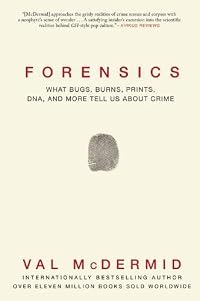
Forensics: What Bugs, Burns, Prints, DNA, and More Tell Us About Crime
by Val McDermid
On This Page
Description
Val McDermid is one of the finest crime writers we have, whose novels have captivated millions of readers worldwide with their riveting narratives of characters who solve complex crimes and confront unimaginable evil. In the course of researching her bestselling novels McDermid has become familiar with every branch of forensics, and now she uncovers the history of this science, real-world murders and the people who must solve them. The dead talk to the right listener. They can tell us all show more about themselves: where they came from, how they lived, how they died, and, of course, who killed them. Forensic scientists can unlock the mysteries of the past and help serve justice using the messages left by a corpse, a crime scene, or the faintest of human traces. Forensics draws on interviews with some of these top-level professionals, ground-breaking research, and McDermid's own original interviews and firsthand experience on scene with top forensic scientists. Along the way, McDermid discovers how maggots collected from a corpse can help determine one's time of death; how a DNA trace a millionth the size of a grain of salt can be used to convict a killer; and how a team of young Argentine scientists led by a maverick American anthropologist were able to uncover the victims of a genocide. It's a journey that will take McDermid to war zones, fire scenes, and autopsy suites, and bring her into contact with both extraordinary bravery and wickedness, as she traces the history of forensics from its earliest beginnings to the cutting-edge science of the modern day. show lessTags
Recommendations












Member Reviews
Val McDermid turns her considerable narrative skill to a non-fiction history of the development of forensics, from the days of Jack the Ripper to the 21st century. It's almost as gripping as one of her novels. Each chapter deals with one branch of forensics (Toxicology, DNA and Blood Spatter, Facial Reconstruction, etc.) and how it has come to be essential to crime scene investigators, prosecutors and defense attorneys. "The courtroom is the anvil on which scientific evidence is struck. With a well-prepared lawyer playing the part of the hammer, forensic techniques are either strengthened or broken, according to their merit." McDermid uses some classic cases, both unsolved and resolved, to illustrate what can be proven in a court of law show more (and equally what sometimes cannot be known for certain). The details of some of them were already familiar to me, but her perspective on the scientific evidence was still worth reading about. Comparisons of procedures in the US and the UK were often surprising, and who knew how much the insect world has to contribute to interpretation of a crime scene! show less
Val McDermid takes her readers on a whirlwind tour of the various kinds of forensic science, from the early days of fingerprinting to the cutting edge of digital forensics. Along the way she interviews experts about what they enjoy or don’t about their professions and discusses the cases that brought each method of forensic analysis into the spotlight. The writing style is conversational and easy to follow, and the book is amply illustrated with black-and-white photos and a glossy spread in the middle. I would maybe suggest avoiding the chapter on entomology if you’re eating lunch—even I felt a bit queasy and I have a fairly strong stomach for reading while eating. And the chapter on forensic psychology is just creepy enough that show more you might not want to read it if you’re alone at night.
While this is a good overview, it was published in 2014, and shockingly has been outpaced by other literature on the subject. Two of the experts quoted and discussed in the book—Richard (Dick) Shepherd and Professor Dame Sue Black—have since published their own memoirs (Unnatural Causes and All That Remains, respectively) that cover similar ground to this book. And while the chapter on poisons and toxicology discusses radium poisoning and name-checks Deborah Blum’s The Poisoner’s Handbook, Kate Moore has published a stand-alone work about The Radium Girls.
So if you haven’t read the above books, this would be a good place to start. If you’ve already read them, you may find some parts repetitive. But it is still a good book. show less
While this is a good overview, it was published in 2014, and shockingly has been outpaced by other literature on the subject. Two of the experts quoted and discussed in the book—Richard (Dick) Shepherd and Professor Dame Sue Black—have since published their own memoirs (Unnatural Causes and All That Remains, respectively) that cover similar ground to this book. And while the chapter on poisons and toxicology discusses radium poisoning and name-checks Deborah Blum’s The Poisoner’s Handbook, Kate Moore has published a stand-alone work about The Radium Girls.
So if you haven’t read the above books, this would be a good place to start. If you’ve already read them, you may find some parts repetitive. But it is still a good book. show less
A brilliantly entertaining whirlwind tour through forensic science from some of its origins to the present day. Using case histories this has a great feeling of pace and is never boring. I'm not particularly interested in the origins and development of fingerprints for example, but Val McDermid makes it interesting. Very disturbing in places, I found the articles on medicine and some of the psychiatric issues to be well researched. Recommended not only for the interested reader but the general reader too. Will make me look at more books on some of the fields in here.
I have so many thoughts about this book and they're scattered all over the joint.
It occurred to me as I finally finished reading it that we sometimes come at books in much the same way faulty investigators come at a crime scene: we take in the initial information (in our case, the title, cover and jacket flap) and make assumptions as to how the book is going to play out. If, as we start to read the book, it fails to fulfil our assumptions, we tend to then judge it on its failure to be what thought it would be, instead of judging it on what it is.
The differences between investigating crimes and reading books are ... obvious and profound, but in the case of books, the blame lies squarely on poor marketing. This book, for instance, has show more had two titles. It's original on release was Forensics: Anatomy of a Crime (the edition I have) and then upon reprinting, it was named Forensics: What Bugs, Burns, Prints, DNA and More Tell Us About Crime. It's former title is problematic, but not misleading. Those that choose the book based on the latter I think are bound for disappointment, unless they know absolutely nothing about forensics, have only a general interest in it, and very little curiosity about the actual science involved.
I wanted the science. I expected the science. I wasn't expecting the very journalistic style of the narrative. That part is on me, because I've never before read McDermid and didn't know about her background in journalism. I really dislike the style of writing journalists do; in too many cases the narrative ends up with a sensationalist tone that feels manipulative and turns me off. This book started off that way and had it not been for reassurances by friends that it would get better, I doubt I'd have continued reading it.
Thankfully, I found the remaining chapters more palatable, and once I re-adjusted my expectations (i.e. this is not a science book) I was able to more or less find something interesting in each. I also was left wanting though, too; she mentions the science, but never how it's done. She doesn't explain why polymerase enzyme would make DNA 'replicate the hell out of itself', or how forensics scientists lift fingerprints from seemingly impossible places. And I really had a problem with some statistics she included in the chapter on blood spatter/DNA, concerning the number of African-descent males in the UK vs US databases. I'm not objecting to the veracity of it, but the writing in that section was so badly done that at first glance, it appears she's using her words to skew the reader's perception. It took my husband and I 5 minutes of reading it and re-reading it before we decided it was probably just very terrible editing.
But there were lots of interesting bits too; with the right expectations, this would not be a wasted or disappointing read. For those with an interest in true crime and history, this book might be a winner. It's easy reading, the crimes she chooses are interesting (when they aren't horrific) and the book rarely drags.
At the end of the day, Forensics and the author would have been better served had they stuck with Anatomy of a Crime as a subtitle and marketed it as General Interest / True Crime*. As such, I think it would have a found a very appreciative audience. As it is, marketing it as a Popular Science book is setting everyone up for disappointment.
*Oddly enough, the publisher did list the subject as "True Crime", but then proceeded to use the back cover / page flap to sell the book as using "ground-breaking research" to "lay bare the secrets of this fascinating science".
And finally, my husband asked that I include his complete annoyance with the flies printed on all the pages of the book; he didn't read it, but every time he saw me with it, he'd catch a glimpse of the flies and think I'd squashed one between the pages. If they insisted on persevering with that theme, at least vary the squashed insects... show less
It occurred to me as I finally finished reading it that we sometimes come at books in much the same way faulty investigators come at a crime scene: we take in the initial information (in our case, the title, cover and jacket flap) and make assumptions as to how the book is going to play out. If, as we start to read the book, it fails to fulfil our assumptions, we tend to then judge it on its failure to be what thought it would be, instead of judging it on what it is.
The differences between investigating crimes and reading books are ... obvious and profound, but in the case of books, the blame lies squarely on poor marketing. This book, for instance, has show more had two titles. It's original on release was Forensics: Anatomy of a Crime (the edition I have) and then upon reprinting, it was named Forensics: What Bugs, Burns, Prints, DNA and More Tell Us About Crime. It's former title is problematic, but not misleading. Those that choose the book based on the latter I think are bound for disappointment, unless they know absolutely nothing about forensics, have only a general interest in it, and very little curiosity about the actual science involved.
I wanted the science. I expected the science. I wasn't expecting the very journalistic style of the narrative. That part is on me, because I've never before read McDermid and didn't know about her background in journalism. I really dislike the style of writing journalists do; in too many cases the narrative ends up with a sensationalist tone that feels manipulative and turns me off. This book started off that way and had it not been for reassurances by friends that it would get better, I doubt I'd have continued reading it.
Thankfully, I found the remaining chapters more palatable, and once I re-adjusted my expectations (i.e. this is not a science book) I was able to more or less find something interesting in each. I also was left wanting though, too; she mentions the science, but never how it's done. She doesn't explain why polymerase enzyme would make DNA 'replicate the hell out of itself', or how forensics scientists lift fingerprints from seemingly impossible places. And I really had a problem with some statistics she included in the chapter on blood spatter/DNA, concerning the number of African-descent males in the UK vs US databases. I'm not objecting to the veracity of it, but the writing in that section was so badly done that at first glance, it appears she's using her words to skew the reader's perception. It took my husband and I 5 minutes of reading it and re-reading it before we decided it was probably just very terrible editing.
But there were lots of interesting bits too; with the right expectations, this would not be a wasted or disappointing read. For those with an interest in true crime and history, this book might be a winner. It's easy reading, the crimes she chooses are interesting (when they aren't horrific) and the book rarely drags.
At the end of the day, Forensics and the author would have been better served had they stuck with Anatomy of a Crime as a subtitle and marketed it as General Interest / True Crime*. As such, I think it would have a found a very appreciative audience. As it is, marketing it as a Popular Science book is setting everyone up for disappointment.
*Oddly enough, the publisher did list the subject as "True Crime", but then proceeded to use the back cover / page flap to sell the book as using "ground-breaking research" to "lay bare the secrets of this fascinating science".
And finally, my husband asked that I include his complete annoyance with the flies printed on all the pages of the book; he didn't read it, but every time he saw me with it, he'd catch a glimpse of the flies and think I'd squashed one between the pages. If they insisted on persevering with that theme, at least vary the squashed insects... show less
'Every contact leaves a trace.'
This is the Locard Exchange Principle and it's the fundamental building block of what we term 'forensics'. In this neatly presented book, talented crime writer Val McDermid explores the development of forensic science and its applications in solving real life crime.
-- What's it about? --
McDermid explores the interaction of justice and evidence, from the initial crime scene to the courtroom, from the eighteenth century to up-to-the-minute scientific advances. Each chapter focuses on a different area of forensics, such as toxicology or facial reconstruction, and explores key developments within that field, including their application in particularly well-known criminal cases. Classic British crimes are show more touched upon - Jack the Ripper, the Brides in the Bathtub, Harold Shipman - as are influential criminalists amd scientists like Alec Jeffries and Val Tomlinson. Of course, being a writer of fiction, McDermid also mentions some of the links between fiction and forensics, with particular reference to Sherlock Holmes, who anticipated many modern forensic discoveries, and CSI, which can lead the public to expect miracles of scientists.
-- What's it like? --
'More and more, scientists can discern details about a suspect's physical appearance from their DNA: traces left at a crime scene can describe the people who were there almost as accurately as an eye witness.'
Fascinating. Easy to read. Engrossing. McDermid's concise written style ensures information is conveyed clearly and effectively. When quoting experts in the field she frequently quotes at length, allowing the experts to explain key features of their field or crucial elements of a case. Along the way there's some fascinating information, including the fact that eighty percent of children tested in one small sample (30 children) failed to wake up when a fire alarm was sounded at random hours of the night, even though some of them had the alarm in their bedroom.
This disturbing fact was only unearthed due to the inquisitiveness and diligence of the team investigating the fire, (while the rest of the UK was busy denouncing Mick Philpott as a vile beast, the investigators were wondering why the children weren't woken by the fire alarms,) and this is what McDermid's book really celebrates: the tireless dedication of numerous people in disparate fields which means that we 'can live knowing that, if we are the victims of crime, the perpetrators will be brought to justice'.
Whether she's examining maggots or burnt-out buildings, McDermid brings the same eye for detail to the scene and smoothly relates individual cases to the broader developments in each discipline. Her tone strikes the perfect balance between knowledgable and approachably friendly, making this feel a bit like an informative chat with a favourite teacher or lecturer.
-- Final thoughts --
This was just as interesting and well written as I'd anticipated. McDermid effectively illuminates a range of forensic disciplines, including examining their limitations and the possibility of abuse and/or error. There's a helpful bibliography for those who want to find out more about specific areas or cases, but I feel my interest has been quite satisfied! She concludes by reflecting on the way in which forensic evidence and the way it's gathered is examined in the courtroom, and maintains a deeply positive attitude despite noting some problems caused by our adversarial system.
Ultimately, this is a surprisingly feel-good read, despite its inevitable accounts of death and human cruelty, probably because McDermid's amazement and genuine appreciation of what science can achieve and what people will do is inspiring. show less
This is the Locard Exchange Principle and it's the fundamental building block of what we term 'forensics'. In this neatly presented book, talented crime writer Val McDermid explores the development of forensic science and its applications in solving real life crime.
-- What's it about? --
McDermid explores the interaction of justice and evidence, from the initial crime scene to the courtroom, from the eighteenth century to up-to-the-minute scientific advances. Each chapter focuses on a different area of forensics, such as toxicology or facial reconstruction, and explores key developments within that field, including their application in particularly well-known criminal cases. Classic British crimes are show more touched upon - Jack the Ripper, the Brides in the Bathtub, Harold Shipman - as are influential criminalists amd scientists like Alec Jeffries and Val Tomlinson. Of course, being a writer of fiction, McDermid also mentions some of the links between fiction and forensics, with particular reference to Sherlock Holmes, who anticipated many modern forensic discoveries, and CSI, which can lead the public to expect miracles of scientists.
-- What's it like? --
'More and more, scientists can discern details about a suspect's physical appearance from their DNA: traces left at a crime scene can describe the people who were there almost as accurately as an eye witness.'
Fascinating. Easy to read. Engrossing. McDermid's concise written style ensures information is conveyed clearly and effectively. When quoting experts in the field she frequently quotes at length, allowing the experts to explain key features of their field or crucial elements of a case. Along the way there's some fascinating information, including the fact that eighty percent of children tested in one small sample (30 children) failed to wake up when a fire alarm was sounded at random hours of the night, even though some of them had the alarm in their bedroom.
This disturbing fact was only unearthed due to the inquisitiveness and diligence of the team investigating the fire, (while the rest of the UK was busy denouncing Mick Philpott as a vile beast, the investigators were wondering why the children weren't woken by the fire alarms,) and this is what McDermid's book really celebrates: the tireless dedication of numerous people in disparate fields which means that we 'can live knowing that, if we are the victims of crime, the perpetrators will be brought to justice'.
Whether she's examining maggots or burnt-out buildings, McDermid brings the same eye for detail to the scene and smoothly relates individual cases to the broader developments in each discipline. Her tone strikes the perfect balance between knowledgable and approachably friendly, making this feel a bit like an informative chat with a favourite teacher or lecturer.
-- Final thoughts --
This was just as interesting and well written as I'd anticipated. McDermid effectively illuminates a range of forensic disciplines, including examining their limitations and the possibility of abuse and/or error. There's a helpful bibliography for those who want to find out more about specific areas or cases, but I feel my interest has been quite satisfied! She concludes by reflecting on the way in which forensic evidence and the way it's gathered is examined in the courtroom, and maintains a deeply positive attitude despite noting some problems caused by our adversarial system.
Ultimately, this is a surprisingly feel-good read, despite its inevitable accounts of death and human cruelty, probably because McDermid's amazement and genuine appreciation of what science can achieve and what people will do is inspiring. show less
If the study of forensics were put on a chart, it would look like human population. It would flatline for thousands of years, then suddenly take off about 200 years ago, and shoot straight up in the 21st century. Val McDermid leverages that parabolic curve in her crime fiction. Her research is meant to make her stories exciting, amazing and authentic. But as in everything, truth is stranger than fiction, and Forensics is amazing because it traces these astonishing developments in depth. The level of sophistication seems to rise almost daily, changing the nature of investigations, the rate of convictions, and the very process of justice. Cold cases can be revived and solved, and the wrongly convicted can go free. Sometimes.
Along the way, show more it is inevitable that the reader learns some odd facts:
-dead bodies absorb arsenic from surrounding soil, making the claim of arsenic poisoning suspect.
-hair grows about a centimeter month, allowing scientists to track drug consumption.
-the iphone 5S has a specialized location chip that runs off reserve power. People have reported their iphones continuing to track their movements for four days after the battery has died and the phone shut itself off.
-thanks to various insatiably curious scientists, we know the thickness of facial flesh and can reconstruct faces from skulls. We can determine the size and shape of an entire body from a bone fragment. We know what bugs consume dead human flesh, when they do it, what stage of life they were at the time, and can pinpoint the time of death by them.
-the study of blood splatter has come to the point where we can reconstruct everything about the scene from it. Tiny splatters of DNA-worthy blood are now expected and found in places no one ever looked before.
-women are 85% of forensic psychologists.
-the British police hire scientists and psychologists to solve crimes, creating profiles from the clues at the crime scene. They help narrow the list of suspects and focus searches. And add their own errors and prejudices.
Forensics would do Sherlock Holmes proud. It makes a continually changing and fascinating read. The successes, failures and abuses of the system share space with the human sloppiness and mistakes that land innocent people in prison for life – or worse. McDermid demonstrates them concretely and fairly. She obviously both loves and appreciates it all, and it shows.
David Wineberg show less
Along the way, show more it is inevitable that the reader learns some odd facts:
-dead bodies absorb arsenic from surrounding soil, making the claim of arsenic poisoning suspect.
-hair grows about a centimeter month, allowing scientists to track drug consumption.
-the iphone 5S has a specialized location chip that runs off reserve power. People have reported their iphones continuing to track their movements for four days after the battery has died and the phone shut itself off.
-thanks to various insatiably curious scientists, we know the thickness of facial flesh and can reconstruct faces from skulls. We can determine the size and shape of an entire body from a bone fragment. We know what bugs consume dead human flesh, when they do it, what stage of life they were at the time, and can pinpoint the time of death by them.
-the study of blood splatter has come to the point where we can reconstruct everything about the scene from it. Tiny splatters of DNA-worthy blood are now expected and found in places no one ever looked before.
-women are 85% of forensic psychologists.
-the British police hire scientists and psychologists to solve crimes, creating profiles from the clues at the crime scene. They help narrow the list of suspects and focus searches. And add their own errors and prejudices.
Forensics would do Sherlock Holmes proud. It makes a continually changing and fascinating read. The successes, failures and abuses of the system share space with the human sloppiness and mistakes that land innocent people in prison for life – or worse. McDermid demonstrates them concretely and fairly. She obviously both loves and appreciates it all, and it shows.
David Wineberg show less
Modern criminal convictions are now reliant on the work of the forensic scientist. Carefully analysis of a scene can reveal secrets of what happened, sometimes from beyond the grave. A single hair, or a speck of blood on a coat can reveal so much information about the last moments of someone’s life and allow close and justice. McDermid is best know for her gritty crime fiction, but in this book she is talking with the experts and recalling the origins of all types of forensic science. There are interesting chapters on DNA and blood splatter, extracting details from the scene of a fire, the history of fingerprints and how they are still used in modern crime investigations and how anthropology and facial reconstruction can bring the show more people alive once again.
McDermid has blended fairly well the history of forensics and early developments along with the more exacting modern day techniques. It is a reasonably accessible book, not too challenging scientifically, with a good narrative all the way through. It is a bit gory at times, not exactly the best thing to read when eating your lunch, and there are a reasonable number of photographs and illustrations to enhance the text. The final chapter on the actual trial is quite an eye opener, as she gets the experts to describe the way that they are treated in the adversarial battleground that is the modern court room. Overall worth reading I thought. show less
McDermid has blended fairly well the history of forensics and early developments along with the more exacting modern day techniques. It is a reasonably accessible book, not too challenging scientifically, with a good narrative all the way through. It is a bit gory at times, not exactly the best thing to read when eating your lunch, and there are a reasonable number of photographs and illustrations to enhance the text. The final chapter on the actual trial is quite an eye opener, as she gets the experts to describe the way that they are treated in the adversarial battleground that is the modern court room. Overall worth reading I thought. show less
Members
- Recently Added By
Lists

TBR of Books I Don't Own
132 works; 1 member
Author Information

102+ Works 30,106 Members
Val McDermid was born in Scotland on June 4, 1955. She was the first student from a state school in Scotland accepted to read English at St Hilda's College, Oxford. She graduated in 1975 and became a journalist. She wrote her first novel at the age of 21. It didn't get published, but she turned it into a play entitled Like a Happy Ending. It was show more performed by the Plymouth Theatre Company and was later adapted for BBC radio. Her first book, Report for Murder, was published in 1987. She is the author of the Lindsay Gordon Mystery series, the Kate Brannigan Mystery series, and the Dr. Tony Hill and Carol Jordan Mysteries series as well as several stand alone books including The Distant Echo, A Darker Domain, Trick of the Dark and Out of Bounds. The Mermaids Singing won the Crime Writers' Association Gold Dagger for Best Crime Novel of the Year. (Bowker Author Biography) show less
Some Editions
Awards and Honors
Awards
Distinctions
Common Knowledge
- Canonical title
- Forensics: What Bugs, Burns, Prints, DNA, and More Tell Us About Crime
- Original title
- Forensics: The Anatomy of Crime
- Alternate titles
- Forensics: The Anatomy of Crime
- Original publication date
- 2014
- Dedication
- For Cameron, with love
Without science, there would be no you; without you, the future would offer a much narrower prospect. Good stuff, science. - First words
- The face of justice we know today has not always been judicious. The notion that the criminal law should be based on evidence is a relatively recent one. For centuries, people were accused and found guilty because of their la... (show all)ck of status; because they weren't from round here; because they or their wife or their mother was handy with herbs; because of colour of their skin; because they were in the wrong place at the wrong time; or just because. -Preface
'Code Zero. Officer in need of assistance.' It's the call sign every British police officer dreads. One grey November afternoon in 2005, PC Teresa Millburn's broken words on the radio sent a child round the West Yorkshire Pol... (show all)ice control room. Her message heralded a case that touched everyone in the police community. That afternoon, the fear that cops live with every day became a bleak reality for two women. -Chapter One: Crime Scene - Publisher's editor
- Franklin, Andrew; Gayford, Cecily
- Original language
- English
- Canonical DDC/MDS
- 363.25
- Canonical LCC
- HV8073.M3327
Classifications
- Genres
- Science & Nature, General Nonfiction, Nonfiction, Politics and Government, History
- DDC/MDS
- 363.25 — Society, Government, and Culture Social problems and social services Public Safety - Police, Crime Investigation Police services Criminal investigation & forensics
- LCC
- HV8073 .M3327 — Social sciences Social pathology. Social and public welfare. Criminology Social pathology. Social and public welfare. Criminal justice administration Police. Detectves. Constabulary Police duty. Methods of protection Investigation of crimes. Examination
- BISAC
Statistics
- Members
- 1,130
- Popularity
- 22,133
- Reviews
- 36
- Rating
- (3.85)
- Languages
- 6 — Dutch, English, French, German, Italian, Swedish
- Media
- Paper, Audiobook, Ebook
- ISBNs
- 29
- ASINs
- 10