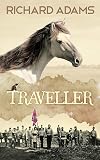
Traveller
by Richard Adams
On This Page
Description
Examines the events of the Civil War through the eyes of General Robert E. Lee's closest companion and devoted horse, Traveller.Tags
Recommendations
























Member Reviews
I really did not like this book. I'm going to have to reread Watership Down to remind myself that Adams can be a good author. Part of it is that I am _not_ a Civil War buff - perhaps if one were, one would enjoy reading the war narrated by a horse. I spent most of the book as confused about the bigger picture as Traveller was. Then there were a lot of very strange choices made by the author - from having Traveller speak in heavy dialect (he mentions getting help with it, in the acknowledgements), to the peculiar paragraphs scattered throughout (mostly as chapter headers) written in the (somewhat florid) style of the period, in present tense, but with future knowledge ("This siege...is to last for nine and half months, until the show more beginning of April, 1865."). Having most (not all) of the generals referred to by nicknames (Red Shirt, Cap-in-his-eyes, Jine-the-Cavalry...) only made the whole thing more confusing. Traveller's language and understanding waver randomly - he starts out referring to "bangs", later starts calling them "guns", then randomly switches back and forth between the terms. He never does learn a name for flags or "colors" - calls them "cloth on sticks" throughout, except once. I don't know. It just did not work for me at all - not the characters (which were pretty faintly sketched in), not the events (as I said above, I never knew what was going on or why - which is, I suppose, appropriate for a war narrated by a horse...), not the language. Oh, and racism in language too - not in the story, just in how Adams-through-Traveller referred to the "black fellas" or later "darkies" serving the white folk. Again, appropriate for the times - but could just as easily have been left out, like Traveller's dialect. The rabbits didn't speak broad Yorkshire, and it made them richer characters that they didn't. I can't complain that the "black fellas" didn't get more depth as characters, because neither did anyone else, including "Marse Roberts" (General Lee). So I was mostly bored except when I was annoyed - not something I'm pleased to have read (except in the sense that I'm done, and never have to read this again!), and certainly not something I'd ever reread. show less
A disappointment. VERY repetitive, felt very long, just battle after battle after battle (granted, I'm not a war book buff...). Maybe the biggest problem with it, though, was Adams' choice to go with dialect. Granted, I'm not a dialect buff, but usually--if it's well done--after struggling through a few paragraphs, the ear picks it up and you can carry it through. Not here. I ended up ignoring it. Needless to say, when a writer's going for ventriloquism(sp), not succeeding leaves a pretty big gaping hole where the narrative voice should be. There's also a weirdness where Adams doesn't seem to trust his choice of narrator and these redundant, AP-like reports of what's going on in the war are inserted, just in case we're not capable of show more following Traveller's account. On top of that, there's the hokey narrative device of having Traveller in retirement telling his story to Lee's daughter's cat (Tom the Nipper--great historic name), which adds to the sense of tedium and repetition, as if you're listening to some old doughboy a-settin' on the porch telling tale after tale of the trenches to anybody unfortunate enough to be within hearing distance.
Positives, though. Traveller has the wonderful awareness of what's going on with his beloved "Marse Robert" (an example of the wretched dialect--why can't he call him The General or even MASTER Robert--reminds me of all that slave dialect I skimmed in Gone With The Wind), which evokes that magical synchronicity between perfectly matched horse and rider. He can tell by Lee's hands on the reins whether he's angry or tense; knows he's falling ill long before any human, etc. One of the most striking is Lee's heart condition--Traveller says his Master never felt quite the same to him again. I didn't think the narrative choice of Traveller was exploited to the degree it could've been in this regard, though; there was just too much pedantic blow-by-blow war accounting going on (you want to read a history book, buy a history book--you don't need a book narrated by a horse!).
This is a book I came close to quitting on, but was glad I didn't, because the last few chapters are quite strong. Dear Traveller has such wholehearted love and respect for his Master that he believes to the end that Lee won the war--simply could not have lost. (This is a good example, too, of how Traveller's narrative is completely sufficient without the authorial intrusions to "clarify" things. He sees the white flag, hears the cries of "surrender," witnesses the great historic moment when the "Blue men" doff their hats to Lee out of respect--of course Traveller misinterprets it, and of course the reader understands what's really happening and doesn't need "help.") The final chapter is truly poignant. Traveller, who outlives Lee by about a year, doesn't understand why his beloved Master Robert hasn't come to visit him at the stable (though he realizes he's very busy running the whole country). Then he's tacked up and draped in black crepe for some reason to participate in one last parade. He's led behind a wagon carrying a box to the building with the pointed top. Where are the usual cheers that accompany parades he's been in? No one's told him, of course. And we leave him there in his stall afterwards, waiting for Master Robert to return.
A quotation from Lucy Rees, whose book The Horse's Mind was Adams' primary source for Traveller's point of view: "[Traveller's] fears and pleasures, his eternal hopefulness, his striving to interpret events beyond his comprehension and his convinced misunderstandings will be as familiar as the smell of a horse to any rider." True enough. show less
Positives, though. Traveller has the wonderful awareness of what's going on with his beloved "Marse Robert" (an example of the wretched dialect--why can't he call him The General or even MASTER Robert--reminds me of all that slave dialect I skimmed in Gone With The Wind), which evokes that magical synchronicity between perfectly matched horse and rider. He can tell by Lee's hands on the reins whether he's angry or tense; knows he's falling ill long before any human, etc. One of the most striking is Lee's heart condition--Traveller says his Master never felt quite the same to him again. I didn't think the narrative choice of Traveller was exploited to the degree it could've been in this regard, though; there was just too much pedantic blow-by-blow war accounting going on (you want to read a history book, buy a history book--you don't need a book narrated by a horse!).
This is a book I came close to quitting on, but was glad I didn't, because the last few chapters are quite strong. Dear Traveller has such wholehearted love and respect for his Master that he believes to the end that Lee won the war--simply could not have lost. (This is a good example, too, of how Traveller's narrative is completely sufficient without the authorial intrusions to "clarify" things. He sees the white flag, hears the cries of "surrender," witnesses the great historic moment when the "Blue men" doff their hats to Lee out of respect--of course Traveller misinterprets it, and of course the reader understands what's really happening and doesn't need "help.") The final chapter is truly poignant. Traveller, who outlives Lee by about a year, doesn't understand why his beloved Master Robert hasn't come to visit him at the stable (though he realizes he's very busy running the whole country). Then he's tacked up and draped in black crepe for some reason to participate in one last parade. He's led behind a wagon carrying a box to the building with the pointed top. Where are the usual cheers that accompany parades he's been in? No one's told him, of course. And we leave him there in his stall afterwards, waiting for Master Robert to return.
A quotation from Lucy Rees, whose book The Horse's Mind was Adams' primary source for Traveller's point of view: "[Traveller's] fears and pleasures, his eternal hopefulness, his striving to interpret events beyond his comprehension and his convinced misunderstandings will be as familiar as the smell of a horse to any rider." True enough. show less
I love Watership Down and am a Civil War buff but this equine perspective is truly asinine. Talking straight from the horse's mouth, Adams stays rigidly within biographical boundaries without any leaps of imagination. A dull exercise, it is neither a worthy novel nor an interesting biography.
The Civil War as told through the eyes of General Lee's horse, Traveller. Unique idea, very long book. This probably would have been a great short story, but there is only so much a horse can observe and comment in and this quickly became very repetative. I must say that this book is the only I've ever read told from the Southern POV and in that respect it certainly opened my eyes.
I read this as part of a book club and it's one of those books that has stayed with me for a long time. I remember a lot of the people from the book club did not like it, but I found the story very interesting. Perhaps it's my love of horses?
Traveller is General Robert Lee's horse and tells the tale of some of the things he did during the Civil War, and life at that time from a horse's perspective.
Traveller is General Robert Lee's horse and tells the tale of some of the things he did during the Civil War, and life at that time from a horse's perspective.
Horse to Robert E. Lee, you'd probably have privy to moments like no other possible entity in that historical niche, right? I tend to like stories told by animals...
Really interesting look into the Civil War through the point of view of a horse.
Members
- Recently Added By
Lists

Favorite Animal Fiction
359 works; 156 members
Nonhuman Protagonists
243 works; 35 members

BingoDOG - Animals in Adult Fiction
78 works; 20 members
Author Information

87+ Works 39,703 Members
Richard George Adams was born in Newbury, England on May 9, 1920. He enrolled at the University of Oxford in 1938, but his studies were interrupted by World War II. During the war, he served with the British airborne forces in the Middle East and India. After the war, he returned to Oxford and received a degree in history in 1948. He joined the show more Ministry of Housing and Local Government and worked his way up over 20 years to a senior post in the clean-air section of the environmental department. He retired in 1974 to become a full-time writer. His first his novel, Watership Down, was published in 1972. It received the Carnegie Medal in Literature in 1972 and the Guardian Children's Fiction Prize in 1973. His other books include Shardik, The Plague Dogs, Traveller, and Tales from Watership Down. He also wrote an autobiography entitled The Day Gone By. He died on December 24, 2016 at the age of 96. (Bowker Author Biography) show less
Work Relationships
Common Knowledge
- Canonical title
- Traveller
- Original publication date
- 1988-05-10
- People/Characters
- Robert E. Lee; Traveller
- Important events
- American Civil War (1861 | 1865)
- First words
- Early Spring, 1866.
- Last words
- (Click to show. Warning: May contain spoilers.)You say, "Strike the tent!"
Classifications
Statistics
- Members
- 492
- Popularity
- 61,570
- Reviews
- 9
- Rating
- (3.51)
- Languages
- 5 — Danish, English, German, Italian, Swedish
- Media
- Paper, Ebook
- ISBNs
- 13
- ASINs
- 5