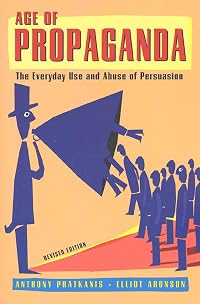
Age of Propaganda: The Everyday Use and Abuse of Persuasion
by Anthony Pratkanis, Elliot Aronson
On This Page
Description
Americans create 57% of the world's advertising while representing only 6% of its population; half of our waking hours are spent immersed in the mass media. Persuasion has always been integral to the democratic process, but increasingly, thoughtful discussion is being replaced with simplistic soundbites and manipulative messages. Drawing on the history of propaganda as well as on contemporary research in social psychology, "Age of Propaganda" shows how the tactics used by political show more campaigners, sales agents, advertisers, televangelists, demagogues, and others often take advantage of our emotions by appealing to our deepest fears and most irrational hopes, creating a distorted vision of the world we live in. This revised and updated edition includes coverage of the Clinton/Lewinsky scandal, recent election campaigns, talk radio, teen suicide, U.F.O. abductions, the Columbine shootings, and novel propaganda tactics based on hypocrisy and false allegations. show lessTags
Recommendations





Member Reviews
The author Anthony Pratkanis writes about the history of propaganda and the social psychology of why the tactics used to influence us (manipulate) works so well in influencing the decisions we make. The focus of the book is about how media, government, religion, corporations and individuals use propaganda, and devious persuasive techniques to manipulate the masses. He cites numerous studies that have been conducted that help explain how and why we are so easily persuaded. I don’t use this phrase often but this book truly opened my eyes and changed my entire way of thinking.
Abordagem muito interessante e útil das temáticas relacionadas com a propaganda. Afinal, propaganda, publicidade, relações públicas, utilizam as mesmas técnicas de persuasão, a única diferença entre elas está nos objectivos. Esta abordagem do ponto de vista psicológico, quer da psicologia individual quer da psicologia social é muito esclarecedora, está escrita em linguagem acessível para leigos e parece bem fundamentada. Muitos destes capítulos merecem segunda leitura, pois incidem sobre temas importantes que carecem de melhor compreensão.
Como os seus autores são psicólogos, abordaram o tema do ponto de vista da sua especialidade, o que além de ser inteiramente válido e ter resultado numa obra muito útil, apresenta show more a lacuna de ter dado pouca atenção à propaganda política não democrática. Ao capítulo dedicado ao nazismo devia ter sido acrescentado outro sobre o bolchevismo. Além disso, sendo os autores americanos, o livro assenta muito na realidade americana quer na sua peculiar democracia quer no seu excessivo liberalismo comercial. show less
Como os seus autores são psicólogos, abordaram o tema do ponto de vista da sua especialidade, o que além de ser inteiramente válido e ter resultado numa obra muito útil, apresenta show more a lacuna de ter dado pouca atenção à propaganda política não democrática. Ao capítulo dedicado ao nazismo devia ter sido acrescentado outro sobre o bolchevismo. Além disso, sendo os autores americanos, o livro assenta muito na realidade americana quer na sua peculiar democracia quer no seu excessivo liberalismo comercial. show less
Aug 28, 2022Portuguese (Portugal)
Ratings
Members
- Recently Added By
Author Information
8+ Works 415 Members

34+ Works 3,336 Members
Elliot Aronson is one of the most eminent and versatile psychologists of our time. He is the only person in the 120-year history of the American Psychological Association to have won all three of its major awards: Distinguished Research (1999), Distinguished Teaching (1973), and Distinguished Writing (1975). In addition, among his many honors are show more the Gordon Allport Prize for his contributions to the betterment of intergroup relations and the Donald Campbell Award for distinguished research in social psychology. In 1981, he was named Professor of the Year by the American Council for the Advancement and Support of Education. Inducted in 1992, he is a Fellow of the American Academy of Arts and Sciences. In 2007, he was named a William James Fellow in commemoration of a lifetime of creative contributions to scientific psychology. show less
Common Knowledge
- Original publication date
- 1992
- Dedication
- To the memory of my parents, Harry Aronson (1903 - 1950) and Dorothy Aronson (1901 - 1989)
They had a wonderfully innocent, childlike trust that, in this country, almost everything they read (especially if it was be... (show all)tween the covers of a book) was absolutely true.
E. A.
To my son, Tony Pratkanis (born 1991)
Chances are, he will grow up with a healthy skepticism but a regrettable cynicism about the truth of everything he reads, hears, and sees.
A. R. P. - First words
- We are of different generations.
- Last words
- (Click to show. Warning: May contain spoilers.)In large measure, the responsibility for raising Peitho's children is ours.
Classifications
- Genres
- Nonfiction, Sociology, General Nonfiction
- DDC/MDS
- 303.375 — Society, government, & culture Social sciences, sociology & anthropology Social processes Coordination and control Social norms Propaganda
- LCC
- HM263 .P715 — Social sciences Sociology (General) Sociology These are obsolete numbers no longer used
- BISAC
Statistics
- Members
- 384
- Popularity
- 81,667
- Reviews
- 2
- Rating
- (4.13)
- Languages
- Chinese, English, Hungarian, Polish
- Media
- Paper
- ISBNs
- 12