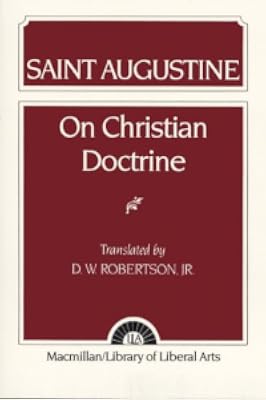
On Christian Teaching
by Saint Augustine
On This Page
Description
?There are certain rules for the interpretation of Scripture which I think might with great advantage be taught to earnest students of the word, that they may profit not only from reading the works of others who have laid open the secrets of the sacred writings, but also from themselves opening such secrets to others. These rules I propose to teach to those who are able and willing to learn.' With these words Saint Augustine (354-430 AD) began one of the finest theological treatments ever show more written on reading and interpreting Holy Scripture. Pastors, monks, and educated laypersons cherished De Doctrina Christiana from the time Augustine wrote it through the Middle Ages. Today, if this wonderful little book is less well-known, it nevertheless remains as insightful as ever. show lessTags
Recommendations






Member Reviews
Augustine's On Christian Doctrine would perhaps be better titled On Biblical Exegesis, an observation also made by the translator of this volume, D.W. Robertson, in the book's Introduction: "Esssentially, On Christian Doctrine is an introduction to the interpretation and explanation of the Bible" (ix). It is a fairly short work, consisting of a Prologue and four books. Its brevity appears at odds with Augustine's warning at the beginning: "[The subject of this book] is a great and arduous work, and since it is difficult to sustain, I fear some temerity in undertaking it" (Book One, I.1, 7).
Augustine believed that Biblical interpretation was something for "students", and perhaps shows some pride when he announces that Biblical show more understanding is not a subjective undertaking of the hoi polloi: such "detractors...see, or think they see, that they are already equipped to expound the sacred books without having read any of the observations which I have set out to make, so that they will declare that these regulations are necessary to no one, but that everything which may laudably be revealed about the obscurities of those books can be revealed with divine assistance" (3).
Not only, however, is OCD a work of Biblical exegesis, and by proxy Christian Doctrine -- perhaps Augustine in his title was alluding to this distance between a sign and the thing signified -- but it is also an important work in the field of critical theory. His discussion of signs is a precursor to the semiological studies of Peirce and Eco some 1500 years later. Augustine begins Book Two:
For Augustine, correct doctrine can only be the product of correct interpretation, which is necessary because "There are two reasons why things written are not understood: they are obscured either by unknown or by ambiguous signs. For signs are either literal or figurative" (Book Two, X.15, 43). Thus a thorough understanding of signs is a necessity for the Biblical exegete.
Book Three aims to illustrate some examples of ambiguity in Scripture, and their correct interpretations. For example, regarding Luke 7:37-38, Augustine asserts the following: "Thus no reasonable person would believe under andy circumstances that the feet of the Lord were anointed with precious ointment by the woman in the manner of lecherous and dissolute men whose banquets we despise" (Book 3, XII.18, 90. Or Hosea 1:2: "Certainly union with a prostitute is one thing when morals are corrupted and quite another thing in the prophecy of the prophet Osee" (Book 3, XII.18, 90). Where a literal interoperation may offend, a figurative one is sought.
In Book Four, Augustine moves from "discovery" to the teaching of what has been discovered., Given his history as a teacher of rhetoric, he begins with an apophatic warning:
Perhaps humorously, he then proceeds to discuss "teaching" (i.e., rhetoric) -- albeit not as rigorously as I'm sure he once did.
Five stars from me, for what it's worth. show less
Augustine believed that Biblical interpretation was something for "students", and perhaps shows some pride when he announces that Biblical show more understanding is not a subjective undertaking of the hoi polloi: such "detractors...see, or think they see, that they are already equipped to expound the sacred books without having read any of the observations which I have set out to make, so that they will declare that these regulations are necessary to no one, but that everything which may laudably be revealed about the obscurities of those books can be revealed with divine assistance" (3).
Not only, however, is OCD a work of Biblical exegesis, and by proxy Christian Doctrine -- perhaps Augustine in his title was alluding to this distance between a sign and the thing signified -- but it is also an important work in the field of critical theory. His discussion of signs is a precursor to the semiological studies of Peirce and Eco some 1500 years later. Augustine begins Book Two:
Just as I began, when I was writing about things, by warning that no one should consider them except as they are, without reference to what they signify beyond themselves, now when I am discussing signs I wish it understood that no one should consider them for what they are but rather for their value as signs which signify something else. A sign is a thing which causes us to think of something beyond the impression the thing itself makes upon the senses (Book Two, I.1, 34).
For Augustine, correct doctrine can only be the product of correct interpretation, which is necessary because "There are two reasons why things written are not understood: they are obscured either by unknown or by ambiguous signs. For signs are either literal or figurative" (Book Two, X.15, 43). Thus a thorough understanding of signs is a necessity for the Biblical exegete.
Book Three aims to illustrate some examples of ambiguity in Scripture, and their correct interpretations. For example, regarding Luke 7:37-38, Augustine asserts the following: "Thus no reasonable person would believe under andy circumstances that the feet of the Lord were anointed with precious ointment by the woman in the manner of lecherous and dissolute men whose banquets we despise" (Book 3, XII.18, 90. Or Hosea 1:2: "Certainly union with a prostitute is one thing when morals are corrupted and quite another thing in the prophecy of the prophet Osee" (Book 3, XII.18, 90). Where a literal interoperation may offend, a figurative one is sought.
In Book Four, Augustine moves from "discovery" to the teaching of what has been discovered., Given his history as a teacher of rhetoric, he begins with an apophatic warning:
But first in these preliminary remarks I must thwart the expectation of those readers who think that I shall give the rules of rhetoric here which I learned and taught in the secular schools. And I admonish them not to expect such rules from me, not that they have no utility, but because, if they have any, it should be sought elsewhere if perhaps some good man has the opportunity to learn them. But he should not expect these rules from me, either in this work or in any other" (Book Four, I.2, 118).
Perhaps humorously, he then proceeds to discuss "teaching" (i.e., rhetoric) -- albeit not as rigorously as I'm sure he once did.
Five stars from me, for what it's worth. show less
A fascinating little book for all kinds of people: late antiquity buffs; philosophers; hermeneuts; and of course, Christians. Augie usually manages to find his way to a reasonable middle position: against biblical literalism, also against waiting for a direct experience of God.
Book one describes 'things' rather than signs, and we get some of Augie's less up to date opinions: you shouldn't love people for themselves, but for the sake of God, and the same thing goes for one's self. But these are backed by more liberal-friendly ideas. The neighbor who we are to love, for instance, is pretty much everyone.
We then move on to 'signs, ambiguities and difficulties of,' which is full of fairly sensible advice for anyone who wants to read show more anything. There are some things you have to know in order to interpret words: languages, for instance, institutions, general facts, logic, rhetoric. But we shouldn't take too much pleasure in these. It sometimes seems, unfortunately, that Augie really thinks you should only know things that are boring and will help you conform to society. I suspect that this claim needs to be put in some kind of historical context--in a solidly Christian culture, presumably, we would be more free to enjoy "human-made institutions," since, he goes on to say, there is much of value to be found even in pagan literature.
Having dealt with the difficulties, we move on to the division between literal and figurative understanding of signs. If sections of scripture are not related to moral behavior or to faith, they should be interpreted figuratively (which, though he doesn't say it, means pretty much all of it should be interpreted figuratively). He goes on to discuss morality at some length, making a nice distinction between the corruption of one's own mind and body (wickedness) and harm to another (wrongdoing). Augie, and almost every religious thinker after him, focuses too much on wickedness, and nowhere near enough on wrongdoing.
Interestingly, book three was started in the 390s, but abandoned, and only finished in the 420s; much of the later work is less interesting, though classicists might appreciate his description of Tyconius, who wrote his own system of interpretation.
Book four, also late, is a defense of the rhetorical beauty of the bible. Not riveting. Not at all.
But on the whole, a fascinating, quickish read. show less
Book one describes 'things' rather than signs, and we get some of Augie's less up to date opinions: you shouldn't love people for themselves, but for the sake of God, and the same thing goes for one's self. But these are backed by more liberal-friendly ideas. The neighbor who we are to love, for instance, is pretty much everyone.
We then move on to 'signs, ambiguities and difficulties of,' which is full of fairly sensible advice for anyone who wants to read show more anything. There are some things you have to know in order to interpret words: languages, for instance, institutions, general facts, logic, rhetoric. But we shouldn't take too much pleasure in these. It sometimes seems, unfortunately, that Augie really thinks you should only know things that are boring and will help you conform to society. I suspect that this claim needs to be put in some kind of historical context--in a solidly Christian culture, presumably, we would be more free to enjoy "human-made institutions," since, he goes on to say, there is much of value to be found even in pagan literature.
Having dealt with the difficulties, we move on to the division between literal and figurative understanding of signs. If sections of scripture are not related to moral behavior or to faith, they should be interpreted figuratively (which, though he doesn't say it, means pretty much all of it should be interpreted figuratively). He goes on to discuss morality at some length, making a nice distinction between the corruption of one's own mind and body (wickedness) and harm to another (wrongdoing). Augie, and almost every religious thinker after him, focuses too much on wickedness, and nowhere near enough on wrongdoing.
Interestingly, book three was started in the 390s, but abandoned, and only finished in the 420s; much of the later work is less interesting, though classicists might appreciate his description of Tyconius, who wrote his own system of interpretation.
Book four, also late, is a defense of the rhetorical beauty of the bible. Not riveting. Not at all.
But on the whole, a fascinating, quickish read. show less
There are two possible aims implied in the title of this work: “On Christian Teaching”: to distinguish the Christian from the pagan—“a manifesto for a particularly Christian culture” (translator Green, viii, dismisses this idea—but see my remarks below on Book III), OR “On Christian Teaching”: to identify and communicate the pedagogical process (per Augustine’s preface). Augustine here works in four connected fields of thought, roughly one in each of the Books I through IV of the treatise: ethics, semiotics, hermeneutics, and rhetoric.
The treatise is sometimes understood as consisting of two parts, according to its compositional history. There was an interruption of two or three decades at III.78. Green indicates “a show more certain bittiness” in the later part of Book III (xi). Many readers, including Green, seem to understand the first three books as properly about learning rather than teaching, while leaving the real doctrina to Book IV. They take that division as reflecting Augustine’s initial distinction between discovery (inventio) and presentation (I.1, IV.1).
I seem to detect a tension between the conception of evil as absence/nonquality on the one hand, and the implication of (original) sin as a positive condition on the other.
At the end of Book III, Augustine credits Tyconius (and downplays the latter’s Donatism), but his frequent citations from Cicero are all tacit. Is this discrepancy in his treatment of Christian and pagan sources a demonstration of how to “spoil the Egyptians”? show less
The treatise is sometimes understood as consisting of two parts, according to its compositional history. There was an interruption of two or three decades at III.78. Green indicates “a show more certain bittiness” in the later part of Book III (xi). Many readers, including Green, seem to understand the first three books as properly about learning rather than teaching, while leaving the real doctrina to Book IV. They take that division as reflecting Augustine’s initial distinction between discovery (inventio) and presentation (I.1, IV.1).
I seem to detect a tension between the conception of evil as absence/nonquality on the one hand, and the implication of (original) sin as a positive condition on the other.
At the end of Book III, Augustine credits Tyconius (and downplays the latter’s Donatism), but his frequent citations from Cicero are all tacit. Is this discrepancy in his treatment of Christian and pagan sources a demonstration of how to “spoil the Egyptians”? show less
The book can be tough to read through at times, such as the last part discussing the use of rhetoric in the book. However, the book was still interesting and thought provoking. Some parts still seem relevant today, such as the part discussing different translations of the Bible. Potentially worth reading if you're interested in theology and are looking for a historical book on the subject.
"Of all the Christian authors I've read (such as St. Teresa of Avila, C.S.Lewis, G.K.Chesterton, Thomas Merton), St. Augustine is the one I find most approachable and enjoyable, although he lived more than 1600 years ago. His books at once stimulate the mind, warm the heart and uplift the spirit, instructional and yet delightful, deep and rich in meaning and yet eloquent in style.
It's been more than 4 months since I finished his masterpieces
[b:Confessions of Saint Augustine|242885|Confessions of Saint Augustine|Saint Augustine of Hippo|http://d.gr-assets.com/books/1320398822s/242885.jpg|1427207] and [b:City of God|25673|City of God|Saint Augustine of Hippo|http://d.gr-assets.com/books/1348947938s/25673.jpg|5814]. Now reading his book show more again is like visiting an old friend and mentor.
In this book, he taught me why Christian love is different from secular love, which things are essential to a life of "faith, hope and love" and which are mere signs and images referring to them, and perhaps more importantly, how to read, interpret and appreciate the eloquence and beauty of the Scriptures, and how to make influential speeches as a Christian using the techniques developed by Cicero, the great Roman orator and statesman. show less
It's been more than 4 months since I finished his masterpieces
[b:Confessions of Saint Augustine|242885|Confessions of Saint Augustine|Saint Augustine of Hippo|http://d.gr-assets.com/books/1320398822s/242885.jpg|1427207] and [b:City of God|25673|City of God|Saint Augustine of Hippo|http://d.gr-assets.com/books/1348947938s/25673.jpg|5814]. Now reading his book show more again is like visiting an old friend and mentor.
In this book, he taught me why Christian love is different from secular love, which things are essential to a life of "faith, hope and love" and which are mere signs and images referring to them, and perhaps more importantly, how to read, interpret and appreciate the eloquence and beauty of the Scriptures, and how to make influential speeches as a Christian using the techniques developed by Cicero, the great Roman orator and statesman. show less
I think this may be a dubious translation as "Augustine" in this work gets a little cheeky at times, which wasn't exactly what I was expecting. Still, a nice work at the intersection of rhetoric, hermeneutics, and exegetical methods in the late antiquity/early middle ages period.. good for both its content and its historical value.
One of my favorites. Profound and stimulating. Should be required reading in every hermeneutics class.
Members
- Recently Added By
Lists

CCE 100 Great Books List
145 works; 8 members

Art of Reading
188 works; 5 members

Shaykh Hamza's Book Recommendations
439 works; 3 members

How to Read a Book's Recommended Reading List
309 works; 10 members
Author Information

1,931+ Works 57,907 Members
Saint Augustine was born to a Catholic mother and a pagan father on November 13, 354, at Thagaste, near Algiers. He studied Latin literature and later taught rhetoric in Rome and Milan. He originally joined the Manicheans, a religious sect, but grew unhappy with some of their philosophies. After his conversion to Christianity and his baptism in show more 387, Augustine developed his own approach to philosophy and theology, accommodating a variety of methods and different perspectives. He believed that the grace of Christ was indispensable to human freedom, and he framed the concepts of original sin and just war. His thoughts greatly influenced the medieval worldview. One of Augustine's major goals was a single, unified church. He was ordained a priest in 391 and appointed Bishop of Hippo, in Roman Africa, in 396. Augustine was one of the most prolific Latin authors in terms of surviving works, and the list of his works consists of more than one hundred separate titles. His writings and arguments with other sects include the Donatists and the Pelagians. On the Trinity, The City of God, and On Nature and Grace are some of his important writings. Confessions, which is considered his masterpiece, is an autobiographical work that recounts his restless youth and details the spiritual experiences that led him to Christianity. Many of Augustine's ideas, such as those concerning sin and predestination, became integral to the doctrines of the Roman Catholic Church. In the Catholic Church he is a saint and pre-eminent Doctor of the Church, and the patron of the Augustinians. He is the patron saint of brewers, printers, and theologians. Augustine died on August 28, 430. (Bowker Author Biography) show less
Some Editions
Series
Belongs to Publisher Series
Work Relationships
Is contained in
Common Knowledge
- Canonical title
- On Christian Teaching
- Original title
- De Doctrina Christiana
- Original publication date
- 397 (Books I-III) (Books I-III); 426 (Book IV) (Book IV)
- Original language
- Latin
Classifications
- Genres
- Religion & Spirituality, Nonfiction, Philosophy, General Nonfiction, History
- DDC/MDS
- 230.14 — Religion Christianity Christianity Patristics and Orthodox theology
- LCC
- BR65 .A655 .E5 — Philosophy, Psychology and Religion Christianity Christianity Early Christian literature. Fathers of the Church, etc.
- BISAC
Statistics
- Members
- 2,080
- Popularity
- 9,967
- Reviews
- 11
- Rating
- (3.88)
- Languages
- 10 — English, Finnish, German, Hungarian, Italian, Latin, Portuguese, Romanian, Slovenian, Swedish
- Media
- Paper, Audiobook, Ebook
- ISBNs
- 50
- UPCs
- 1
- ASINs
- 21