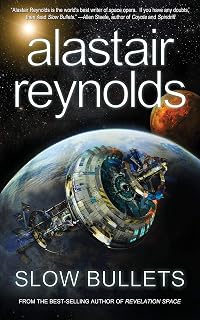
Slow Bullets
by Alastair Reynolds
On This Page
Description
From the author of the Revelation Space series comes an interstellar adventure of war, identity, betrayal, and the preservation of civilization itself. A vast conflict, one that has encompassed hundreds of worlds and solar systems, appears to be finally at an end. A conscripted soldier is beginning to consider her life after the war and the family she has left behind. But for Scur-and for humanity-peace is not to be. On the brink of the ceasefire, Scur is captured by a renegade war criminal, show more and left for dead in the ruins of a bunker. She revives aboard a prisoner transport vessel. Something has gone terribly wrong with the ship. Passengers-combatants from both sides of the war-are waking up from hibernation far too soon. Their memories, embedded in bullets, are the only links to a world which is no longer recognizable. And Scur will be reacquainted with her old enemy, but with much higher stakes than just her own life. show lessTags
Recommendations























Member Reviews
The novella is the native genre of science fiction - even though nowadays most books are a lot longer, that is the length that allows the storytelling to shine - not too short (short stories are great but they rarely have enough space to expand on the story), not too long to need padding and secondary story lines. And Reynolds's craft shines in this one.
Slow Bullets are used as recording devices for the soldiers in a war - they hide in their bodies, they cannot be removed without killing them (or it is very hard anyway) and they contain information about who they are (like high-tech version of dog tags except carrying a lot more information). Their name comes from the way they are put there - they are injected and then the AI bullet show more finds its place to the middle of the body, carefully skirting any areas where it can cause damage. But they are not that harmless either - they can be ordered to kill (or really do anything else depending on what the person programming them wants to do). And hat duality is what Reynolds uses to build his story.
Scur is a soldier at the end of a war that had devastated the worlds (of course all is happening in space and on a lot of planets - this is Reynolds after all). And just when she believes she is done with the war she is captured by one of the worst from the other side - a man that is considered a monster from both side; a man that is heading to the war tribunals no matter who wins. The irony of the fact that the war is over and the Scur should not have been in the war to start with is just part of it; the fact that she is going to die is the bigger problem. Although her being the narrator, we already know that she somehow survives - although for a minute here I did wonder if she will end up being trapped in a bullet or something.
She does survive - just to wake on a half-dead ship, bound to military prison and the war tribunals. Where she does not belong. And while protesting her innocence, she realizes that it does not matter - technology backfired a bit and she and everyone on the ship are the last chance of humanity to survive an alien threat. Of course the story takes its time revealing the pieces of it and how things happened - there is enough material in that story to cover a trilogy (and a sequel to it) and Reynolds condenses it in a way that proves again that he knows his craft.
And then the real story begins - because the ship is full with both good and bad people (including the monster from the start of the story) and everyone needs to make a decision - are their old deeds more important than humanity; can monstrosity be forgotten and forgiven for the sake of survival; what is more important - personal history and memories or the memories of the race.
In a way it is a story of redemption but it is also a story about the hard choices that everyone need to make; about memory and belonging; about desperation and hope. It is the kind of story that made me fall in love with the genre all those years ago. show less
Slow Bullets are used as recording devices for the soldiers in a war - they hide in their bodies, they cannot be removed without killing them (or it is very hard anyway) and they contain information about who they are (like high-tech version of dog tags except carrying a lot more information). Their name comes from the way they are put there - they are injected and then the AI bullet show more finds its place to the middle of the body, carefully skirting any areas where it can cause damage. But they are not that harmless either - they can be ordered to kill (or really do anything else depending on what the person programming them wants to do). And hat duality is what Reynolds uses to build his story.
Scur is a soldier at the end of a war that had devastated the worlds (of course all is happening in space and on a lot of planets - this is Reynolds after all). And just when she believes she is done with the war she is captured by one of the worst from the other side - a man that is considered a monster from both side; a man that is heading to the war tribunals no matter who wins. The irony of the fact that the war is over and the Scur should not have been in the war to start with is just part of it; the fact that she is going to die is the bigger problem. Although her being the narrator, we already know that she somehow survives - although for a minute here I did wonder if she will end up being trapped in a bullet or something.
She does survive - just to wake on a half-dead ship, bound to military prison and the war tribunals. Where she does not belong. And while protesting her innocence, she realizes that it does not matter - technology backfired a bit and she and everyone on the ship are the last chance of humanity to survive an alien threat. Of course the story takes its time revealing the pieces of it and how things happened - there is enough material in that story to cover a trilogy (and a sequel to it) and Reynolds condenses it in a way that proves again that he knows his craft.
And then the real story begins - because the ship is full with both good and bad people (including the monster from the start of the story) and everyone needs to make a decision - are their old deeds more important than humanity; can monstrosity be forgotten and forgiven for the sake of survival; what is more important - personal history and memories or the memories of the race.
In a way it is a story of redemption but it is also a story about the hard choices that everyone need to make; about memory and belonging; about desperation and hope. It is the kind of story that made me fall in love with the genre all those years ago. show less
Read as part of the Hugo Voters' Packet.
And... I think this one is creeping up past 'Penric's Demon' to get my vote.
A vicious interstellar conflict is coming to an end. A ceasefire has been announced. Unfortunately for one soldier, the enemy who's captured her is infamous for his brutality, and he couldn't care less that hostilities are officially over. Scur fully expects to be tortured to death.
Unexpectedly, however, she awakes from coldsleep aboard a transport ship. A panicked crewmember lets her know that it was relocating a full component of mainly war criminals - but that something has gone wrong. They don't know where they are - or how much time has passed. With brutal 'dregs' from both sides of the war awakening to an uncertain show more situation, chaos is imminent - unless Scur can seize the opportunity and get all the survivors to pull together.
Very nicely done - well-drawn setting, some good plot twists, excellent pacing. The story bears some definite similarities to Sean Danker's 'Admiral' (https://www.goodreads.com/review/show/1527829067) - I'd definitely recommend the one for fans of the other - I liked both. show less
And... I think this one is creeping up past 'Penric's Demon' to get my vote.
A vicious interstellar conflict is coming to an end. A ceasefire has been announced. Unfortunately for one soldier, the enemy who's captured her is infamous for his brutality, and he couldn't care less that hostilities are officially over. Scur fully expects to be tortured to death.
Unexpectedly, however, she awakes from coldsleep aboard a transport ship. A panicked crewmember lets her know that it was relocating a full component of mainly war criminals - but that something has gone wrong. They don't know where they are - or how much time has passed. With brutal 'dregs' from both sides of the war awakening to an uncertain show more situation, chaos is imminent - unless Scur can seize the opportunity and get all the survivors to pull together.
Very nicely done - well-drawn setting, some good plot twists, excellent pacing. The story bears some definite similarities to Sean Danker's 'Admiral' (https://www.goodreads.com/review/show/1527829067) - I'd definitely recommend the one for fans of the other - I liked both. show less
I read this as part of the Hugo finalist packet.
Dang, but Reynolds can write. This sci-fi novella grips from the start as you follow Scur, a conscripted soldier in a war that is finally at end. She is caught by a sadistic thug and tortured briefly. When she awakens, she's on a ship in a hibernation chamber. Something has gone very, very wrong on board, and Scur and other characters slowly find out how dire their situation really is. The whole scenario is truly horrific. It's almost soothing to be in Scur's perspective. She may not have chosen to be a soldier but she's a darn good one. She is cool and calculated, even when she finds out the man who tortured her is also on board. The novella threatens to become a dark revenge tale, but show more the story is much deeper and complicated than that. Again--dang, Reynolds can write. This has it all: a fantastic premise, a solid protagonist, and incredible tension to carry everyone along. show less
Dang, but Reynolds can write. This sci-fi novella grips from the start as you follow Scur, a conscripted soldier in a war that is finally at end. She is caught by a sadistic thug and tortured briefly. When she awakens, she's on a ship in a hibernation chamber. Something has gone very, very wrong on board, and Scur and other characters slowly find out how dire their situation really is. The whole scenario is truly horrific. It's almost soothing to be in Scur's perspective. She may not have chosen to be a soldier but she's a darn good one. She is cool and calculated, even when she finds out the man who tortured her is also on board. The novella threatens to become a dark revenge tale, but show more the story is much deeper and complicated than that. Again--dang, Reynolds can write. This has it all: a fantastic premise, a solid protagonist, and incredible tension to carry everyone along. show less
SLOW BULLETS, a new novella by Alastair Reynolds, is a very good piece of "hard" science fiction, without quite being up to the standard of Reynolds's usually excellent style. The text reads more like a manuscript summary, a submission to the publisher providing the sketch for a future novel, broken up into separate chunks or segments. Despite the fact that each segment is gripping and contains very interesting ideas, there are big gaps in the narrative sequence begging to be filled in, and many segments have gaping plot-holes or contradictions that could have been ironed out in a final novel, that was never written. Still, it was a very enjoyable read.
The story is based on ambivalence, as the title announces. A bullet is a high-speed show more projectile, so the title "slow bullets" is a contradiction in terms, an oxymoron, as in the classical example: festina lente, hasten slowly. The contradictory nature of the expression serves to highlight the adjective "slow", and we see that the "slowness" involved has two values: positive, the bullet is slow so as to do no harm to vital organs; and negative, the bullet is slow so as to cause as much pain as possible, to prolong the pain.
In classical terms, a "slow bullet" is a pharmakon, something that can be either a remedy or a poison, a cure or a curse. This ambivalence is coded into the heroine's name "Scur", which is phonetically an anagramme of both "curse" and "cures". We can see the possibility of these two pronunciations in the full form of that name, "Scurelya". The audiobook version had to decide on one pronunciation, and chose "Scur" to rhyme with "cur", but two pronunciations are possible. On the second hypothesis "Scur" would rhyme with "secure", or "cure".
The pharmakon as the indetermination between two opposing values, or ambivalent medecine/poison, goes back to Plato. In the PHAEDRUS, writing is presented as a pharmakon. Supposedly an aid to memory, writing as an exteriorised or artificial memory potentially will weaken or destroy our personal memories. This theme is at work in the whole concept of the bullet and its actual and potential functions, and what information it can usefully contain.
Another ambivalence in the PHAEDRUS, and in SLOW BULLETS is the answer to the question who is wise? The sophists who write down their discourses, relying on the artificial memory of writing, or Socrates who doesn't write, but relies on the living memory of the active soul? They have much in common, but one is a poison or curse (Lysias, the sophist) and the other is a remedy or cure (Socrates, the philosopher). We find this theme in the opposition and identification between the heroine Scur and the vilain Orvin. Is Scur just as bad as Orvin, as Orvin himself claims? Can Scur bring something good out of Orvin, despite himself?
Memory and its ambivalence is at the heart of this story: is memory a blessing or a curse? Which memories are the "best", personal remembrances or collective culture ? Personal memories give us anchor, focus, and centredness. But they also give us division, repetition of the past, an appette for revenge. Cultural memory gives us poetry, science and humanity, but also weapons and sectarian strife. Wiping out the personal information on your bullet means passing from memory as literal proof of one's identity, to memory as personal relation to the past and creative relation to our individuality. Putting cultural information on the bullet means passing from narcissistic nostalgic self-authentication to collective future-oriented construction.
Another theme of the novella is the danger of literalism. The Holy Scripture of this future civilisation, called simply "The Book", exists in two versions, very similar but with crucial differences. Seeing The Book through the eyes of the heroine Scur who was brought up in a religious family but is not a believer, we can see how it is divisive if taken literally, but consolatory and wisdom-bearing if one approaches it free from literal belief, more poetically.
The pharmakon theme (curse or cure, poison or remedy) can be seen very clearly in the ship's auto-surgeon, which could heal you or butcher you. Right at the beginning of the novella we have the collection of poems of Giresun, with the poem entitled "Morning Flowers". Scur tells us that this poem is about death and memory ("remembrance"), loss and life. This sets up from the outset the thematics of the story in cameo form.
Another ambivalent term is "caprice", an unreasoning or inexplicable change of mood or line of action, in violation of accepted rules of behaviour. The ship on which almost all the action takes place is called "The Caprice". A caprice can be frivolous whim, often egotistical, or it can be a deeper impulse. When Scur asks Orvin why he is torturing her despite the ceasefire, he laughs and asks "Why not?" This is a negative caprice, meant to be lethal. When Scur spares Orvin, and gives him a second chance, this was an unexpected move, a positive caprice. Prad exclaims: “I did not think Scur would do the obvious thing”. The outcome is uncertain and Scur has violated the wishes of the ruling "Trinity", but Prado concludes that despite this uncertainty and despite the illegality of the action, Scur's caprice was a positive gesture: "It was good that we not kill this man, and good that we gave him a chance to do some good himself”.
I think that SLOW BULLETS is a good place to start reading Alastair Reynolds. In the space of a novella of 192 pages, or an audiobook of just under 4 and a half hours, we have a new world sketched out with great clarity in such a relatively small space. We have the sense of wonder of space opera combined with philosophical ideas about memory and forgetting, and their relation to identity. There is also a breaking free of the gender stereotypes that sometimes go with space opera: the most important characters, except for the vilain, are women, and they are treated in a much more human way than for example in Peter Hamilton's space operas. What begins as military science fiction grows into more philosophical speculative fiction. So I would recommend this book to those who would like to get an idea of the range of Reynolds's speculative imagination, his approach to technology in SF, and his sympathetic treatment of human beings. show less
The story is based on ambivalence, as the title announces. A bullet is a high-speed show more projectile, so the title "slow bullets" is a contradiction in terms, an oxymoron, as in the classical example: festina lente, hasten slowly. The contradictory nature of the expression serves to highlight the adjective "slow", and we see that the "slowness" involved has two values: positive, the bullet is slow so as to do no harm to vital organs; and negative, the bullet is slow so as to cause as much pain as possible, to prolong the pain.
In classical terms, a "slow bullet" is a pharmakon, something that can be either a remedy or a poison, a cure or a curse. This ambivalence is coded into the heroine's name "Scur", which is phonetically an anagramme of both "curse" and "cures". We can see the possibility of these two pronunciations in the full form of that name, "Scurelya". The audiobook version had to decide on one pronunciation, and chose "Scur" to rhyme with "cur", but two pronunciations are possible. On the second hypothesis "Scur" would rhyme with "secure", or "cure".
The pharmakon as the indetermination between two opposing values, or ambivalent medecine/poison, goes back to Plato. In the PHAEDRUS, writing is presented as a pharmakon. Supposedly an aid to memory, writing as an exteriorised or artificial memory potentially will weaken or destroy our personal memories. This theme is at work in the whole concept of the bullet and its actual and potential functions, and what information it can usefully contain.
Another ambivalence in the PHAEDRUS, and in SLOW BULLETS is the answer to the question who is wise? The sophists who write down their discourses, relying on the artificial memory of writing, or Socrates who doesn't write, but relies on the living memory of the active soul? They have much in common, but one is a poison or curse (Lysias, the sophist) and the other is a remedy or cure (Socrates, the philosopher). We find this theme in the opposition and identification between the heroine Scur and the vilain Orvin. Is Scur just as bad as Orvin, as Orvin himself claims? Can Scur bring something good out of Orvin, despite himself?
Memory and its ambivalence is at the heart of this story: is memory a blessing or a curse? Which memories are the "best", personal remembrances or collective culture ? Personal memories give us anchor, focus, and centredness. But they also give us division, repetition of the past, an appette for revenge. Cultural memory gives us poetry, science and humanity, but also weapons and sectarian strife. Wiping out the personal information on your bullet means passing from memory as literal proof of one's identity, to memory as personal relation to the past and creative relation to our individuality. Putting cultural information on the bullet means passing from narcissistic nostalgic self-authentication to collective future-oriented construction.
Another theme of the novella is the danger of literalism. The Holy Scripture of this future civilisation, called simply "The Book", exists in two versions, very similar but with crucial differences. Seeing The Book through the eyes of the heroine Scur who was brought up in a religious family but is not a believer, we can see how it is divisive if taken literally, but consolatory and wisdom-bearing if one approaches it free from literal belief, more poetically.
The pharmakon theme (curse or cure, poison or remedy) can be seen very clearly in the ship's auto-surgeon, which could heal you or butcher you. Right at the beginning of the novella we have the collection of poems of Giresun, with the poem entitled "Morning Flowers". Scur tells us that this poem is about death and memory ("remembrance"), loss and life. This sets up from the outset the thematics of the story in cameo form.
Another ambivalent term is "caprice", an unreasoning or inexplicable change of mood or line of action, in violation of accepted rules of behaviour. The ship on which almost all the action takes place is called "The Caprice". A caprice can be frivolous whim, often egotistical, or it can be a deeper impulse. When Scur asks Orvin why he is torturing her despite the ceasefire, he laughs and asks "Why not?" This is a negative caprice, meant to be lethal. When Scur spares Orvin, and gives him a second chance, this was an unexpected move, a positive caprice. Prad exclaims: “I did not think Scur would do the obvious thing”. The outcome is uncertain and Scur has violated the wishes of the ruling "Trinity", but Prado concludes that despite this uncertainty and despite the illegality of the action, Scur's caprice was a positive gesture: "It was good that we not kill this man, and good that we gave him a chance to do some good himself”.
I think that SLOW BULLETS is a good place to start reading Alastair Reynolds. In the space of a novella of 192 pages, or an audiobook of just under 4 and a half hours, we have a new world sketched out with great clarity in such a relatively small space. We have the sense of wonder of space opera combined with philosophical ideas about memory and forgetting, and their relation to identity. There is also a breaking free of the gender stereotypes that sometimes go with space opera: the most important characters, except for the vilain, are women, and they are treated in a much more human way than for example in Peter Hamilton's space operas. What begins as military science fiction grows into more philosophical speculative fiction. So I would recommend this book to those who would like to get an idea of the range of Reynolds's speculative imagination, his approach to technology in SF, and his sympathetic treatment of human beings. show less
I received this book through NetGalley, in exchange for an honest review.
My thanks to both NetGalley and Tachyon Publications for granting my request, since Alastair Reynolds is one of my favorite SF authors.
Slow Bullets is slightly different from the kind of narrative I grew used to after reading Reynolds’ books like Chasm City, Revelation Space, Redemption Ark or Absolution Gap: the scope here does not concern galactic civilizations or multi-layered political plots, but rather focuses on smaller-scale events that nonetheless manage to gain intensity and depth because of that reduced focus, and not in spite of it.
The main character here is Scur, a soldier who’s been conscripted to fight in a bloody war: when we first see her, a show more ceasefire has just been declared and yet she’s captured by the enemy and subjected to torture by Orvin, an infamous psychopathic killer from the opposite side. Left for dead, she wakes up in a hibernation pod on a ship that’s undergone some form of catastrophic malfunction and is now orbiting what looks like a dead system. The great majority of the slowly waking occupants of the hibernation pods seems to be composed of soldiers from both sides of the war, plus a smattering of civilians, and a skeleton crew: Scur takes on, almost by default, the job of organizing the survivors and finding out their chances of repairing the ship and trying to get back to their intended destination.
The questions about what happened and the need for survival, this last endangered by far-reaching frictions between the waking passengers, are compounded by the awareness that the ship is slowly, but surely, losing precious information because of a program rewriting initiated by the malfunction itself. And memory is indeed at the core of this story, starting with the titular slow bullets – a recording device implanted in soldiers to keep score of their actions and also to store important memories and personal data.
The fact that Scur’s torture at the hands of Orvin occurs through the twisted use of a slow bullet underlines how memory can be painful as well as a comfort. So, as the marooned passengers slowly understand that their predicament could not be purely ascribed to an accident, as they realize their numbers are mostly composed by people no one wants around – because they are useless, or dangerous, or simply a burden - they also recognize that only by letting go of their personal memories, of their past, they can start planning for the future. It’s a terrible, sad realization, placed into stark relief by Scur’s attachment to her parents’ pictures, stored in her slow bullet – her only contact with them, with her past and the person she was before the war and her conscription in the army. What she and the other survivors must accept the terrible necessity to give up that past to be able to build a future: even though the hope for that future is clearly expressed in the story, the price it requires seems too high, too heartrending.
All this is presented through Scur's voice and point of view: her almost blunt, soldierly manner cracks at times to show a different person, one far less pragmatic and hardened than the one she shows to the world, and these chinks in her armor endeared her to me, made her real. Underneath the soldier, and survivor of a heated conflict, sometimes lurks a person who pines for her lost life, the missed opportunities, the untrodden paths that fate denied her: it's never openly stated, never spoken out loud, but it's there and it's a form of quiet desperation that denies detachment and does not leave you untouched.
It’s a more intimate vision than what I encountered until now in Reynolds’ books, but for this very reason it felt more profound and poignant than any other I read so far, and it gave me a new level of interpretation for this author, and a key to a new way of reading his stories.
Highly recommended, both for Reynolds' admirers and as an introduction to this author.
review on Space and Sorcery blog show less
My thanks to both NetGalley and Tachyon Publications for granting my request, since Alastair Reynolds is one of my favorite SF authors.
Slow Bullets is slightly different from the kind of narrative I grew used to after reading Reynolds’ books like Chasm City, Revelation Space, Redemption Ark or Absolution Gap: the scope here does not concern galactic civilizations or multi-layered political plots, but rather focuses on smaller-scale events that nonetheless manage to gain intensity and depth because of that reduced focus, and not in spite of it.
The main character here is Scur, a soldier who’s been conscripted to fight in a bloody war: when we first see her, a show more ceasefire has just been declared and yet she’s captured by the enemy and subjected to torture by Orvin, an infamous psychopathic killer from the opposite side. Left for dead, she wakes up in a hibernation pod on a ship that’s undergone some form of catastrophic malfunction and is now orbiting what looks like a dead system. The great majority of the slowly waking occupants of the hibernation pods seems to be composed of soldiers from both sides of the war, plus a smattering of civilians, and a skeleton crew: Scur takes on, almost by default, the job of organizing the survivors and finding out their chances of repairing the ship and trying to get back to their intended destination.
The questions about what happened and the need for survival, this last endangered by far-reaching frictions between the waking passengers, are compounded by the awareness that the ship is slowly, but surely, losing precious information because of a program rewriting initiated by the malfunction itself. And memory is indeed at the core of this story, starting with the titular slow bullets – a recording device implanted in soldiers to keep score of their actions and also to store important memories and personal data.
The fact that Scur’s torture at the hands of Orvin occurs through the twisted use of a slow bullet underlines how memory can be painful as well as a comfort. So, as the marooned passengers slowly understand that their predicament could not be purely ascribed to an accident, as they realize their numbers are mostly composed by people no one wants around – because they are useless, or dangerous, or simply a burden - they also recognize that only by letting go of their personal memories, of their past, they can start planning for the future. It’s a terrible, sad realization, placed into stark relief by Scur’s attachment to her parents’ pictures, stored in her slow bullet – her only contact with them, with her past and the person she was before the war and her conscription in the army. What she and the other survivors must accept the terrible necessity to give up that past to be able to build a future: even though the hope for that future is clearly expressed in the story, the price it requires seems too high, too heartrending.
All this is presented through Scur's voice and point of view: her almost blunt, soldierly manner cracks at times to show a different person, one far less pragmatic and hardened than the one she shows to the world, and these chinks in her armor endeared her to me, made her real. Underneath the soldier, and survivor of a heated conflict, sometimes lurks a person who pines for her lost life, the missed opportunities, the untrodden paths that fate denied her: it's never openly stated, never spoken out loud, but it's there and it's a form of quiet desperation that denies detachment and does not leave you untouched.
It’s a more intimate vision than what I encountered until now in Reynolds’ books, but for this very reason it felt more profound and poignant than any other I read so far, and it gave me a new level of interpretation for this author, and a key to a new way of reading his stories.
Highly recommended, both for Reynolds' admirers and as an introduction to this author.
review on Space and Sorcery blog show less
In the aftermath of a galactic war, soldier Scur finds herself waking up on a derelict spaceship with no memory of how she got there. On the ship are other soldiers from both sides of the conflict, all having data capsules named "slow bullets" implanted in their bodies containing fragmented memories, along with some civilians without these "slow bullets". Forced to cooperate, Scur must unravel the mystery of the ship, their fragmented pasts, and a looming threat that could jeopardize everything. It's a tense, claustrophobic thriller set against the backdrop of a shattered universe, exploring themes of war, identity, and the power of memory.
...Slow Bullets is a very enjoyable novella. Reynolds makes some bold choices over the course of the story and not everybody will like those. In the end I think it turned out quite well. The novella does not quite have the beauty of some of Reynold's other novellas but in a way the rough structure fits the story. It is different enough from much of Reynolds' other works that it will be interesting reading for people who have read his novels, but also contains enough recurring elements that to make it a decent entry point for new readers. It might not be the very best Reynolds has produced but it is not that far off either. You could do worse than pick up this novella.
Full Random Comments review
Full Random Comments review
Members
- Recently Added By
Lists

2016 Hugo Eligible Novellas
12 works; 9 members

Books Read in 2016
4,666 works; 199 members

ALA The Reading List
490 works; 28 members

Books featured on I Don't Even Own a Television
167 works; 3 members
SFF standalone novellas with female protagonists
101 works; 4 members
Author Information

141+ Works 40,096 Members
Some Editions
Awards and Honors
Series
Belongs to Publisher Series
Orpheuse Raamatukogu (27)
Common Knowledge
- Canonical title*
- Mémoire de métal
- Original title
- Slow Bullets
- Original publication date
- 2015
- People/Characters
- Scur; Prad; Orvin
- Important places
- Caprice (starship)
- First words
- My mother had a fondness for poetry.
- Last words
- (Click to show. Warning: May contain spoilers.)I set my hand to these words.
- Blurbers
- Steele, Allen
- Original language
- English
*Some information comes from Common Knowledge in other languages. Click "Edit" for more information.
Classifications
Statistics
- Members
- 522
- Popularity
- 57,495
- Reviews
- 37
- Rating
- (3.56)
- Languages
- 5 — English, Estonian, Finnish, French, Hungarian
- Media
- Paper, Audiobook, Ebook
- ISBNs
- 19
- ASINs
- 9