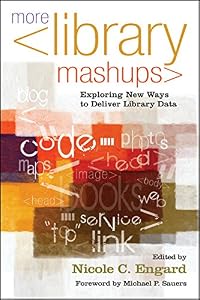
More Library Mashups: Exploring New Ways to Deliver Library Data
by Nicole C. Engard 
On This Page
Description
A collection of mashup projects that virtually any library can emulate, customize, and build upon. Discover how to use free and inexpensive digital tools and techniques to improve library services and meet everyday-- and unexpected-- challenges.--Tags
Recommendations















Member Reviews
More Library Mashups continues the idea first started in Library Mashups: providing librarians ideas on combining some library data they have with free web services to provide something seemingly new. This volume offers over twenty recipes for further enhancing library data. Those new to mashups may want to start with the first book, as this one assumes a greater familiarity with the concept. There's a little something for everyone -- there are some very theoretical chapters, and there are some chapters filled with code snippets. Few of the chapters will walk you step-by-step through the process the originating library went through; instead, the aim is to give a broader view so that the features discussed may be more widely used.
I was show more grimly pleased to note two chapters did point out the "danger" of using free web services for mashups or services, as they could become pay-to-use at any time, or they could disappear completely without any warning (goodbye, Google Reader). I'm not anti-mashup -- I've created a number of projects, like timelines and Google maps -- but there's a big risk when, after spending a lot of time fiddling with APIs and learning specific programming languages, suddenly something breaks.
Librarians who have at least experimented with programming should enjoy this book. But I'd be a bit cautious about loaning a copy to a librarian who, without any experience, wants to jump in and try something -- there's just a little too much in this book to overwhelm a newbie.
[Early Reviewer book]
-------------------------
LT Haiku:
Libraries always
feel the need to prove themselves:
Show off your data! show less
I was show more grimly pleased to note two chapters did point out the "danger" of using free web services for mashups or services, as they could become pay-to-use at any time, or they could disappear completely without any warning (goodbye, Google Reader). I'm not anti-mashup -- I've created a number of projects, like timelines and Google maps -- but there's a big risk when, after spending a lot of time fiddling with APIs and learning specific programming languages, suddenly something breaks.
Librarians who have at least experimented with programming should enjoy this book. But I'd be a bit cautious about loaning a copy to a librarian who, without any experience, wants to jump in and try something -- there's just a little too much in this book to overwhelm a newbie.
[Early Reviewer book]
-------------------------
LT Haiku:
Libraries always
feel the need to prove themselves:
Show off your data! show less
 This review was written for LibraryThing Early Reviewers.
Libraries interested in using their data to improve service should get More Library Mashups: Exploring New Ways to Deliver Library Data edited by Nicole Engard. It is a strong book that balances both highly technical developer-grade projects with ones that any library could do with basic technology skills and the ability to follow instructions.
The book defines mashups as mixing two or more data sources to create a better service. Some of the examples rely on consumer cloud services like IFTTT.com (a triggering service), Yahoo! Pipes, and Google Drive. Others require infrastructure - often Ruby on Rails or PHP - to deliver more complicated results. Whether you are a developer or just a tech-curious information worker, you will find show more interesting options. All the projects are well-documented, almost like recipes, but individual authors frequently also provide their own code.
I was particularly struck by the Umlaut, Rapier, Search with Twitter, and News Awareness projects. But there are many more examples in the book, particularly focusing on catalogs and maps. These held less interest for me but emphasize an important point about the book. Few readers will find everything applicable to their library environment. But every information pro who leafs through this will find more than one good idea that they might be able to do, whether it's improving presentation and serendipity of calendar information or better kiosk desktop management.
Librarians should buy this for their own professional development and library directors should look at as an investment in their people. Whether you complete the projects listed or are just inspired - as I was - to think about how to apply their concepts to my own library, this book is worth your time. show less
The book defines mashups as mixing two or more data sources to create a better service. Some of the examples rely on consumer cloud services like IFTTT.com (a triggering service), Yahoo! Pipes, and Google Drive. Others require infrastructure - often Ruby on Rails or PHP - to deliver more complicated results. Whether you are a developer or just a tech-curious information worker, you will find show more interesting options. All the projects are well-documented, almost like recipes, but individual authors frequently also provide their own code.
I was particularly struck by the Umlaut, Rapier, Search with Twitter, and News Awareness projects. But there are many more examples in the book, particularly focusing on catalogs and maps. These held less interest for me but emphasize an important point about the book. Few readers will find everything applicable to their library environment. But every information pro who leafs through this will find more than one good idea that they might be able to do, whether it's improving presentation and serendipity of calendar information or better kiosk desktop management.
Librarians should buy this for their own professional development and library directors should look at as an investment in their people. Whether you complete the projects listed or are just inspired - as I was - to think about how to apply their concepts to my own library, this book is worth your time. show less
This review was written for LibraryThing Early Reviewers.As with any book with multiple contributors, no one is going to find every chapter applicable to them, especially when the topic is something specific as this. That said, I found much of the book quite good. The first section in particular provides a great introduction to library mashups. For less technical readers, the first chapter exploring IFTTT (If This Then That), a mashup generator that doesn't require any programming, is a great way to begin the book. It introduces the topic and lets people try their hand at some mashups using their own social media data to get a feel for what the book is about.
There were only two chapters which I didn't find at all helpful. The rest were decent to very good. As you would expect, there is a lot show more of content about maps mashups, what with geographic data being easily available and maps being a well understood visualization.
My only complaint is with the combination of the book's dimensions and the formatting. The book itself is tall and narrow. Unfortunately, this means that code samples often have their lines wrapped. In some cases, this could cause some confusion as comment lines which begin with a '#' character, when wrapped, aren't always obvious. If would've been better if the book were physically wider and/or the font for the code snippets was slightly smaller. show less
There were only two chapters which I didn't find at all helpful. The rest were decent to very good. As you would expect, there is a lot show more of content about maps mashups, what with geographic data being easily available and maps being a well understood visualization.
My only complaint is with the combination of the book's dimensions and the formatting. The book itself is tall and narrow. Unfortunately, this means that code samples often have their lines wrapped. In some cases, this could cause some confusion as comment lines which begin with a '#' character, when wrapped, aren't always obvious. If would've been better if the book were physically wider and/or the font for the code snippets was slightly smaller. show less
This review was written for LibraryThing Early Reviewers.Like all cookbooks, read this collection skimmingly to sample what is available. The first couple pages of each chapter offers an overview describing the problem to be solved. That serves to tell the reader whether the details are of sufficient interest to warrant working through all the details to pull off a successful project. Not every idea will appeal to everyone, so the first run through will be reasonably quick. I found some of the ideas quite intriguing, although it would take more courage than I can muster to actually try to pull one off, but I'm impressed that there are other people out there working this magic.
This review was written for LibraryThing Early Reviewers.This is Engard’s second volume of examples and illustrations of how libraries are using open data sources to provide better information tools and services. Mashups, or combinations of distinct products into something new (like Reece’s Peanut Butter Cups), look for ways to use free tools to aggregate, distribute, and increase access to information. Examples in the book range from an automatic weather search triggering a tweet about library closure status to integrating book cover images into the card cataloge, creating computer availability maps, or using drupal to create a library calendar.
The projects aren’t terribly technical. They are meant to show what can be done with available tools, and to inspire further investigation and show more development by readers. The authors vary, of course, but most chapters are clear and easy to follow. More than any single project, though, these ideas are valuable for developing new ways of thinking about what our users need and how we can help them get and utilize that. show less
The projects aren’t terribly technical. They are meant to show what can be done with available tools, and to inspire further investigation and show more development by readers. The authors vary, of course, but most chapters are clear and easy to follow. More than any single project, though, these ideas are valuable for developing new ways of thinking about what our users need and how we can help them get and utilize that. show less
This review was written for LibraryThing Early Reviewers.An interesting collection of essays covering various widgets, tools, and other technological goodies. Not every chapter will be relevant. Not every chapter will be 100% understandable. However, together, the chapters make an interesting case for librarians to learn more and do more with coding, APIs, widgets, etc.
**This was an advanced reader copy won through the LibraryThing Early Reviewers program.**
**This was an advanced reader copy won through the LibraryThing Early Reviewers program.**
This review was written for LibraryThing Early Reviewers.I received this book through the Early Reviewers program.
More Library Mashups is a collection of how to essays on a variety of methods/tools that modern librarians can use to collect/organize/display data! By definition, a mashup is a combination of two plus sources to create something better than the originals. There are some highly technical/specialized topics and jargon included. If you wish to implement any of these mashups you will definitely need some basic computer skills and perhaps some more advanced coding experience.
The essays included in More Library Mashups cover topics useful for catalogs, maps, databases, reader's advisory, websites, and current news. It's probably safe to say that not every librarian will use every show more guide within this book, but I think every librarian (or library) can find something exciting to try in this book! All the essays are clearly written and the book is full of helpful images.
The only component I felt this book was lacking was a more thorough exploration of the practical uses/experiences of each completed project. How did these mashups fair in the real world? show less
More Library Mashups is a collection of how to essays on a variety of methods/tools that modern librarians can use to collect/organize/display data! By definition, a mashup is a combination of two plus sources to create something better than the originals. There are some highly technical/specialized topics and jargon included. If you wish to implement any of these mashups you will definitely need some basic computer skills and perhaps some more advanced coding experience.
The essays included in More Library Mashups cover topics useful for catalogs, maps, databases, reader's advisory, websites, and current news. It's probably safe to say that not every librarian will use every show more guide within this book, but I think every librarian (or library) can find something exciting to try in this book! All the essays are clearly written and the book is full of helpful images.
The only component I felt this book was lacking was a more thorough exploration of the practical uses/experiences of each completed project. How did these mashups fair in the real world? show less
This review was written for LibraryThing Early Reviewers.Members
- Recently Added By
Author Information

4 Works 282 Members
Nicole C. Engard and 35 contributors from all over the world share definitions, tools, techniques, and real life applications. Examples range from ways to allow those without programming skills to make simple website updates, to modifying the library OPAC, to using popular sites like Flickr, Yahoo!, Library Thing, Google Maps, and Delicious to show more share and combine digital content. show less
Nicole C. Engard is a LibraryThing Author, an author who lists their personal library on LibraryThing.
Common Knowledge
- Dedication
- To my sisters, Alissa and Kristen, for being my very first students so many years ago
- First words
- Whenever I give a talk about mashups, I like to start with a picture of s'mores.
- Blurbers
- Sarah Houghton; Jason Puckett; Polly-Alida Farrington
Classifications
- Genres
- Nonfiction, Technology, General Nonfiction
- DDC/MDS
- 020.285 — Computer science, information & general works Library & information sciences Science and administration of libraries in general Compends; Shortened or concise version of a larger work, acting as a summary Digital Librarianship, Library 2.0 Computer Applications
- LCC
- Z674.75 .W67 .M67 — Bibliography, Library Science and Information Resources Libraries Library science. Information science Library information networks
- BISAC
Statistics
- Members
- 32
- Popularity
- 877,523
- Reviews
- 15
- Rating
- (4.00)
- Languages
- English
- Media
- Paper, Ebook
- ISBNs
- 4