Caprice
by Ronald Firbank
On This Page
Description
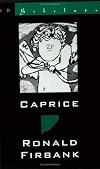
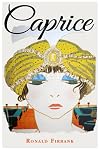
Sarah Sinquier, living with her father and mother, a cathedral canon and his wife, in a town bursting with churches, is champing at the bit.She has a dream: the stage. Her dramatic sense is certainly acute. Shall she simply recite, as her father suggests? Or does life hold more? Throwing off caution, and a few choice treasures into the folds of her cloak for succour, she slips out one misty night for London, City of Love.Thence follow the struggles of an ing nue to gain the notice of the show more denizens of the theatre, who are themselves vulnerable votaries of fame. Gossip, parties, the Caf Royal - the right connection may raise its head at any time. Finally the boards heed her call, and Sarah's caprice is made good. Surely her name is now destined to be known? But the hand of fate moves unexpectedly. . .Caprice, first published in 1917, was Ronald Firbank's third novel. His much-vaunted eccentric concision is here at a high point, as is his exotic treatment of character and breathless conversational camp. These thespian exploits which delight in suggestions of scandal and expose them with audacious wit are the perfect Firbank concern. show lessTags
Recommendations





















Member Reviews
On the basis of this book, I feel confident saying that Firbank's family tree obviously leads to early Evelyn Waugh, Ivy Compton-Burnett, and Muriel Spark: extreme minimalism, a high dose of dialogue, and far greater attention to sentences than to the tropes of realism (character, setting, etc...). I imagine this would be a great litmus test for those who claim that they value literature as literature rather than literature as cod philosophy, because it has many characteristics of modernism (the aforementioned minimalism demands a lot from the reader; if you're not paying attention from line to line, you'll get completely lost)--but it avoids the usual ideas of the modernists (nothing here about the ineradicable absurdity of existence, show more no ultra-individualism, no epatering of the bourgeoisie).
I'm not sure I enjoyed reading it at the time, but in hindsight I do enjoy it, and I'm looking forward to more. It's funny, it's gleefully artificial, and it's completely uninterested in all the things that serious literature is meant to be about (other than linguistic playfulness), and, quite frankly, that makes me very happy. show less
I'm not sure I enjoyed reading it at the time, but in hindsight I do enjoy it, and I'm looking forward to more. It's funny, it's gleefully artificial, and it's completely uninterested in all the things that serious literature is meant to be about (other than linguistic playfulness), and, quite frankly, that makes me very happy. show less
"There she sits all day, reading Russian novels. Talk of gloom!" So says Mr. Smee of his wife, Mrs. Smee, in Firbank's Caprice, which is here to dispel any such gloom with its campy and satirical take on London's theatre scene in the early twentieth century. A modernist contemporary of Woolf and Joyce, Firbank wrote Caprice mostly in zany dialogue, quickly jumping from one scene to the next as if dubious of the reader's attention span.
Miss Sally Sinquier, daughter of a respectable provincial clergyman, sneaks off to London with some family heirlooms and a grandiose ambition to be an actress. Careless of an intriguing world about her, she falls in with a theatre crowd who both help and exploit her. She rejects the suggestion to start show more with small roles... I shall play Juliet. I shall have a season.... and throws her ill-gotten money into financing a production of Romeo and Juliet. Improbably it opens with great success, only for Miss Sinquier to fall through a stage trap door to her death the following day. C'est la vie, eh?
My dear, I once was thought to be a very pretty woman... All I can do now is to urge my remains. show less
Miss Sally Sinquier, daughter of a respectable provincial clergyman, sneaks off to London with some family heirlooms and a grandiose ambition to be an actress. Careless of an intriguing world about her, she falls in with a theatre crowd who both help and exploit her. She rejects the suggestion to start show more with small roles... I shall play Juliet. I shall have a season.... and throws her ill-gotten money into financing a production of Romeo and Juliet. Improbably it opens with great success, only for Miss Sinquier to fall through a stage trap door to her death the following day. C'est la vie, eh?
My dear, I once was thought to be a very pretty woman... All I can do now is to urge my remains. show less
This novella is set in the London theatre world of the early 20th century. Sarah Sinquier feels constricted in the cathedral town where her father is a canon. She longs for the London stage, and she runs away to fulfill her true calling as an actress. Sarah quickly falls in with a theatre crowd. Most of the novel builds toward the opening night of a production of Romeo and Juliet. Young Sarah learns how quickly triumph can turn to tragedy.
Apparently, Firbank’s novels are characterized by a heavy emphasis on dialogue. I’ve always appreciated this quality in Agatha Christie’s novels. Sadly, Firbank is no Christie. A century later, most readers will not have enough context to easily make sense of the dialogue. However, I’m not sure show more readers of a century ago would have had enough context either, unless they moved in the same social circle as Firbank. Maybe that was the point. show less
Apparently, Firbank’s novels are characterized by a heavy emphasis on dialogue. I’ve always appreciated this quality in Agatha Christie’s novels. Sadly, Firbank is no Christie. A century later, most readers will not have enough context to easily make sense of the dialogue. However, I’m not sure show more readers of a century ago would have had enough context either, unless they moved in the same social circle as Firbank. Maybe that was the point. show less
Ratings
Members
- Recently Added By
Lists

The Guardian's 1000 Novels Everyone Must Read
1,005 works; 552 members
Author Information

52+ Works 1,296 Members
Born in London, the son of a wealthy businessman, Ronald Firbank was educated at Uppingham and Cambridge University. In 1909 he converted to Roman Catholicism and left the university without taking a degree. Instead, he embarked on extensive travels in Spain, Italy, the Middle East, and North Africa. By nature he was a rather solitary individual, show more perhaps because of his rather delicate health and his homosexuality. Firbank's first novel, Vainglory (1915), was originally published privately, as were other early works. He wrote his novels on blue postcards. Though slight, these works were innovative and prefigured the works of such writers as Ivy Compton-Burnett and Evelyn Waugh. Elements in the work of Aldous Huxley, Angus Wilson, and Iris Murdoch can also be attributed to Firbank's creativity. Firbank's original and subtle novels have appealed to a small but appreciative audience, and, during the 1950s and early 1960s, he posthumously acquired a band of devoted disciples. Firbank had a fine disdain for plot and a taste for eccentric characters. The world he created was small and creditable. The Complete Ronald Firbank (1961), with a preface by Anthony Powell, is a worthwhile edition of his works. Still a young man, Ronald Firbank died in Rome in 1926. (Bowker Author Biography) show less
Awards and Honors
Notable Lists
Series
Belongs to Publisher Series
Work Relationships
Common Knowledge
- Canonical title
- Caprice
- Original publication date
- 1917
- Important places
- London
Classifications
Statistics
- Members
- 70
- Popularity
- 450,427
- Reviews
- 3
- Rating
- (3.05)
- Languages
- English, Italian
- Media
- Paper, Ebook
- ISBNs
- 5
- ASINs
- 5