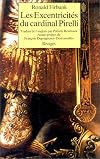
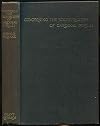
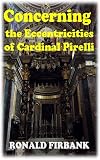
Concerning the Eccentricities of Cardinal Pirelli
by Ronald Firbank
On This Page
Tags
Recommendations























Member Reviews
Ronald Firbank whips up a ‘froth of choirboys’ in his 1926 novel Concerning the Eccentricities of Cardinal Pirelli. One choir boy, the ‘impish Chicklet’, is portrayed as an unobtainable tease. After serving dinner, Chicklet bids His Eminence good night and says, ‘And if you should want me sir . . .’ Chicklet forgets his responses during Mass one day and the cardinal locks him in a vault full of coffins. He later relents, unlocks the vault where he finds Chicklet fast asleep. As he mutters, ‘...and lead us not into temptation’, Chicklet wakes up and provokes the cardinal to chase him round and round the cathedral while the boy openly flirts and mocks him. The unfortunate Don Alvaro Narciso Hernando Pirelli, show more Cardinal-Archbishop of Clemenza, dies of a heart attack and is found naked on the floor the next morning. show less
An interesting test-case for how much your really care about literary innovation and modernism: Firbank, like other modernists, eliminates much of the traditional novel. There's no plot, there's little attempt to unify anything, he doesn't bother helping the reader understand what's going on. If you want to know what's going on, pay attention. He won't spoon feed you.
On the other hand, Firbank is utterly unlike any other modernist, because rather than deal with THE WASTE LAND or model himself on Homer, he writes fripperies. The Eccentricities really is about what its title suggests. The bit question in the book is whether the Cardinal will be removed from his diocese for baptising his rich parishioner's puppies. Plot spoiler: yes. He show more is not interested in boiling his prose down to hard diamond like nuggets. He stuffs as many words as he can into his sentences, particularly adverbs and adjectives. He always chooses the word order that sounds best (or perhaps oddest), never the one that makes matters clearer. Consider: "Returning however no answer she moved distractedly away." (McElroy gets a lot of praise for this lightly punctuated kind of thing; Firbank, of course, doesn't write about big political themes).
So, dear reader, do you really care for interesting, different, odd artworks? If so, Firbank is for you. It's best to read his novels as you would look at a painting; any plot is implicit, the characters are only ever their surface appearances; they are arranged in space, rather than narrative time. We love that in paintings; why not try it in prose?
On the other hand, if you're like me, and you like modernism mainly because of its ideas, or like aesthetically progressive literature because it's left wing, Firbank will be quite a challenge. show less
On the other hand, Firbank is utterly unlike any other modernist, because rather than deal with THE WASTE LAND or model himself on Homer, he writes fripperies. The Eccentricities really is about what its title suggests. The bit question in the book is whether the Cardinal will be removed from his diocese for baptising his rich parishioner's puppies. Plot spoiler: yes. He show more is not interested in boiling his prose down to hard diamond like nuggets. He stuffs as many words as he can into his sentences, particularly adverbs and adjectives. He always chooses the word order that sounds best (or perhaps oddest), never the one that makes matters clearer. Consider: "Returning however no answer she moved distractedly away." (McElroy gets a lot of praise for this lightly punctuated kind of thing; Firbank, of course, doesn't write about big political themes).
So, dear reader, do you really care for interesting, different, odd artworks? If so, Firbank is for you. It's best to read his novels as you would look at a painting; any plot is implicit, the characters are only ever their surface appearances; they are arranged in space, rather than narrative time. We love that in paintings; why not try it in prose?
On the other hand, if you're like me, and you like modernism mainly because of its ideas, or like aesthetically progressive literature because it's left wing, Firbank will be quite a challenge. show less
I'm not sure why I did this to myself again, but I guess I'm not sorry I did.
https://donut-donut.dreamwidth.org/914643.html
https://donut-donut.dreamwidth.org/914643.html
Ratings
Members
- Recently Added By
Lists

Best of British Literature
226 works; 41 members

Publishing Triangle 100 Best Lesbian and Gay Novels
97 works; 6 members

Authors from England
147 works; 4 members
Author Information

52+ Works 1,289 Members
Born in London, the son of a wealthy businessman, Ronald Firbank was educated at Uppingham and Cambridge University. In 1909 he converted to Roman Catholicism and left the university without taking a degree. Instead, he embarked on extensive travels in Spain, Italy, the Middle East, and North Africa. By nature he was a rather solitary individual, show more perhaps because of his rather delicate health and his homosexuality. Firbank's first novel, Vainglory (1915), was originally published privately, as were other early works. He wrote his novels on blue postcards. Though slight, these works were innovative and prefigured the works of such writers as Ivy Compton-Burnett and Evelyn Waugh. Elements in the work of Aldous Huxley, Angus Wilson, and Iris Murdoch can also be attributed to Firbank's creativity. Firbank's original and subtle novels have appealed to a small but appreciative audience, and, during the 1950s and early 1960s, he posthumously acquired a band of devoted disciples. Firbank had a fine disdain for plot and a taste for eccentric characters. The world he created was small and creditable. The Complete Ronald Firbank (1961), with a preface by Anthony Powell, is a worthwhile edition of his works. Still a young man, Ronald Firbank died in Rome in 1926. (Bowker Author Biography) show less
Awards and Honors
Notable Lists
Work Relationships
Is contained in
Common Knowledge
- Canonical title
- Concerning the Eccentricities of Cardinal Pirelli
- Original publication date
- 1926
- People/Characters
- Cardinal Pirelli
- Important places
- England, UK
Classifications
Statistics
- Members
- 102
- Popularity
- 317,029
- Reviews
- 3
- Rating
- (3.73)
- Languages
- 6 — Dutch, English, French, Italian, Portuguese, Spanish
- Media
- Paper, Ebook
- ISBNs
- 11
- ASINs
- 9