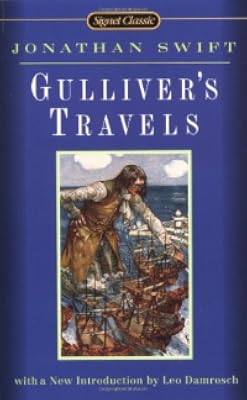
Gulliver's Travels: Lilliput and Brobdingnag
by Jonathan Swift
On This Page
Description
Gulliver's Travels by Jonathan Swift is a witty and insightful satirical novel recounts the history of Lemuel Gulliver, "First a Surgeon, and then a Captain of several Ships". In his travels Gulliver visits the Land of Lilliput, where he towers over the local inhabitants, the land of Brobdingnag where he is much smaller than the citizens, the floating island of Laputa, infested with fanatical scientists who in their obsession with reason behave with no sense at all and finally to the land of show more the brutish Yahoos who look to all intents and purposes like humans and are derided by the intelligent horse people. John Gay said in a 1726 letter to Swift that "it is universally read, from the cabinet council to the nursery". show less
Tags
Recommendations
























Member Reviews
The introduction to my edition claims that "Gulliver's Travels has held our attention for nearly three centuries because of its uncanny ability to be whatever we have wanted it to be: a political book, a children's book, a merry book, a mad book, satiric, ironic, parodic, perhaps a novel, perhaps not." The source material sure doesn't read like children's fare. Although I suppose small boys might very well adore the bathroom humor, I can't see them getting past the antique language with unending paragraphs, random capitalizations, archaic spellings and a wealth of political allusions needing footnotes to unravel. And after the first half, with Gulliver as giant to the Lilliputans and then a doll-sized figure among the giant show more Brobdingnags, these tall tales become both too erudite and too bitter for children. In the third part dealing with the flying island of Laputa, the political allegory becomes a lot more pointed. Gulliver's Travels reminds me of a blend of Alice in Wonderland and science fiction--using strange unknown lands and peoples to look at ourselves in fresh ways. It's often funny and wildly imaginative in its details, although other parts make for heavy reading with lots of dense, pedantic exposition.
I wouldn't call Swift congenial company among classic writers. He said in a letter to Pope his purpose is "to vex the world rather than divert it." Swift also strikes me as a very conservative mindset, and I don't mean that in a simple political capital "C" contemporary sense. In fact in some ways he can be very forward looking for his period. He believed women should be educated the same as men and had the same intellectual potential. So the introduction and notes say, and you can see hints of that view in Gulliver's Travels and more explicitly in his "Letter to a Young Lady." But Swift is also deeply suspicious of innovation or the possibility of real progress. To change is to degenerate according to Swift, not improve. The derision leveled at the Academy in Part III and its junk science and absurdest art is particularly cutting--and still feels relevant. (Although that's nothing to the utterly scathing rant against lawyers in Part IV--and yes, a lot of its points are still relevant too.) Certainly his tale in the last part of the Yahoos (humanoid beasts) and Houyhnhnms (horse-shaped but noble and rational) is deeply biting about human nature. Given this is all told through Gulliver's first person narrative and the way Gulliver degenerates after living among the Houyhnhms I'm not certain which ways it cuts. Are the Houyhnhms really noble creatures against which humans are found wanting? Or are they a commentary about the dehumanizing effects of slavery and imperialism?
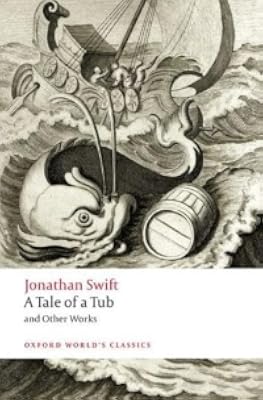
I suppose I might be able to tell better by reading more of Swift. And I tried. The edition I have includes other writings by Swift, the most substantial of which is The Tale of the Tub. I'm afraid I found it far less engaging than Gulliver's Travels. Perhaps if I were a student of the period or a contemporary of Swift I might have found it much more relevant or amusing. But since I really couldn't care less whether Roman Catholicism, the Church of England, or "Dissenters" such as Baptists or Quakers constitute the "true" faith I admit I was soon so very, very bored--and grateful I wasn't forced to read this for school. The one other work of Swift beside Gulliver's Travels I would very much recommend to a general reader is his lacerating satiric essay "A Modest Proposal." I don't want to give too much away, but it's one of those very few essays, such as Virginia Woolf's "A Room of One's Own," that you remember vividly once read even decades later. show less
I wouldn't call Swift congenial company among classic writers. He said in a letter to Pope his purpose is "to vex the world rather than divert it." Swift also strikes me as a very conservative mindset, and I don't mean that in a simple political capital "C" contemporary sense. In fact in some ways he can be very forward looking for his period. He believed women should be educated the same as men and had the same intellectual potential. So the introduction and notes say, and you can see hints of that view in Gulliver's Travels and more explicitly in his "Letter to a Young Lady." But Swift is also deeply suspicious of innovation or the possibility of real progress. To change is to degenerate according to Swift, not improve. The derision leveled at the Academy in Part III and its junk science and absurdest art is particularly cutting--and still feels relevant. (Although that's nothing to the utterly scathing rant against lawyers in Part IV--and yes, a lot of its points are still relevant too.) Certainly his tale in the last part of the Yahoos (humanoid beasts) and Houyhnhnms (horse-shaped but noble and rational) is deeply biting about human nature. Given this is all told through Gulliver's first person narrative and the way Gulliver degenerates after living among the Houyhnhms I'm not certain which ways it cuts. Are the Houyhnhms really noble creatures against which humans are found wanting? Or are they a commentary about the dehumanizing effects of slavery and imperialism?
I suppose I might be able to tell better by reading more of Swift. And I tried. The edition I have includes other writings by Swift, the most substantial of which is The Tale of the Tub. I'm afraid I found it far less engaging than Gulliver's Travels. Perhaps if I were a student of the period or a contemporary of Swift I might have found it much more relevant or amusing. But since I really couldn't care less whether Roman Catholicism, the Church of England, or "Dissenters" such as Baptists or Quakers constitute the "true" faith I admit I was soon so very, very bored--and grateful I wasn't forced to read this for school. The one other work of Swift beside Gulliver's Travels I would very much recommend to a general reader is his lacerating satiric essay "A Modest Proposal." I don't want to give too much away, but it's one of those very few essays, such as Virginia Woolf's "A Room of One's Own," that you remember vividly once read even decades later. show less
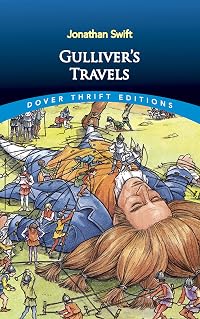
"I attempted to rise, but was not able to stir: for, as I happened to lie on my back, i found my arms and legs were strongly fastened on each side to the ground; and my hair, which was long and thick, tied down in the same manner. I likewise felt several slender ligatures across my body, from my armpits to my thighs. I could only look upwards; the sun began to grow hot, and the light offended my eyes. I heard a confused noise about me, but in the posture I lay, could see nothing except the sky" - page 7
In the same vein as "The Odyssey" and "Castaway", "Gulliver's Travels" takes us on four different voyages with Lemuel Gulliver as the adventurous traveler. He's tied down by Lilliputians who bury people upside down and punish fraud with show more death; dressed up by Brobdingnagians where he defends himself from giant bees with a fly stinger; held hostage by crazed mathematicians called Laputians who travel the countryside in their floating diamond fortress; pitied by horse-headed philosophers whose name sounds similar to the clearing of one's throat.
I found this book incredibly frustrating. The main reason being that Swift's satire as a book just didn't work for me. I'm sure the reason being that I'm so far removed from the 18th century society Swift was mocking. I feel that the book may have worked better as a lecture.
I had so many questions about various delicious tidbits Swift doles out. For example, there was a temple in Lilliput "polluted by an unnatural murder". What exactly happened we never find out. As well, the idea of the Laputians calling people back from the dead and conversing with them was very H.G. Wells. I also liked how the floating diamond fortress only occasionally crushed people.
What I found interesting and enjoyed though, was far outweighed by what I found boring and pedantic, especially when it came to describing how the diamond fortress stayed aloft. We skip moments that might have added to the story like Gulliver's shipwreck. The reader is only given a small summary of what happened and they miss what might have been an amazing description of the storm and his survival. As well, Swift occasionally writes "I shall not trouble the reader", as if to excuse him from removing what little excitement might be found in a particular story. The sentences are convoluted, there's little description of action and the plot suffers while Swift's busy making his point about society and everything about it that he finds insufferable.
The thing I find most frustrating though is that Swift could have done so much more with the story. It could have stayed a satire while beefing up the story. Instead of spending so much time describing the silly rituals and culture of the specific peoples he meets, Gulliver could have been taking action. The part where he's attacked by giant bees is exciting and interesting but it takes up less than a paragraph before Swift moves on. The result being that if I was asked I couldn't tell you much about what happens in the book because that's exactly what happens. Not much. show less
In the same vein as "The Odyssey" and "Castaway", "Gulliver's Travels" takes us on four different voyages with Lemuel Gulliver as the adventurous traveler. He's tied down by Lilliputians who bury people upside down and punish fraud with show more death; dressed up by Brobdingnagians where he defends himself from giant bees with a fly stinger; held hostage by crazed mathematicians called Laputians who travel the countryside in their floating diamond fortress; pitied by horse-headed philosophers whose name sounds similar to the clearing of one's throat.
I found this book incredibly frustrating. The main reason being that Swift's satire as a book just didn't work for me. I'm sure the reason being that I'm so far removed from the 18th century society Swift was mocking. I feel that the book may have worked better as a lecture.
I had so many questions about various delicious tidbits Swift doles out. For example, there was a temple in Lilliput "polluted by an unnatural murder". What exactly happened we never find out. As well, the idea of the Laputians calling people back from the dead and conversing with them was very H.G. Wells. I also liked how the floating diamond fortress only occasionally crushed people.
What I found interesting and enjoyed though, was far outweighed by what I found boring and pedantic, especially when it came to describing how the diamond fortress stayed aloft. We skip moments that might have added to the story like Gulliver's shipwreck. The reader is only given a small summary of what happened and they miss what might have been an amazing description of the storm and his survival. As well, Swift occasionally writes "I shall not trouble the reader", as if to excuse him from removing what little excitement might be found in a particular story. The sentences are convoluted, there's little description of action and the plot suffers while Swift's busy making his point about society and everything about it that he finds insufferable.
The thing I find most frustrating though is that Swift could have done so much more with the story. It could have stayed a satire while beefing up the story. Instead of spending so much time describing the silly rituals and culture of the specific peoples he meets, Gulliver could have been taking action. The part where he's attacked by giant bees is exciting and interesting but it takes up less than a paragraph before Swift moves on. The result being that if I was asked I couldn't tell you much about what happens in the book because that's exactly what happens. Not much. show less
A reminder that there will always be those that attempt to maintane their unerned place of privilege in the social order, this classic work of satire bites as deeply now as it did in 1726.
Political commentary wrapped in the disguise of a travelogue, 'Guliver's Travels' remains both readable and exciting.
Political commentary wrapped in the disguise of a travelogue, 'Guliver's Travels' remains both readable and exciting.
I never read Gulliver's Travels when I was younger, although I did know about it. I found it an interesting way to point of the inadequencies of the English government at the time (which I know I would have not gotten out of it if I had read it when I was younger), but only two travels to strange lands seems too little for a good adventure.
It was worth reading at least once. Definitely not my favorite book but I loved the snarky British humor. It has some very long descriptive parts that made it hard to stay focused on.
I was pleasantly surprised when I read this book. In addition to the travels with which we are all familiar, there were other mysterious lands also visited by Gulliver.
There are a number of philosophical thoughts sprinkled throughout, as well as a number of jabs delivered to the government. There are a lot of political viewpoints and legal suggestions that take this work into an intellectual realm without detracting from the story.
A solid novel, worth reading.
There are a number of philosophical thoughts sprinkled throughout, as well as a number of jabs delivered to the government. There are a lot of political viewpoints and legal suggestions that take this work into an intellectual realm without detracting from the story.
A solid novel, worth reading.
Although I recognize the brilliance of this story and Swift's creativity, I must say that 'Gulliver's Travels' can be a dull, tedious, even annoying book to read. It's much more fun analyzing and discussing this book than it is reading it in the first place. Ho hum.
Members
- Recently Added By
Lists

Eton's list - the books every bright 16 year-old should read
40 works; 6 members

The League of Extraordinary Gentlemen
87 works; 4 members

Best of World Literature
435 works; 52 members
Author Information

1,105+ Works 45,672 Members
Apparently doomed to an obscure Anglican parsonage in Laracor, Ireland, even after he had written his anonymous masterpiece, A Tale of a Tub (c.1696), Swift turned a political mission to England from the Irish Protestant clergy into an avenue to prominence as the chief propagandist for the Tory government. His exhilaration at achieving importance show more in his forties appears engagingly in his Journal to Stella (1710--13), addressed to Esther Johnson, a young protegee for whom Swift felt more warmth than for anyone else in his long life. At the death of Queen Anne and the fall of the Tories in 1714, Swift became dean of St. Patrick's Cathedral, Dublin. In Ireland, which he considered exile from a life of power and intellectual activity in London, Swift found time to defend his oppressed compatriots, sometimes in such contraband essays as his Drapier's Letters (1724), and sometimes in such short mordant pieces as the famous A Modest Proposal (1729); and there he wrote perhaps the greatest work of his time, Gulliver's Travels (1726). Using his characteristic device of the persona (a developed and sometimes satirized narrator, such as the anonymous hack writer of A Tale of a Tub or Isaac Bickerstaff in Predictions for the Ensuing Year, who exposes an astrologer), Swift created the hero Gulliver, who in the first instance stands for the bluff, decent, average Englishman and in the second, humanity in general. Gulliver is a full and powerful vision of a human being in a world in which violent passions, intellectual pride, and external chaos can degrade him or her---to animalism, in Swift's most horrifying images---but in which humans do have scope to act, guided by the Classical-Christian tradition. Gulliver's Travels has been an immensely successful children's book (although Swift did not care much for children), so widely popular through the world for its imagination, wit, fun, freshness, vigor, and narrative skill that its hero is in many languages a common proper noun. Perhaps as a consequence, its meaning has been the subject of continuing dispute, and its author has been called everything from sentimental to mad. Swift died in Dublin and was buried next to his beloved "Stella." (Bowker Author Biography) show less
Some Editions
Series
Belongs to Publisher Series
Work Relationships
Inspired
Common Knowledge
- Canonical title
- Gulliver's Travels: Lilliput and Brobdingnag
- Original title
- Gulliver's Travels #1
- Alternate titles*
- Gullivers Travels to Lilliput and Brobdingnag; Viaggi di Gulliver in vari paesi del mondo
- Original publication date
- 1726
- People/Characters*
- Lemuel Gulliver
- Important places*
- Lilliput; Brobdingnag
- Related movies
- Gulliver's Travels (2010 | IMDb); Gulliver's Travels (1939 | IMDb)
- First words
- My father had a small estate in Nottinghamshire; I was the third of five sons.
- Last words
- (Click to show. Warning: May contain spoilers.)In the mean time I here conclude the second part of my unfortunate voyages.
- Original language
- English
- Disambiguation notice
- This entry is for books that contain Gulliver's first 2 voyages only, but aren't retellings or abridgements. Please distinguish this from other abridgements and from the complete work.
*Some information comes from Common Knowledge in other languages. Click "Edit" for more information.
Classifications
Statistics
- Members
- 1,598
- Popularity
- 14,228
- Reviews
- 14
- Rating
- (3.62)
- Languages
- 11 — Catalan, Danish, Dutch, English, Finnish, French, German, Hungarian, Italian, Norwegian (Bokmål), Swedish
- Media
- Paper, Ebook
- ISBNs
- 53
- UPCs
- 1
- ASINs
- 34