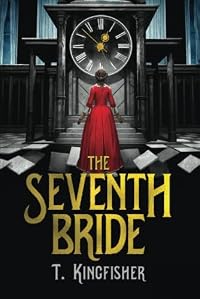
The Seventh Bride
by T. Kingfisher
On This Page
Description
Young Rhea is a miller's daughter of low birth, so she is understandably surprised when a mysterious nobleman, Lord Crevan, shows up on her doorstep and proposes marriage. Since commoners don't turn down lords--no matter how sinister they may seem--Rhea is forced to agree to the engagement. Lord Crevan demands that Rhea visit his remote manner before their wedding. Upon arrival, she discovers that not only was her betrothed married six times before, but his previous wives are all imprisoned show more in his enchanted castle. Determined not to share their same fate, Rhea asserts her desire for freedom. In answer, Lord Crevan gives Rhea a series of magical tasks to complete, with the threat "Come back before dawn, or else I'll marry you." With time running out and each task more dangerous and bizarre than the last, Rhea must use her resourcefulness, compassion, and bravery to rally the other wives and defeat the sorcerer before he binds her to him forever. show lessTags
Recommendations

















Member Reviews
T. Kingfisher stories have a kind of magic for me. They seem to be exactly what I need to read at that point in time.
The Seventh Bride is the tale of a fifteen-year-old girl who gets betrothed to a noble, much to her dismay. When she is finally required to go to his house, she meets three other women who are somewhat reluctant to share their stories. It doesn't take long before the girl makes up her mind that this is not a place she wants to stay.
Mind you; this isn't entirely a feminist tale. Or maybe it is, in the sense that it respects the range of female experiences and coping skills, particularly in the area of male-female relationships. At any rate, though it is ostensibly about Bluebeard, it's really mostly about the women. It'd show more be a fascinating book to discuss in context of the Bechdel test, honestly.
But it's also about one young woman facing her fears, even if the reasons change each time she does so (nostalgia/longing, fear, anger, desperation). And that is a message I need to hear. Good stuff, but not immediately re-readable, unlike The Tomato Thief, which I immediately re-read after finishing. show less
The Seventh Bride is the tale of a fifteen-year-old girl who gets betrothed to a noble, much to her dismay. When she is finally required to go to his house, she meets three other women who are somewhat reluctant to share their stories. It doesn't take long before the girl makes up her mind that this is not a place she wants to stay.
Mind you; this isn't entirely a feminist tale. Or maybe it is, in the sense that it respects the range of female experiences and coping skills, particularly in the area of male-female relationships. At any rate, though it is ostensibly about Bluebeard, it's really mostly about the women. It'd show more be a fascinating book to discuss in context of the Bechdel test, honestly.
But it's also about one young woman facing her fears, even if the reasons change each time she does so (nostalgia/longing, fear, anger, desperation). And that is a message I need to hear. Good stuff, but not immediately re-readable, unlike The Tomato Thief, which I immediately re-read after finishing. show less
I love hedgehogs too.
This is T. Kingfisher’s take on the Bluebeard story, she took a theme and restructured and reimagined it.
Rhea is fifteen, a daughter of a miller. She is suddenly engaged to a lord named Crevan – he came out of the blue and asked for her hand. Something isn’t quite right. Lord Crevan is creepy and weird, but you don’t turn down lords, do you? The family’s helplessness was written very well.
“It was as if the words they spoke were weaving a kind of net, a net of normalcy and propriety and sanity, around a situation that was anything but.”
Crevan invites Rhea for a visit to his manor before the wedding takes place. Everything around her gets darker and stranger. It’s a good thing she met that show more hedgehog!
“She was still going somewhere terrible, but she had a hedgehog, dammit.”
As in every self-respecting fairy tale, Rhea has to do impossible tasks “or else I’ll marry you.”
The way the hedgehog helps her with the first task is absolutely delicious. I smiled and said “only in a T. Kingfisher book!” Rhea is a very nice character who learns to be brave, but she didn’t have as much agency as I would have liked. Stuff just happens to her and she gets help when she needs it. It is fitting for the fairy tale feel, but in general, I expect want more from T. Kingfisher. All the other characters were much more intriguing.
The ending was nice, but felt a bit rushed. Still, I am satisfied. This was a spooky read with a touch of humour – perfect for Halloween.
A few more cool quotes:
“Potatoes were, for some reason, more prone to fits of random magic than other vegetables.”
”...when your future husband is a mad sorcerer, following a hedgehog sometimes seems like a good option.”
“I would follow this hedgehog into the mouth of hell.” show less
This is T. Kingfisher’s take on the Bluebeard story, she took a theme and restructured and reimagined it.
Rhea is fifteen, a daughter of a miller. She is suddenly engaged to a lord named Crevan – he came out of the blue and asked for her hand. Something isn’t quite right. Lord Crevan is creepy and weird, but you don’t turn down lords, do you? The family’s helplessness was written very well.
“It was as if the words they spoke were weaving a kind of net, a net of normalcy and propriety and sanity, around a situation that was anything but.”
Crevan invites Rhea for a visit to his manor before the wedding takes place. Everything around her gets darker and stranger. It’s a good thing she met that show more hedgehog!
“She was still going somewhere terrible, but she had a hedgehog, dammit.”
As in every self-respecting fairy tale, Rhea has to do impossible tasks “or else I’ll marry you.”
The way the hedgehog helps her with the first task is absolutely delicious. I smiled and said “only in a T. Kingfisher book!” Rhea is a very nice character who learns to be brave, but she didn’t have as much agency as I would have liked. Stuff just happens to her and she gets help when she needs it. It is fitting for the fairy tale feel, but in general, I expect want more from T. Kingfisher. All the other characters were much more intriguing.
The ending was nice, but felt a bit rushed. Still, I am satisfied. This was a spooky read with a touch of humour – perfect for Halloween.
A few more cool quotes:
“Potatoes were, for some reason, more prone to fits of random magic than other vegetables.”
”...when your future husband is a mad sorcerer, following a hedgehog sometimes seems like a good option.”
“I would follow this hedgehog into the mouth of hell.” show less
Rhea, a fifteen year old daughter of millers, is made an offer of marriage she can’t refuse -- there are consequences when peasants go around offending lords. But Lord Crevan’s house is found at the end of an eerie white road and when Rhea arrives there, she discovered he is already married.
This book is creepy and yet I never found it too dark. It’s the sort of darkness found in fairytales. This story acknowledges that horrors exist and shows someone ordinary who has courage and resourcefulness equal to overcoming them. Rhea looks things in the face, focuses on practicalities and doesn’t ever believe that this situation is okay. She also isn’t alone. Her hedgehog companion and some of Lord Crevan’s other wives are supportive show more and trustworthy.
I’m sure Kingfisher is capable of writing something totally terrifying but I trusted that that was not the goal here.
She wasn’t sure which was more infuriating, that some stranger was interested in marrying her or that her whole family had apparently known about it without immediately telling her.
At the moment, the second one was the only thing she could focus on. Marriage was so far from her thoughts that it was like some far-off foreign country, possibly with elephants. show less
This book is creepy and yet I never found it too dark. It’s the sort of darkness found in fairytales. This story acknowledges that horrors exist and shows someone ordinary who has courage and resourcefulness equal to overcoming them. Rhea looks things in the face, focuses on practicalities and doesn’t ever believe that this situation is okay. She also isn’t alone. Her hedgehog companion and some of Lord Crevan’s other wives are supportive show more and trustworthy.
I’m sure Kingfisher is capable of writing something totally terrifying but I trusted that that was not the goal here.
She wasn’t sure which was more infuriating, that some stranger was interested in marrying her or that her whole family had apparently known about it without immediately telling her.
At the moment, the second one was the only thing she could focus on. Marriage was so far from her thoughts that it was like some far-off foreign country, possibly with elephants. show less
A fascinating take on an old story - it's Bluebeard, more or less (mostly less). The miller's daughter, who is firmly ordinary and fifteen years old, is chosen as a bride by a noble. She and her parents are bewildered - this doesn't happen, except in fairy tales - but quite aware there's no way out of it. She goes to his house (and how can he have a house so close to the town, that no one knows about?)...and finds that's the least of the mysteries and oddities she has to contend with. Lovely characters, events, and points of view; I love Ursula Vernon's take on things. Nicely handled ending, too - solid solutions that indicate new beginnings, sometime. I need to read more by Ursula/T. Kingfisher - they're always worth reading.
It is now my firm conviction that I can’t go wrong with any T. Kingfisher book I pick up: this is my third foray into her stories and once again I’m amazed at the way she can weave drama and humor into compelling tales that keep me riveted from start to finish.
The Seventh Bride is a reimagining of the Bluebeard myth, but it adds many intriguing elements to the classic fairy tale, turning it into something delightfully new. Rhea is the daughter of the village’s miller, her only troubles in life coming from the slight drudgery of repetitive work and the fierce battles she wages with a bellicose swan fixed on depriving her of her lunch. When the local ruler, Lord Crevan, asks for her hand in marriage, Rhea is both surprised and show more worried, because royalty never marries into the common folk, so something must certainly be wrong with both the proposal and the man. Equally startling is Crevan’s invitation to visit his castle before the wedding; once there (and not before gathering an unlikely companion in the form of a very special hedgehog) she makes an awful discovery: there have been six other wives before her, and some of them have been either killed or horribly mutilated. For his part, Crevan sets Rhea a series of tasks: failure to complete them before each dawn will lead to the inevitability of marriage - something that Rhea now completely dreads.
Rhea’s horrific journey toward Crevan’s castle and her sojourn there, not to mention the increasingly difficult tasks that also reveal the depths of cruelty of her future husband, make for a very immersive read, one that reveals the girl’s strength of character: instead of succumbing to the fear of what future might have in store for her, she grows in her determination to avoid the fate of her predecessors while safeguarding the life and livelihood of her family, not-so-subtly threatened by the intended groom. I enjoyed Rhea’s show of courage, her practical nature managing to tame the primal fear engendered by the horrific discoveries she makes in Crevan’s house, her willingness to face head-on the man’s cruel, manipulative attitude.
Where the book truly excels, however, is in the strong bonds Rhea forms with some of the surviving wives, and her feelings of compassion for the one who seems to have fully embraced a sort of Stockholm Syndrome with their captor. Once she realizes that she’s not alone in the plight of becoming a victim to Crevan’s nasty plans, she finds the courage to defy him, and even challenge him on his own playing field. Unlike other fairy tales’ protagonists, the miller’s daughter does not wait to be saved but rather goes on the offensive, armed with even more tenacity than we witnessed at the start of the story when battling that dastardly swan in defense of her lunch.
The subtle humor pervading this novel effectively counters the sense of horror the readers feel through Rhea’s reactions when she witnesses the brutal, callous injuries perpetrated on some of Crevan’s wives - the ones still alive, that is - and yet that humor is not enough to erase our anger at the man’s inhuman treatment of them. Lord Crevan becomes the embodiment of every abusive husband we learn about in the real world, and more than once I wondered if the author chose that name as the scrambled version of “craven”, because that’s what he ultimately is, an empowered coward who steals women’s choices (together with their magic, or their sight, or their voice) simply because he enjoys doing so. Which makes Rhea’s rebellious and proactive choices all the more worthy of cheering on.
A special mention goes for the oh-so-cute hedgehog that acts as Rhea’s unlikely but effective companion: once again T. Kingfisher chooses to pair her protagonist with a representative from the animal kingdom, in what seems to me like a recurring theme - and one that I hope will be present in her other stories as well, since I enjoy them immensely. The hedgehog is not only a delightful creature or a sort of talisman for the young girl, who seems to draw courage from its presence in the pocket of her dress, it’s also something of a conduit for help when Rhea most needs it, and a charming, sunny element in the overall darkness of the tale.
Despite that darkness, however, The Seventh Bride is a refreshing story of courage and determination and of the strength that can come from bonds of friendship and - in this specific case - of sisterhood forged in adversity. It will leave you with a satisfactorily pleasant taste, and the urge to explore more of this author’s works - at least it did for me… show less
The Seventh Bride is a reimagining of the Bluebeard myth, but it adds many intriguing elements to the classic fairy tale, turning it into something delightfully new. Rhea is the daughter of the village’s miller, her only troubles in life coming from the slight drudgery of repetitive work and the fierce battles she wages with a bellicose swan fixed on depriving her of her lunch. When the local ruler, Lord Crevan, asks for her hand in marriage, Rhea is both surprised and show more worried, because royalty never marries into the common folk, so something must certainly be wrong with both the proposal and the man. Equally startling is Crevan’s invitation to visit his castle before the wedding; once there (and not before gathering an unlikely companion in the form of a very special hedgehog) she makes an awful discovery: there have been six other wives before her, and some of them have been either killed or horribly mutilated. For his part, Crevan sets Rhea a series of tasks: failure to complete them before each dawn will lead to the inevitability of marriage - something that Rhea now completely dreads.
Rhea’s horrific journey toward Crevan’s castle and her sojourn there, not to mention the increasingly difficult tasks that also reveal the depths of cruelty of her future husband, make for a very immersive read, one that reveals the girl’s strength of character: instead of succumbing to the fear of what future might have in store for her, she grows in her determination to avoid the fate of her predecessors while safeguarding the life and livelihood of her family, not-so-subtly threatened by the intended groom. I enjoyed Rhea’s show of courage, her practical nature managing to tame the primal fear engendered by the horrific discoveries she makes in Crevan’s house, her willingness to face head-on the man’s cruel, manipulative attitude.
Where the book truly excels, however, is in the strong bonds Rhea forms with some of the surviving wives, and her feelings of compassion for the one who seems to have fully embraced a sort of Stockholm Syndrome with their captor. Once she realizes that she’s not alone in the plight of becoming a victim to Crevan’s nasty plans, she finds the courage to defy him, and even challenge him on his own playing field. Unlike other fairy tales’ protagonists, the miller’s daughter does not wait to be saved but rather goes on the offensive, armed with even more tenacity than we witnessed at the start of the story when battling that dastardly swan in defense of her lunch.
The subtle humor pervading this novel effectively counters the sense of horror the readers feel through Rhea’s reactions when she witnesses the brutal, callous injuries perpetrated on some of Crevan’s wives - the ones still alive, that is - and yet that humor is not enough to erase our anger at the man’s inhuman treatment of them. Lord Crevan becomes the embodiment of every abusive husband we learn about in the real world, and more than once I wondered if the author chose that name as the scrambled version of “craven”, because that’s what he ultimately is, an empowered coward who steals women’s choices (together with their magic, or their sight, or their voice) simply because he enjoys doing so. Which makes Rhea’s rebellious and proactive choices all the more worthy of cheering on.
A special mention goes for the oh-so-cute hedgehog that acts as Rhea’s unlikely but effective companion: once again T. Kingfisher chooses to pair her protagonist with a representative from the animal kingdom, in what seems to me like a recurring theme - and one that I hope will be present in her other stories as well, since I enjoy them immensely. The hedgehog is not only a delightful creature or a sort of talisman for the young girl, who seems to draw courage from its presence in the pocket of her dress, it’s also something of a conduit for help when Rhea most needs it, and a charming, sunny element in the overall darkness of the tale.
Despite that darkness, however, The Seventh Bride is a refreshing story of courage and determination and of the strength that can come from bonds of friendship and - in this specific case - of sisterhood forged in adversity. It will leave you with a satisfactorily pleasant taste, and the urge to explore more of this author’s works - at least it did for me… show less
The Seventh Bride is in many ways a typical T. Kingfisher story. We have a down-to-earth, snarky heroine in a dark fairy-tale-ish setting with more than a few touches of horror. That said, it never becomes too dark or grim because of Kingfisher's characteristic light humour and focus on practical elements, such as doing laundry, even when you're engaged to an evil sorcerer. Is there such a thing as cozy horror? If so, T. Kingfisher is a master of it.
This is one of T. Kingfisher's earlier novels, and I did not love it as much as her more recent work. Part of the problem is Lord Crevan. He seems to get relatively little page time and we never learn much about him other than he has too many wives and he's bad. He's just too flat of a show more character to be interesting. I liked Rhea, and the hedgehog was, of course, the best, but some of the other aspects of the story were a bit confusing. Did the clock wife have an inherent connection to time and clocks already, or was the clock merely her prison? How was she able to drop the floor if she was imprisoned? The golem birds seemed to have no real purpose, and neither did their cryptic warnings. The ending was very abrupt, and left me feeling a bit unsure of what happened.
That said, even a weaker T. Kingfisher novel is still a pretty good book. It contains more discussion of the wicked ways of swans than I was expecting, an adorable and helpful hedgehog, and a satisfying conclusion. show less
This is one of T. Kingfisher's earlier novels, and I did not love it as much as her more recent work. Part of the problem is Lord Crevan. He seems to get relatively little page time and we never learn much about him other than he has too many wives and he's bad. He's just too flat of a show more character to be interesting. I liked Rhea, and the hedgehog was, of course, the best, but some of the other aspects of the story were a bit confusing. Did the clock wife have an inherent connection to time and clocks already, or was the clock merely her prison? How was she able to drop the floor if she was imprisoned? The golem birds seemed to have no real purpose, and neither did their cryptic warnings. The ending was very abrupt, and left me feeling a bit unsure of what happened.
That said, even a weaker T. Kingfisher novel is still a pretty good book. It contains more discussion of the wicked ways of swans than I was expecting, an adorable and helpful hedgehog, and a satisfying conclusion. show less
Rhea is a miller’s daughter. She is fifteen. And she is engaged. Her betrothed is a lord, and she had never met him before he gave her is ring to wear. But she is only the daughter of the miller, and even though the miller may be an important man in the village, to a lord, to the nobles, he is nothing.
So Rhea does her duty. She does as Lord Crevan has commanded and leaves her home to visit his home. He is not in when she arrives, but she is welcomed by his other wives.
That general outline is probably ringing some Bluebeard related bells, as well it should, but this is not just a retelling of that Bloody Chamber. Crevan doesn’t kill his wives, he steals from them, something different from each. A life from one, a death from another, show more and usually not for himself to use, but if he thinks a gift might be served better elsewhere then he will take it from his wife and sell it on.
So what does Rhea have that he wants?
She certainly doesn’t want to find out. Luckily she is not alone, she has a hedgehog for company, and for occasional guidance. Not that the hedgehog can talk, but he manages to communicate through body language.
If you’re at all familiar with Ursula Vernon (T. Kingfisher is her pseudonym) then you’ll have a fair idea of what to expect from this story. Creepy, strangeness, but also adorable awesomeness. And The Seventh Bride certainly delivers on both fronts. Lord Crevan’s house is all manner of wrong, from the golem-birds that warn you to “be bold, but not too bold”, to the inhabitants, there is a palpable sense of “nope” from Crevan. But there is Rhea and her helpful hedgehog, and that’s just great.
I’m probably biased, because I’ve been a fan of Vernon’s work for ages now, from back when I first discovered her Digger comic online, and this story has just what I love about her work, whether it is her art or her stories. They’re all just so original and, well, cool, in a “damn, that makes for a great whatever, how is it noone thought of that before” sort of a way.
But it also that the fantastical is grounded in the practical and the realistic. Rhea has a solid head on her, she is somewhat familiar with the magic of her world, about sometimes flowers outside her house will turn plaid, and how the local conjure woman’s cure always seems to be the same thing, but it works. And yet there is the ordinary, realistic side to her do. The side that is very aware that real life can be boring and undemanding, making sure mice don’t end up in the grinder is not exactly stimulating, and digging an out-house isn’t anyone’s idea of fun. I love that blend.
I also loved the way Rhea knows that something isn’t right. She knows the situation is all manner of wrong, but what are her options? Lord Crevan is a noble, she is a peasant. She doesn’t have any other options. She just has to figure out how to make the best of the situation.
So if you like that sort of thing then I’d highly recommend The Seventh Bride, it is great fun. show less
So Rhea does her duty. She does as Lord Crevan has commanded and leaves her home to visit his home. He is not in when she arrives, but she is welcomed by his other wives.
That general outline is probably ringing some Bluebeard related bells, as well it should, but this is not just a retelling of that Bloody Chamber. Crevan doesn’t kill his wives, he steals from them, something different from each. A life from one, a death from another, show more and usually not for himself to use, but if he thinks a gift might be served better elsewhere then he will take it from his wife and sell it on.
So what does Rhea have that he wants?
She certainly doesn’t want to find out. Luckily she is not alone, she has a hedgehog for company, and for occasional guidance. Not that the hedgehog can talk, but he manages to communicate through body language.
If you’re at all familiar with Ursula Vernon (T. Kingfisher is her pseudonym) then you’ll have a fair idea of what to expect from this story. Creepy, strangeness, but also adorable awesomeness. And The Seventh Bride certainly delivers on both fronts. Lord Crevan’s house is all manner of wrong, from the golem-birds that warn you to “be bold, but not too bold”, to the inhabitants, there is a palpable sense of “nope” from Crevan. But there is Rhea and her helpful hedgehog, and that’s just great.
I’m probably biased, because I’ve been a fan of Vernon’s work for ages now, from back when I first discovered her Digger comic online, and this story has just what I love about her work, whether it is her art or her stories. They’re all just so original and, well, cool, in a “damn, that makes for a great whatever, how is it noone thought of that before” sort of a way.
But it also that the fantastical is grounded in the practical and the realistic. Rhea has a solid head on her, she is somewhat familiar with the magic of her world, about sometimes flowers outside her house will turn plaid, and how the local conjure woman’s cure always seems to be the same thing, but it works. And yet there is the ordinary, realistic side to her do. The side that is very aware that real life can be boring and undemanding, making sure mice don’t end up in the grinder is not exactly stimulating, and digging an out-house isn’t anyone’s idea of fun. I love that blend.
I also loved the way Rhea knows that something isn’t right. She knows the situation is all manner of wrong, but what are her options? Lord Crevan is a noble, she is a peasant. She doesn’t have any other options. She just has to figure out how to make the best of the situation.
So if you like that sort of thing then I’d highly recommend The Seventh Bride, it is great fun. show less
Members
- Recently Added By
Lists

Fantasy/Scifi Heroines Without Love Intrests
46 works; 10 members

KayStJ's to-read list
1,616 works; 11 members

Books Read in 2016
4,666 works; 199 members

Books Read in 2017
4,249 works; 129 members

Books Read in 2018
4,360 works; 110 members

Books Read in 2019
4,052 works; 110 members

Books Read in 2020
4,379 works; 123 members

Books Read in 2021
5,361 works; 114 members

Books Read in 2022
5,164 works; 111 members

SFF standalone novellas with female protagonists
101 works; 4 members

Books Read 2025
70 works; 2 members

Favorite Fairy Tales
269 works; 103 members
Author Information

100+ Works 37,586 Members
Ursula Vernon is a freelance writer, artist and illustrator. She received an undergraduate degree in anthropology at Macalester College in Saint Paul, Minnesota. She took several art classes in college. Her first children's book, Nurk: The Strange Surprising Adventures of a (Somewhat) Brave Shrew, was published in 2008. Her other works include show more Black Dogs: The House of Diamond and the Dragonbreath series. She also writes and illustrates the webcomic Digger and the creator of The Biting Pear of Salamanca. (Bowker Author Biography) show less
Some Editions
Common Knowledge
- Canonical title
- The Seventh Bride
- Original title
- The Seventh Bride
- Original publication date
- 2014-11-11
- People/Characters
- Rhea; Lord Crevan
- Dedication
- For Brooke
(stone) - First words
- Her name was Rhea.
- Last words
- (Click to show. Warning: May contain spoilers.)The hedgehog sighed and curled up in a ball, and the three of them began the long walk home.
- Original language
- English
Classifications
Statistics
- Members
- 753
- Popularity
- 37,121
- Reviews
- 52
- Rating
- (3.91)
- Languages
- English
- Media
- Paper, Audiobook, Ebook
- ISBNs
- 3
- ASINs
- 4