
On This Page
Description
A reminiscence of a Christmas shared by a seven-year-old boy and a sixtyish childlike woman, with enormous love and friendship between them.Tags
Recommendations














Member Reviews
This short story is the best Christmas literature. Yes, better than A Christmas Carol and The Night Before Christmas. Don’t bother to lecture me.
I have read this bittersweet story so many times that I’ve lost count. And every time I cry. The simple friendship of an abandoned child and his child-like cousin is made even more poignant when you find out the story is true, right down to the rat terrier Queenie: Buddy is actually Truman Capote, and the cousin is his mother’s cousin Nanny “Sook” Faulk. Tru and Sook were steadfast friends until his unreliable, self-absorbed mother removed him from the only home he’d ever known only to ship him off to military school a few years later when she tired of him.
P.S.: Reading Tru & Nelle show more by G. Neri will make you love “A Christmas Memory” even more. show less
I have read this bittersweet story so many times that I’ve lost count. And every time I cry. The simple friendship of an abandoned child and his child-like cousin is made even more poignant when you find out the story is true, right down to the rat terrier Queenie: Buddy is actually Truman Capote, and the cousin is his mother’s cousin Nanny “Sook” Faulk. Tru and Sook were steadfast friends until his unreliable, self-absorbed mother removed him from the only home he’d ever known only to ship him off to military school a few years later when she tired of him.
P.S.: Reading Tru & Nelle show more by G. Neri will make you love “A Christmas Memory” even more. show less
Celebrated American novelist Truman Capote looks back to his childhood in this lovely short memoir, recalling the Christmas customs he observed with his best friend and distant grown relative, Cousin Sook. Declaring, at the end of every November, that "it's fruitcake weather," this childlike grownup, her young boy cousin, and their dog companion Queenie set out to gather the pecans and to purchase the other necessaries for the many cakes they will make and mail...
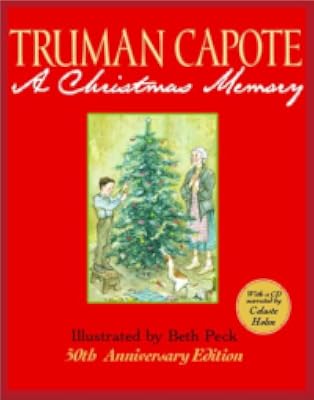
Apparently first published in 1956, this beautifully descriptive and emotionally resonant short story was made into a picture-book, with the artwork of Beth Peck, in 1989. This new edition from 2014 contains that artwork, as well as a CD with the narration of Celeste Holm. show more Despite being well familiar with Truman Capote's name, I had never before read any of his work, so A Christmas Memory was my introduction to his writing. I certainly was engrossed in its pages, by turns amused and moved by its narrative. It is clear that Cousin Sook, in addition to her physical ailments, has some sort of developmental disability, but to the seven-year-old Truman, who considers her his best and only friend in a family of distant (and seemingly cold) relatives, this is entirely irrelevant. I appreciated that, and I appreciated the poignant conclusion. The accompanying artwork done by Beth Peck is absolutely lovely, capturing the close emotional bond between Truman, Cousin Sook, and the lively Queenie. Recommended to fans of the author, and to anyone looking for short stories set at Christmas. Although not written for children, I do think it can be shared with them, with the proviso that parents and guardians be aware that there is loss here, especially in the conclusion. show less
Apparently first published in 1956, this beautifully descriptive and emotionally resonant short story was made into a picture-book, with the artwork of Beth Peck, in 1989. This new edition from 2014 contains that artwork, as well as a CD with the narration of Celeste Holm. show more Despite being well familiar with Truman Capote's name, I had never before read any of his work, so A Christmas Memory was my introduction to his writing. I certainly was engrossed in its pages, by turns amused and moved by its narrative. It is clear that Cousin Sook, in addition to her physical ailments, has some sort of developmental disability, but to the seven-year-old Truman, who considers her his best and only friend in a family of distant (and seemingly cold) relatives, this is entirely irrelevant. I appreciated that, and I appreciated the poignant conclusion. The accompanying artwork done by Beth Peck is absolutely lovely, capturing the close emotional bond between Truman, Cousin Sook, and the lively Queenie. Recommended to fans of the author, and to anyone looking for short stories set at Christmas. Although not written for children, I do think it can be shared with them, with the proviso that parents and guardians be aware that there is loss here, especially in the conclusion. show less
This is a remarkable story. In it's few pages Truman Capote manages to paint a picture of a seven-year-old boy and his sixty-something year old friend and a Christmas that they spend together. The language in the story is lyrical and beautifully descriptive. Is this book autobiographical? The way it is written, I believe it is. The story is told from the heart and from deep in Capote's soul. Truman Capote had to have lived this in order to describe it so exquisitely. This little book was given to me as a gift, and I waited to read it during the Christmas season. The Christmas season with another Covid-19 wave turned out to be perfect timing for me. If you can get your hands on this little gem, I highly recommend that you take a few show more minutes to read it. Merry Christmas. show less
5***** and a ❤
This autobiographical novella is a wonderful, touching story of family love. Capote is at the peak of his writing ability here. Our hearts embrace Buddy and Sookie. The date listed is when our book club discussed it, but I've had this book for ages and I read it every December on my birthday.
Update: December 2010
This autobiographical story is based on Capote’s own childhood, living with relatives in Alabama. It’s a memory of the innocence of childhood and the anticipation of something special. It is also a story of love and respect, as well as of loneliness and want.
One crisp November morning 7-year-old Buddy hears his cousin Sook (whom he calls Friend) declare, “It’s fruitcake weather!” With that show more pronouncement, the two set off on their annual campaign to bake dozens of fruitcakes for “friends.” Sook is an elderly woman with a child’s mind, and she and Buddy are constant companions (and each other’s only friend). It is during the Great Depression and times are hard. It takes them all year to save the pennies, nickels, dimes for their Fruitcake Fund, and the other relatives in their household look upon them with derision. Still, nothing can dampen their spirits as they bake and mail the fruitcakes, hunt deep into the woods for the perfect Christmas tree, make the ornaments and decorations that will make it look “good enough to eat!”
Capote was a gloriously talented writer and he is at his best here. The reader feels the anticipation of a child, smells the piney woods, shivers in the crisp morning, and is comforted in the warmth of love.
His writing is never so brilliant as when he is mining his childhood for stories such as this. The emotion is evident and genuine. His descriptions are gloriously vivid without overwhelming the story. The lessons learned – about kindness, tolerance, family, love and forgiveness – are gently told but ring loud and clear in the reader’s heart.
I leave you with one quote from the story. Sook and Buddy are enjoying the outdoors and she has a revelation …
“You know what I’ve always thought?” she asks in a tone of discovery, and not smiling at me but a point beyond. “I’ve always thought a body would have to be sick and dying before they saw the Lord. And I imagined that when He came it would be like looking at the Baptist window: pretty as colored glass with the sun pouring through, such a shine you don’t know it’s getting dark. And it’s been a comfort: to think of that shine taking away all the spooky feeling. But I’ll wager it never happens. I’ll wager at the very end a body realizes the Lord has already shown Himself. That things as they are” – her hand circles in a gesture that gathers clouds and kites and grass and Queenie pawing earth over her bone – “just what they’ve always seen, was seeing Him. As for me, I could leave the world with today in my eyes.” show less
This autobiographical novella is a wonderful, touching story of family love. Capote is at the peak of his writing ability here. Our hearts embrace Buddy and Sookie. The date listed is when our book club discussed it, but I've had this book for ages and I read it every December on my birthday.
Update: December 2010
This autobiographical story is based on Capote’s own childhood, living with relatives in Alabama. It’s a memory of the innocence of childhood and the anticipation of something special. It is also a story of love and respect, as well as of loneliness and want.
One crisp November morning 7-year-old Buddy hears his cousin Sook (whom he calls Friend) declare, “It’s fruitcake weather!” With that show more pronouncement, the two set off on their annual campaign to bake dozens of fruitcakes for “friends.” Sook is an elderly woman with a child’s mind, and she and Buddy are constant companions (and each other’s only friend). It is during the Great Depression and times are hard. It takes them all year to save the pennies, nickels, dimes for their Fruitcake Fund, and the other relatives in their household look upon them with derision. Still, nothing can dampen their spirits as they bake and mail the fruitcakes, hunt deep into the woods for the perfect Christmas tree, make the ornaments and decorations that will make it look “good enough to eat!”
Capote was a gloriously talented writer and he is at his best here. The reader feels the anticipation of a child, smells the piney woods, shivers in the crisp morning, and is comforted in the warmth of love.
His writing is never so brilliant as when he is mining his childhood for stories such as this. The emotion is evident and genuine. His descriptions are gloriously vivid without overwhelming the story. The lessons learned – about kindness, tolerance, family, love and forgiveness – are gently told but ring loud and clear in the reader’s heart.
I leave you with one quote from the story. Sook and Buddy are enjoying the outdoors and she has a revelation …
“You know what I’ve always thought?” she asks in a tone of discovery, and not smiling at me but a point beyond. “I’ve always thought a body would have to be sick and dying before they saw the Lord. And I imagined that when He came it would be like looking at the Baptist window: pretty as colored glass with the sun pouring through, such a shine you don’t know it’s getting dark. And it’s been a comfort: to think of that shine taking away all the spooky feeling. But I’ll wager it never happens. I’ll wager at the very end a body realizes the Lord has already shown Himself. That things as they are” – her hand circles in a gesture that gathers clouds and kites and grass and Queenie pawing earth over her bone – “just what they’ve always seen, was seeing Him. As for me, I could leave the world with today in my eyes.” show less
This book is bittersweet. I love that Capote highlights an unusual friendship: that between the very old and the very young. It's not a common grouping and it reminds me of the immense love and friendship shared between my grandmother and my young son. Of course the ending is sad, as it must always be in these cases, but the rest is so filled with warmth, love, and happiness. Do we dwell on the outcome, or the journey there?
As always, Capote's prose is easy-to-read yet filled with depth and nuance. I adore it.
As always, Capote's prose is easy-to-read yet filled with depth and nuance. I adore it.
Caught up in the fact that I do not like the personality of what was Truman Capote. Dying from alcoholism, with few friends because he threw them away with his cutting, acerbic, back-biting nastiness, in his insecurity, claiming he helped Harper Lee pen her award-winning novel, while in fact she helped him write his masterpiece In Cold Blood, I allowed this to cloud my opinion of his writing.
Then, I read this incredible book and it confirmed what a talented, gifted writer he was.
His childhood was terrible, neglected by parents, abandoned by both, his early life was filled with instability. Save for a wonderful elderly cousin in Alabama, who understood this intelligent, feminine, lonely child and who surrounded him with unconditional show more love and memories to last a life time, his early life was insecure and lonely.
With a nasty custody battle looming over his head, he landed with distant relatives in Alabama. It is in Alabama that he met his long-time friend Harper Lee, who befriended Truman, and developed his personality into the character of Dill in her Pulitzer Prize winning To Kill a Mockingbird.
This book, however is not about Harper; it is about Christmas; it is about times that were economically difficult, and emotionally trying. Living in a house of one elderly man and three older spinsters, he sensed that it was cousin Sooke who broke through his barriers and allowed him to be temporarily free of pain.
Some said she was "simple minded", "childlike", yet those were the traits that endeared Truman to her and that enabled her to love him with a pure, innocent love that endured.
Scrimping together enough pennies to make 30 fruit cakes, Truman and his cousin carefully collected the items and made batches of wonderful smelling, great tasting treats to give to those they knew, and to some they hardly knew. Tasting the last bit of whiskey at the bottom of the jar, and dancing in the candle light provided laughter to a boy who barely knew how to laugh.
Walking through the woods to cut down the nicest tree; slipping in the water as they trudged through the underbrush; pulling the large pine and stopping when they grew tired, were but a part of the memories that Truman held dear.
Carefully fashioning hand-made kites to give to each other for Christmas presents, and then allowing their spirits to soar with the wind that held the kites aloft provided rare memories to hold in his heart.
Five Stars! show less
Then, I read this incredible book and it confirmed what a talented, gifted writer he was.
His childhood was terrible, neglected by parents, abandoned by both, his early life was filled with instability. Save for a wonderful elderly cousin in Alabama, who understood this intelligent, feminine, lonely child and who surrounded him with unconditional show more love and memories to last a life time, his early life was insecure and lonely.
With a nasty custody battle looming over his head, he landed with distant relatives in Alabama. It is in Alabama that he met his long-time friend Harper Lee, who befriended Truman, and developed his personality into the character of Dill in her Pulitzer Prize winning To Kill a Mockingbird.
This book, however is not about Harper; it is about Christmas; it is about times that were economically difficult, and emotionally trying. Living in a house of one elderly man and three older spinsters, he sensed that it was cousin Sooke who broke through his barriers and allowed him to be temporarily free of pain.
Some said she was "simple minded", "childlike", yet those were the traits that endeared Truman to her and that enabled her to love him with a pure, innocent love that endured.
Scrimping together enough pennies to make 30 fruit cakes, Truman and his cousin carefully collected the items and made batches of wonderful smelling, great tasting treats to give to those they knew, and to some they hardly knew. Tasting the last bit of whiskey at the bottom of the jar, and dancing in the candle light provided laughter to a boy who barely knew how to laugh.
Walking through the woods to cut down the nicest tree; slipping in the water as they trudged through the underbrush; pulling the large pine and stopping when they grew tired, were but a part of the memories that Truman held dear.
Carefully fashioning hand-made kites to give to each other for Christmas presents, and then allowing their spirits to soar with the wind that held the kites aloft provided rare memories to hold in his heart.
Five Stars! show less
Truman Capote was a literary genius who grew up in my neck of the woods....in a small AL town...with distant relatives. He gets mass acclaim from his work like A Breakfast At Tiffany's, but, in my humble opinion, these autobiographical pieces are where he shone the brightest.
This is one of my absolute favorite Christmas stories. The unconditional love and friendship he shared with his distant elderly cousin is touching and beautifully raw. This story encompasses everything you want in your life around the holidays.....and beyond.
Thank you for sharing your memories and your literary gifts with the rest of us Mr. Capote!
This is one of my absolute favorite Christmas stories. The unconditional love and friendship he shared with his distant elderly cousin is touching and beautifully raw. This story encompasses everything you want in your life around the holidays.....and beyond.
Thank you for sharing your memories and your literary gifts with the rest of us Mr. Capote!
Members
- Recently Added By
Lists

Christmas Books
370 works; 40 members

Winter Books
127 works; 17 members

1950s
340 works; 22 members

Books We Love to Reread
688 works; 296 members
Author Information

175+ Works 57,103 Members
Truman Capote, 1924 - 1984 Novelist and playwright Truman Streckfus Person was born in 1924 in New Orleans to a salesman and a 16-year-old beauty queen. His parents divorced when he was four years old and was then raised by relatives for a few years in Monroeville. His mother was remarried to a successful businessman, moved to New York, and Truman show more adopted his stepfather's surname. He attended Greenwich High School and never went to college. When he was 17, Capote's formal education ended when he was employed at The New Yorker magazine. He belived he did not need to go to college to be a writer, since he was writing seriously since age 11. Capote's first novel was "Other Voices, Other Rooms" (1948), which told the story of a boy growing up in the Deep South. "The Grass Harp" (1951) is about a young boy and his elderly cousin discovering that some compromise is necessary for people to live together in a community and was adapted to screen in 1996. The play "The House of Flowers" (1954) is a musical set in a West Indies bordello. Capote then wrote, "Breakfast at Tiffanys" (1958), which tells the story of how Holly Golightly goes to New York seeking happiness. Capote became preoccupied with journalism and, sparked by the murder of a wealthy family in Holcomb, Kansas, began interviewing the locals to recreate the lives of the murderers and their victims. The research and writing for this novel, "In Cold Blood" (1966), took six years for him to complete. Other works of Capote's include the classic "A Christmas Memory" (1966), which is an autobiographical account of a seven-year-old boy, his cousin, and an eccentric old lady, "Music for Chameleons" (1981), which is a collection of short pieces, interviews, stories and conversations that were published in several magazines, and "One Christmas" (1982). On August 26, 1984 in Los Angeles, Truman Capote died of liver disease complicated by phlebitis and multiple drug intoxication. Published after his death were "Conversations With Capote" (1985) and "Answered Prayers: The Untitled Novel" (1986). (Bowker Author Biography) show less
Some Editions
Awards and Honors
Awards
Series

Work Relationships
Is contained in
Has the adaptation
Is abridged in
Is expanded in
Has as a student's study guide
Common Knowledge
- Canonical title
- A Christmas Memory
- Original publication date
- 1956
- People/Characters
- Truman Capote
- Important places
- Alabama, USA
- Important events
- Christmas; Prohibition; 1930s
- Dedication
- for Catherine Wood
- First words
- Imagine a morning in late November.
- Last words
- (Click to show. Warning: May contain spoilers.)As if I expected to see, rather like hearts, a lost pair of kites hurrying toward heaven.
- Disambiguation notice
- Capote's "A Christmas Memory" ("Un ricordo di Natale", "Eine Weihnachts-Erinnerung", "Een kerstherinnering", etc.) should not be confused with his "One Christmas" ("Un Noel", "Eine Weinechtan", "Un Natale", etc).
Classifications
Statistics
- Members
- 1,173
- Popularity
- 21,338
- Reviews
- 49
- Rating
- (4.33)
- Languages
- 5 — Dutch, English, German, Italian, Spanish
- Media
- Paper, Audiobook, Ebook
- ISBNs
- 29
- ASINs
- 16