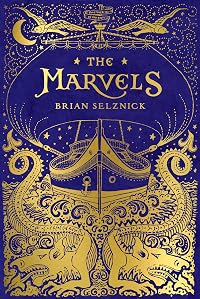
The Marvels
by Brian Selznick
On This Page
Description
In 1766, a boy, Billy Marvel, is shipwrecked, rescued, and goes on to found a brilliant family of actors that flourishes in London until 1900--and nearly a century later, Joseph Jervis, runs away from home, seeking refuge with his uncle in London, and is captivated by the Marvel house, with its portraits and ghostly presences.Tags
Recommendations

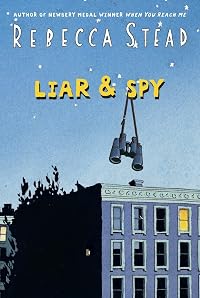
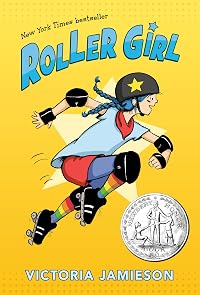
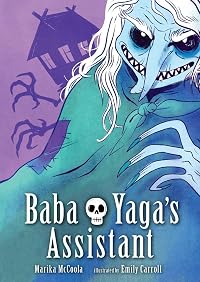
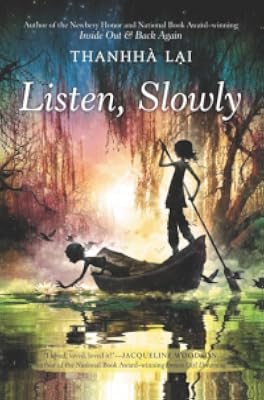

Member Reviews
I think this might be my favorite Selznick so far. I loved the meta-ness of the story and I adored Joseph and Albert and Frankie. This is the first time one of Selznick's books has made me weep openly and being someone who appreciates an emotional whammy of a book, that weeping immediately earned it favorite status. As always, the illustrations are gorgeous and the story they tell is rich and layered. It is the prose section, though, that really grabbed my heart and wouldn't let go and I sincerely hope that Joseph got the future he imagined for himself.
If you're lucky enough to get ahold of an advance copy, don't take that for granted. If you have to wait until publication to discover 'The Marvels', then be assured, it's well worth the show more wait. show less
If you're lucky enough to get ahold of an advance copy, don't take that for granted. If you have to wait until publication to discover 'The Marvels', then be assured, it's well worth the show more wait. show less
(4.5)
I definitely didn't expect this kind of depth when I picked this up! I'm not sure why, since a good friend recommended it to me, and she has really good taste. Maybe it's because I've read Brian Selznick's other works, and none of them really resonated with me the way this one has.
Book content warnings:
some unreality (if you dissociate easily)
grief & trauma
The first half (and very last bit) of this book is solely composed of illustrations--as anyone who's read Brian Selznick's other works are familiar with. Gorgeous pictures! The second half is where the "real" story comes in to play, and where the first half is explained (ish). The composition of the story (illustrations first, prose second) is actually part of the reason I love show more it so much. Kind of genius actually, because it's part of the book's major twist.
Joseph has run away in 1990 from his boarding school to London on the search for his Uncle Albert. He hopes to get his help in finding someone else: his friend who was removed from school mysteriously, leaving no way to be found. But when Joseph finds his uncle, he finds a house where time has stopped and a mystery (in the form of the first part of the book) he needs to solve. But as he tries to solve it, will it end up severing his fragile relationship with his uncle?
Again, I have to mention: the composition of this book is marvelous (ha). As a reader, you genuinely don't know what's happening before the characters, and the surprises and twists are genuinely eye-opening and amazing!
Besides that, characters and places are very painstakingly and lovingly created, even when given very little scene-time. Including the Uncle Albert's relationship with Billy, his late husband--yes, he's LGBT. :') It's also heavily implied that the main character, Joseph, is too, when the book returns to illustrative form at the very end--where it ends very sweetly and in the most satisfying way. In fact, the entire second half of the book seems to have "straight-baited" the audience instead of "lgbt-baiting" it, which almost makes me want to cry with happiness.
All in all, this was a wonderfully, carefully-crafted book, and I definitely need to buy the hardcover version to keep. show less
I definitely didn't expect this kind of depth when I picked this up! I'm not sure why, since a good friend recommended it to me, and she has really good taste. Maybe it's because I've read Brian Selznick's other works, and none of them really resonated with me the way this one has.
Book content warnings:
some unreality (if you dissociate easily)
grief & trauma
The first half (and very last bit) of this book is solely composed of illustrations--as anyone who's read Brian Selznick's other works are familiar with. Gorgeous pictures! The second half is where the "real" story comes in to play, and where the first half is explained (ish). The composition of the story (illustrations first, prose second) is actually part of the reason I love show more it so much. Kind of genius actually, because it's part of the book's major twist.
Joseph has run away in 1990 from his boarding school to London on the search for his Uncle Albert. He hopes to get his help in finding someone else: his friend who was removed from school mysteriously, leaving no way to be found. But when Joseph finds his uncle, he finds a house where time has stopped and a mystery (in the form of the first part of the book) he needs to solve. But as he tries to solve it, will it end up severing his fragile relationship with his uncle?
Again, I have to mention: the composition of this book is marvelous (ha). As a reader, you genuinely don't know what's happening before the characters, and the surprises and twists are genuinely eye-opening and amazing!
Besides that, characters and places are very painstakingly and lovingly created, even when given very little scene-time. Including the Uncle Albert's relationship with Billy, his late husband--yes, he's LGBT. :') It's also heavily implied that the main character, Joseph, is too, when the book returns to illustrative form at the very end--where it ends very sweetly and in the most satisfying way. In fact, the entire second half of the book seems to have "straight-baited" the audience instead of "lgbt-baiting" it, which almost makes me want to cry with happiness.
All in all, this was a wonderfully, carefully-crafted book, and I definitely need to buy the hardcover version to keep. show less
This was not the book I thought it was going to be. It's better. About the power of art, and chosen families, and I don't want to say any more because it's important not to know what's coming.
What made me sob most wasthat this is an AIDS story, and I'd had no idea. The strange uncle Joseph runs away to meet in 1990 is a gay man in his thirties who has already lost his partner to AIDS and who is HIV-positive himself. AIDS is briefly mentioned -- you die of it, some mystery and fear surround it, Princess Diana visited a clinic to show that you can't get it by touching people; that is all the young reader is told. What else would a reader born in the 2000s bring to this story? For them, AIDS is a disease associated with Africa, not gay show more men. An old theater hand, telling Joseph about Uncle Albert's partner, says he was "[o]ne of the first, I'm afraid. ....We've been losing so many of our friends." None of my students, unless AIDS was part of their family story or they'd happened to watch a movie or read a more explicit book about that time, would pick up on that at all. It's an important part of recent history and I'm grateful to books like this for dropping the clues that I hope my students will pick up on later. show less
What made me sob most was
The Marvels is another tour de force by Brian Selznick, who has pioneered this particular format of illustrated novel. In the first half of the book, through illustrations, we follow the story of a theatrical family in London. The second half of the book, in text, is the story of a troubled young boy in the 1990s who runs away from school and ends up with his curmudgeonly uncle, who lives in a most extraordinary house. The two stories come together in magical and surprising ways.
I enjoyed this book more than Wonderstruck but not as much as Hugo Cabret. I've seen the three books referred to as a series, or companion novels, but they are really tied together only by format, as there is no overlap in characters or plot that I can see. I show more found the story intriguing, and now I have another place on the list of attractions to visit next time I go to London! show less
I enjoyed this book more than Wonderstruck but not as much as Hugo Cabret. I've seen the three books referred to as a series, or companion novels, but they are really tied together only by format, as there is no overlap in characters or plot that I can see. I show more found the story intriguing, and now I have another place on the list of attractions to visit next time I go to London! show less
Don't let the length deter you, as I foolishly did for too long; the first half of the book is told in beautiful, expressive illustrations. It conveys the story of Billy Marvel, the lone survivor (along with his dog, Tar) of the shipwreck of the Kraken. In London, Billy finds a home at the Royal Theatre, just being built when he arrives, and generations of Marvels star on its stage, until Leontes - Leo - who doesn't want to act, and is running away when a fire draws him back to rescue his mad grandfather Alexander.
In the second part of the story, set in 1990, Joseph is running away from a boarding school in England, heading for the house of his uncle, Albert Nightingale, whom he has never met. He convinces Albert to take him in, and show more becomes convinced that they are related to the Marvels, but cannot figure out how, since their story ends with Leo running into a fire.
It becomes clear to Joseph and the reader, in a metafictional turn that reminded me of Kate Atkinson (Life After Life, A God in Ruins). Absolutely beautiful and magical - a treasure box.
First page:
You either see it or you don't.
[Joseph] imagined that a curse had been put on his uncle, condemning him to live in this house forever. Maybe Albert Nightingale was like a vampire in a novel, doomed to witness centuries going by. Maybe he was forced to work day and night to keep the future from seeping into the house, making a kind of refuge of the past, the only world he knew. (446)
"Stories aren't the same as facts!"
"No, but they can both be true." (Joseph and Albert, 534)
"Everything in our lives became the stories..." (Albert to Joseph, 550)
Sources from Author's Note
https://www.dennissevershouse.co.uk/
https://www.theguardian.com/news/2000/jan/10/guardianobituaries
http://spitalfieldslife.com/ show less
In the second part of the story, set in 1990, Joseph is running away from a boarding school in England, heading for the house of his uncle, Albert Nightingale, whom he has never met. He convinces Albert to take him in, and show more becomes convinced that they are related to the Marvels, but cannot figure out how, since their story ends with Leo running into a fire.
It becomes clear to Joseph and the reader, in a metafictional turn that reminded me of Kate Atkinson (Life After Life, A God in Ruins). Absolutely beautiful and magical - a treasure box.
First page:
You either see it or you don't.
[Joseph] imagined that a curse had been put on his uncle, condemning him to live in this house forever. Maybe Albert Nightingale was like a vampire in a novel, doomed to witness centuries going by. Maybe he was forced to work day and night to keep the future from seeping into the house, making a kind of refuge of the past, the only world he knew. (446)
"Stories aren't the same as facts!"
"No, but they can both be true." (Joseph and Albert, 534)
"Everything in our lives became the stories..." (Albert to Joseph, 550)
Sources from Author's Note
https://www.dennissevershouse.co.uk/
https://www.theguardian.com/news/2000/jan/10/guardianobituaries
http://spitalfieldslife.com/ show less
This beautifully illustrated juvenile fiction book tells two stories that have a mysterious connection. The first half of the book is told completely in Selznick's amazing cross-hatched drawings. Billy Marvel survives a shipwreck in 1766 and settles in London and works at the Royal Theater. Several generations of Marvels follow, all of whom are actors on the Royal stage until a fire destroys the theater in 1900, possibly killing 2 of the Marvel family. The second half of the book begins in 1990 London with 12-year-old Joseph Jervis running away from boarding school to find his mysterious uncle Albert Nightingale. The reclusive Albert lives in a large cluttered house, is driven to and from the local theater by horse-drawn carriage, and show more is less than welcoming to his nephew. Albert reluctantly agrees to let Joseph stay with him until Albert is able to send Joseph back to school or to reach Joseph's traveling parents. Joseph is constantly admonished against touching anything in the house and not to worry about the sounds and voices he hears. With his new friend Frankie, Joseph finds the mystery of his uncle and the strange house too hard to ignore, and the two youngsters set out to figure out the mystery Albert is surely hiding.
Once again I am amazed at the beauty of Selznick's artwork. What a gifted illustrator this man is. I would give the book 5 stars for this alone. While the story of Joseph and Albert is not as exciting as that of the Marvels, it is intriguing and strange but, at the same time, very touching. Working at a library I know that this book will probably have its share of critics among the parents of youngsters who might read this. It does deal with a few adult topics that may be uncomfortable for a parent to discuss with a child but these topics are certainly part of today's reality. Please don't take that sentence as anything sinister, as Albert is a kind, upstanding man. It is a lovely book and, surprisingly, loosely based on a real person and his London home. show less
Once again I am amazed at the beauty of Selznick's artwork. What a gifted illustrator this man is. I would give the book 5 stars for this alone. While the story of Joseph and Albert is not as exciting as that of the Marvels, it is intriguing and strange but, at the same time, very touching. Working at a library I know that this book will probably have its share of critics among the parents of youngsters who might read this. It does deal with a few adult topics that may be uncomfortable for a parent to discuss with a child but these topics are certainly part of today's reality. Please don't take that sentence as anything sinister, as Albert is a kind, upstanding man. It is a lovely book and, surprisingly, loosely based on a real person and his London home. show less
The Marvels is his newest work and combines two stories into one. The first half is told entirely through pictures and is incredibly moving and beautiful. If I didn't convey this before, I find Selznick's art highly compelling and capable of telling a story without words being necessary. That didn't stop me from loving the second half of the book which is told from a different perspective and through text alone. The ending is a delightful mixture of the two which makes total sense with the narrative. It's difficult to explain this one without giving anything away but I'll give it my best shot. There's a boy who runs away, a sad man living in a house which has its own lively spirit, a girl chasing a dog, and the pangs of first love. show more Selznick touches on topics such as abandonment, homosexuality, AIDS, death, and ultimately coming into one's own. It's all about the choices that we make and the people that we want to become. It's phenomenal and maybe my favorite of the lot. 10/10 show less
Members
- Recently Added By
Lists

Books Read in 2017
4,249 works; 130 members

Top Five Books of 2018
802 works; 265 members

LGBTQ Books for Preteens
86 works; 2 members
Author Information

21+ Works 17,949 Members
Brian Selznick is a Caldecott-winning author and illustrator of children's books born July 14, 1966 in East Brunswick Township, New Jersey. He graduated from the Rhode Island School of Design and then worked for three years at Eeyore's Books for Children in Manhattan while working on his first book, The Houdini Box. Selznick received the 2008 show more Caldecott Medal for The Invention of Hugo Cabret. He also won the Caldecott Honor for The Dinosaurs of Waterhouse Hawkins in 2002. Additional awards include the Texas Bluebonnet Award, the Rhode Island Children's Book Award, and the Christopher Award. The Invention of Hugo Cabret will be made into a film by director Martin Scorsese to be released in 2011. Other titles by illustrated by Selznick include: Frindle, The Landry News, Lunch Money, Wingwalker, and Baby Monkey, Private Eye. (Bowker Author Biography) show less
Awards and Honors
Awards
Distinctions
Notable Lists
Common Knowledge
- Canonical title*
- De Wonderlingen
- Original title
- The Marvels
- Original publication date
- 2015-09-15
- People/Characters
- Billy Marvel; Joseph; Albert Nightingale
- Epigraph
- You either see it or you don't.
- Dedication
- Dit boek is opgedragen aan
David Milne en David Serlin
en aan de nagedachtenis van
Dennis Severs
This book is dedicated to David Milne and David Serlin
and to the memory of Dennis Severs - First words
- Kracken sinks during storm at sea.
- Last words
- (Click to show. Warning: May contain spoilers.)So Joseph turned the page.
(Click to show. Warning: May contain spoilers.)"Is this a true story?"
I said: "It is now." --Wim Wenders, "The Act of Seeing" - Original language*
- Engels
*Some information comes from Common Knowledge in other languages. Click "Edit" for more information.
Classifications
- Genres
- Tween, Kids, Fiction and Literature, Graphic Novels & Comics
- DDC/MDS
- 813.6 — Literature & rhetoric American literature in English American fiction in English 2000-
- LCC
- PZ7 .S4654 .M — Language and Literature Fiction and juvenile belles lettres Fiction and juvenile belles lettres Juvenile belles lettres
- BISAC
Statistics
- Members
- 1,301
- Popularity
- 18,670
- Reviews
- 76
- Rating
- (4.13)
- Languages
- Dutch, English, Italian, Portuguese
- Media
- Paper, Ebook
- ISBNs
- 9
- UPCs
- 1
- ASINs
- 3