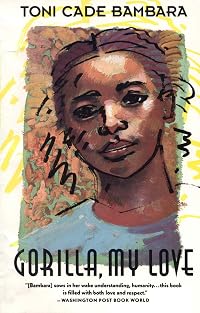
Gorilla, My Love
by Toni Cade Bambara
On This Page
Description
Fifteen short stories record the author's ideas about the challenge and complexity of contemporary life.Tags
Recommendations










Member Reviews
This collection of stories are evocative of the world of the mid-twentieth century, which is when they were written, and, therefore, somewhat innocent, but also sometimes sassy. Most are written in the first person with authentic voices, especially those of the adolescent girls growing up and trying to make sense in their world. Beautifully written, and sometimes in dialect, with vivid descriptions, apt wisdom (" . . . gonna speak on your life and drop the truth in your lap"), and with great effort to set the frame of mind of the narrator, as in the long "train of thought" at the start of The Basement. In addition to that story, I especially liked Mississippi Ham Rider, The Lesson, The Johnson Girls, and, of course, Gorilla, My Love.
My friend who recommended this collection of short stories to me described it as "unapologetic." I can't think of a more fitting word. Some of the stories were difficult to follow perhaps because I am unaccustomed with the language style, however overall I found the unapologetic tone incredibly inspiring. "Raymond's Run" was my favorite and one of the best things I have read in a while. I recommend this book.
Tales of black people, I mention this because it does not transcend into people, instead focusing on this POV.
La propia Bambara dejó escrito, con esa ironía suya, por qué prefería la ficción a la autobiografía: «Escribir ficción autobiográfica no es bueno para nada, porque en cuanto el libro sale a la venta aparece tu madre gritando: ‘¡Cómo has podido!’ […] Así que yo me dedico a la ficción pura y dura, porque valoro a mi familia y a mis amigos. Y sobre todo porque, de todas formas, miento mucho.» Esa declaración de principios condensa perfectamente su universo literario: la vida cotidiana de las comunidades negras de Harlem y el sur de Estados Unidos narrada con una voz que mezcla humor, rabia y una agudeza moral que no tiene nada de ingenua.
Los quince relatos que componen el volumen fueron escritos entre 1959 y 1971, en show more un período en que Bambara compaginaba la escritura con el activismo en el Movimiento por los Derechos Civiles y el Black Power, la docencia en el City College de Nueva York y la organización comunitaria en Harlem. Bambara nunca concibió la escritura como un ejercicio estético separado de la realidad material de las comunidades negras. Para ella, escribir era también una forma de organizarse. show less
Los quince relatos que componen el volumen fueron escritos entre 1959 y 1971, en show more un período en que Bambara compaginaba la escritura con el activismo en el Movimiento por los Derechos Civiles y el Black Power, la docencia en el City College de Nueva York y la organización comunitaria en Harlem. Bambara nunca concibió la escritura como un ejercicio estético separado de la realidad material de las comunidades negras. Para ella, escribir era también una forma de organizarse. show less
Jun 30, 2026Spanish
Ratings
Members
- Recently Added By
Lists

Classics you know you should have read but probably haven't
421 works; 408 members

Female Author
1,234 works; 67 members

20th Century Literature
1,161 works; 55 members

Favorite Short Fiction
228 works; 99 members

Short Story Collections and Anthologies
261 works; 42 members

500 Great Books by Women
507 works; 60 members

The Zora Canon
98 works; 4 members

Black Authors
384 works; 32 members

Zora Canon
100 works; 6 members

Books published by The Women's Press
14 works; 1 member
Author Information

22+ Works 1,799 Members
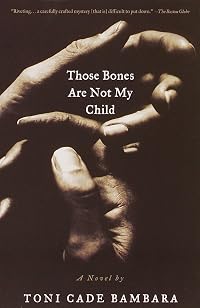
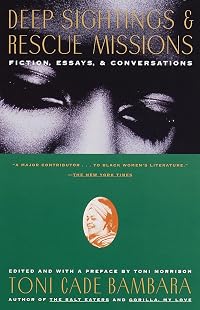
Toni Cade Bambara, a well-known teacher, writer, and social activist, was born on March 25, 1939, in New York. Bambara's mother was influenced by the Harlem Renaissance and fostered creativity in her daughter. After graduating from Queens College in 1959, Bambara worked as a social investigator for the New York Department of Welfare. This show more experience influenced her writing and reflected her interest in the welfare of the black community. Bambara returned to school, receiving her MA from City College of New York in 1965, where she taught until 1969. It was in the 1970s that Bambara wrote her most important works, including Black Woman, Southern Black Utterances Today, and Gorilla My Love. Bambara's works are frequently written in black street dialect and are set in the rural South and the urban North. She is interested in the identities and experiences of the black community and writes about their effects as a society. She has also authored several film and television scripts. Bambara is a frequent guest lecturer, visiting professor, and community leader. She received an American Book Award in 1981 Her novel The Salt Eaters (1980) is centered around a healing event that coincides with a community festival in the fictional city of Claybourne, Georgia. The novel Those Bones Are Not My Child or If Blessings Come (title of the manuscript), was published posthumously in 1999. It deals with the disappearance and murder of forty black children in Atlanta between 1979 and 1981. It was called her masterpiece by Toni Morrison, who edited it and also gathered some of Bambara's short stories, essays, and interviews in the volume Deep Sightings & Rescue Missions: Fiction, Essays & Conversations. (Vintage, 1996). Toni Cade Bambara was diagnosed with colon cancer in 1993 and died of it in 1995, at age 56. (Bowker Author Biography) show less
Awards and Honors
Work Relationships
Contains
Has as a student's study guide
Common Knowledge
- Original publication date
- 1972
Classifications
Statistics
- Members
- 460
- Popularity
- 66,316
- Reviews
- 4
- Rating
- (3.90)
- Languages
- English, French, Italian, Portuguese
- Media
- Paper, Ebook
- ISBNs
- 11
- ASINs
- 2