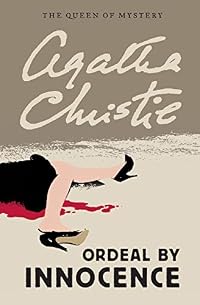
Ordeal by Innocence
by Agatha Christie
On This Page
Description
Soon to be a limited streaming series starring Anna Chancellor and Bill NighyConsidered by critics the one of the best of Agatha Christie's later novels, and a personal favorite for Christie herself, Ordeal by Innocence is a psychological thriller involving crimes from both past and present. According to the courts, Jacko Argyle bludgeoned his mother to death with a poker. The sentence was life imprisonment. But when Dr. Arthur Calgary arrives with the proof that confirms Jacko's innocence, show more it is too late-Jacko died behind bars following a bout of pneumonia. Worse still, the doctor's revelations reopen old wounds in the family, increasing the likelihood that the real murderer will strike again. show lessTags
Recommendations













Member Reviews
‘All right. It’s your say so–and you’re sticking to it. Jacko didn’t kill her. Very well then–who did kill her? You haven’t thought about that one, have you? Think about it now. Think about it–and then you’ll begin to see what you’re doing to us all…’
I've been reading away on my Agatha Christie project for a while, and although the books tend to, with exceptions, follow a formula, there are other issues or themes that Christie discusses in the different books. This could be anything from discussing morality and justice (as she does in Orient Express and And Then There Were None) to superstitions (as she does in Endless Night).
She's not always successful with this in the sense that she makes a valid argument or show more finds common ground with the sensibilities of her readers - tho, maybe she was more successful with the latter in her own time - but she does pick up topics for discussion that have nothing to do with the murder plot itself.
In Ordeal by Innocence, Christie dedicates her "side discussion" to the topic of adoption.
‘All tragic histories in a way,’ said Philip. ‘All poor unwanted little devils.’
‘Yes,’ said Leo. ‘That’s what made Rachel feel so passionately about them all. She was determined to make them feel wanted, to give them a real home, be a real mother to them.’
‘It was a fine thing to do,’ said Philip.
‘Only–only it can never work out exactly as she hoped it might,’ said Leo. ‘It was an article of faith with her that the blood tie didn’t matter. But the blood tie does matter, you know. There is usually something in one’s own children, some kink of temperament, some way of feeling that you recognize and can understand without having to put into words. You haven’t got that tie with children you adopt. One has no instinctive knowledge of what goes on in their minds. You judge them, of course, by yourself, by your own thoughts and feelings, but it’s wise to recognize that those thoughts and feelings may be very widely divergent from theirs.’
‘You understood that, I suppose, all along,’ said Philip.
‘I warned Rachel about it,’ said Leo, ‘but of course she didn’t believe it. Didn’t want to believe it. She wanted them to be her own children.’
Having read her points, it seems Christie argues that adoptive parents can never have the same bond with "their" children as natural parents and that all adopted children will carry a chip of rejection on their shoulder. I am not going to argue for nor against this thesis, but I do acknowledge that there is a lot of controversy in Christie's statements on the subject of adoption in this book. There is no indication of what made Christie bring this up other than to have a side discussion in the book, but to me these side issues - however controversial or even offensive they may be - are an aspect of what I enjoy about the books.
I guess, Christie's use of the uncertainty about familial trust as the major drivers of plot in this particular mystery makes it quite similar to Appointment with Death, but family set up is completely different in this story. It has been fun to watch the mystery unravel, knowing that the similarity with her other books is just one of the red herrings that Christie is so famous for.
Who is it who said: “Nothing is ever settled until–”’ ‘“Until it is settled right,”’ Miss Vaughan finished for him. ‘Kipling.’ show less
I've been reading away on my Agatha Christie project for a while, and although the books tend to, with exceptions, follow a formula, there are other issues or themes that Christie discusses in the different books. This could be anything from discussing morality and justice (as she does in Orient Express and And Then There Were None) to superstitions (as she does in Endless Night).
She's not always successful with this in the sense that she makes a valid argument or show more finds common ground with the sensibilities of her readers - tho, maybe she was more successful with the latter in her own time - but she does pick up topics for discussion that have nothing to do with the murder plot itself.
In Ordeal by Innocence, Christie dedicates her "side discussion" to the topic of adoption.
‘All tragic histories in a way,’ said Philip. ‘All poor unwanted little devils.’
‘Yes,’ said Leo. ‘That’s what made Rachel feel so passionately about them all. She was determined to make them feel wanted, to give them a real home, be a real mother to them.’
‘It was a fine thing to do,’ said Philip.
‘Only–only it can never work out exactly as she hoped it might,’ said Leo. ‘It was an article of faith with her that the blood tie didn’t matter. But the blood tie does matter, you know. There is usually something in one’s own children, some kink of temperament, some way of feeling that you recognize and can understand without having to put into words. You haven’t got that tie with children you adopt. One has no instinctive knowledge of what goes on in their minds. You judge them, of course, by yourself, by your own thoughts and feelings, but it’s wise to recognize that those thoughts and feelings may be very widely divergent from theirs.’
‘You understood that, I suppose, all along,’ said Philip.
‘I warned Rachel about it,’ said Leo, ‘but of course she didn’t believe it. Didn’t want to believe it. She wanted them to be her own children.’
Having read her points, it seems Christie argues that adoptive parents can never have the same bond with "their" children as natural parents and that all adopted children will carry a chip of rejection on their shoulder. I am not going to argue for nor against this thesis, but I do acknowledge that there is a lot of controversy in Christie's statements on the subject of adoption in this book. There is no indication of what made Christie bring this up other than to have a side discussion in the book, but to me these side issues - however controversial or even offensive they may be - are an aspect of what I enjoy about the books.
I guess, Christie's use of the uncertainty about familial trust as the major drivers of plot in this particular mystery makes it quite similar to Appointment with Death, but family set up is completely different in this story. It has been fun to watch the mystery unravel, knowing that the similarity with her other books is just one of the red herrings that Christie is so famous for.
Who is it who said: “Nothing is ever settled until–”’ ‘“Until it is settled right,”’ Miss Vaughan finished for him. ‘Kipling.’ show less
The nature versus nurture debate is at the heart of this standalone psychological mystery. Jacko Argyle died in prison after he was convicted of murdering his mother by hitting her over the head with a poker. A couple of years after the trial, a new witness appears with exculpatory evidence that proves Jacko was not in the house when his mother was murdered. But if Jacko was innocent, then someone else must be guilty. The rest of the family and the household employees will live under a cloud of suspicion until the real murderer is discovered. The witness, Dr. Calgary, feels responsible for stirring up the cloud of suspicion, and he believes he has a moral obligation to solve the crime and free the innocent from suspicion.
This novel is show more very similar to many of Poirot’s cases, and I think it would have worked better as a Poirot mystery. It suffers from lack of an easily identifiable protagonist/detective. Sometimes Arthur Calgary works on the puzzle. Sometimes the local police superintendent works on it. Sometimes Philip Durant, the murder victim’s disabled son-in-law, fancies he can solve the mystery. Christie excelled at revealing character through conversation, and her dialogue carries her best novels. This novel focuses more on what various characters are thinking to themselves, and there isn’t a lot of dialogue. I think that’s why the pace seems to drag. show less
This novel is show more very similar to many of Poirot’s cases, and I think it would have worked better as a Poirot mystery. It suffers from lack of an easily identifiable protagonist/detective. Sometimes Arthur Calgary works on the puzzle. Sometimes the local police superintendent works on it. Sometimes Philip Durant, the murder victim’s disabled son-in-law, fancies he can solve the mystery. Christie excelled at revealing character through conversation, and her dialogue carries her best novels. This novel focuses more on what various characters are thinking to themselves, and there isn’t a lot of dialogue. I think that’s why the pace seems to drag. show less
You really have to admire 1950s for their marvelous plot devices. Amnesiacs, mistaken identities, and in this mystery by Agatha Christie, a man with a concussion fails to provide an alibi, and shortly after recovering, heads off to Antarctica for a research expedition. Barring that somewhat awkward premise, Ordeal was an interesting psychological mystery that kept me engaged.
Dr. Calgary, the Antarctic research scientist, discovers through old newspaper articles that he was the missing alibi for Jack Argyle, accused and convicted of killing his mother. Despite steadily maintaining his innocence, Jack was sent to prison, where he died of pneumonia after only six months. Troubled by guilt, Dr. Calgary consults with the lawyer of the show more Jack's family, determined to seek them out and assure them of Jack's innocence. He expects a mixed emotional reaction, perhaps to be thanked or perhaps to bear the brunt of their anger for his untimely appearance and information. Unfortunately, the facts of the case have failed to impress Dr. Calgary, and not even the warning from Jack's sister makes it clear: "it's not the guilty who matter. It's the innocent... It's we who matter. Don't you see what you've done to us all?"
One of her brothers visits Dr. Calgary at his hotel, examining his story and providing Calgary with the background on his family--and the reason they are so upset by his news. Calgary, shocked, finds himself back at the lawyer's seeking more information, and then proceeds to talk with some of the principles. "I thought that I was ending something, giving--shall we say--a different end to a chapter already written. But I was made to feel, I was made to see, that instead of ending something I was starting something. Something altogether new." Meanwhile, the police, while doubtful of their ultimate success, are determinedly re-opening the case, and eventually Dr. Calgary's goals dovetail with their own.
Technically, her writing is impressive. On re-read, I realized how streamlined and exacting her prose is, and all the clever ways she conveys dialogue without resorting to a simple "he said," "she said" format that plagues less experienced writers.
Characterization is also impeccably done, a few short sentences illuminating an entire personality:
"Arthur Calgary walked down the sloping ramp and got into the boat as the ferryman steadied it with a boathook. He was an old man and gave Calgary the fanciful impression that he and his boat belonged together, were one and indivisible."
"For a moment a feeling of poignant sadness came over him as he confronted the virile youth of the boy facing him."
"Superintendent Huish was a tall, sad-looking man. His air of melancholy was so profound that no one would have believed that he could be the life and soul of a children's party, cracking jokes and bringing pennies out of little boys' ears."
"It was a pretty, rather vapid little face, plastered with make-up, eyebrows plucked, hair hideous and stiff in a cheap perm."
Writing like this reminds me of the certain degree of sloppiness I see in current writers who are churning out book after book. Easy enough to do, if your last ten books bore any resemblance to Parker phoning in [b:Bad Business|632946|Bad Business (Spenser, #31)|Robert B. Parker|http://d202m5krfqbpi5.cloudfront.net/books/1309287291s/632946.jpg|3173270] or Evanovich and her umpteenth Plum fiasco. But Christie wrote for over 40 years and had 66 detective novels to her credit; while not all of them hit excellence, I'm not sure they fell quite to those depths. Grand Dame indeed.
To top it off, the mystery was decent and the solution a surprise. There were pieces Christie left in place, and while I picked up on a few, I was short of constructing the picture.It was also a pleasure when all ended well, if rather sweetly.
Note: Christie does show her upper class British upbringing in this one. One character is referred to a "half-caste" and a "dark horse." I assumed the dark-horse to refer to her status as a potential murderer, but it could be a racial remark. She ends up being quite a sympathetic character so it bothered me less than it could have.
At any rate, four stars for Christie's delicious period piece and managing to surprise me with a couple different twists.
Cross posted at http://clsiewert.wordpress.com/2013/01/27/ordeal-by-innocence-by-agatha-christie... show less
Dr. Calgary, the Antarctic research scientist, discovers through old newspaper articles that he was the missing alibi for Jack Argyle, accused and convicted of killing his mother. Despite steadily maintaining his innocence, Jack was sent to prison, where he died of pneumonia after only six months. Troubled by guilt, Dr. Calgary consults with the lawyer of the show more Jack's family, determined to seek them out and assure them of Jack's innocence. He expects a mixed emotional reaction, perhaps to be thanked or perhaps to bear the brunt of their anger for his untimely appearance and information. Unfortunately, the facts of the case have failed to impress Dr. Calgary, and not even the warning from Jack's sister makes it clear: "it's not the guilty who matter. It's the innocent... It's we who matter. Don't you see what you've done to us all?"
One of her brothers visits Dr. Calgary at his hotel, examining his story and providing Calgary with the background on his family--and the reason they are so upset by his news. Calgary, shocked, finds himself back at the lawyer's seeking more information, and then proceeds to talk with some of the principles. "I thought that I was ending something, giving--shall we say--a different end to a chapter already written. But I was made to feel, I was made to see, that instead of ending something I was starting something. Something altogether new." Meanwhile, the police, while doubtful of their ultimate success, are determinedly re-opening the case, and eventually Dr. Calgary's goals dovetail with their own.
Technically, her writing is impressive. On re-read, I realized how streamlined and exacting her prose is, and all the clever ways she conveys dialogue without resorting to a simple "he said," "she said" format that plagues less experienced writers.
Characterization is also impeccably done, a few short sentences illuminating an entire personality:
"Arthur Calgary walked down the sloping ramp and got into the boat as the ferryman steadied it with a boathook. He was an old man and gave Calgary the fanciful impression that he and his boat belonged together, were one and indivisible."
"For a moment a feeling of poignant sadness came over him as he confronted the virile youth of the boy facing him."
"Superintendent Huish was a tall, sad-looking man. His air of melancholy was so profound that no one would have believed that he could be the life and soul of a children's party, cracking jokes and bringing pennies out of little boys' ears."
"It was a pretty, rather vapid little face, plastered with make-up, eyebrows plucked, hair hideous and stiff in a cheap perm."
Writing like this reminds me of the certain degree of sloppiness I see in current writers who are churning out book after book. Easy enough to do, if your last ten books bore any resemblance to Parker phoning in [b:Bad Business|632946|Bad Business (Spenser, #31)|Robert B. Parker|http://d202m5krfqbpi5.cloudfront.net/books/1309287291s/632946.jpg|3173270] or Evanovich and her umpteenth Plum fiasco. But Christie wrote for over 40 years and had 66 detective novels to her credit; while not all of them hit excellence, I'm not sure they fell quite to those depths. Grand Dame indeed.
To top it off, the mystery was decent and the solution a surprise. There were pieces Christie left in place, and while I picked up on a few, I was short of constructing the picture.
Note: Christie does show her upper class British upbringing in this one. One character is referred to a "half-caste" and a "dark horse." I assumed the dark-horse to refer to her status as a potential murderer, but it could be a racial remark. She ends up being quite a sympathetic character so it bothered me less than it could have.
At any rate, four stars for Christie's delicious period piece and managing to surprise me with a couple different twists.
Cross posted at http://clsiewert.wordpress.com/2013/01/27/ordeal-by-innocence-by-agatha-christie... show less
I wanted to read Ordeal of Innocence because the premise was both intriguing and ridiculous. First, the fascinating part: New information comes to light that shows that Jacko Argyle, although convicted of the crime, could not possibly have killed his mother, but somehow the news of Jacko’s innocence doesn’t seem to make anyone in his family seem pleased or relieved. In fact, other than a vague sadness that their adopted brother died in prison, the rest of the family almost seems like they want Jacko to be guilty.
Now, the ridiculous part. The alibi comes because Jacko was picked up as a hitchhiker during the time the crime was committed, but the driver never gave the alibi because he was… wait for it…. hit on the head almost show more immediately after dropping Jacko off, in a totally unrelated random accident, got an amnesiac concussion, and then set off for Antarctica. As one does.
I kind of love this kind of device in mystery fiction, there’s something so bold about a tossing a ridiculous event into a carefully plotted mystery. I enjoyed a similar device a great deal in At Bertram’s Hotel, too.
Besides this hook, the rest of the novel is twisty and spare. The Argyle family has never really questioned that Jacko was the murderer, since he’d been in and out of trouble since childhood, and was known to need money to get out of yet another shady situation. Without the family wrong ‘un taking the blame, though, the rest of the family begins to look suspiciously at each other, and it’s already a family full of secrets and odd relationships. Ordeal by Innocence not at all a locked-room mystery, but the scenes of the family and domestic staff eying each other suspiciously has a similar feel and tension.
Unfortunately, this mystery includes some pretty cringy attitudes of the day, mostly around adoption. There’s an unpleasant armchair psych analysis of a woman who is infertile and decides to have her family through adoption. A lot of this is based on the social assumption that all women must want children, and without children, a woman’s natural instincts are thwarted. Many characters also believe that adopted children are all well and good, but blood and breeding will tell eventually. It’s a bit cringy now to hear about educated people who really believe that being born into poverty or being born illegitimate is a stain upon one’s personality and capacity for ever. But, again, an accepted belief of that time.
Overall, recommended as a surprising standalone mystery, with a note that some of the ideas about class and psychology are very dated, and not in a charming way. show less
Now, the ridiculous part. The alibi comes because Jacko was picked up as a hitchhiker during the time the crime was committed, but the driver never gave the alibi because he was… wait for it…. hit on the head almost show more immediately after dropping Jacko off, in a totally unrelated random accident, got an amnesiac concussion, and then set off for Antarctica. As one does.
I kind of love this kind of device in mystery fiction, there’s something so bold about a tossing a ridiculous event into a carefully plotted mystery. I enjoyed a similar device a great deal in At Bertram’s Hotel, too.
Besides this hook, the rest of the novel is twisty and spare. The Argyle family has never really questioned that Jacko was the murderer, since he’d been in and out of trouble since childhood, and was known to need money to get out of yet another shady situation. Without the family wrong ‘un taking the blame, though, the rest of the family begins to look suspiciously at each other, and it’s already a family full of secrets and odd relationships. Ordeal by Innocence not at all a locked-room mystery, but the scenes of the family and domestic staff eying each other suspiciously has a similar feel and tension.
Unfortunately, this mystery includes some pretty cringy attitudes of the day, mostly around adoption. There’s an unpleasant armchair psych analysis of a woman who is infertile and decides to have her family through adoption. A lot of this is based on the social assumption that all women must want children, and without children, a woman’s natural instincts are thwarted. Many characters also believe that adopted children are all well and good, but blood and breeding will tell eventually. It’s a bit cringy now to hear about educated people who really believe that being born into poverty or being born illegitimate is a stain upon one’s personality and capacity for ever. But, again, an accepted belief of that time.
Overall, recommended as a surprising standalone mystery, with a note that some of the ideas about class and psychology are very dated, and not in a charming way. show less
This book doesn't have the quirkiness of Marple or Poirot. It has a lot of quite intense characters. And it has a lot of tension, but what it doesn't have is a lot of plot movement--that is, until the last couple of chapters. And then things go off with a bang. Not one of Christie's most memorable, but readable as always.
Dr Calgary returns from an expedition to find that he could have provided an alibi for a young man who without his evidence was found guilty of murder and died in prison of pneumonia. He goes to apologise to Jacko's family but they are less than pleased with the news, forced to consider that if Jacko was innocent someone else in the household actually committed the crime, but who?
Somewhat different from Christie's other work in that the focus is on who is psychologically the most likely to be guilty rather than on the physical evidence. It still had me turning the pages, though.
Somewhat different from Christie's other work in that the focus is on who is psychologically the most likely to be guilty rather than on the physical evidence. It still had me turning the pages, though.
Jacko Argyle, the youngest of five children, is convicted of murdering his own mother. It's very sad for his relatives, but somehow not surprising, because they've always known him to have a criminal streak in him. Imagine their surprise when they open their door to find Dr. Arthur Calgary on their doorstep, telling them he was the missing link in Jacko's alibi for the crucial time. Then imagine Dr. Calgary's surprise when his news is not received with the relief and gratitude he expected. Jacko as the killer was a convenient solution. If he was actually innocent, that means the murderer has gone unpunished, and is likely one of them…
This was definitely a puzzler; the way the information was presented, each relative became the suspect show more by turns, so it was hard to figure out just who had actually done it. The tension builds and builds as everyone begins to suspect each other and wonder just how much they really know about each other. I did feel a bit muddled at the end and somewhat deflated by the reveal, so I can't say I liked this quite as much as Agatha herself did. Still, it met my expectations for a puzzling mystery that kept me turning the pages to find out more. Recommended if you'd like. show less
This was definitely a puzzler; the way the information was presented, each relative became the suspect show more by turns, so it was hard to figure out just who had actually done it. The tension builds and builds as everyone begins to suspect each other and wonder just how much they really know about each other. I did feel a bit muddled at the end and somewhat deflated by the reveal, so I can't say I liked this quite as much as Agatha herself did. Still, it met my expectations for a puzzling mystery that kept me turning the pages to find out more. Recommended if you'd like. show less
Members
- Recently Added By
Lists

British Mystery
469 works; 14 members

Crime and Mysteries to Read
746 works; 31 members

Prison Books
3 works; 1 member

Agatha Christie
28 works; 3 members

Books About Murder
313 works; 7 members

Detective Stories
343 works; 5 members

Books Read in 2019
4,052 works; 110 members

Books Read in 2018
4,360 works; 110 members

TBR
77 works; 1 member

Agatha Christie Chronology
93 works; 1 member
Author Information

2,122+ Works 438,477 Members
One of the most successful and beloved writer of mystery stories, Agatha Mary Clarissa Christie was born in 1890 in Torquay, County Devon, England. She wrote her first novel, The Mysterious Affair at Styles, in 1920, launching a literary career that spanned decades. In her lifetime, she authored 79 crime novels and a short story collection, 19 show more plays, and six novels written under the name of Mary Westmacott. Her books have sold over a billion copies in the English language with another billion in 44 foreign languages. Some of her most famous titles include Murder on the Orient Express, Mystery of the Blue Train, And Then There Were None, 13 at Dinner and The Sittaford Mystery. Noted for clever and surprising twists of plot, many of Christie's mysteries feature two unconventional fictional detectives named Hercule Poirot and Miss Jane Marple. Poirot, in particular, plays the hero of many of her works, including the classic, The Murder of Roger Ackroyd (1926), and Curtain (1975), one of her last works in which the famed detective dies. Over the years, her travels took her to the Middle East where she met noted English archaeologist Sir Max Mallowan. They married in 1930. Christie accompanied Mallowan on annual expeditions to Iraq and Syria, which served as material for Murder in Mesopotamia (1930), Death on the Nile (1937), and Appointment with Death (1938). Christie's credits also include the plays, The Mousetrap and Witness for the Prosecution (1953; film 1957). Christie received the New York Drama Critics' Circle Award for 1954-1955 for Witness. She was also named Dame Commander of the Order of the British Empire in 1971. Christie died in 1976. (Bowker Author Biography) show less
Some Editions
Series
Belongs to Publisher Series
Oscar Narrativa (121)
Selecciones de Biblioteca Oro (libro 277)
Work Relationships
Is contained in
Agatha Christie Crime Collection: Ordeal by Innocence / One, Two Buckle My Shoe / Adventure of the Christmas Pudding by Agatha Christie
1950s Omnibus: They Came to Baghdad, Destination Unknown, Ordeal by Innocence, The Pale Horse by Agatha Christie
Murder at the Manor : The Seven Dials Mystery | Crooked House | Ordeal by Innocence by Agatha Christie
Common Knowledge
- Canonical title
- Ordeal by Innocence
- Original title
- Ordeal by Innocence
- Alternate titles*
- Tödlicher Irrtum
- Original publication date
- 1958
- People/Characters
- Arthur Calgary (Dr.); Philip Durrant; Mary Durrant; Hester Argyle; Leo Argyle; Gwenda Vaughan (show all 13); Kirsten Lindstrom; Michael "Micky" Argyle; Tina Argyle; Superintendent Huish; Dr. Donald Craig; Maureen Clegg; Jack "Jacko" Argyle
- Important places
- Drymouth, England, UK
- Related movies
- Ordeal by Innocence (1985 | IMDb); Marple: Ordeal by Innocence (2007 | IMDb); "Les petits meurtres d'Agatha Christie" Am stram gram (2009 | IMDb); Ordeal by Innocence (2018 | IMDb)
- Epigraph
- If I justify myself, mine own mouth shall condemn me.
I am afraid of all my sorrows. I know that Thou wilt not hold me innocent.
Job - Dedication
- To Billy Collins
with affection and gratitude - First words
- It was dusk when he came to the Ferry.
- Quotations
- Justice is, after all, in the hands of men and men are fallible.
- Last words
- (Click to show. Warning: May contain spoilers.)"Oh, I want you!" said Arthur Calgary.
- Original language
- English
- Canonical DDC/MDS
- 823.912
- Canonical LCC
- PR6005.H66
*Some information comes from Common Knowledge in other languages. Click "Edit" for more information.
Classifications
Statistics
- Members
- 3,265
- Popularity
- 5,198
- Reviews
- 77
- Rating
- (3.53)
- Languages
- 26 — Catalan, Chinese, Czech, Danish, Dutch, English, Estonian, Finnish, French, German, Greek, Hungarian, Italian, Japanese, Latvian, Norwegian (Bokmål), Norwegian, Polish, Portuguese, Romanian, Serbian, Croatian, Slovenian, Spanish, Swedish, Turkish
- Media
- Paper, Audiobook, Ebook
- ISBNs
- 139
- UPCs
- 1
- ASINs
- 71