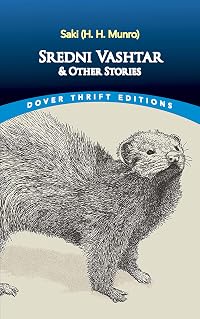
Sredni Vashtar and Other Stories
by Saki
On This Page
Description
Born in Burma in 1870, Scottish writer H. H. Munro adopted the pseudonym Saki to satirize the social conventions, cruelty, and foolishness of the Edwardian era. His highly readable blend of flippant humor and outrageous inventiveness is often overlaid with a mood of horror. After Munro's untimely death in action during World War I, Christopher Morley wrote: "the empty glass we turn down for him is the fragile, hollow-stemmed goblet meant for the finest champagne; it is of the driest." show more Readers can sample Munro's special brand of well-plotted satiric fiction in this inexpensive collectionof his best tales. In addition to the title story, selections include "Tobermory, " "Laura, " "The Open Window, " and "The Schartz-Metterklume Method." With its biting wit and vein of cruelty, Munro's work has sometimes been compared to early Evelyn Waugh; admirers of Waugh and other discerning readers are sure to savor this stimulating taste of vintage Saki. show lessTags
Recommendations




































Member Reviews
"Mrs. De Ropp was Conradin's cousin and guardian, and in his eyes she represented those three-fifths of the world that are necessary and disagreeable and real; the other two-fifths, in perpetual antagonism to the foregoing, were summed up in himself and his imagination"
I love that kind of writing, those kinds of sentences: controlled, complex, original. In other words, just so stinkin' well written, a contrast to the loosey-goosey vernacular (as is this review, all my reviews).
This is just one short story from the collection, The Chronicles of Clovis, by Saki, 1911. I will be reading all the stories soon. I have a minor 2025 project where I want to purposely read works from www.gutenberg.org. I don't know why. I want to give the site show more some love, I think. Does reading in the html from there give it love? I hope so. (I also do make semi-regular small donations to it and www.openlibrary.org.)
Another minor mission I'm on is to learn, "What is this sort of story called?!" It's the kind of short tale where at the end, there is, not exactly a twist, but a sudden comeuppance for one or more of the characters as a result of their bad, or at least misguided, behavior. I've read two others like that of late: The Phoenix by Sylvia Townsend Warner (of Lolly Willowes fame and Mr Loveday's Little Outing & Other Early Stories by Evelyn Waugh of Brideshead Revisited fame.
So, something of a sub-sub genre. (I'm vaguely also reminded of some of Ray Bradbury short stories which depend upon a sudden realization at the end.)
It's as if the writer is entertaining you and knows you are blithely going along, willing to be entertained effortlessly. Then at the end, slap!, as if the writer is saying, "What do you think of that? Now go back and contemplate what you've just read and with a little more depth this time if you please." It's a little gimmicky, but also perversely rewarding.
If you know the name of the technique, I'd love to know!
"Do one thing for me, Sredni Vashtar." show less
I love that kind of writing, those kinds of sentences: controlled, complex, original. In other words, just so stinkin' well written, a contrast to the loosey-goosey vernacular (as is this review, all my reviews).
This is just one short story from the collection, The Chronicles of Clovis, by Saki, 1911. I will be reading all the stories soon. I have a minor 2025 project where I want to purposely read works from www.gutenberg.org. I don't know why. I want to give the site show more some love, I think. Does reading in the html from there give it love? I hope so. (I also do make semi-regular small donations to it and www.openlibrary.org.)
Another minor mission I'm on is to learn, "What is this sort of story called?!" It's the kind of short tale where at the end, there is, not exactly a twist, but a sudden comeuppance for one or more of the characters as a result of their bad, or at least misguided, behavior. I've read two others like that of late: The Phoenix by Sylvia Townsend Warner (of Lolly Willowes fame and Mr Loveday's Little Outing & Other Early Stories by Evelyn Waugh of Brideshead Revisited fame.
So, something of a sub-sub genre. (I'm vaguely also reminded of some of Ray Bradbury short stories which depend upon a sudden realization at the end.)
It's as if the writer is entertaining you and knows you are blithely going along, willing to be entertained effortlessly. Then at the end, slap!, as if the writer is saying, "What do you think of that? Now go back and contemplate what you've just read and with a little more depth this time if you please." It's a little gimmicky, but also perversely rewarding.
If you know the name of the technique, I'd love to know!
"Do one thing for me, Sredni Vashtar." show less
Picture a sickly ten-year old Edwardian boy, raised in a big house by a strict guardian. You might think of Colin in The Secret Garden (written and published shortly before WW1, as this was).
Image: Heydon Prowse as Colin Craven, 1993 (Source.)
But Conradin’s unspecified diagnosis seems more of an excuse for “coddling restrictions and drawn-out dullness” than the physical limitations imposed by Colin’s condition. And because Conradin is a child of Saki’s mind, he’s wily, and out to outsmart the elders, who are not, to his bright mind, his betters.
He finds small but significant ways to rebel against “the Woman” (actually his cousin). Their antipathy is mutual. She takes him to church each week, in what may be his only show more outings.
He keeps secrets.
He keeps things.
He acquires a pet and, although “dreadfully afraid of it”, he worships it - literally.
And then he prays to it to “do one thing for me”. That thing is not stated. It doesn’t need to be.
Should he be careful of what he wishes for?
Saki’s brilliance here is a climax that happens in the shadows, but that shines a bright light on the true nature of Conradin.
“Conradin fished a toasting-fork out of the sideboard drawer and proceeded to toast himself a piece of bread. And during the toasting of it and the buttering of it with much butter and the slow enjoyment of eating it, Conradin listened…[and] made himself another piece of toast.”
Image: Spreading butter thickly, on toast. (Source.)
You will never picture someone cooly buttering hot toast in quite the same way again.
Other Quotes
• “Thwarting him ‘for his good’ was a duty which she did not find particularly irksome. Conradin hated her with a desperate sincerity which he was perfectly able to mask.”
• “His imagination… was rampant under the spur of loneliness.”
• “In the dull, cheerless garden, overlooked by so many windows that were ready to open with a message not to do this or that… The few fruit-trees that it contained were set jealously apart from his plucking.”
• “A disused tool-shed... a haven, something that took on the varying aspects of a playroom and a cathedral.”
More Saki
I'm gradually collating reviews of Saki short stories under The Best of Saki, HERE, as I read them in a rambling way, over several weeks and months.
You can find his stories, free, on Gutenberg. For example, HERE. Most are very short. show less
Image: Heydon Prowse as Colin Craven, 1993 (Source.)
But Conradin’s unspecified diagnosis seems more of an excuse for “coddling restrictions and drawn-out dullness” than the physical limitations imposed by Colin’s condition. And because Conradin is a child of Saki’s mind, he’s wily, and out to outsmart the elders, who are not, to his bright mind, his betters.
He finds small but significant ways to rebel against “the Woman” (actually his cousin). Their antipathy is mutual. She takes him to church each week, in what may be his only show more outings.
He keeps secrets.
He keeps things.
He acquires a pet and, although “dreadfully afraid of it”, he worships it - literally.
And then he prays to it to “do one thing for me”. That thing is not stated. It doesn’t need to be.
Should he be careful of what he wishes for?
Saki’s brilliance here is a climax that happens in the shadows, but that shines a bright light on the true nature of Conradin.
“Conradin fished a toasting-fork out of the sideboard drawer and proceeded to toast himself a piece of bread. And during the toasting of it and the buttering of it with much butter and the slow enjoyment of eating it, Conradin listened…[and] made himself another piece of toast.”
Image: Spreading butter thickly, on toast. (Source.)
You will never picture someone cooly buttering hot toast in quite the same way again.
Other Quotes
• “Thwarting him ‘for his good’ was a duty which she did not find particularly irksome. Conradin hated her with a desperate sincerity which he was perfectly able to mask.”
• “His imagination… was rampant under the spur of loneliness.”
• “In the dull, cheerless garden, overlooked by so many windows that were ready to open with a message not to do this or that… The few fruit-trees that it contained were set jealously apart from his plucking.”
• “A disused tool-shed... a haven, something that took on the varying aspects of a playroom and a cathedral.”
More Saki
I'm gradually collating reviews of Saki short stories under The Best of Saki, HERE, as I read them in a rambling way, over several weeks and months.
You can find his stories, free, on Gutenberg. For example, HERE. Most are very short. show less
I highly recommend Saki's short stories. The first story in this collection, *Tobermory,* is not typical, so if this is your intro to him, keep going. This collection is some from [b:Beasts and Super-Beasts|3392692|Beasts and Super-Beasts|Saki|https://i.gr-assets.com/images/S/compressed.photo.goodreads.com/books/1347798416l/3392692._SX50_.jpg|3432566] and some from [b:The Chronicles of Clovis|937219|The Chronicles of Clovis|Saki|https://i.gr-assets.com/images/S/compressed.photo.goodreads.com/books/1508860058l/937219._SY75_.jpg|922198]. All should be readily available on Project Gutenberg or wherever you get your out-of-copyright classics.
My brother says "I tried both WHEN WILLIAM CAME and THE UNBEARABLE BASSINGTON, but I was quickly show more unrecoverably bored.
•• BEST (short stories, with a few occasionally-reappearing characters)
Beasts and Super-Beasts
The Toys of Peace, and Other Papers
•• PRETTY GOOD, but MAY BE SKIPPED (short stories revolving around the indicated characters)
The Chronicles of Clovis
Reginald
Reginald in Russia, and Other Sketches
•• SKIP THESE
The Unbearable Bassington (a novel)
When William Came (a novel)
The Rise of the Russian Empire (a history)" show less
My brother says "I tried both WHEN WILLIAM CAME and THE UNBEARABLE BASSINGTON, but I was quickly show more unrecoverably bored.
•• BEST (short stories, with a few occasionally-reappearing characters)
Beasts and Super-Beasts
The Toys of Peace, and Other Papers
•• PRETTY GOOD, but MAY BE SKIPPED (short stories revolving around the indicated characters)
The Chronicles of Clovis
Reginald
Reginald in Russia, and Other Sketches
•• SKIP THESE
The Unbearable Bassington (a novel)
When William Came (a novel)
The Rise of the Russian Empire (a history)" show less
Ratings
Members
- Recently Added By
Lists

Short Stories, Tales and Novellas
31 works; 1 member
Author Information

318+ Works 6,373 Members
Work Relationships
Contains
Common Knowledge
- Canonical title
- Sredni Vashtar and Other Stories
Classifications
Statistics
- Members
- 90
- Popularity
- 357,079
- Reviews
- 3
- Rating
- (4.44)
- Languages
- English
- Media
- Paper, Ebook
- ISBNs
- 2
- UPCs
- 1
- ASINs
- 1