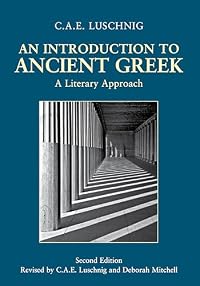
An Introduction to Ancient Greek: A Literary Approach
by C. A. E. Luschnig
On This Page
Description
C.A.E. Luschnig's An Introduction to Ancient Greek: A Literary Approach prepares students to read Greek in less than a year by presenting basic traditional grammar without frills and by introducing real Greek written by ancient Greeks, from the first day of study. The second edition retains all the features of the first but is more streamlined, easier on the eyes, more gender-inclusive, and altogether more 21st century. It is supported by a Web site for teachers and learners at show more http://worldwidegreek.com/. show lessTags
Recommendations




Member Reviews
I have a long history with this book. I used the last preliminary edition (offset, spiral bound, green paper covers) when I first studied Greek in college. The first actual published edition (Scribner's) came out shortly after that. I got the second edition recently. I haven't taught Greek in almost five years and that was koine. The paradigms are fading; occasional reading doesn't keep up all the details and certainly not any active knowledge of the language. So time to go through Luschnig again, reciting the pardigms and doing the exercises.
The outline is still pretty much the same as I remember. Fourteen long lessons, that should have been divided into at least twice that number. Pretty good explanations of grammar, good lexical show more notes, a lot of short bits of real Greek literature to read. Not enough repetition in the exercises as you go along. Not the worst ancient Greek textbook; not sure that I would call any of them really good. It's okay and it's what I am used to. When I taught Greek to theology students, I used John Dobson's Learn Biblical Greek; natural language method, light on grammar, but good for adults who want a basic reading knowledge of NT Greek in the shortest possible time. Dobson is definitely not the best for anyone who plans on doing serious work in Greek, but it worked for my audience.
After I work through Luschnig, I really should read through a serious Greek Grammar. show less
The outline is still pretty much the same as I remember. Fourteen long lessons, that should have been divided into at least twice that number. Pretty good explanations of grammar, good lexical show more notes, a lot of short bits of real Greek literature to read. Not enough repetition in the exercises as you go along. Not the worst ancient Greek textbook; not sure that I would call any of them really good. It's okay and it's what I am used to. When I taught Greek to theology students, I used John Dobson's Learn Biblical Greek; natural language method, light on grammar, but good for adults who want a basic reading knowledge of NT Greek in the shortest possible time. Dobson is definitely not the best for anyone who plans on doing serious work in Greek, but it worked for my audience.
After I work through Luschnig, I really should read through a serious Greek Grammar. show less
I like Luschnig a lot. The way she introduces real Greek early and often is excellent.
Ratings
Members
- Recently Added By
Author Information
10+ Works 189 Members
C. A. E. Luschnig, Ph.D. (1972) in Classics, University of Cincinnati, is Professor Emerita
Classifications
Statistics
- Members
- 147
- Popularity
- 221,998
- Reviews
- 2
- Rating
- (3.50)
- Languages
- English
- Media
- Paper, Ebook
- ISBNs
- 6