On This Page
Description
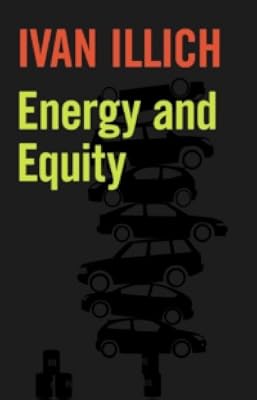
Ivan Illich poses that human problems must be solved by the impressment of still more energy slaves' to meet the expanding demand of human masters. The two solutions consist of securing the current source of the drug, or finding a different, more secure pusher. In this essay, Illich examines the question of whether or not humans need any more energy than is their natural birthright. Along the way he gives a startling analysis of the marginal disutility of tools. After a certain point, that show more is, more energy gives negative returns. For example, moving around causes loss of time proportional to the amount of energy which is poured into the transport system, so that the speed of the fastest traveller correlates inversely to the equality as well as freedom of the median traveller. show lessTags
Recommendations













































Member Reviews
It takes me between 25-30 minutes to ride my bicycle to work. It takes me 45 minutes on average to take the train or tram. When I take my bike, I arrive refreshed, energised, fit, hedonic. I don't get that on the train or tram. Now, some would call me a lefty, progressive, arrogant, greenie, elitist, partly because I live close to the city and can do this. But there is in fact no better way to travel. Illich would imagine our cities designed for such purposes as joy and health rather than despair and exhaustion. We are all equal if we can access the benefits of good ideas. Like all his books, if we could only step away from the authorities that rule our lives and implement the sensible ideas, give up the self-important metaphors and show more symbols, everyone would share the benefits of existence. It always sounds utopian. And yet it always seems close as an idea. show less
Subtitle added by the editor
"La democrazia partecipativa richiede una tecnologia a basso consumo energetico, e gli uomini liberi possono percorrere la strada che conduce a relazioni sociali produttive solo alla velocità di una bicicletta" pag. 20
See Energy, Equity, and Encounter at From Word to Word
Theoretisch betoog in de tijden van energie crisis. In huidige situatie is energie te vervangen voor alle grondstoffen en ruimte, en zou het een pleidooi voor duurzaamheid zijn.
Illich vergelijkt transport (geindustrialiseerd vervoer mbv brandstof) met transit (vervoer op eigen kracht). In de jaren 70 van de vorige eeuw was driekwart van de mensheid nog in transit, en had zelfs geen toegang tot transport. Illich betoogt dat energie (brandstof) dus gelijk staat aan ongelijkheid, en betoogt dat er per persoon een maximimum aan energie beschikbaar gesteld mag worden.
Illich vergelijkt transport (geindustrialiseerd vervoer mbv brandstof) met transit (vervoer op eigen kracht). In de jaren 70 van de vorige eeuw was driekwart van de mensheid nog in transit, en had zelfs geen toegang tot transport. Illich betoogt dat energie (brandstof) dus gelijk staat aan ongelijkheid, en betoogt dat er per persoon een maximimum aan energie beschikbaar gesteld mag worden.
Nov 25, 2024Dutch
Ratings
Members
- Recently Added By
Author Information

78 Works 4,685 Members
Born in Vienna in 1926, Ivan Illich grew up in Europe. He studied theology, philosophy, history, and natural science. During the 1950s he worked as a parish priest among Puerto Ricans in the Hell's Kitchen section of New York City and then served as rector of the Catholic University of Puerto Rico. During the 1960s he founded centers for show more cross-cultural communication, first in Puerto Rico and then in Cuernavaca, Mexico. Since the late 1970s, he has divided his time among Mexico, the United States, and Germany. He is also a professor of Science, Technology, and Society at Penn State University. Illich's radical anarchist views first became widely known through a set of four books published during the early 1970s---Deschooling Society (1971), Tools for Conviviality (1973), Energy and Equity (1974), and Medical Nemesis (1976). Tools is the most general statement of Illich's principles; the other three expand on examples sketched in Today in order to critique what he calls "radical monopolies" in the technologies of education, energy consumption, and medical treatment. This critique applies equally to both the so-called developed and the developing nations but in different ways. Two subsequent collections of occasional pieces---Toward a History of Needs (1978) and Shadow Work (1981)---stress the distorting influence on society and culture of the economics of scarcity, or the presumption that economies function to remedy scarcities rather than to share goods. Toward a History of Needs also initiates a project in the history or archaeology of ideas that takes its first full-bodied shape in Gender (1982), an attempt to recover social experiences of female-male complementarity that have been obscured by the modern economic regime. H2O and the Waters of Forgetfulness (1985) extends this project into a history of "stuff." ABC:The Alphabetization of the Popular Mind (1988) carries Illich's project forward into the area of literacy, as does his most recent book, In the Vineyard of the Text (1993). In the Mirror of the Past (1992) is a collection of occasional essays and talks from the 1980s, linking his concerns with economics, education, history, and the new ideological meaning of life. Illich himself is a polymath who speaks at least six languages fluently and who writes regularly in three of these (English, Spanish, and German); his books have been translated into more than 15 other languages. (Bowker Author Biography) show less
Series

Common Knowledge
- First words
- It has recently become fashionable to insist on an impending energy crisis.
- Quotations
- High quanta of energy degrade social relations just as inevitably as they destroy the physical milieu
- Last words
- (Click to show. Warning: May contain spoilers.)The crucial point at which these effects can be reversed is not, however, a matter of deduction, but of decision.
Classifications
- Genres
- Sociology, Nonfiction, Science & Nature, General Nonfiction, Economics, Philosophy, History
- DDC/MDS
- 301.5 — Society, government, & culture Social sciences, sociology & anthropology Sociology and anthropology Formerly: Institutions
- LCC
- HE193 .I44 — Social sciences Transportation and communications Transportation and communications
- BISAC
Statistics
- Members
- 176
- Popularity
- 186,470
- Reviews
- 6
- Rating
- (3.83)
- Languages
- 8 — Danish, Dutch, English, French, German, Italian, Spanish, Swedish
- Media
- Paper, Ebook
- ISBNs
- 16
- ASINs
- 4