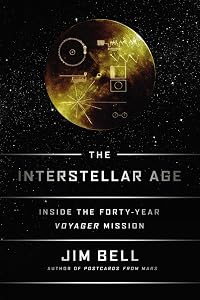
The Interstellar Age: Inside the Forty-Year Voyager Mission
by Jim Bell
On This Page
Description
"The story of the men and women who drove the Voyager spacecraft mission- told by a scientist who was there from the beginning. The Voyager spacecraft are our farthest-flung emissaries-11.3 billion miles away from the crew who built and still operate them, decades since their launch. Voyager 1 left the solar system in 2012; its sister craft, Voyager 2, will do so in 2015. The fantastic journey began in 1977, before the first episode of Cosmos aired. The mission was planned as a grand tour show more beyond the moon; beyond Mars, Jupiter, and Saturn; and maybe even into interstellar space. The fact that it actually happened makes this humanity's greatest space mission. In The Interstellar Age, award-winning planetary scientist Jim Bell reveals what drove and continues to drive the members of this extraordinary team, including Ed Stone, Voyager's chief scientist and the one-time head of NASA's Jet Propulsion Lab; Charley Kohlhase, an orbital dynamics engineer who helped to design many of the critical slingshot maneuvers around planets that enabled the Voyagers to travel so far; and the geologist whose Earth-bound experience would prove of little help in interpreting the strange new landscapes revealed in the Voyagers' astoundingly clear images of moons and planets. Speeding through space at a mind-bending eleven miles a second, Voyager 1 is now beyond our solar system's planets. It carries with it artifacts of human civilization. By the time Voyager passes its first star in about 40,000 years, the gold record on the spacecraft, containing various music and images including Chuck Berry's "Johnny B. Goode," will still be playable"-- show lessTags
Recommendations





Member Reviews
In The Interstellar Age: Inside the Forty-Year Voyager Mission, Jim Bell tells the story of NASA’s Voyagers 1 and 2, from the original realization that a rare planetary alignment would allow a Grand Tour of the outer solar system through their current work mapping the boundary between the sun’s influence and interstellar space. As awe-inspiring as the information Voyager is, Bell humanizes his narrative by focusing on the lives and work of those involved in the project in one form or another over its 40-year history. He focuses on how they organized their lives around the planetary fly-bys and how they inscribed their hopes and dreams onto Voyager 1 and 2, literally in the case of the Golden Record. Discussing the differences show more between the period in which Voyager launched and now, Bell writes of New Horizons (which flew-by Pluto in 2015), “It was launched without an interstellar message like Voyager’s on board. Perhaps this is a sign of a more anxious age” (pg. 97). In this, Bell examines the shifting national mood since the 1970s and new concerns about possible contact with extraterrestrial life based on our own history, such as the encounters between the Old World and the New. In turning to follow-up missions like Galileo and Cassini, which expanded upon the Voyager mission’s data from Jupiter and Saturn, respectively, Bell argues that both Uranus and Neptune deserve follow-up as they each only received a single fly-by and the most recent information comes at a distance from Earth-based observatories. He writes, “In the Interstellar Age, we know that to truly get to know a place, you’ve got to spend real time there, among the locals, learning their strange, alien ways” (pg. 189). Both NASA aficionados and those studying the history of space flight will find Bell’s work a valuable addition to their bookshelves. show less
I was in elementary school and middle school in the late 90s/early 2000s, and until I read this book, I had no idea that the pictures of the planets in my textbooks, specifically Saturn, Jupiter, Neptune, and Uranus, were taken by the Voyager satellites only years before. I took it for granted that scientists somehow had pictures (or at least a general idea of what those planets looked like), and that was how we knew, too. It was really exciting and interesting to read about how the Voyager scientists planned and implemented the mission (two Voyager satellites were sent out into space to photograph and study the 4 planets and their moons, using gravity from each as a slingshot to get to the next planet; the first was sent off into space show more after Jupiter, and the second continued on to the last two planets before it, too, continued its interstellar journey). It's amazing that some of the scientists working on this mission have been doing so for 40 years! Talk about your life's work...
Bell writes about the science involved with the Voyagers in a mostly understandable way. There were only a few points where I had to re-read or just skim altogether because I had no idea what was going on. I also enjoyed how he framed his Voyager history by going into his own personal history with science and space (although this may annoy some readers, I found his humor and absolute awe with JPL, NASA, and space exploration a delight). Bell conducted interviews with scientists who were/are involved with the mission, so it was neat to get first person insight into the successes and troubles of the mission.
Since the satellites completed their "prime directive" of studying the planets some years ago, they have spent the time since travelling ever onward into interstellar space, with the goal of one day passing the heliopause (the boundary between the solar and interstellar winds, aka, Way Way Far Out). What’s amazing is that the satellites have the capacity to last for decades more out in space, which means we can still get readings on the space that they are travelling through (and I mean travel: the satellites are going about 1o miles per second!). Now this is what really blows my mind: even travelling at that speed, the Voyagers will still take about 30,000 years to reach the edge of the Oort Cloud (the huge shell of asteroids and comets that extends to the edge of the sun’s gravitational influence). Space! It’s HUGE! Clearly, I geeked out hardcore over this book. I thoroughly enjoyed learning about the Voyagers, and I especially enjoyed Bell's ruminations on extraterrestrial beings (or future Earth space travelers in the distant future who will be able to catch up to them) finding the satellites and the Golden Record on which we recorded what we and our planet are like. show less
Bell writes about the science involved with the Voyagers in a mostly understandable way. There were only a few points where I had to re-read or just skim altogether because I had no idea what was going on. I also enjoyed how he framed his Voyager history by going into his own personal history with science and space (although this may annoy some readers, I found his humor and absolute awe with JPL, NASA, and space exploration a delight). Bell conducted interviews with scientists who were/are involved with the mission, so it was neat to get first person insight into the successes and troubles of the mission.
Since the satellites completed their "prime directive" of studying the planets some years ago, they have spent the time since travelling ever onward into interstellar space, with the goal of one day passing the heliopause (the boundary between the solar and interstellar winds, aka, Way Way Far Out). What’s amazing is that the satellites have the capacity to last for decades more out in space, which means we can still get readings on the space that they are travelling through (and I mean travel: the satellites are going about 1o miles per second!). Now this is what really blows my mind: even travelling at that speed, the Voyagers will still take about 30,000 years to reach the edge of the Oort Cloud (the huge shell of asteroids and comets that extends to the edge of the sun’s gravitational influence). Space! It’s HUGE! Clearly, I geeked out hardcore over this book. I thoroughly enjoyed learning about the Voyagers, and I especially enjoyed Bell's ruminations on extraterrestrial beings (or future Earth space travelers in the distant future who will be able to catch up to them) finding the satellites and the Golden Record on which we recorded what we and our planet are like. show less
While the writing won't win any awards, I have to say I really, really loved this frankly adoring account of the Voyager mission, complete with profiles of the people involved that fall well over the line into hero-worship. Bell's enthusiasm is irresistible, and his descriptions of the many technical issues the teams of scientists and engineers had to solve are just fascinating. In the end the reader feels that Bell's sometimes gushing praise of the project and the people involved in it is entirely deserved -- the fact that the mission performed so well, for so long, as teams cycled in and out of the Voyager project, budgets were allocated and then cut, equipment updated, failed, upgraded, and all the while this bundle of parts armed show more with technology analogous to 8 track tape players hurtled farther and farther away....it really is a testament to what we can achieve when we want to. It would be dismissing the hard work of the people involved to call the Voyager mission "miraculous," but by the end of the book it sure feels that way. Especially now, against the backdrop of a polarized, petty American political climate.
But the real attraction of the book was the enthusiastic guided tour it offers of the solar system. Each time Voyager passes a planet, or a moon, Bell can barely contain himself while describing how amazing the discoveries were -- how unexpected so many things turned out to be -- rings around Uranus! Volcanoes on Io! Windy weather on Neptune! It really made me realize how much I take for granted, living in an era where space exploration is a reality, where periodic pictures of other planets, from space probes launched decades ago, showing up in my facebook news feed are wonderful, but not so surprising.
I kind of want to send the book to any member of congress who questions why we should spend money on the space program. But even more than that, I'm reminded of why I am very lucky to be of the generation who understands what it means to be able to see the Earth, and so much more, from space. show less
But the real attraction of the book was the enthusiastic guided tour it offers of the solar system. Each time Voyager passes a planet, or a moon, Bell can barely contain himself while describing how amazing the discoveries were -- how unexpected so many things turned out to be -- rings around Uranus! Volcanoes on Io! Windy weather on Neptune! It really made me realize how much I take for granted, living in an era where space exploration is a reality, where periodic pictures of other planets, from space probes launched decades ago, showing up in my facebook news feed are wonderful, but not so surprising.
I kind of want to send the book to any member of congress who questions why we should spend money on the space program. But even more than that, I'm reminded of why I am very lucky to be of the generation who understands what it means to be able to see the Earth, and so much more, from space. show less
I thoroughly enjoyed this book, and I think that it was the perfect balance between narrative and science. Bell begins the book by giving an overview of his background and his connection to the Voyagers. Luckily, this section didn't drone on and on (his life is interesting, but then again, this is not a memoir), and Bell quickly transitioned to speaking about the Voyagers. The book is logically organized - based upon the chronological order of the Voyager events - and that makes it easy to follow. Bell does an excellent job of weaving imagery, science, and the story of Voyager into well-paced chapters of digestible length. He is also spot on with the amount of scientific detail he provides. It is enough to satisfy an information hungry show more person like me, but it is easily digestible for someone who may not be as familiar with the science before reading the book. In all, I gained a great appreciation for the not only the Voyager missions, but also for the planets and moons in our own backyard. show less
I love space. Space missions, thinking about other planets/worlds/alien life. It's all so cool to me. I also read a huge amount, primarily science fiction and fantasy. One thing I get less of though is non-fiction, and from time to time I try to fix that.
[b:The Interstellar Age: Inside the Forty-Year Voyager Mission|22571516|The Interstellar Age Inside the Forty-Year Voyager Mission|Jim Bell|https://i.gr-assets.com/images/S/compressed.photo.goodreads.com/books/1404484684l/22571516._SX50_.jpg|42038013] is a great way to change that. (That's quite the title).
In a nutshell, it's a story of the Voyager missions, going into background years (centuries) before they were even launched up through each of the fly-bys, and into a more than show more decent sprinkling of the human side of the story.
There are some wonderful scientific tidbits in there that I half knew but really liked getting numbers for.
I work with computer hardware and software day in and out, so seeing just how underpowered Voyager was compared to modern devices? Awesome.
Learning about how they reprogrammed it and added compression remotely (about as remotely as has ever been done...) to better change in software what hardware couldn't change? Awesome.
Realizing that these are human devices mind numbingly far away from us... and yet we can still talk to them and get data back? Awesome.
The human half of the story... I'm still not sure what to think about it. It ends up being rather more personal, with the author's tangential involvement taking up a lot of the story. And... I didn't always care about it. Get me back to the technology and SCIENCE! But really, without the human part of it, we never would have had this mission. We never would have had this book. So for that at least, it makes it work.
All together, it's a wonderful story and a well written book. Well worth the read. show less
[b:The Interstellar Age: Inside the Forty-Year Voyager Mission|22571516|The Interstellar Age Inside the Forty-Year Voyager Mission|Jim Bell|https://i.gr-assets.com/images/S/compressed.photo.goodreads.com/books/1404484684l/22571516._SX50_.jpg|42038013] is a great way to change that. (That's quite the title).
In a nutshell, it's a story of the Voyager missions, going into background years (centuries) before they were even launched up through each of the fly-bys, and into a more than show more decent sprinkling of the human side of the story.
There are some wonderful scientific tidbits in there that I half knew but really liked getting numbers for.
I work with computer hardware and software day in and out, so seeing just how underpowered Voyager was compared to modern devices? Awesome.
Learning about how they reprogrammed it and added compression remotely (about as remotely as has ever been done...) to better change in software what hardware couldn't change? Awesome.
Realizing that these are human devices mind numbingly far away from us... and yet we can still talk to them and get data back? Awesome.
The human half of the story... I'm still not sure what to think about it. It ends up being rather more personal, with the author's tangential involvement taking up a lot of the story. And... I didn't always care about it. Get me back to the technology and SCIENCE! But really, without the human part of it, we never would have had this mission. We never would have had this book. So for that at least, it makes it work.
All together, it's a wonderful story and a well written book. Well worth the read. show less
One of the greatest voyages of discovery humanity has ever embarked upon began with the launch of the Voyager spacecraft in 1977. In this book, Bell provides a historical narrative that almost reads like an adventure novel. It's engaging, informative, and inspiring.
This is an ok book. It's a decent overview of the Voyager missions which started in the 1970s and are still ongoing. Mr. Bell coincidentally started his space career in the 70s and we follow his voyages through life in parallel with those of the satellites. It has a romantic touch. But there is something forced about his continual excitement, I never got too excited anyway. But it was interesting to learn how this mission came about, including the guy who figured it was possible due to the planets lining up perfectly and then wasn't given credit for the discovery - d'oh. The debate over if/when they have left the solar system is curious and ongoing. I thought giving the job to Carl Sagan to create a message for aliens was political and show more should have been given to someone in the humanities - history etc - who are trained and experienced in separating short term trends (pop culture) from immutable traits. show less
Members
- Recently Added By
Lists

Science: Astronomy
62 works; 2 members

2016 Notable Books for Adults
26 works; 7 members

al.vick-wishlist-science and nature
83 works; 1 member

Books in the Bibliography of The Alchemy of Us by Ainissa Ramirez
181 works; 1 member
Author Information

13+ Works 752 Members
Jim Bell, is a professor in the School of Earth and Space Exploration at Arizona, State University, an adjunct professor in the Department of Astronomy at Cornell University, and the president of the Planetary Society. He and his teammates have received more than a dozen NASA Group Achievement Awards for the work on space missions, and he was the show more recipient of the 2011 Carl Sagan Medal for Excellence in Public Communication in Planetary Science from the American Astronomical Society. show less
Awards and Honors
Distinctions
Common Knowledge
- Original publication date
- 2015
Classifications
- Genres
- Science & Nature, Nonfiction, General Nonfiction, Travel, History
- DDC/MDS
- 919.9 — History & geography Geography & travel Geography of and travel in Australasia, Pacific Ocean islands, Atlantic Ocean islands, Arctic islands, Antarctica and on extraterrestrial worlds Extraterrestrial regions
- LCC
- QB601 .B45 — Science Astronomy Astronomy Descriptive astronomy Solar system
- BISAC
Statistics
- Members
- 210
- Popularity
- 155,709
- Reviews
- 12
- Rating
- (4.09)
- Languages
- English, Italian
- Media
- Paper, Audiobook, Ebook
- ISBNs
- 5
- ASINs
- 6