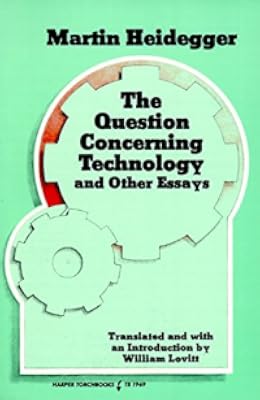
The Question Concerning Technology, and Other Essays
by Martin Heidegger
On This Page
Description
"To read Heidegger is to set out on an adventure. The essays in this volume--intriguing, challenging, and often baffling to the reader--call him always to abandon all superficial scanning and to enter wholeheartedly into the serious pursuit of thinking.... "Heidegger is not a 'primitive' or a 'romanitic.' He is not one who seeks escape from the burdens and responsibilities of contemporary life into serenity, either through the re-creating of some idyllic past or through the exalting of some show more simple experience. Finally, Heidegger is not a foe of technology and science. He neither disdains nor rejects them as though they were only destructive of human life. "The roots of Heidegger's hinking lie deep in the Western philosophical tradition. Yet that thinking is unique in many of its aspects, in its language, and in its leterary expression. In the development of this thought Heidegger has been taught chiefly by the Greeks, by German idealism, by phenomenology, and by the scholastic theological tradition. In him these and other elements have been fused by his genius of sensitivity and intellect into a very individual philosophical expression." --William Lovitt, from the Introduction show lessTags
Recommendations












Member Reviews
Many people who seem to be considered and insightful have expressed respect for the work of Martin Heidegger. But I have found the "Heideggerian" theorists I've read to be invested in what seemed to be painfully obscure jargon, and I decided that I wouldn't make much headway without reading some of Heidegger's own writings. This relatively slim volume looked optimal, in that it is trained on topics both important to Heidegger's larger project and interesting to me. In particular, the idea of "technology" as a fundamental aspect of human thought and an examination of Nietzsche as an epochal thinker were more-than-tempting attractions.
Alas, I doubt that I will return to Heidegger after this experience. As I read, I constantly felt like I show more was getting a snow job. How else should I react to this sort of prose?
"Reality means, then, when thought sufficiently broadly: that which, brought forth hither into presencing, lies before; it means the presencing, consummated in itself, of self-bringing-forth." (160)
Is the translator William Lovitt to blame? Well, Lovitt has labored mightily to make his work transparent; the book is littered with long footnotes discussing his translation choices and analyzing the polyvalence and connotative shades of Heidegger's German diction. In his introduction to the volume Lovitt heaps adulation on Heidegger as a thinker and a stylist, but the texts at hand did not justify the praise from where I sit. Lovitt writes:
"Above all, the reader must not grow deaf to Heidegger's words; he must not let their continual repetition or their appearance in all but identical phrases lull him into gliding effortlessly on, oblivious to the subtle shifts and gatherings of meaning that are constantly taking place." (xxiii)
But I can only conclude that such a numbed trance is exactly the effect Heidegger is after with his incantations. These essays are obscurantist sermons: "philosophy" in the pontifical vein, rather than the critical. To the extent that there were worthwhile ideas here, I have seen them treated more usefully by post-structuralists who had doubtless read their Heidegger. But I will not accept Heidegger's notion of "metaphysics," nor will I be suckered by his "Being as distinct from that which is." show less
Alas, I doubt that I will return to Heidegger after this experience. As I read, I constantly felt like I show more was getting a snow job. How else should I react to this sort of prose?
"Reality means, then, when thought sufficiently broadly: that which, brought forth hither into presencing, lies before; it means the presencing, consummated in itself, of self-bringing-forth." (160)
Is the translator William Lovitt to blame? Well, Lovitt has labored mightily to make his work transparent; the book is littered with long footnotes discussing his translation choices and analyzing the polyvalence and connotative shades of Heidegger's German diction. In his introduction to the volume Lovitt heaps adulation on Heidegger as a thinker and a stylist, but the texts at hand did not justify the praise from where I sit. Lovitt writes:
"Above all, the reader must not grow deaf to Heidegger's words; he must not let their continual repetition or their appearance in all but identical phrases lull him into gliding effortlessly on, oblivious to the subtle shifts and gatherings of meaning that are constantly taking place." (xxiii)
But I can only conclude that such a numbed trance is exactly the effect Heidegger is after with his incantations. These essays are obscurantist sermons: "philosophy" in the pontifical vein, rather than the critical. To the extent that there were worthwhile ideas here, I have seen them treated more usefully by post-structuralists who had doubtless read their Heidegger. But I will not accept Heidegger's notion of "metaphysics," nor will I be suckered by his "Being as distinct from that which is." show less
Technology in the twentieth and twenty-first centuries can be as much of a problem as a help. As an instrument, it can make mass killing much easier. Indeed, nuclear bombs enable the world to potentially destroy itself in less than an hour. Yet technology can enable human flourishing as well. For instance, I develop software professionally that I hope will help my domain (medical research) advance. How are we to understand technology, a concept as ancient as early Greeks, and how do we ensure that we use it properly? These questions, Heidegger – the famous German philosopher – considers in his essay “The Question Concerning Technology.” (I will not here address the other essays in this volume.)
Heidegger describes technology by show more the cryptic but descriptive word, an “Enframing.” That is, technology frames a truth about the world and about human nature. For example, cars encapsulate the truth about the combustion engine and also the truth that humans like motility. Technology is related to science by presenting this truth of use of combustion to provide energy, but technology is not merely applied science. Instead, technology is somewhat of an art-form that engages the human spirit. Cars therefore become an extension of who we owners are.
Understanding instruments as “Enframings” makes us understand that technology merely presents humanity with an ethical question: Should I act thusly? It is up to the human to decide this, and it is up to the arts to allow us to see our situation clearly enough to make the right choice. Science provides the truth that the instrument is based upon, but the arts engage the human soul. Used correctly, technology can have “saving power.” Used incorrectly, it can merely provides humans with estrangement and alienation. Potentially, it can lead to our destruction.
Science (first) and industry (later) have transformed civilization and produced the modern world. Some fear that the technological revolution has created a world that is run afoul of its purpose. Instead of this reactionary view that would have us return to an agrarian society, Heidegger provides a way forward by identifying technology’s saving power. In an era where American Big Tech is accused of monopolizing and censoring powers, such a saving power is still needed. That makes this essay, published originally in the 1950s (shortly after the mass destruction of World War II), more relevant than ever seventy years later. show less
Heidegger describes technology by show more the cryptic but descriptive word, an “Enframing.” That is, technology frames a truth about the world and about human nature. For example, cars encapsulate the truth about the combustion engine and also the truth that humans like motility. Technology is related to science by presenting this truth of use of combustion to provide energy, but technology is not merely applied science. Instead, technology is somewhat of an art-form that engages the human spirit. Cars therefore become an extension of who we owners are.
Understanding instruments as “Enframings” makes us understand that technology merely presents humanity with an ethical question: Should I act thusly? It is up to the human to decide this, and it is up to the arts to allow us to see our situation clearly enough to make the right choice. Science provides the truth that the instrument is based upon, but the arts engage the human soul. Used correctly, technology can have “saving power.” Used incorrectly, it can merely provides humans with estrangement and alienation. Potentially, it can lead to our destruction.
Science (first) and industry (later) have transformed civilization and produced the modern world. Some fear that the technological revolution has created a world that is run afoul of its purpose. Instead of this reactionary view that would have us return to an agrarian society, Heidegger provides a way forward by identifying technology’s saving power. In an era where American Big Tech is accused of monopolizing and censoring powers, such a saving power is still needed. That makes this essay, published originally in the 1950s (shortly after the mass destruction of World War II), more relevant than ever seventy years later. show less
Elegance is king. At a vulgar-relationistic level, Heidegger is just making the same argument re technology here that Foucault makes re sex in The History of Sexuality--disciplining injunctions of the centre, etc. etc., you know. But he does it in such a graceful way, with prose that not only has to communicate the argument but also carry the implicit weight of Heidegger's conceptual universe--Dasein and Gestell and all the rest. He is a brilliant stylist.
With a brilliant argument! I said "disciplining" injunctions, but that really is more appropriate to Foucault and sex--Heidegger sees post-industrial technology functioning more as a regulatory, enframing, interpellating world-system, no longer materiel or practices open to show more instrumental use by humans, interacting with them in an instrumental or knowledgeable or artisanal way, but an ideological demand to lay the world open as a standing reserve, immediate potential wealth or energy or whatever, from the airplane always on the runway to the electricity always available at the flick of a switch--and then to keep it open. He contrasts the pre-modern woodsman, interacting with the forest in a sensual, craftsmanlike way that requires immersion in a body of knowledge and practices--a forestness--and the modern, industrial stripping of a hillside. He contrasts the poet Hoelderlin's (allegedly) authentic, numinous experience of the Rhine with the modern relationship--we worship the river god by tending the hydroelectric dam that enchains him according to the procedures in the manual; by viewing Hoelderlin's perch as part of a tour group. It's a bureaucratized technology, death by a thousand paper cuts. You know.
And he doesn't explicitly contrast it with art, at least not here, but I suspect Heidegger would not quibble with the idea that we need to bring a little art to technological civilization--or more specifically, that science is to technology as arts are to crafts, and that to deny that is to deny a facet of our humanity, the Dasein transfixing itself in an internally reproduced and too too restrictive Gestell. We need to "enclear" the mystery of ourselves and our practices, bring the magic into the light, stop it from receding in front of a growing cleared, laid-open space, but entice and foster it into a non-totalizing Lichtung, a temple.
Can I put it in everyday 2010 terms for you like this? How much time every day do you spend checking your Facebook, shopping for shit on Amazon, reading stuff three link-degrees away from what you started on where once you would have skimmed the finite paper over coffee, even fighting with the bank because their online system fucked up your mortgage payment, or with the insurance people because THEIR automated phone system sent you into an endless purgatorial loop . . . . And then--perhaps--you spend your work day servicing some part of this system too, in some way, or you know someone who does, yeah?
And useful and fascinating and bracing and empowering as that all is, it also enrages me. Heidegger talks about how he's not reaching backward to an idealized preindustrial state, but "looking forward to the dawn". But he is absolutely looking back! All this woodsman stuff, and you can't help but remark the glaring lack at the centre of his argument--not once does he mention capital. If we're the yeomen of the laying-open, Marty Mart, who is setting us to it? Technology is regulation of the human. I get that. But it's also the means of wealth creation--the two blend seamlessly into each other, in fact, reserve capability, reserve production, reserve funds. How much money have you spent on all that computer and ipod and cellphone junk this year? Twenty years ago that figure would have been close to zero.
And Heidegger elides, and evokes a mythic past. And eventually you can't escape his Naziness, not in that cheap rhetorical "his politics invalidate his philosophy" way, but he is a reactionary! And it is, in fact, that much-maligned and allegedly outdated ol' Karl Marx who talked about this stuff, a hundred years earlier, in terms of the alienation of the worker from his labour, the monetization of everything, and the capitalist social order. Heidegger ignores that, and he is not ignorant, and I think that makes him dishonest, and given his politics, that makes him terrifying. This is a great read, both for its ideas and to see the virtuosity with which Heidegger pulls off his sleazeball fascist move. show less
With a brilliant argument! I said "disciplining" injunctions, but that really is more appropriate to Foucault and sex--Heidegger sees post-industrial technology functioning more as a regulatory, enframing, interpellating world-system, no longer materiel or practices open to show more instrumental use by humans, interacting with them in an instrumental or knowledgeable or artisanal way, but an ideological demand to lay the world open as a standing reserve, immediate potential wealth or energy or whatever, from the airplane always on the runway to the electricity always available at the flick of a switch--and then to keep it open. He contrasts the pre-modern woodsman, interacting with the forest in a sensual, craftsmanlike way that requires immersion in a body of knowledge and practices--a forestness--and the modern, industrial stripping of a hillside. He contrasts the poet Hoelderlin's (allegedly) authentic, numinous experience of the Rhine with the modern relationship--we worship the river god by tending the hydroelectric dam that enchains him according to the procedures in the manual; by viewing Hoelderlin's perch as part of a tour group. It's a bureaucratized technology, death by a thousand paper cuts. You know.
And he doesn't explicitly contrast it with art, at least not here, but I suspect Heidegger would not quibble with the idea that we need to bring a little art to technological civilization--or more specifically, that science is to technology as arts are to crafts, and that to deny that is to deny a facet of our humanity, the Dasein transfixing itself in an internally reproduced and too too restrictive Gestell. We need to "enclear" the mystery of ourselves and our practices, bring the magic into the light, stop it from receding in front of a growing cleared, laid-open space, but entice and foster it into a non-totalizing Lichtung, a temple.
Can I put it in everyday 2010 terms for you like this? How much time every day do you spend checking your Facebook, shopping for shit on Amazon, reading stuff three link-degrees away from what you started on where once you would have skimmed the finite paper over coffee, even fighting with the bank because their online system fucked up your mortgage payment, or with the insurance people because THEIR automated phone system sent you into an endless purgatorial loop . . . . And then--perhaps--you spend your work day servicing some part of this system too, in some way, or you know someone who does, yeah?
And useful and fascinating and bracing and empowering as that all is, it also enrages me. Heidegger talks about how he's not reaching backward to an idealized preindustrial state, but "looking forward to the dawn". But he is absolutely looking back! All this woodsman stuff, and you can't help but remark the glaring lack at the centre of his argument--not once does he mention capital. If we're the yeomen of the laying-open, Marty Mart, who is setting us to it? Technology is regulation of the human. I get that. But it's also the means of wealth creation--the two blend seamlessly into each other, in fact, reserve capability, reserve production, reserve funds. How much money have you spent on all that computer and ipod and cellphone junk this year? Twenty years ago that figure would have been close to zero.
And Heidegger elides, and evokes a mythic past. And eventually you can't escape his Naziness, not in that cheap rhetorical "his politics invalidate his philosophy" way, but he is a reactionary! And it is, in fact, that much-maligned and allegedly outdated ol' Karl Marx who talked about this stuff, a hundred years earlier, in terms of the alienation of the worker from his labour, the monetization of everything, and the capitalist social order. Heidegger ignores that, and he is not ignorant, and I think that makes him dishonest, and given his politics, that makes him terrifying. This is a great read, both for its ideas and to see the virtuosity with which Heidegger pulls off his sleazeball fascist move. show less
Briljante uitwerking van het gevaar van de techNiek: niet beleren of technofobisch, maar haast metafysisch. Mooie inleiding ook tot Heideggers denken (hij legt helder uit wat er met verhullen en onthullen bedoeld wordt). Een aanrader!
The essays in this volume are fascinating, thought-provoking, and frequently perplexing to the reader. They urge him to always give up on cursory reading and to fully commit to the serious practice of thinking. Even though these essays are difficult, they illustrate Heidegger's techniques and offer the reader multiple interpretations.
Whatever you think about Heidegger the title essay is a "must read".
I have read in English Martin Heidegger's, "The Question Concerning Technology and Other Essays". I started reading at the beginning and continued reading generally forward temporally and linear-spatially throughout the entire middle until arriving at the end. On reaching the end, I stopped.
Heidegger builds an argument atom by atom. He does not simply assert a few figurative electrons, protons and neutrons, because as individuals-in-themselves the electrons (and so forth) do not comprise atoms-as-atoms since they must first be configured in each of the three arbitrarily oriented but necessarily orthogonal dimensions and in time, both at a moment and at a location however imprecisely known or unknowable in detail, in order to act as show more atoms-as-atoms rather than as electrons (and so forth)-as their-various-selves.
His atoms in delineated circumstances collide or approach sufficiently to form molecules unique, though not impossibly mutually dissimilar, to their precise content and form. Each molecule embodies two or more atoms. Their molecular essence differs from that of their composite atoms-as-atoms when their properties are represented by qualities subject to the senses, whether experienced directly by the senses-in-themselves or indirectly by sense-enhancement technologies only thereafter accessed and evaluated in turn through the senses-in-themselves. The widened spectrum of the sense-properties of molecules over atoms is a combinatorial power-in-itself, -as-itself and -of-itself. Call this power the power of emergence.
Heidegger's molecules are organic. Their essences as-organics instantiate themselves in ur-chains and ur-loops.
Ur-chains may be arranged or may rather self-arrange into various quasi-linear structural formations with a privileged-as-endpoint atom at each atom-discontinuation position (and time) characterized by adjoinment to only a single other atom rather than to two others. Each simple chain comprises two ends exactly, along with the middle, save for absence of the middle in the two-atom molecule, which is un-organic in spirit if not by convention. In principle although not invariably, the longer stretches the chain, the more it can do, despite some very long ones which do nothing whatever. Call this power the power of concatenation.
The ur-loops gain their particular circuitous-object essence by providing a course around the molecule in either, indeed in both, of the two available directions without any particular and specific discoverable-in-principle terminus-locus which may objectively privilege-as-endpoint itself above any other, before returning along its full periphery to the initial atom-itself, not to admit in this context a different atom merely of the same category-as-atom, if any other such is present, compared in mutual isolation. Loops, as compared to chains, engender added levels to senses-themselves and may characteristically, but not must invariably, require relatively less axilineal or volumetric extension. Call this power the power of loopiness.
The smallest ur-chains and ur-loops are further sequentially assembled into larger entities to form amalgamated chains and loops: each with one ur-another, with their own ur-self-types, or indeed and remarkably with enwreathed ur-loops-within-ur-loops. (Remember the ur-loops-within-ur-loops.) This implicates the capacity inherent in chains to converge and conjoin within chains themselves, similar or divergent, which event-type could in any case result in a longer yet still simple chain-itself or else some propeller-like or other multi-spindled oddity, which might or might not exhibit both simple-chain-like and loop-like characteristics and would necessitate new and more inclusive or exclusive (and if exclusive, then additional or conditional) definitions of chain, end-point, or both. The ur-loops-within-ur-loops (remember) promise yet even greater things ahead: uber-loops.
As new things-in-themselves arise in consequence, new words must be fashioned in order to delineate precisely the nature of their resulting experiential qualities. Or we may instead re-define old words or hyphenate them newly. We may also hyphenate the new ones. We may do both simultaneously, contingently, consequentially, or (inclusively or [exclusively] exclusively) merely consecutively, forward or retrograde. Call this power the power of word-power, a power which must be respected.
Now we are unhindered in word-sense. We have accumulated and assembled molecules by powers of emergence, concatenation, loopiness and word-power into a new-name class of material. Its substance-as-usage is necessarily, indeed strictly logically, circumscribed or narrowed by our definitional precision, yet is unrestrained by any narrowness in latitude not always correctly and coherently imputable, nor by any which is invariably consistently and positively non-imputable, to the new-or old-hyphenated-or-both (and so forth)-words-as-words-in-themselves. We are unlikely of indisputable reproach.
The Question Concerning Heidegger-as-philosopher arises in deciding whether this new-name material is useful.
If Philosophy can answer this question clearly and if the answer is positive, then good for Philosophy. If not, then too bad for Philosophy. Perhaps any advance is already entrained imperceptibly with the numinous zeitgeist. show less
Heidegger builds an argument atom by atom. He does not simply assert a few figurative electrons, protons and neutrons, because as individuals-in-themselves the electrons (and so forth) do not comprise atoms-as-atoms since they must first be configured in each of the three arbitrarily oriented but necessarily orthogonal dimensions and in time, both at a moment and at a location however imprecisely known or unknowable in detail, in order to act as show more atoms-as-atoms rather than as electrons (and so forth)-as their-various-selves.
His atoms in delineated circumstances collide or approach sufficiently to form molecules unique, though not impossibly mutually dissimilar, to their precise content and form. Each molecule embodies two or more atoms. Their molecular essence differs from that of their composite atoms-as-atoms when their properties are represented by qualities subject to the senses, whether experienced directly by the senses-in-themselves or indirectly by sense-enhancement technologies only thereafter accessed and evaluated in turn through the senses-in-themselves. The widened spectrum of the sense-properties of molecules over atoms is a combinatorial power-in-itself, -as-itself and -of-itself. Call this power the power of emergence.
Heidegger's molecules are organic. Their essences as-organics instantiate themselves in ur-chains and ur-loops.
Ur-chains may be arranged or may rather self-arrange into various quasi-linear structural formations with a privileged-as-endpoint atom at each atom-discontinuation position (and time) characterized by adjoinment to only a single other atom rather than to two others. Each simple chain comprises two ends exactly, along with the middle, save for absence of the middle in the two-atom molecule, which is un-organic in spirit if not by convention. In principle although not invariably, the longer stretches the chain, the more it can do, despite some very long ones which do nothing whatever. Call this power the power of concatenation.
The ur-loops gain their particular circuitous-object essence by providing a course around the molecule in either, indeed in both, of the two available directions without any particular and specific discoverable-in-principle terminus-locus which may objectively privilege-as-endpoint itself above any other, before returning along its full periphery to the initial atom-itself, not to admit in this context a different atom merely of the same category-as-atom, if any other such is present, compared in mutual isolation. Loops, as compared to chains, engender added levels to senses-themselves and may characteristically, but not must invariably, require relatively less axilineal or volumetric extension. Call this power the power of loopiness.
The smallest ur-chains and ur-loops are further sequentially assembled into larger entities to form amalgamated chains and loops: each with one ur-another, with their own ur-self-types, or indeed and remarkably with enwreathed ur-loops-within-ur-loops. (Remember the ur-loops-within-ur-loops.) This implicates the capacity inherent in chains to converge and conjoin within chains themselves, similar or divergent, which event-type could in any case result in a longer yet still simple chain-itself or else some propeller-like or other multi-spindled oddity, which might or might not exhibit both simple-chain-like and loop-like characteristics and would necessitate new and more inclusive or exclusive (and if exclusive, then additional or conditional) definitions of chain, end-point, or both. The ur-loops-within-ur-loops (remember) promise yet even greater things ahead: uber-loops.
As new things-in-themselves arise in consequence, new words must be fashioned in order to delineate precisely the nature of their resulting experiential qualities. Or we may instead re-define old words or hyphenate them newly. We may also hyphenate the new ones. We may do both simultaneously, contingently, consequentially, or (inclusively or [exclusively] exclusively) merely consecutively, forward or retrograde. Call this power the power of word-power, a power which must be respected.
Now we are unhindered in word-sense. We have accumulated and assembled molecules by powers of emergence, concatenation, loopiness and word-power into a new-name class of material. Its substance-as-usage is necessarily, indeed strictly logically, circumscribed or narrowed by our definitional precision, yet is unrestrained by any narrowness in latitude not always correctly and coherently imputable, nor by any which is invariably consistently and positively non-imputable, to the new-or old-hyphenated-or-both (and so forth)-words-as-words-in-themselves. We are unlikely of indisputable reproach.
The Question Concerning Heidegger-as-philosopher arises in deciding whether this new-name material is useful.
If Philosophy can answer this question clearly and if the answer is positive, then good for Philosophy. If not, then too bad for Philosophy. Perhaps any advance is already entrained imperceptibly with the numinous zeitgeist. show less
Members
- Recently Added By
Lists

Blindpill
20 works; 2 members
Author Information

456+ Works 23,524 Members
Martin Heidegger was born in Messkirch, Baden, Germany on September 22, 1889. He studied Roman Catholic theology and philosophy at the University of Frieburg before joining the faculty at Frieburg as a teacher in 1915. Eight years later Heidegger took a teaching position at Marburg. He taught there until 1928 and then went back to Frieburg as a show more professor of philosophy. As a philosopher, Heidegger developed existential phenomenology. He is still widely regarded as one of the most original philosophers of the 20th century. Influenced by other philosophers of his time, Heidegger wrote the book, Being in Time, in 1927. In this work, which is considered one of the most important philosophical works of our time, Heidegger asks and answers the question "What is it, to be?" Other books written by Heidegger include Basic Writings, a collection of Heidegger's most popular writings; Nietzsche, an inquiry into the central issues of Friedrich Nietzsche's philosophy; On the Way to Language, Heidegger's central ideas on the origin, nature and significance of language; and What is Called Thinking, a systematic presentation of Heidegger's later philosophy. Since the 1960s, Heidegger's influence has spread beyond continental Europe and into a number of English-speaking countries. Heidegger died in Messkirch on May 26, 1976. (Bowker Author Biography) show less
Common Knowledge
- Original publication date
- 1950-1954 (original lectures) (original lectures); 1952-1962 (German publication) (German publication); 1977 (English: Lovitt) (English: Lovitt)
Classifications
Statistics
- Members
- 984
- Popularity
- 26,681
- Reviews
- 7
- Rating
- (4.01)
- Languages
- 9 — Danish, Dutch, English, German, Italian, Norwegian (Bokmål), Spanish, Swedish, Turkish
- Media
- Paper, Ebook
- ISBNs
- 15
- ASINs
- 4