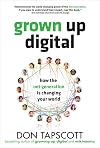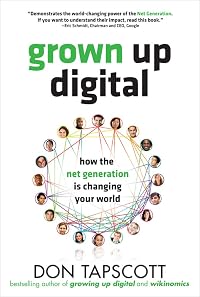
Grown Up Digital: How the Net Generation is Changing Your World
by Don Tapscott
On This Page
Description
The Net Generation Has Arrived. Are you ready for it? Chances are you know a person between the ages of 11 and 30. You've seen them doing five things at once: texting friends, downloading music, uploading videos, watching a movie on a two-inch screen, and doing who-knows-what on Facebook or MySpace. They're the first generation to have literally grown up digital--and they're part of a global cultural phenomenon that's here to stay. The bottom line is this: If you understand the Net show more Generation, you will understand the future. If you're a Baby Boomer or Gen-Xer: This is your field guide. A fascinating inside look at the Net Generation, Grown Up Digital is inspired by a $4 million private research study. New York Times bestselling author Don Tapscott has surveyed more than 11,000 young people. Instead of a bunch of spoiled "screenagers" with short attention spans and zero social skills, he discovered a remarkably bright community which has developed revolutionary new ways of thinking, interacting, working, and socializing. Grown Up Digital reveals: How the brain of the Net Generation processes information Seven ways to attract and engage young talent in the workforce Seven guidelines for educators to tap the Net Gen potential Parenting 2.0: There's no place like the new home Citizen Net: How young people and the Internet are transforming democracy Today's young people are using technology in ways you could never imagine. Instead of passively watching television, the "Net Geners" are actively participating in the distribution of entertainment and information. For the first time in history, youth are the authorities on something really important. And they're changing every aspect of our society-from the workplace to the marketplace, from the classroom to the living room, from the voting booth to the Oval Office. The Digital Age is here. The Net Generation has arrived. Meet the future. show lessTags
Recommendations





















Member Reviews
I have never read about about the sociological impact of technology of such vintage that still seems so prescient, considered, and relevant. Built around interaction with actual 11 - 15 year-olds (mostly), there is a lot of first-hand "N-gen" experience here, as the author labels the generation born and growing up digital. Admittedly as a non-parent much of this is not targeted at me directly, but I find the many situations presented and observations made entertaining and even enlightening. For me, judging such a book come inevitably from grading its predictions. This one has a good list toward the end of Chapter 9:
In this postTo Catch a Predator times it really seems the dark corners of the Net are downplayed: "pornographic images represent less than one half of one percent of images on the Net." More recent data suggests that "30 percent of Internet content is porn" and that "90 percent of boys and 60 percent of girls are exposed to Internet porn by age 18."
The author does warn about "dataveillance" with foresight and accuracy in regarding the privacy debates and commodification of identity that happens today.
As a footnote, the author recommends [book:Virtuous Reality|472439]. show less
- Real Estate: I find much of this book's insight demographic, centered around the bump up in youth numbers in the Baby Boom
- Echo. Still, these N-Geners I find want mobility not ownership and needing "wired" homes, etc.? Well, the author missed the wireless transformation...
- "telework centers": I wish...
- Community gardens and whatnot ...I see that. Missed the whole Whole Foods thing where this gets sold back to the N-Geners
- "They'll want the car to be a place for entertainment" Yup.
- "Clothing. This is a generation with a strong sense of style." I see that.
- "cyberbank" Check.
- "N-Geners love to play" They sure do!
- "Education... delivered to them on the Net" Yes
- ..and more accuracy, like the growth in UPS etc. for Net-ordered goods. Totally missed all that pirated digital media, though...
In this postTo Catch a Predator times it really seems the dark corners of the Net are downplayed: "pornographic images represent less than one half of one percent of images on the Net." More recent data suggests that "30 percent of Internet content is porn" and that "90 percent of boys and 60 percent of girls are exposed to Internet porn by age 18."
The author does warn about "dataveillance" with foresight and accuracy in regarding the privacy debates and commodification of identity that happens today.
As a footnote, the author recommends [book:Virtuous Reality|472439]. show less
Maybe it's because I find myself nodding in agreement after almost every sentence, but this book is a must read for anyone interested in how the digital natives are changing and will continue to change our world. As a Gen-Xer, I say bring them on!!
This is a look at the young generation, the first to grow up with interactive media and the Internet as natural elements of everyday life. Tapscott characterizes the Net Generation, or N-Gen, in terms of its media use and points to the important distinction between the passivity of broadcast media and the activity of interactive media. Even though the book in some ways is tied too strongly to the Internet hype of the late 1990s, some of the observations and ideas introduced are still valid, long after the bottom fell out of the stock market.
In the early ‘90’s, when Internet or the Electronic Highway, was just starting, Don Tapscott noticed changes in the behaviour of his kids. They were adopting the Internet (and later mobile) in their daily life. Don labelled them the ‘Net Generation’ to differentiate them from their parents ‘Generation X” and their grandparents the ‘Baby Boomers’. Don experienced that for the first time in his life he had to ask his kids how things worked. He never stopped asking. Tapscott wrote about his early experiences with this fast developing generation, the young ‘Netters’ in his 1996-classic Growing up Digital. Now, 12 years later, these kids have matured to adults and Tapscott has launched a large worldwide survey of which show more his latest book Grown up Digital ‘How the NET Generation is Changing YOUR World’ (McGraw-Hill) is the result.
Tapscott of course was ahead of his time. He witnessed the behaviours in social networks, messaging, texting, virtual worlds and gaming. Kids building websites and later a complete new industry around Web 2.0. An industry which gives people tools like Youtube and Flickr. MySpace and Facebook, Google-application and Twitter. To name just a few. It gives them connection to people worldwide to think and work on School 2.0 , Consumer 2.0 etc. Communication involves MSN, mobile, (micro)blogging and virtual realities. Interactive ways to connect, share, learn and grow.
Thousands of Netter conducted material for the research of which his latest Grown up Digital gives the conclusions. An optimistic book which gives deep inside in the way people between 12 and 30 use Internet and Mobile and all it’s applications in a very positive and future oriented way.
The impact on the culture, communications and worldview of this generation is immense. It is at this time hard to forcast the long term effect. Evaluation of the Obama-campagn already revealed the insight that using Internet’s social networktools Obama’s campaing team created a connecting to new voters which leads to believe in change.
Like Wikinomics, Grown up Digital is a rich book with statistics, a lot of background material and answers. The 368 pages (more material on the website Grownupdigital.com) give answers to important questions other generations ask: How do they think about politics? About healthcare? School? The workplace and our environment? The Netters, Tapscott concludes, live by eight fundamental norms: Freedom, Customization, Scrunity, Integrity, Collaboration, Entertainment, Speed and Innovation. These norms are broadly shared and combined & supported with new technologies used.
Grown up Digital is a must read for all who parent, educate, sell to and work with young people. If you do all four things: read it four times!
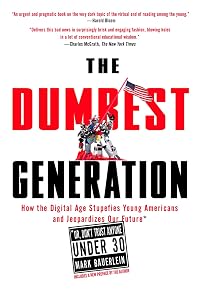
Tapscott closes with a chapter to answer the critics on the Net-generation like Mark Bauerlein and his book The Dumbest Generation. The “dark sides” we like to see (as a defensing mechanism to our ‘unknown’) are their potential violence for playing shooter games (or worce), there disability to communicate because they spend hours behind laptops and game-consoles. All and more issues are raised and answered.
Just one point Tapscott is worried and that is the issue of privacy. The way the Netters share information on social network, use webcams and publish videos on YouTube. It can backfire and used in a uncontrolled way.
But, the overall conclusion after spending years with and studing this generation, is an optimistic one. The Net-generation has a lot to offer and already is taking responsibilities on issues like education and the environment. A generation we already live with and in which we have to spend a lot more time to understand the fundamental new way they look at us and the world.
This article was published in a somewhat different form in Dutch @ Boekcover.nl: Growing up Digital Revisited show less
Tapscott of course was ahead of his time. He witnessed the behaviours in social networks, messaging, texting, virtual worlds and gaming. Kids building websites and later a complete new industry around Web 2.0. An industry which gives people tools like Youtube and Flickr. MySpace and Facebook, Google-application and Twitter. To name just a few. It gives them connection to people worldwide to think and work on School 2.0 , Consumer 2.0 etc. Communication involves MSN, mobile, (micro)blogging and virtual realities. Interactive ways to connect, share, learn and grow.
Thousands of Netter conducted material for the research of which his latest Grown up Digital gives the conclusions. An optimistic book which gives deep inside in the way people between 12 and 30 use Internet and Mobile and all it’s applications in a very positive and future oriented way.
The impact on the culture, communications and worldview of this generation is immense. It is at this time hard to forcast the long term effect. Evaluation of the Obama-campagn already revealed the insight that using Internet’s social networktools Obama’s campaing team created a connecting to new voters which leads to believe in change.
Like Wikinomics, Grown up Digital is a rich book with statistics, a lot of background material and answers. The 368 pages (more material on the website Grownupdigital.com) give answers to important questions other generations ask: How do they think about politics? About healthcare? School? The workplace and our environment? The Netters, Tapscott concludes, live by eight fundamental norms: Freedom, Customization, Scrunity, Integrity, Collaboration, Entertainment, Speed and Innovation. These norms are broadly shared and combined & supported with new technologies used.
Grown up Digital is a must read for all who parent, educate, sell to and work with young people. If you do all four things: read it four times!
Tapscott closes with a chapter to answer the critics on the Net-generation like Mark Bauerlein and his book The Dumbest Generation. The “dark sides” we like to see (as a defensing mechanism to our ‘unknown’) are their potential violence for playing shooter games (or worce), there disability to communicate because they spend hours behind laptops and game-consoles. All and more issues are raised and answered.
Just one point Tapscott is worried and that is the issue of privacy. The way the Netters share information on social network, use webcams and publish videos on YouTube. It can backfire and used in a uncontrolled way.
But, the overall conclusion after spending years with and studing this generation, is an optimistic one. The Net-generation has a lot to offer and already is taking responsibilities on issues like education and the environment. A generation we already live with and in which we have to spend a lot more time to understand the fundamental new way they look at us and the world.
This article was published in a somewhat different form in Dutch @ Boekcover.nl: Growing up Digital Revisited show less
Maybe this just caught me in a dyspeptic or impatient state, but it's one of the few books I've started this year that I wasn't actually able to finish. The message, overly simple, seemed to repeat endlessly -- our kids are very tech savvy and that ain't necessarily a bad thing. I don't think there was much here for me that I didn't already know. But I live with this stuff both at work and at home.
A hora da geração digital traça um retrato da geração que chega agora ao mercado de trabalho. Trata-se de uma geração que cresceu tendo a internet não como uma novidade, mas como uma mídia inerente as suas atividades mais triviais, como escolher filmes, livros, auxílio nas tarefas escolares, etc. No livro, o autor traça uma perspectiva de transformações a partir de uma geração cujas palavras de ordem são compartilhamento, redes, blogs, e principalmente, comunicação. O autor analisa estas transformações em todas as dimensões - social, econômica, cultural - demonstrando principalmente o papel ativo que estas pessoas assumem em todos os aspectos de sua vida.
Mar 11, 2011Portuguese (Brazil)
Members
- Recently Added By
Author Information

25+ Works 4,846 Members
Don Tapscott is Chairman of the Alliance for Converging Technologies (www.actnet.com), an international research and consulting group that advises corporations and governments worldwide on strategy in the digital economy.
Awards and Honors
Distinctions
Classifications
Statistics
- Members
- 860
- Popularity
- 31,867
- Reviews
- 8
- Rating
- (3.73)
- Languages
- 9 — Chinese, English, Finnish, French, German, Hungarian, Japanese, Portuguese (Portugal), Spanish
- Media
- Paper, Ebook
- ISBNs
- 22
- UPCs
- 1
- ASINs
- 6