
On This Page
Description
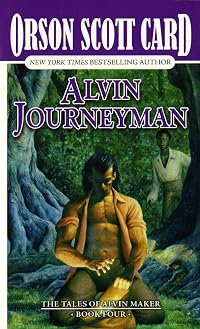
Alvin is a Maker, the first to be born in a century. Now a grown man and a journeyman smith, Alvin has returned to his family in the town of Vigor Church. He will share in their isolation, work as a blacksmith, and try to teach anyone who wishes to learn the knack of being a Maker. For Alvin has had a vision of the Crystal City he will build, and he knows that he cannot build it alone. But he has left behind in Hatrack River enemies as well as true friends. His ancient foe, the Unmaker, show more whose cruel whispers and deadly plots have threatened Alvin's life at every turn, has found new hands to do his work of destruction. show lessTags
Recommendations



Member Reviews
This is one of the best alternate history series I've ever read. It's clever, well-researched, and incredibly entertaining. For those of you who know your early American history, you will appreciate Card's rendition of mid-nineteenth century America. What I appreciate the most about this series is the writing. It's clean and efficient, and he trusts his reader. Despite all the information he throws at you, he doesn't stop and take the time to explain every little detail; he trusts that you'll pick up on the historical references.
One of the main things I love about this series is that you get to see the characters grow. By the end of each book, all the characters have gone through obstacles and are changed because of it. In this show more particular novel, Alvin is put in jail and tried for the "theft" of the golden plow from Makepeace. We are introduced to some very interesting new characters and meet up with quite a few old faces from Hatrack River.
Alvin Journeyman is also one of the more suspenseful books so far in this series. Between the trial, Calvin's troubles, and Peggy's dilemma about whether or not to go back to Hatrack River and help Alvin, I couldn't stop turning the pages. It is a bit slower going in this novel because of the lack of war and action, but I didn't enjoy it any less. It is a middle book in a series, so there's going to be quite a bit of set-up for the end, and I'm sure there will be a payoff.
Overall, I like how this series is progressing. I love how Alvin isn't the perfect hero -- he has a good heart to be sure, but he has many flaws and a lot of doubts about his work in the world. The challenges between Alvin and the Unmaker are kept fresh, and now we're seeing a big conflict coming up between Alvin and Calvin, something I saw coming, but I'm excited to read about nonetheless. show less
One of the main things I love about this series is that you get to see the characters grow. By the end of each book, all the characters have gone through obstacles and are changed because of it. In this show more particular novel, Alvin is put in jail and tried for the "theft" of the golden plow from Makepeace. We are introduced to some very interesting new characters and meet up with quite a few old faces from Hatrack River.
Alvin Journeyman is also one of the more suspenseful books so far in this series. Between the trial, Calvin's troubles, and Peggy's dilemma about whether or not to go back to Hatrack River and help Alvin, I couldn't stop turning the pages. It is a bit slower going in this novel because of the lack of war and action, but I didn't enjoy it any less. It is a middle book in a series, so there's going to be quite a bit of set-up for the end, and I'm sure there will be a payoff.
Overall, I like how this series is progressing. I love how Alvin isn't the perfect hero -- he has a good heart to be sure, but he has many flaws and a lot of doubts about his work in the world. The challenges between Alvin and the Unmaker are kept fresh, and now we're seeing a big conflict coming up between Alvin and Calvin, something I saw coming, but I'm excited to read about nonetheless. show less
This time around Alvin is on trial. Not even kidding. Most of the book is taken up by Alvin going back to stand trial for 'stealing' the golden plow from Makepeace. It's actually a surprisingly decently plot and we get a lot more worldbuilding, including two different viewpoints in Europe. In one, we have a lawyer with a knack of his own who wants to learn from Alvin and looks to be a new main character. In the other, Alvin's brother Calvin's adventures in France, meeting Napoleon.
Unfortunately, it seems like we've spent yet another book just spinning in place. Alvin continues to plan on building his Crystal City and training new Makers... but he's not getting to either any time soon. At the very end, he does manage tomarry Peggy and show more meet up with the Prophet again, but it feels only to set up the next sequel.
Characterwise, I do like Verily. It's interesting to see how someone with a powerful knack akin to Alvin's, but that grew up in a land where such a thing is supposed to be a death sentence. Likewise, I think Calvin's story is interesting. He has such a completely different view of the world from Alvin and doesn't even seem to realize it. He's not a particularly good person and seems to be okay with that. It makes him feel a little more real than Alvin ever did.
All together, I think I'm done with the series for the time being. It's not flat out a bad series, but I feel like there are better books I could be reading first. show less
Unfortunately, it seems like we've spent yet another book just spinning in place. Alvin continues to plan on building his Crystal City and training new Makers... but he's not getting to either any time soon. At the very end, he does manage to
Characterwise, I do like Verily. It's interesting to see how someone with a powerful knack akin to Alvin's, but that grew up in a land where such a thing is supposed to be a death sentence. Likewise, I think Calvin's story is interesting. He has such a completely different view of the world from Alvin and doesn't even seem to realize it. He's not a particularly good person and seems to be okay with that. It makes him feel a little more real than Alvin ever did.
All together, I think I'm done with the series for the time being. It's not flat out a bad series, but I feel like there are better books I could be reading first.
Card is an extremely good writer, and his books are always a pleasure to read, but at times I did feel that the stories here occasionally suffered for being too allegorical, and too much about Card's ideas of morality.
In the 4th book, 'Alvin Journeyman' Alvin tries to strike out on his own, with his visions of creating a 'Crystal City' (kinda like Augustine's City of God?) before him... however, he is accused, falsely, of theft, and his concepts of justice impel him to sit in jail and face charges, even though his powers mean that he doesn't have to. Too much of the book is really spent in courtroom drama, and Alvin begins to really just seem annoyingly 'moral.' As a foil, the character of his younger brother Calvin is drawn - Calvin show more also has quite a lot of magic powers, but none of Alvin's desire to use them only for good - he kinda rides a line between being amoral and actively malicious. show less
In the 4th book, 'Alvin Journeyman' Alvin tries to strike out on his own, with his visions of creating a 'Crystal City' (kinda like Augustine's City of God?) before him... however, he is accused, falsely, of theft, and his concepts of justice impel him to sit in jail and face charges, even though his powers mean that he doesn't have to. Too much of the book is really spent in courtroom drama, and Alvin begins to really just seem annoyingly 'moral.' As a foil, the character of his younger brother Calvin is drawn - Calvin show more also has quite a lot of magic powers, but none of Alvin's desire to use them only for good - he kinda rides a line between being amoral and actively malicious. show less
In his introduction, Card acknowledges that when "Alvin Journeyman" was first published, some fans had been waiting several years for the next installment in the series. Had I been one of those fans, I would have probably been really annoyed that I'd waited a long time and only got "Alvin Journeyman."
Just as is the case with the later Ender novels, the Alvin series seems to have descended into a series where people sit around and have lots of philosophical conversations that, while interesting, don't really do much to advance the plot. The most frustrating part of this is that we have some interesting subplots in here such as the rift between Calvin and Alvin that are brought up, sort of developed and then left dangling once the final show more pages are turned. Card hints at something more to come and maybe this novel is groundwork for that, but it still feels like an incomplete read. Or maybe this is just one long preview for the next installment in the series.
"Alvin Journeyman" seems to be more concerned with wrapping up bits from the last book and introducing a plethora of new characters more than it is about advancing the story of Alvin and his becoming a maker. Enough with visions of the Crystal City. Let's get onto actually building it or bringing it back. show less
Just as is the case with the later Ender novels, the Alvin series seems to have descended into a series where people sit around and have lots of philosophical conversations that, while interesting, don't really do much to advance the plot. The most frustrating part of this is that we have some interesting subplots in here such as the rift between Calvin and Alvin that are brought up, sort of developed and then left dangling once the final show more pages are turned. Card hints at something more to come and maybe this novel is groundwork for that, but it still feels like an incomplete read. Or maybe this is just one long preview for the next installment in the series.
"Alvin Journeyman" seems to be more concerned with wrapping up bits from the last book and introducing a plethora of new characters more than it is about advancing the story of Alvin and his becoming a maker. Enough with visions of the Crystal City. Let's get onto actually building it or bringing it back. show less
Alvin, the man with the golden plow (I still wonder if that isn't a whimsical reference to James Bond) is still trying to oppose the designs of the Unmaker, build his own community of followers, figure out what he's supposed to do with his life, and somehow figure out how to build the Crystal City of his dreams. This all takes place in an alternate history version of early 1800's America.
Originally posted at FanLit.http://www.fantasyliterature.com/reviews/alvin-journeyman/
Alvin Miller is finally a journeyman blacksmith and a Maker. Heƒ??s back home in Vigor Church, trying to teach others his Making skills because he believes he needs Makers to create the Crystal City heÂ??s dreamed of. But the Unmaker is hard at work, trying to unravel AlvinÂ??s plans. With the help of a girl who has a crush on Alvin, the Unmaker manages to get Alvin to flee back to Hatrack River where Makepeace Smith is waiting to sue him for that golden plow. The prosecutor is none other than Daniel Webster.
Alvin�?s brother Calvin, who is jealous of Alvin, has gone to Europe to learn from Napoleon Bonaparte. While he�?s there, he meets a show more young lawyer who is also a Maker and, inadvertently, sends him to Alvin�?s defense. Meanwhile, Peggy, who continues to watch over Alvin and Calvin, is on a crusade to end slavery. She�?d also like to ruin William �?Tippecanoe� Harrison�?s chance of being elected president. When she realizes that Alvin is in danger, she goes to warn him and picks up a transformed Mike Fink along the way.
Alvin Journeyman, which won the 1996 Locus Award for Best Fantasy Novel, is the fourth book in Orson Scott CardÂ??s TALES OF ALVIN MAKER. There were some great moments in Alvin Journeyman, such as when the slave finders try to identify Arthur Stuart, but at this point in the series, the plot has slowed drastically and this book feels like a detour. Alvin spends most of his time in jail and most of the word count consists of charactersÂ?? verbal sparring with each other, usually in a teasing manner. Some of this is clever, but it becomes increasingly tiresome. The same thing happened with CardÂ??s ENDER WIGGIN series. Orson Scott CardÂ??s characters talk too much. IÂ??m ready for everyone to shut up and get moving. Come on, letÂ??s go!
IÂ??m still listening to Blackstone AudioÂ??s version which is very good. To their credit, the narrators donÂ??t appear to be as bored as I am. show less
Alvin Miller is finally a journeyman blacksmith and a Maker. Heƒ??s back home in Vigor Church, trying to teach others his Making skills because he believes he needs Makers to create the Crystal City heÂ??s dreamed of. But the Unmaker is hard at work, trying to unravel AlvinÂ??s plans. With the help of a girl who has a crush on Alvin, the Unmaker manages to get Alvin to flee back to Hatrack River where Makepeace Smith is waiting to sue him for that golden plow. The prosecutor is none other than Daniel Webster.
Alvin�?s brother Calvin, who is jealous of Alvin, has gone to Europe to learn from Napoleon Bonaparte. While he�?s there, he meets a show more young lawyer who is also a Maker and, inadvertently, sends him to Alvin�?s defense. Meanwhile, Peggy, who continues to watch over Alvin and Calvin, is on a crusade to end slavery. She�?d also like to ruin William �?Tippecanoe� Harrison�?s chance of being elected president. When she realizes that Alvin is in danger, she goes to warn him and picks up a transformed Mike Fink along the way.
Alvin Journeyman, which won the 1996 Locus Award for Best Fantasy Novel, is the fourth book in Orson Scott CardÂ??s TALES OF ALVIN MAKER. There were some great moments in Alvin Journeyman, such as when the slave finders try to identify Arthur Stuart, but at this point in the series, the plot has slowed drastically and this book feels like a detour. Alvin spends most of his time in jail and most of the word count consists of charactersÂ?? verbal sparring with each other, usually in a teasing manner. Some of this is clever, but it becomes increasingly tiresome. The same thing happened with CardÂ??s ENDER WIGGIN series. Orson Scott CardÂ??s characters talk too much. IÂ??m ready for everyone to shut up and get moving. Come on, letÂ??s go!
IÂ??m still listening to Blackstone AudioÂ??s version which is very good. To their credit, the narrators donÂ??t appear to be as bored as I am. show less
There is a lot about this series to like, but I fear that the more books in it I read the less I'm finding those likeable aspects. At this point, it feels very much like the characters are being thrown into random trials for the sake of plot, rather than simply living their extraordinary lives like they were in the first books.
That being said, I'm sucked in now, and need to see what happens, so I'll doubtlessly finish the series.
That being said, I'm sucked in now, and need to see what happens, so I'll doubtlessly finish the series.
Members
- Recently Added By
Published Reviews
ThingScore 100
Card fuses the best of Mark Twain with Peter Beagle to tell his tale in the proper voice. The only fault in this otherwise enchanting tour-de-force of magical Americana is the long wait between volumes in the series.
added by Nevov
Lists

Best-selling Books by Latter-day Saints
58 works; 2 members

Books Read in 2021
5,361 works; 113 members
Author Information

575+ Works 213,658 Members
Orson Scott Byron Walley Card, was born in 1951 and studied theater at Brigham Young University. He received his B.A. in 1975 and his M.A. in English in 1981. He wrote plays during that time, including Stone Tables (1973) and the musical, Father, Mother, Mother and Mom (1974). A Mormon, Scott served a two-year mission in Brazil before starting show more work as a journalist in Utah. He also designed games at Lucas Film Games, 1989-92. He is best known for his science fiction novels, including the popular Ender series. Well known titles include A Planet Called Treason (1979), Treasure Box (1996), and Heartfire (1998). He has also written the guide called How to Write Science Fiction and Fantasy (1990). His novel Ender's Game and its sequel Speaker for the Dead, both won Hugo and Nebula awards, making Card the only author to win both prizes in consecutive years. His titles Shadows in Flight, Ruins and Ender's Game made The New York Times Best Seller List. He is also the author of The First Formic War Series, which includes the titles Earth Unaware, Earth Afire, and Earth Awakens. (Bowker Author Biography) show less
Some Editions
Awards and Honors
Awards
Series

Belongs to Publisher Series
Work Relationships
Common Knowledge
- Canonical title
- Alvin Journeyman
- Original title
- Alvin Journeyman
- Alternate titles
- Alvin Journeyman: The Tales of Alvin Maker IV; Tales of Alvin Maker, Book 4: Alvin Journeyman
- Original publication date
- 1995
- People/Characters
- Alvin Smith; Daniel Webster
- Important places
- Hatrack River
- Dedication
- To Jason Lewis,
long-legged wanderer,
walker through woods,
dreamer of true dreams. - First words
- I thought I was done writing about Alvin Smith.
- Last words
- (Click to show. Warning: May contain spoilers.)Then he thought, No I couldn't, and went to sleep.
- Original language
- English
Classifications
Statistics
- Members
- 2,807
- Popularity
- 6,461
- Reviews
- 23
- Rating
- (3.57)
- Languages
- 9 — Dutch, English, Finnish, French, German, Hungarian, Polish, Spanish, Swedish
- Media
- Paper, Audiobook, Ebook
- ISBNs
- 36
- ASINs
- 11