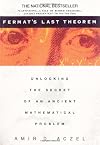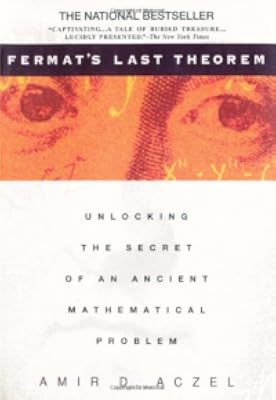
Fermat's Last Theorem: Unlocking the Secret of an Ancient Mathematical Problem
by Amir D. Aczel
On This Page
Description
Over three hundred years ago, a French scholar scribbled a simple theorem in the margin of a book. It would become the world's most baffling mathematical mystery. Simple, elegant, and utterly impossible to prove, Fermat's Last Theorem captured the imaginations of amateur and professional mathematicians for over three centuries. For some it became a wonderful passion. For others it was an obsession that led to deceit, intrigue, or insanity. In a volume filled with the clues, red herrings, and show more suspense of a mystery novel, Dr. Amir Aczel reveals the previously untold story of the people, the history, and the cultures that lie behind this scientific triumph. From formulas devised for the farmers of ancient Babylonia to the dramatic proof of Fermat's theorem in 1993, this extraordinary work takes us along on an exhilarating intellectual treasure hunt. Revealing the hidden mathematical order of the natural world in everything from stars to sunflowers, Fermat's Last Theorem brilliantly combines philosophy and hard science with investigative journalism. The result: a real-life detective story of the intellect, at once intriguing, thought-provoking, and impossible to put down. show lessTags
Recommendations



Member Reviews
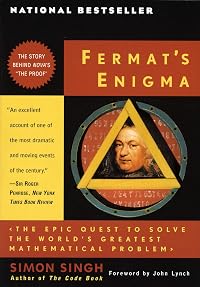
Earlier this year I read a book by the same title by Simon Singh, and unfortunately it is the superior read. Both are about the steps leading to Andrew Wile's 1993 solution to Fermat's Last Theorem, from ancient Greece on. At less than 140 pages, this tiny volume does not do the story justice. I have a decent math background, but I found myself getting lost in places, and the intrigue simply didn't grab me like it did in Singh's book. If you're in a hurry and just want a bare bones account of the history behind Fermat's Last Theorem, this will do, but if you want the whole story, go straight to Simon Singh.
I never thought that Fermat's conjecture was very interesting: I don't really care that x^n + y^n = z^n has no whole number solution when n is greater than 2. What is fascinating is that the formulation is so simple, you wonder how it has not been proved or disproved in 300 years. And if you have the slightest interest in math, it becomes a challenge. I guess anybody who passed the SAT and is a bit curious has secretly given it a try. A mathematician called Andrew Wiles finally proved it in 1993. I wanted to know what it takes, but within limits: first I am not a mathematician, second it is not a major subject of interest to me. Still, I was curious: what did it take? What are the major mathematical ideas involved?
For people like me, show more this is the perfect book: hardly any equation in it , and the book is SHORT!
Aczel's ambition is to tell just what kind of mathematical discoveries were involved in this. I knew most of what the book says, because I am interested in the history of mathematics. But I could not have written the book; it is like reverse engineering: you got to understand Wile's proof first and run backwards.
So the book is not as simple as it sounds. It is readable, it is interesting, it does the job. show less
For people like me, show more this is the perfect book: hardly any equation in it , and the book is SHORT!
Aczel's ambition is to tell just what kind of mathematical discoveries were involved in this. I knew most of what the book says, because I am interested in the history of mathematics. But I could not have written the book; it is like reverse engineering: you got to understand Wile's proof first and run backwards.
So the book is not as simple as it sounds. It is readable, it is interesting, it does the job. show less
This book fills a significant void in scientific education: making mathematics fascinating and tangible through its historical origins. Despite being exquisitely succinct, Amir takes his readers on a multimillennial voyage as he in turn sets out to prove why Fermat's Last Theorem is proven to be so beautiful, both mathematically and beyond.
Mathematical ignoramus that I am, I was sufficiently impressed by the announcement a few years ago that a mathematician had solved Fermat's Last Theorem. I guess what impressed and drew me to this is the fact that the theorem had lain unproven for over 300 years, ever since Fermat noted it in the margin of a book he was reading, said he had a "truly marvellous proof" of it, but not sufficient space to elucidate, and left it at that; he never returned to the question in any of his writings on mathematics (although he lived for 28 years afterwards). The theorem is elegant in its simplicity: x+y=z (where each is raised to the nth power), has no whole number solution where n is greater than 2.
This exercised many great mathematicians and show more students over the centuries, but was finally proven by Andrew Wiles, trained in Cambridge and in Princeton at the time. The book provides an overview of the history of mathematics by exploring the various elements and schools of thought that contributed to the solution, beginning with the Greeks and earlier. Frankly, I found it a bit much even in its watered-down form. But I was interested in the basic question: did Fermat have the proof? The book shows that Wiles used the work a number of 20th century mathematicians, building on their work and integrating various schools of thought and approaches, some arcane to put it mildly. Fermat could clearly not have had this proof in mind when he wrote the theorem because much of the mathematics had not yet been invented, but did he have another proof in mind? The author speculates probably not, "but this is not a certainty", as he concedes that there might be simpler proofs of the theorem. The secret went to the grave with Fermat, but it is intriguing to think that his riddle remained unsolved for 300 years. show less
This exercised many great mathematicians and show more students over the centuries, but was finally proven by Andrew Wiles, trained in Cambridge and in Princeton at the time. The book provides an overview of the history of mathematics by exploring the various elements and schools of thought that contributed to the solution, beginning with the Greeks and earlier. Frankly, I found it a bit much even in its watered-down form. But I was interested in the basic question: did Fermat have the proof? The book shows that Wiles used the work a number of 20th century mathematicians, building on their work and integrating various schools of thought and approaches, some arcane to put it mildly. Fermat could clearly not have had this proof in mind when he wrote the theorem because much of the mathematics had not yet been invented, but did he have another proof in mind? The author speculates probably not, "but this is not a certainty", as he concedes that there might be simpler proofs of the theorem. The secret went to the grave with Fermat, but it is intriguing to think that his riddle remained unsolved for 300 years. show less
Excellent book, short but full of relevant and interesting content. Provides a clear historical background of Fermat's last theorem and its resolution.
La lettura di L’enigma di Fermat è stata molto appassionante: è un libriccino agile e perfetto per tuttə coloro che pensano che la matematica sia solo una roba noiosa fatta da persone altrettanto noiose che passano la loro vita a cercare di dimostrare teoremi astrusi. Aczel, infatti, ha cercato di raccontare, insieme alla storia della dimostrazione che l’equazione aⁿ+bⁿ=cⁿ se n>2 non ha soluzioni intere positive – una storia che è anche un po’ la storia di tutta la matematica fino agli anni Novanta del Novecento – la passione per i numeri, che, tra tutte le passioni possibili, è probabilmente quella che risulta più oscura.
Aczel rimette innanzitutto la matematica nella storia: a noi che la studiamo “già show more scoperta” e sistemata in manuali dove i cenni storici , se presenti, sono saltati a piè pari, questo sembra già strano: anche la fredda matematica ha a che fare con gli alti e bassi della nostra storia di esseri umani, sia a livello macroscopico, sia a livello personale, con matematicə che hanno dovuto lottare con povertà, discriminazioni ed ego smisurati.
Ma l’aspetto che forse ho apprezzato di più di L’enigma di Fermat è stata la sua caparbietà nel mostrare che la matematica è bella: così tanto da poter commuovere quanto la visione di un paesaggio mozzafiato o l’ascolto di un brano armonioso. La matematica non è solo astrazione impalpabile, ma è intorno a noi, con le sue forme, i suoi colori e i suoi suoni.
Non vi nego che a un certo punto ho completamente smesso di capire sul serio la parte matematica, ma non tanto per colpa di Aczel, ma della difficoltà della materia: la dimostrazione dell’ultimo teorema di Fermat è così complessa da riempire più di duecento pagine e mi aspettavo di smettere di capire a un certo punto, visto che le mie conoscenze matematiche non sono così avanzate. L’autore stesso si concentra progressivamente più sulle vicende umane che sulla matematica in sé, dando solo le informazioni necessarie per seguire la storia fino alla fine. Cosa che funziona più di quanto possa sembrare a prima vista perché quando Wiles finalmente conclude la sua dimostrazione, mi sono commossa anch’io con lui, pur non avendo idea di come ci sia davvero riuscito. Semplicemente perché la matematica è bella e gli esseri umani sono sensibili alla bellezza. show less
Aczel rimette innanzitutto la matematica nella storia: a noi che la studiamo “già show more scoperta” e sistemata in manuali dove i cenni storici , se presenti, sono saltati a piè pari, questo sembra già strano: anche la fredda matematica ha a che fare con gli alti e bassi della nostra storia di esseri umani, sia a livello macroscopico, sia a livello personale, con matematicə che hanno dovuto lottare con povertà, discriminazioni ed ego smisurati.
Ma l’aspetto che forse ho apprezzato di più di L’enigma di Fermat è stata la sua caparbietà nel mostrare che la matematica è bella: così tanto da poter commuovere quanto la visione di un paesaggio mozzafiato o l’ascolto di un brano armonioso. La matematica non è solo astrazione impalpabile, ma è intorno a noi, con le sue forme, i suoi colori e i suoi suoni.
Non vi nego che a un certo punto ho completamente smesso di capire sul serio la parte matematica, ma non tanto per colpa di Aczel, ma della difficoltà della materia: la dimostrazione dell’ultimo teorema di Fermat è così complessa da riempire più di duecento pagine e mi aspettavo di smettere di capire a un certo punto, visto che le mie conoscenze matematiche non sono così avanzate. L’autore stesso si concentra progressivamente più sulle vicende umane che sulla matematica in sé, dando solo le informazioni necessarie per seguire la storia fino alla fine. Cosa che funziona più di quanto possa sembrare a prima vista perché quando Wiles finalmente conclude la sua dimostrazione, mi sono commossa anch’io con lui, pur non avendo idea di come ci sia davvero riuscito. Semplicemente perché la matematica è bella e gli esseri umani sono sensibili alla bellezza. show less
Dec 30, 2024Italian
Members
- Recently Added By
Lists

In Our Time books
4,934 works; 2 members
Author Information

25 Works 5,276 Members
Amir D. Aczel was born in Haifa, Israel on November 6, 1950. He received bachelor's and master's degrees in mathematics from the University of California, Berkeley and a doctorate in decision sciences from the business school at the University of Oregon. He taught at several universities during his lifetime including the University of Alaska and show more Bentley College. His first book, Complete Business Statistics, was published in 1989 and went through eight editions. His other books include How to Beat the I.R.S. at Its Own Game: Strategies to Avoid - and Fight - an Audit; Fermat's Last Theorem: Unlocking the Secret of an Ancient Mathematical Problem; The Mystery of the Aleph: Mathematics, the Kabbalah, and the Search for Infinity; The Riddle of the Compass: The Invention That Changed the World; Entanglement: The Greatest Mystery in Physics; and Finding Zero: A Mathematician's Odyssey to Uncover the Origins of Numbers. He died from cancer on November 26, 2015 at the age of 65. (Bowker Author Biography) show less
Awards and Honors
Awards
Series
Belongs to Publisher Series
Common Knowledge
- Original publication date
- 1996-10
- People/Characters
- Fermat; Andrew Wiles
- Important events
- Fermat's Last Theorem
- Dedication
- To my father
- First words
- Preface: In June 1993, my old friend Tom Schulte was visiting me in Boston from California.
Just before dawn on June 23, 1993, Professor John Conway approached the darkened mathematics building on the Princeton University campus.
Classifications
Statistics
- Members
- 738
- Popularity
- 38,444
- Reviews
- 9
- Rating
- (3.34)
- Languages
- 12 — Chinese, Dutch, English, Finnish, German, Hungarian, Italian, Japanese, Polish, Portuguese, Croatian, Spanish
- Media
- Paper, Ebook
- ISBNs
- 22
- ASINs
- 3