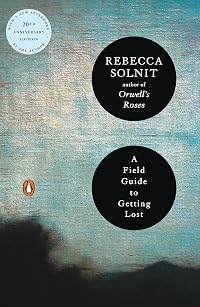
A Field Guide to Getting Lost
by Rebecca Solnit
On This Page
Description
A stimulating exploration of wandering, being lost, and the uses of the unknown from the author of Men Explain Things To Me Written as a series of autobiographical essays, A Field Guide to Getting Lost draws on emblematic moments and relationships in Rebecca Solnit's life to explore issues of uncertainty, trust, loss, memory, desire, and place. Solnit is interested in the stories we use to navigate our way through the world, and the places we traverse, from wilderness to cities, in finding show more ourselves, or losing ourselves. While deeply personal, her own stories link up to larger stories, from captivity narratives of early Americans to the use of the color blue in Renaissance painting, not to mention encounters with tortoises, monks, punk rockers, mountains, deserts, and the movie Vertigo. The result is a distinctive, stimulating voyage of discovery. show lessTags
Recommendations

Member Reviews
Those of you who don't like reading poetry, please don't let the following bit put you off. It took me a while to figure out how to read A Field Guide Lost by Rebecca Solnit. Her writing is so exquisite, I found myself dwelling upon sentences and paragraphs and ruminating about them. Letting myself get lost, I guess she'd say. Then, as I mentioned to our brother Mark, I realized that her essays were like poems. They required that level of attention, and gave back similar substantial rewards. E.g.,
"Children seldom roam, even in the safest places. Because of their parents' fear of the monstrous things that might happen (and do happen, but rarely), the wonderful things that happen as a matter of course are stripped away from them. For me, show more childhood roaming was what developed self-reliance, a sense of direction and adventure, a will to explore, to be able to get a little lost and then figure out the way back. I wonder what will come of placing this generation under house arrest."
Getting lost, of course, is important inside ourselves as well as outside. We learn about her travels in remote parts of our country, and the world. "I leaned over the side of the raft and stared straight down for hours at the floor of that river whose name almost no one knows that flows into another little-known river, stared at thousands of stones, hundreds of thousands of millions of stones sliding by, gray, pink, black, gold, under the clearest water in the whole world, floating for miles and days on water I drank straight out of the river."
Being willing to be lost means being open to whatever may come. She is fascinated, as most of us are, by the exploration of the wild American west. "The vast spaces of the American West, so little known to immigrants even now, have always invited travelers to lose their past like so much luggage, and reinvent themselves." Mapmakers long portrayed California "as a huge island just off the west coast of North America, and the northwest coast of that continent remained undrawn, one of the last expanses of Terra Incognita to the Europeans mapping the world."
She casts a wondering eye in so many surprising directions. One of four essays she has entitled The Blue of Distance" covers, among other things, the artist Yves Klein; artists who disappeared or used themselves up at an early age; Rosicrucianism; judo;the color blue; the famous photo of Yves Klein "Leaping into the Void"; his obsession with painting with "International Klein Blue", a unique color he invented by mixing in synthetic resin, so that it would never lose its brilliance; immaterial paintings bought and sold - that is, nothing but an incorporeal concept sold for money, and the receipt burned; maps in the 1500s; the map of Las Vegas that has to be regularly changed because the city grows so fast; Borges; Ptolemy; and, of course, more. The ending of that essay dazzled me:
"Movies are made out of darkness as well as light; it is the surpassingly brief intervals of darkness between each luminous still image that make it possible to assemble the many images into one moving picture. Without that darkness, there would be only a blur. Which is to say that a full-length movie consists of half an hour or an hour of pure darkness that goes unseen. If you could add up all the darkness, you would find the audience in the theater gazing together at a deep imaginative night. It is the terra incognita of film, the dark continent on every map. In a similar way, a runner's every step is a leap, so that for a moment he or she is entirely off the ground. For those brief instants, shadows no longer spill from their feet, like leaks, but hover below them like doubles, as they do with birds, whose shadows crawl below them, caressing the surface of the earth, growing and shrinking as their makers move nearer or farther from that surface. For my friends who run long distances, these tiny fragments of levitation add up to something considerable, by their own power they hover above the earth for many minutes, perhaps some significant portion of an hour or perhaps far more for the hundred-mile races. We fly; we dream in darkness; we devour heaven in bites too small to be measured."
There's an old exclamation for when one sees something striking and unexpected: "Will wonders never cease?" If that's taken as a question, the answer is, if the sense of wonder never ceases, then wonders won't either. show less
"Children seldom roam, even in the safest places. Because of their parents' fear of the monstrous things that might happen (and do happen, but rarely), the wonderful things that happen as a matter of course are stripped away from them. For me, show more childhood roaming was what developed self-reliance, a sense of direction and adventure, a will to explore, to be able to get a little lost and then figure out the way back. I wonder what will come of placing this generation under house arrest."
Getting lost, of course, is important inside ourselves as well as outside. We learn about her travels in remote parts of our country, and the world. "I leaned over the side of the raft and stared straight down for hours at the floor of that river whose name almost no one knows that flows into another little-known river, stared at thousands of stones, hundreds of thousands of millions of stones sliding by, gray, pink, black, gold, under the clearest water in the whole world, floating for miles and days on water I drank straight out of the river."
Being willing to be lost means being open to whatever may come. She is fascinated, as most of us are, by the exploration of the wild American west. "The vast spaces of the American West, so little known to immigrants even now, have always invited travelers to lose their past like so much luggage, and reinvent themselves." Mapmakers long portrayed California "as a huge island just off the west coast of North America, and the northwest coast of that continent remained undrawn, one of the last expanses of Terra Incognita to the Europeans mapping the world."
She casts a wondering eye in so many surprising directions. One of four essays she has entitled The Blue of Distance" covers, among other things, the artist Yves Klein; artists who disappeared or used themselves up at an early age; Rosicrucianism; judo;the color blue; the famous photo of Yves Klein "Leaping into the Void"; his obsession with painting with "International Klein Blue", a unique color he invented by mixing in synthetic resin, so that it would never lose its brilliance; immaterial paintings bought and sold - that is, nothing but an incorporeal concept sold for money, and the receipt burned; maps in the 1500s; the map of Las Vegas that has to be regularly changed because the city grows so fast; Borges; Ptolemy; and, of course, more. The ending of that essay dazzled me:
"Movies are made out of darkness as well as light; it is the surpassingly brief intervals of darkness between each luminous still image that make it possible to assemble the many images into one moving picture. Without that darkness, there would be only a blur. Which is to say that a full-length movie consists of half an hour or an hour of pure darkness that goes unseen. If you could add up all the darkness, you would find the audience in the theater gazing together at a deep imaginative night. It is the terra incognita of film, the dark continent on every map. In a similar way, a runner's every step is a leap, so that for a moment he or she is entirely off the ground. For those brief instants, shadows no longer spill from their feet, like leaks, but hover below them like doubles, as they do with birds, whose shadows crawl below them, caressing the surface of the earth, growing and shrinking as their makers move nearer or farther from that surface. For my friends who run long distances, these tiny fragments of levitation add up to something considerable, by their own power they hover above the earth for many minutes, perhaps some significant portion of an hour or perhaps far more for the hundred-mile races. We fly; we dream in darkness; we devour heaven in bites too small to be measured."
There's an old exclamation for when one sees something striking and unexpected: "Will wonders never cease?" If that's taken as a question, the answer is, if the sense of wonder never ceases, then wonders won't either. show less
Profound and erudite essays about distance; introspective but painted on a multi-dimensional canvas. They focus on place (deserts, forests, mountains, cities) and loss (abandonment, separation), all mediated through culture (literature, music, and art) and relationships.
Solnit’s connecting theme is the need to be lost before you can find yourself. It sounds like the opposite of Matthew 7:7, "seek and you will find”, but it’s not: being lost is part of seeking, and you can’t be found until you’ve been lost. For Christians, that’s also true in a spiritual sense: you have to acknowledge and repent of your sins before you can be saved. (Her parents are Jewish and Roman Catholic.)
Our arrogant ignorance of the natural world keeps show more park rangers and coastguards busy, but Earth is mapped, so we always know roughly what’s beyond the hill on the horizon. Thus, we are simultaneously more and less able to be lost than early explorers were.
Open Door
“Stories that make the familiar strange again… Conversations that make everything around them disappear. Dreams that I forget until I realized the have colored everything… Getting lost like that seems like the beginning of finding your way or finding another way.”
This gives rationale for the essays that follow. The title refers to the Jewish tradition of leaving the door open overnight at Passover, for Elijah, “a thrilling violation of ordinary practice”.
Solnit explores the idea that “it’s the job of artists to open doors”, with examples including Poe, Keats, Woolf, Thoreau, Meno, and Old Norse. She compares being metaphorically lost with being literally lost in unfamiliar wilderness. Modern people are illiterate in the language of the natural world: even if we notice plants, animals, tracks, weather, and geology, we don’t know or understand the significance of particular ones.
“How do you find what you can’t even conceive of?”
The Blue of Distance
“The world is blue at its edges and in its depths. This blue is the light that got lost… The color of that distance is the color of an emotion, the color of solitude and of desire, the color of there seen from here, the color of where you are not.”
Image: Georgia O’Keeffe. Light Coming on the Plains, I, II and III, 1917 (Source.)
“Distance ceases to be distance and to be blue when we arrive in it. The far becomes near and they are not the same place.”
Searing brilliance: the standout piece. I’ve written a tribute-cum-response HERE.
“Some things we have only as long as they remain lost, some things are not lost only so long as they are distant.”
Daisy Chain
“Things in my family have a way of disappearing… Truth was not a fixed quantity.”
Solnit was thus inspired to study history, but this is personal: examining the experiences of her forebears who immigrated to the US: leaving country, culture, and language, forging new identities in an alien land. A daisy chain of people and conflicting stories - and also a specific memory of making daisy chains with her grandmother.
“Summer breezes caressed me, my legs stepped forward as thought possessed of their own appetites, and the mountains kept promising.”
The Blue of Distance
A history lesson, mourning the fact that we can never be as truly lost in the landscape as the conquistadors in a continent they knew nothing about.
Slave narratives teach that sometimes acceptance is the answer! Like early white captives who embraced tribal life, and resisted “rescue”. Like Cabeza de Vaca, who, after ten years, “ceased to be lost not by returning but by turning into something else”.
We need to find new ways to be lost, with rituals to mark transitions - and that might mean losing the past to join the present.
Abandon
“One of the allures of ruins in the city is that of wilderness… a place full of the promise of the unknown.”
Image: Abandoned Building, Caven Point NJ, by Peter Hujar, who is mentioned in this essay (Source.)
In contrast to natural wilderness, suburbs are like tranquilizers: architecture and topography as drugs. And there’s a sadder story here, about a friend from Solnit’s youth who lived with abandon, but ultimately abandoned her life because of drugs. Her death changed Solnit’s life forever.
The Blue of Distance
“Every love has its landscape… Thus place… possesses you in its absence.”
Musing on music and place, landscape and memory. Country and western songs are about learning from the aftermath of disaster. The blues are “captivity narratives” about “perpetual internal exile” - a contrast to the slave narratives referenced in the preceding Blue essay.
Two Arrowheads
“It wasn’t particular things but the space between them, that abundance of absence, that is the desert’s invitation.”
There is life in the desert, as well as emotion, mystery, and extremes of light and temperature. It’s “alive with the primal forces”. You might even find the odd arrowhead. And tortoises and snakes.
“It was the vastness that I loved and an austerity that was also voluptuous… Solitude in the city is about the lack of other people or rather their distance beyond a door or wall, but in remote places it isn’t an absence but the presence of something else, a kind of humming silence in which solitude seems as natural to your species as any other.”
The Blue of Distance
“Movies are made out of darkness as well as light.”
Sometimes people disappear: Amelia Earheart, Antoine de Saint-Exupery, and in some senses, Yves Klein, among others.
Klein, an artist, patented International Klein Blue in 1960. He was also a Rosicrucian mystic and a fourth dan blackbelt in judo.
The other aspect of this essay is cartography and what’s not included: the difference between what we know we don’t know (terra incognita) and what we imagine we do know (Shangri-La).
Knowledge has many limits, including our understanding of it. She notes Donald Rumsfeld’s famous saying about known knowns, known unknowns, and unknown unknowns, including the context of his being “one of the vultures making the case for bombing Baghdad’s civilians”. She also highlights what he omitted: “unknown knowns” - our unconscious, or disavowed beliefs.
Maps are keys, but do they give us freedom to explore, or lock us into the known?
One-Story House
“The weight of a dream is not in proportion to its size. Some dreams are made of fog, some of lace, some of lead.”
Solnit dreams repeatedly of her single-story childhood home, though the memories are not happy. She pivots to endangered species, and then some success at reversing that in California. It turns out that is partly due to a protection plan her father wrote. By discovering how stressful that job was, she understands and accepts the tensions at home, and thus him.
The one-story house is a place for more than one interpretation, more than one story.
“It is in the nature of things to be lost.”
This was my first Solnit, though it has long been on my radar. I found it in Tate Modern art gallery. Odd (despite one essay about blue and another about Klein), but fortunate. I will return to her. show less
Solnit’s connecting theme is the need to be lost before you can find yourself. It sounds like the opposite of Matthew 7:7, "seek and you will find”, but it’s not: being lost is part of seeking, and you can’t be found until you’ve been lost. For Christians, that’s also true in a spiritual sense: you have to acknowledge and repent of your sins before you can be saved. (Her parents are Jewish and Roman Catholic.)
Our arrogant ignorance of the natural world keeps show more park rangers and coastguards busy, but Earth is mapped, so we always know roughly what’s beyond the hill on the horizon. Thus, we are simultaneously more and less able to be lost than early explorers were.
Open Door
“Stories that make the familiar strange again… Conversations that make everything around them disappear. Dreams that I forget until I realized the have colored everything… Getting lost like that seems like the beginning of finding your way or finding another way.”
This gives rationale for the essays that follow. The title refers to the Jewish tradition of leaving the door open overnight at Passover, for Elijah, “a thrilling violation of ordinary practice”.
Solnit explores the idea that “it’s the job of artists to open doors”, with examples including Poe, Keats, Woolf, Thoreau, Meno, and Old Norse. She compares being metaphorically lost with being literally lost in unfamiliar wilderness. Modern people are illiterate in the language of the natural world: even if we notice plants, animals, tracks, weather, and geology, we don’t know or understand the significance of particular ones.
“How do you find what you can’t even conceive of?”
The Blue of Distance
“The world is blue at its edges and in its depths. This blue is the light that got lost… The color of that distance is the color of an emotion, the color of solitude and of desire, the color of there seen from here, the color of where you are not.”
Image: Georgia O’Keeffe. Light Coming on the Plains, I, II and III, 1917 (Source.)
“Distance ceases to be distance and to be blue when we arrive in it. The far becomes near and they are not the same place.”
Searing brilliance: the standout piece. I’ve written a tribute-cum-response HERE.
“Some things we have only as long as they remain lost, some things are not lost only so long as they are distant.”
Daisy Chain
“Things in my family have a way of disappearing… Truth was not a fixed quantity.”
Solnit was thus inspired to study history, but this is personal: examining the experiences of her forebears who immigrated to the US: leaving country, culture, and language, forging new identities in an alien land. A daisy chain of people and conflicting stories - and also a specific memory of making daisy chains with her grandmother.
“Summer breezes caressed me, my legs stepped forward as thought possessed of their own appetites, and the mountains kept promising.”
The Blue of Distance
A history lesson, mourning the fact that we can never be as truly lost in the landscape as the conquistadors in a continent they knew nothing about.
Slave narratives teach that sometimes acceptance is the answer! Like early white captives who embraced tribal life, and resisted “rescue”. Like Cabeza de Vaca, who, after ten years, “ceased to be lost not by returning but by turning into something else”.
We need to find new ways to be lost, with rituals to mark transitions - and that might mean losing the past to join the present.
Abandon
“One of the allures of ruins in the city is that of wilderness… a place full of the promise of the unknown.”
Image: Abandoned Building, Caven Point NJ, by Peter Hujar, who is mentioned in this essay (Source.)
In contrast to natural wilderness, suburbs are like tranquilizers: architecture and topography as drugs. And there’s a sadder story here, about a friend from Solnit’s youth who lived with abandon, but ultimately abandoned her life because of drugs. Her death changed Solnit’s life forever.
The Blue of Distance
“Every love has its landscape… Thus place… possesses you in its absence.”
Musing on music and place, landscape and memory. Country and western songs are about learning from the aftermath of disaster. The blues are “captivity narratives” about “perpetual internal exile” - a contrast to the slave narratives referenced in the preceding Blue essay.
Two Arrowheads
“It wasn’t particular things but the space between them, that abundance of absence, that is the desert’s invitation.”
There is life in the desert, as well as emotion, mystery, and extremes of light and temperature. It’s “alive with the primal forces”. You might even find the odd arrowhead. And tortoises and snakes.
“It was the vastness that I loved and an austerity that was also voluptuous… Solitude in the city is about the lack of other people or rather their distance beyond a door or wall, but in remote places it isn’t an absence but the presence of something else, a kind of humming silence in which solitude seems as natural to your species as any other.”
The Blue of Distance
“Movies are made out of darkness as well as light.”
Sometimes people disappear: Amelia Earheart, Antoine de Saint-Exupery, and in some senses, Yves Klein, among others.
Klein, an artist, patented International Klein Blue in 1960. He was also a Rosicrucian mystic and a fourth dan blackbelt in judo.
The other aspect of this essay is cartography and what’s not included: the difference between what we know we don’t know (terra incognita) and what we imagine we do know (Shangri-La).
Knowledge has many limits, including our understanding of it. She notes Donald Rumsfeld’s famous saying about known knowns, known unknowns, and unknown unknowns, including the context of his being “one of the vultures making the case for bombing Baghdad’s civilians”. She also highlights what he omitted: “unknown knowns” - our unconscious, or disavowed beliefs.
Maps are keys, but do they give us freedom to explore, or lock us into the known?
One-Story House
“The weight of a dream is not in proportion to its size. Some dreams are made of fog, some of lace, some of lead.”
Solnit dreams repeatedly of her single-story childhood home, though the memories are not happy. She pivots to endangered species, and then some success at reversing that in California. It turns out that is partly due to a protection plan her father wrote. By discovering how stressful that job was, she understands and accepts the tensions at home, and thus him.
The one-story house is a place for more than one interpretation, more than one story.
“It is in the nature of things to be lost.”
This was my first Solnit, though it has long been on my radar. I found it in Tate Modern art gallery. Odd (despite one essay about blue and another about Klein), but fortunate. I will return to her. show less
A tricky collection that almost touches everything whilst also being almost everywhere, Solnit’s A Field Guide To Getting Lost melds cultural history with personal history. Although this makes the collection give off a sense of intimacy without revelling in overbearing nostalgia and sentimentality, Solnit wanders a lot, and I find myself at a lost, often thrown off by the vague link from here to there. But maybe this is the intention. Beyond the seemingly aimless wanderings and arbitrary tangents, it still manages to form a fairly cohesive whole not only by alternating each essay with a different The Blue of Distance (“Some things we have only as long as they remain lost, some things are not lost only so long as they are show more distant.”) each time but also with the fascinating and piquant quality of some fragments of history told. From losing a photograph to losing the old self, the portions about her friend Marine, French artist Yves Klein, how children are better at getting lost than adults, and those who were forced to leave their old self for the New World together with those who were enslaved by tribes without looking back at their old lives make a bent impression. It also reminded me of Elizabeth Bishop’s poem, One Art. Solnit redefines being lost, getting lost, and losing something as privileges instead of the usual anxiety, despair, and heartache they are made out to be. But she does not neglect these either. And there is an eye-opening and appeasing comfort in that. show less
Quite an annoying book. This is like being cornered by a smart self obsessive who is so convinced of their own philosophy they insist on relating it in great detail. I can appreciate the skillful writing, but unfortunately this was not the book for me. I had not realised it is essentially a memoir and musings book. It is loosely connected to the word ‘lost’ and also the colour ‘blue’, at least in the first few sections, before rambling off into the bracken and brambles of her own thoughts. I appreciate I am in a small field of people who didn’t enjoy it, perhaps I will come back to it later, possibly on my deathbed. It was lost on me -see what I did there ;)
In A Field Guide to Getting Lost, Rebecca Solnit examines the differing ideas of being lost and how one finds one’s place in the world. The book is part memoir and part philosophy, examining moments in her own life as well as themes from historical and philosophical thought. She writes, “The question then is how to get lost. Never to get lost is not to live, not to know how to get lost brings you to destruction, and somewhere in the terra incognita in between lies a life of discovery” (pg. 14). Furthermore, “Lost really has two disparate meanings. Losing things is about the familiar falling away, getting lost is about the unfamiliar appearing” (pg. 22).
Discussing the work of a historian, Solnit writes, “It could be best show more served not by claiming an authoritative and disinterested relationship to the facts, but by disclosing your own desires and agendas, for truth lies not only in incidents but in hopes and needs” (pg. 58). In her analysis of what it means to get lost and how we pass on these ideas, Solnit examines colonial captive narratives from Spanish North America and Puritan New England, dissecting both the loneliness their authors experienced as outsiders on a different continent and how readers interpreted the stories once they entered print. She writes, “Eduardo Galeano notes that America was conquered, but not discovered, that the men who arrived with a religion to impose and dreams of gold never really knew where they were, and that this discovery is still taking place in our time. This suggests that most European-Americans remained lost over the centuries, lost not in practical terms but in the more profound sense of apprehending where they truly were, of caring what the history of the place was and its nature” (pg. 66). This, according to Solnit, led colonists to impose an outside system upon the New World, importing names, foodways, and more to recreate the places they left and alleviate a feeling of being lost.
Discussing both the cultural drive to discover lost worlds and the loss of those places as maps filled in, Solnit writes, “Into the nineteenth century, people continued to seek places that had been made up out of imagination and desire. It had already been discovered that the magical Cibola, whose name appears above New Mexico in the old maps, was only Kansas, that Paradise was not located in Central America as Columbus thought, once he admitted that the topographies he had bumped into were not Asia. But even in the 1840s John C. Fremont claimed to be looking for the Buenaventura River that led from the Great Salt Lake into the Pacific” (pg. 166). Though she doesn’t discuss them, one can apply Solnit’s paradigm to the International Polar Year and the later International Geophysical Year, which helped to fill in the rest of the map and extend it out into space through events like the launches of Sputnik and Explorer 1.
Solnit concludes, “It is in the nature of things to be lost and not otherwise” (pg. 185). She gives the examples of lost languages, lost histories, and lost places. We know a great deal about Shakespeare’s plays but little about the author. We can see and study the Nazca lines, but don’t know their purpose or much about those who made them. Of her own historical writing, Solnit finds two purposes: “one was the historian’s yearning to hang onto everything, write everything down, to try to keep everything from slipping away, and the historian’s joy in retrieving out of archives and interviews what was almost forgotten, almost out of reach forever. But the other stream is the common experience that too many things are vanishing without replacement in our time” (pg. 188). show less
Discussing the work of a historian, Solnit writes, “It could be best show more served not by claiming an authoritative and disinterested relationship to the facts, but by disclosing your own desires and agendas, for truth lies not only in incidents but in hopes and needs” (pg. 58). In her analysis of what it means to get lost and how we pass on these ideas, Solnit examines colonial captive narratives from Spanish North America and Puritan New England, dissecting both the loneliness their authors experienced as outsiders on a different continent and how readers interpreted the stories once they entered print. She writes, “Eduardo Galeano notes that America was conquered, but not discovered, that the men who arrived with a religion to impose and dreams of gold never really knew where they were, and that this discovery is still taking place in our time. This suggests that most European-Americans remained lost over the centuries, lost not in practical terms but in the more profound sense of apprehending where they truly were, of caring what the history of the place was and its nature” (pg. 66). This, according to Solnit, led colonists to impose an outside system upon the New World, importing names, foodways, and more to recreate the places they left and alleviate a feeling of being lost.
Discussing both the cultural drive to discover lost worlds and the loss of those places as maps filled in, Solnit writes, “Into the nineteenth century, people continued to seek places that had been made up out of imagination and desire. It had already been discovered that the magical Cibola, whose name appears above New Mexico in the old maps, was only Kansas, that Paradise was not located in Central America as Columbus thought, once he admitted that the topographies he had bumped into were not Asia. But even in the 1840s John C. Fremont claimed to be looking for the Buenaventura River that led from the Great Salt Lake into the Pacific” (pg. 166). Though she doesn’t discuss them, one can apply Solnit’s paradigm to the International Polar Year and the later International Geophysical Year, which helped to fill in the rest of the map and extend it out into space through events like the launches of Sputnik and Explorer 1.
Solnit concludes, “It is in the nature of things to be lost and not otherwise” (pg. 185). She gives the examples of lost languages, lost histories, and lost places. We know a great deal about Shakespeare’s plays but little about the author. We can see and study the Nazca lines, but don’t know their purpose or much about those who made them. Of her own historical writing, Solnit finds two purposes: “one was the historian’s yearning to hang onto everything, write everything down, to try to keep everything from slipping away, and the historian’s joy in retrieving out of archives and interviews what was almost forgotten, almost out of reach forever. But the other stream is the common experience that too many things are vanishing without replacement in our time” (pg. 188). show less
'Leave the door open for the unknown, the door into the dark. That’s where the most important things come from, where you yourself came from, and where you will go.' - Rebecca Solnit
I'm a huge fan of wandering. Late night rambles through Bangor, ME, getting lost in the meandering streets of the Alfama in Lisbon, Portugal, or walking the breadth of an entire country, Malta, from Sliema to the Dingli Cliffs.
I groove on putting one foot in front of the other.
When I first pondered how many stars to give 'A Field Guide to Getting Lost', five stars just popped into my head. These essays are a brilliant, rambling sojourn through Solnit's mind, through history and literature and culture. I'm not saying that collectively all of this writing show more is perfect. It's more like a sapphire mine, a really good one, filled with gems. But there's still some pretty rocks scattered among the precious stones.
The entire book is worth reading because you will *continuously* be stumbling upon these gems. There are some truly beautiful and moving passages.
Highly recommended. show less
I'm a huge fan of wandering. Late night rambles through Bangor, ME, getting lost in the meandering streets of the Alfama in Lisbon, Portugal, or walking the breadth of an entire country, Malta, from Sliema to the Dingli Cliffs.
I groove on putting one foot in front of the other.
When I first pondered how many stars to give 'A Field Guide to Getting Lost', five stars just popped into my head. These essays are a brilliant, rambling sojourn through Solnit's mind, through history and literature and culture. I'm not saying that collectively all of this writing show more is perfect. It's more like a sapphire mine, a really good one, filled with gems. But there's still some pretty rocks scattered among the precious stones.
The entire book is worth reading because you will *continuously* be stumbling upon these gems. There are some truly beautiful and moving passages.
Highly recommended. show less
“Over time you become someone else. Only when the honey turns to dust are you free.”
Rebecca Solnit’s field guide is at once heartbreaking and invigorating. everywhere in this book is the melancholy of change, transition, death, and loss - most of all, loss of yourself. we die to ourselves again and again and again as life goes on, and i found Solnit’s depictions of these losses interesting and lively while also being extremely upsetting in some places. it’s beautiful to think that we are ever changing, but at the same time it’s so sad to change constantly. we never “find” ourselves, rather the world finds us in new and unique situations. reading this brought back memories from former loves, from friends that have show more disappeared from my life, and from places that i yearn to return to someday. it made me think and rethink my relationship to the earth, and why i so often neglect it.
i knock off a star for two reasons: 1. Solnit waxes poetic endlessly, often weaving in only tenuously related threads that break immersion. she is at her best when she recounts her personal experiences - her personal losses and loves. 2. this book skirts around mental illness and substance use, which may be things that Solnit does not want to touch in depth. but I felt that it was a missed opportunity. being lost inside of yourself is the way in which i am lost the most. i wish she had spent more time on that.
there are some truly amazing moments in this book. it’s worth the introspection. some of her instances of clarity are truly devastating.
“Worry is a way to pretend that you have knowledge or control over what you don’t - and it surprises me, even in myself, how much we prefer ugly scenarios to the pure unknown.” show less
Rebecca Solnit’s field guide is at once heartbreaking and invigorating. everywhere in this book is the melancholy of change, transition, death, and loss - most of all, loss of yourself. we die to ourselves again and again and again as life goes on, and i found Solnit’s depictions of these losses interesting and lively while also being extremely upsetting in some places. it’s beautiful to think that we are ever changing, but at the same time it’s so sad to change constantly. we never “find” ourselves, rather the world finds us in new and unique situations. reading this brought back memories from former loves, from friends that have show more disappeared from my life, and from places that i yearn to return to someday. it made me think and rethink my relationship to the earth, and why i so often neglect it.
i knock off a star for two reasons: 1. Solnit waxes poetic endlessly, often weaving in only tenuously related threads that break immersion. she is at her best when she recounts her personal experiences - her personal losses and loves. 2. this book skirts around mental illness and substance use, which may be things that Solnit does not want to touch in depth. but I felt that it was a missed opportunity. being lost inside of yourself is the way in which i am lost the most. i wish she had spent more time on that.
there are some truly amazing moments in this book. it’s worth the introspection. some of her instances of clarity are truly devastating.
“Worry is a way to pretend that you have knowledge or control over what you don’t - and it surprises me, even in myself, how much we prefer ugly scenarios to the pure unknown.” show less
Members
- Recently Added By
Lists

Best Biographies, Autobiographies and Memoirs
465 works; 160 members

Top Five Books of 2020
982 works; 350 members

Top Five Books of 2015
811 works; 241 members

Top Five Books of 2014
1,064 works; 398 members

Emily's Reviews
14 works; 1 member

Penguin Random House
458 works; 4 members

Books Read in 2019
4,052 works; 110 members

Books Read in 2020
4,379 works; 124 members

Books Read in 2021
5,361 works; 114 members

Vlogbrothers Book Recommendations
307 works; 4 members
Author Information

48+ Works 17,189 Members
Rebecca Solnit writes extensively on photography and landscape. She is a contributing editor to Art Issues and Creative Camera and is the author of three books. She has contributed essays to several museum catalogues including Crimes and Splendors: The Desert Cantos of Richard Misrach and the Whitney Museum's Beat Culture and the New America. She show more was a 1993 recipient of a National Endowment for the Arts Fellowship. (Bowker Author Biography) show less
Some Editions
Awards and Honors
Notable Lists
Common Knowledge
- Original title
- A Field Guide to Getting Lost
- Original publication date
- 2005
- People/Characters
- Rebecca Solnit
- Important places
- American West
- First words
- The first time I got drunk was on Elijah's wine.
- Last words
- (Click to show. Warning: May contain spoilers.)The end of the world was wind-scoured but peaceful, black cormorants and red starfish on wave-washed dark rocks below a sandy bluff, and beyond them all the sea spreading far and then farther.
- Original language
- English
- Disambiguation notice
- 2005 edition: A field guide to getting lost / Rebecca Solnit
Classifications
Statistics
- Members
- 2,064
- Popularity
- 10,059
- Reviews
- 51
- Rating
- (3.85)
- Languages
- 6 — English, Finnish, German, Spanish, Swedish, Turkish
- Media
- Paper, Audiobook, Ebook
- ISBNs
- 21
- ASINs
- 8