On This Page
Description
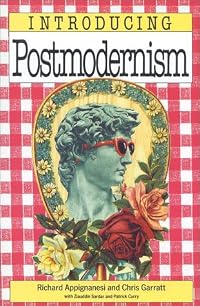
Introducing Postmodernism tracks the idea back to its roots by taking a tour of some of the most extreme and exhilarating events, people and thought of the last hundred years: in art-constructivism, conceptual art, Marcel Duchamp, Jackson Pollock and Andy Warhol; in politics and history - McCarthy's witch-hunts, feminism, Francis Fukuyama and the Holocaust; in philosophy - the work of Derrida, Baudrillard, Foucault and Heidegger. This book also explores postmodernism's take on today, and the show more anxious grip of globalization, unpredictable terrorism and unforeseen war that greeted the dawn of t show lessTags
Recommendations












Member Reviews
Books of the "Introducing..." (Graphic Guide) series use cartoons and minimal text to explain complex ideas, political movements, schools of philosophy, and prominent intellectuals. From the five books that I have read, I find their coverage spotty, and ranging from "acceptable" to "inadequate". This book falls at the low end of that scale -- although as much to the intellectual vacuity of its subject matter as to its presentation.
If "postmodernism" has ever had much to offer beyond a route to tenure in academic fields with low standards, this book has failed to demonstrate what that might be. The welter of images and words reveal it to be a sort of manic nihilism -- an anti-intellectual anarchy. "The Gulf War never happened" insists show more one hemi-intellectual proponent featured in the book (p. 133). (Tell that to the veterans and the families of those killed on both sides of the conflict). "Post-modern science" (an oxymoron if I've ever heard one) "is in a condition of anarchy" we're informed -- and that's a good thing (p. 109). Perhaps the author's confusion explains why he badly misunderstands the "anthropic principle" (p. 110).
Richard Dawkins said it best, when he noted that "a postmodernist in an airplane is a hypocrite." Those who deny scientific facts and principles don't actually do so when their lives are at stake -- nor are they willing to forego the creature comforts, freedom from disease, and longevity that science has provided. Meanwhile, as many have pointed out, postmodernism's insistence that there are no facts (and no means of discovering truths) is a self- refutation (for why should we believe its statements?) Why would a book entitled "Introducing Postmodernism" not take note of the strong refutations of postmodernism from many quarters? How could the authors write such a book without any reference to the episode in which Alan Sokal revealed the movement's fraudulent, anti-intellectual nature? (Do a Google search on "Sokal hoax" for more information). The one-sided view reveals this little book to be a work of advocacy, not an honest exploration.
Happily, the movement seems to have played itself out in the US, now that several of its major proponents (including Stanley Fish) have backed away from it. And so, we have reason to expect that all this silliness will disappear from academia with the now- retiring generation of deluded proponents. Unfortunately, in an age of "alternative facts" and so-called "fake news", the damage postmodernism has done to public discourse in the US is monumental, and appears to be here for the duration.
For readers who want to explore more about this bizarre chapter in intellectual history, I recommend "Fashionable Nonsense: Postmodern Intellectuals' Abuse of Science" by Sokal and Bricmont. show less
If "postmodernism" has ever had much to offer beyond a route to tenure in academic fields with low standards, this book has failed to demonstrate what that might be. The welter of images and words reveal it to be a sort of manic nihilism -- an anti-intellectual anarchy. "The Gulf War never happened" insists show more one hemi-intellectual proponent featured in the book (p. 133). (Tell that to the veterans and the families of those killed on both sides of the conflict). "Post-modern science" (an oxymoron if I've ever heard one) "is in a condition of anarchy" we're informed -- and that's a good thing (p. 109). Perhaps the author's confusion explains why he badly misunderstands the "anthropic principle" (p. 110).
Richard Dawkins said it best, when he noted that "a postmodernist in an airplane is a hypocrite." Those who deny scientific facts and principles don't actually do so when their lives are at stake -- nor are they willing to forego the creature comforts, freedom from disease, and longevity that science has provided. Meanwhile, as many have pointed out, postmodernism's insistence that there are no facts (and no means of discovering truths) is a self- refutation (for why should we believe its statements?) Why would a book entitled "Introducing Postmodernism" not take note of the strong refutations of postmodernism from many quarters? How could the authors write such a book without any reference to the episode in which Alan Sokal revealed the movement's fraudulent, anti-intellectual nature? (Do a Google search on "Sokal hoax" for more information). The one-sided view reveals this little book to be a work of advocacy, not an honest exploration.
Happily, the movement seems to have played itself out in the US, now that several of its major proponents (including Stanley Fish) have backed away from it. And so, we have reason to expect that all this silliness will disappear from academia with the now- retiring generation of deluded proponents. Unfortunately, in an age of "alternative facts" and so-called "fake news", the damage postmodernism has done to public discourse in the US is monumental, and appears to be here for the duration.
For readers who want to explore more about this bizarre chapter in intellectual history, I recommend "Fashionable Nonsense: Postmodern Intellectuals' Abuse of Science" by Sokal and Bricmont. show less
Excellent introduction! Several examples from art, politics, philosophy, science. Loved the illustrations and presentation of the topic.
Postmodernism, a Graphic Guide begins by noting people’s discomfort with postmodern visual arts. It goes on at some length about art movements that exemplify aspects of PoMo, such as altering realism to include the uncertainty principle (that is, that something can be seen simultaneously from different viewpoints); cubism (simplifying the human form to geometry); disposing of the ‘fetish of scared uniqueness’ (because original works of art can be reproduced en masse (through photography); and (the one many people scorn) presenting the unpresentable, i.e. to make visible that there is something that can’t be seen e.g. the empty room stuff. There are other -isms, (constructivism, Dadaism, the ready-mades, pop art, conceptual art, show more installations etc.) but I scampered over these pages to get to the stuff about theory (and hopefully, books).
Whereas the cartoon-style graphics in ‘The genealogy of postmodern art’ were useful, I found that in Part Two, ‘The genealogy of postmodern theory’ the graphics were just distracting, and the text was (by contrast with Butler’s book, Postmodernism, a Very Short Introduction) unnecessarily complex. Things which needed more clarification were hampered by the limitations of the layout, and I didn’t cheer up until I got to the page titled ‘The death of the author’ in which it is explained that Barthes (1967) made this statement in support of his idea that readers create their own meanings, regardless of the author’s intentions: the texts they use to do so are thus ever shifting, unstable or open to question.’
To read the rest of my review please visit https://anzlitlovers.com/2017/11/23/postmodernism-a-very-short-introduction-by-c... show less
Whereas the cartoon-style graphics in ‘The genealogy of postmodern art’ were useful, I found that in Part Two, ‘The genealogy of postmodern theory’ the graphics were just distracting, and the text was (by contrast with Butler’s book, Postmodernism, a Very Short Introduction) unnecessarily complex. Things which needed more clarification were hampered by the limitations of the layout, and I didn’t cheer up until I got to the page titled ‘The death of the author’ in which it is explained that Barthes (1967) made this statement in support of his idea that readers create their own meanings, regardless of the author’s intentions: the texts they use to do so are thus ever shifting, unstable or open to question.’
To read the rest of my review please visit https://anzlitlovers.com/2017/11/23/postmodernism-a-very-short-introduction-by-c... show less
I'm not sure what I think of this book - I liked the format, but I found that there wasn't enough info to understand the short snippets of post-modernism. I really don't understand it - it seems to be at times contradictory, but maybe I just need to find a different book on the subject. Either way, I'm glad I read it.
I'm going to be teaching my nieces very soon, so I got this book in preparation for that. It's a nice hardcover book. The pictures are nice and bright and the info was very good and not too hard to read. I liked the variety of topics. I would recommend this book. 5 out of 5 stars.
Concise and informative. It brings the struggles of post-modern thinkers to light, and gives them wholly new meanings to the initiate.
Don't laugh when you read about Derrida and "logocentrism."
Don't laugh when you read about Derrida and "logocentrism."
A look at the building blocks of postmodernism: structuralism, deconstruction, semiotics and the postmodern icons.
Members
- Recently Added By
Author Information

43+ Works 5,257 Members
Richard Appignanesi is a Research Fellow at King's College London.
All Editions
Some Editions
Series

Common Knowledge
- Canonical title
- Introducing Postmodernism
- People/Characters
- Jacques Derrida; Michel Foucault; Charles Jencks; Karl Marx; Pablo Picasso; Paul Cézanne (show all 32); Walter Benjamin; Jean-François Lyotard; Piet Mondrian; Jackson Pollock; Kurt Schwitters; Marcel Duchamp; Yves Klein; Josef Beuys; Andy Warhol; Jean Baudrillard; Ferdinand de Saussure; Claude Lévi-Strauss; Roland Barthes; Jacques Lacan; Luce Irigaray; Julia Kristeva; Robert Venturi; Arnold Schwarzenegger; Madonna; Pope John Paul II; Margaret Thatcher; Ronald Reagan; Salman Rushdie; Ayatollah Khomeini; Francis Fukuyama; G.W.F. Hegel
- First words
- Charles Jencks, an authority on postmodern architecture and art, provides a useful scanning of the term postmodern.
- Last words
- (Click to show. Warning: May contain spoilers.)The only cure for postmodernism is the incurable illness of romanticism.
Classifications
- Genres
- Philosophy, Nonfiction, Literature Studies and Criticism
- DDC/MDS
- 149.97 — Philosophy and Psychology Philosophical schools of thought Other philosophical systems and doctrines Other systems Postmodernism
- LCC
- B831.2 .A65 — Philosophy, Psychology and Religion Philosophy (General) By period Modern Special topics and schools of philosophy
- BISAC
Statistics
- Members
- 1,077
- Popularity
- 23,585
- Reviews
- 10
- Rating
- (3.19)
- Languages
- 6 — Chinese, Dutch, English, Finnish, Norwegian (Bokmål), Spanish
- Media
- Paper, Audiobook, Ebook
- ISBNs
- 18
- ASINs
- 9
