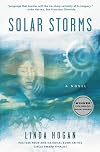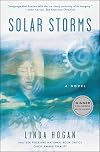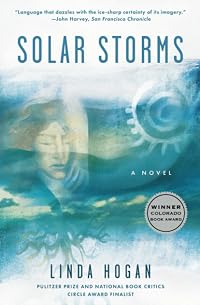
Solar Storms
by Linda Hogan
On This Page
Description
An Indian girl returns home to find her identity. She is Angela Jensen, 17, whose stay in an Indian village in northern Minnesota turns into a depressing lesson in the lot of her people, but also brings self-discovery and love. By the author of Mean Spirit.Tags
Recommendations


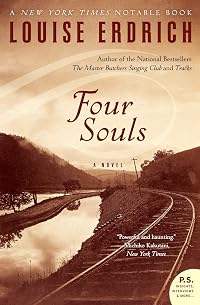
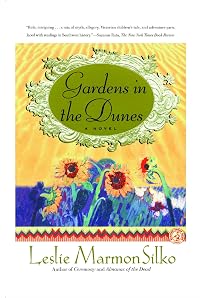
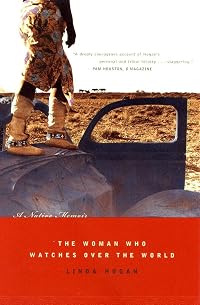

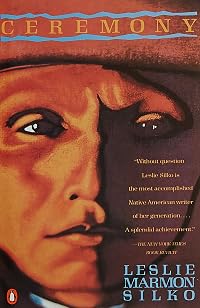






Member Reviews
Soon after starting this book, I realized that I'd read it once before, soon after it was published. That said, there's a reason I'd allowed myself to forget it. While I can see how some readers might find this book a renewing story of celebrating life and embracing the natural world, for this reader, it's anything but.
The book is beautifully written, with striking images. Unfortunately, the vast majority of those images are centered either on endangered nature, brutality, or approaching death. The book presents a bleak view of nature and the human condition, though ironically, the main characters of the book are always moving beyond trauma, and rarely facing trauma. As a result, they seem to be too easily recovered, too easily moving show more forward, and the book as a whole comes across as simplifying issues which cannot (and should not, in my opinion) be simplified. It's true that the power of love, family, and heritage are presented as a vehicle toward recovery and knowing the natural world, but at the expense of the individual and realism, to the extent that it's far from believable.
Peace of mind or spirit isn't easy, and this book comes across as a rather didactic treatise on grief, mourning, and appreciation for life. As a result, while there's beauty in the language, this was one of the more depressing and false-feeling books I've read, and the images of animals dying and lost were often too much for me considering especially how easily the humans all managed to survive the natural world around them.
In the end, this book is one which certainly promotes a wide range of opinions, but it's not for me, and I can't recommend it. There's enough grief and sadness in the world without my reading a book which does little more than dictate that I should be aware of the natural world and move beyond grief.
Lastly, the book's tendancy to over-romanticize Native Americans and their appreciation for the land, unmatched by any around them, only surved to further separate this book from the reality it attempts to criticize. I appreciate and welcome literature with an ecological awareness, and literature that tries to work for the environment, but this book simplifies and over-idealizes the issues to the point that I don't know that it could do much for either awareness or understanding--anyone who comes to this book to learn about those issues already understands them at a deeper level than the book encourages. show less
The book is beautifully written, with striking images. Unfortunately, the vast majority of those images are centered either on endangered nature, brutality, or approaching death. The book presents a bleak view of nature and the human condition, though ironically, the main characters of the book are always moving beyond trauma, and rarely facing trauma. As a result, they seem to be too easily recovered, too easily moving show more forward, and the book as a whole comes across as simplifying issues which cannot (and should not, in my opinion) be simplified. It's true that the power of love, family, and heritage are presented as a vehicle toward recovery and knowing the natural world, but at the expense of the individual and realism, to the extent that it's far from believable.
Peace of mind or spirit isn't easy, and this book comes across as a rather didactic treatise on grief, mourning, and appreciation for life. As a result, while there's beauty in the language, this was one of the more depressing and false-feeling books I've read, and the images of animals dying and lost were often too much for me considering especially how easily the humans all managed to survive the natural world around them.
In the end, this book is one which certainly promotes a wide range of opinions, but it's not for me, and I can't recommend it. There's enough grief and sadness in the world without my reading a book which does little more than dictate that I should be aware of the natural world and move beyond grief.
Lastly, the book's tendancy to over-romanticize Native Americans and their appreciation for the land, unmatched by any around them, only surved to further separate this book from the reality it attempts to criticize. I appreciate and welcome literature with an ecological awareness, and literature that tries to work for the environment, but this book simplifies and over-idealizes the issues to the point that I don't know that it could do much for either awareness or understanding--anyone who comes to this book to learn about those issues already understands them at a deeper level than the book encourages. show less
Solar Storms' extraordinarily beautiful prose makes it a book to savour. It's a coming of age story set in remote Native American community (I don't believe the nation is ever named; Hogan herself is Chickasaw) near the border of Minnesota and Canada, where a young woman called Angel leaves behind the foster system in order to live with her great-grandmother Agnes, her great-great-grandmother Dora Rouge and her step-grandmother Bush. Hogan's writing is full of insight; admittedly, it can tend towards the didactic and the romanticized at points, but overall there is a sense of dignity and restraint here that's compelling. The ending is balanced beautifully between grief and hope. Highly recommended.
There was a lot to love about this book. Hogan's beautiful writing, the environmental ethic, the cast of strong female characters--just to name a few. I had some serious issues with momentum (or lack there of) that made the book less enjoyable to read, but I'd still recommend reading it.
Absolutely beautiful novel. Simultaneously devastating and uplifting, real and magical. I can’t believe it took me this long to read it. It blew me away!
I wouldn't say I enjoyed reading it, but I like the book. It's well-written and full of sadness.
This is a hard book for me to review. I found the first half so slow that I nearly stopped reading. But the second half only gets better and better!
This is the best and most powerfully written novel I have ever had the good fortune to read. Linda Hogan knows what language is for.
Members
- Recently Added By
Published Reviews
ThingScore 100
"Hogan's finely tuned descriptions of the land and its spiritual significance draw a parallel between the ravages suffered by the environment and those suffered by Angela's mother. And, as the land is transformed, so are the lives of the characters, often in deeply resonant ways."
added by juniperSun
Lists

Native American / Indigenous Literature
172 works; 100 members

Top 100 books by Indigenous Masters
134 works; 7 members
Author Information

23+ Works 2,342 Members
Linda Hogan--a Chickasaw writer whose work draws heavily on Native American culture--was born in Denver, Colorado, in 1947. A poet, novelist, screenwriter, and playwright, Hogan writes about topics related to the experiences of Native Americans as well as the relationship between humans and the environment. Her acclaimed first novel, Mean Spirit, show more focused on violence in the Osage Indian community during the Oklahoma oil boom of the 1920s. She has also published volumes of poetry and essays. Hogan has received grants from the National Endowment for the Arts and the Guggenheim Foundation and has taught at University of Colorado, University of Denver, and the University of Minnesota. (Bowker Author Biography) Linda Hogan has published several books of poetry, essays, and fiction. She lives in Colorado. (Bowker Author Biography) Linda Hogan is the recipient of an American Book Award. Her novel, "Mean Spirit," was a finalist for the Pulitzer Prize. She lives in Idledale, Colorado. (Bowker Author Biography) show less
Awards and Honors
Awards
Common Knowledge
- Canonical title*
- Sonnenstaub
- Original title
- Solar storms
- Original publication date
- 1995
- People/Characters
- Angel Jensen; Dora-Rouge; Agnes Iron; Bush; John Husk
- Important places
- Canada; Minnesota, USA
- Dedication
- For Danielle Marie. May you find your way always to those who love you.
- First words
- Sometimes now I hear the voice of my great-grandmother, Agnes.
- Last words
- (Click to show. Warning: May contain spoilers.)You will see.
- Blurbers
- Kingsolver, Barbara
- Original language*
- Amerikanisch
*Some information comes from Common Knowledge in other languages. Click "Edit" for more information.
Classifications
Statistics
- Members
- 379
- Popularity
- 82,818
- Reviews
- 10
- Rating
- (3.93)
- Languages
- English, German
- Media
- Paper, Ebook
- ISBNs
- 6
- ASINs
- 2