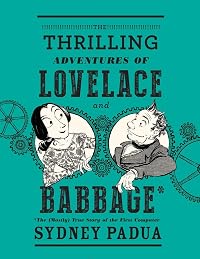
The Thrilling Adventures of Lovelace and Babbage: The (Mostly) True Story of the First Computer
by Sydney Padua
On This Page
Description
Meet Victorian London's most dynamic duo: Charles Babbage, the unrealized inventor of the computer, and his accomplice, Ada, Countess of Lovelace, the peculiar protoprogrammer and daughter of Lord Byron. When Lovelace translated a description of Babbage's plans for an enormous mechanical calculating machine in 1842, she added annotations three times longer than the original work. Her footnotes contained the first appearance of the general computing theory, a hundred years before an actual show more computer was built. Sadly, Lovelace died of cancer a decade after publishing the paper, and Babbage never built any of his machines. But do not despair! The Thrilling Adventures of Lovelace and Babbage presents a rollicking alternate reality in which Lovelace and Babbage do build the Difference Engine and then use it to build runaway economic models, battle the scourge of spelling errors, explore the wilder realms of mathematics, and, of course, fight crime -- for the sake of both London and science. Complete with extensive footnotes that rival those penned by Lovelace herself, historical curiosities, and never-before-seen diagrams of Babbage's mechanical, steam-powered computer. show lessTags
Recommendations










Member Reviews
Whimsical, educational, and yes, even thrilling. Padua's graphic novel eloquently and humorously tells the story of Charles Babbage and Ada Lovelace -- both the real timeline, in which the brilliant but temperamental inventors never realize their visions, and an imaginary one in which they actually build a ginormous steam-powered computer. The research is meticulous (there are tons of excerpts from the main characters' papers, as well as various diagrams that I wish I understood better), and the illustrations are just fantastic. I'm looking forward to sequels -- and, once Padua recovers from publishing this, more webcomics!
The book spawned by the webcomic 2dgoggles. It probably qualifies as a comic book, but between the copious footnotes, endnotes, and primary source documents that doesn’t seem entirely correct.
I actually didn’t read this book for a long time after buying it, as I thought it would simply print parts of the webcomic. Much to my surprise, the parts of the comic which had already appeared online were expanded and improved upon! Generally, when such a thing happens it is a letdown for someone who has read the original, but though a bit of the brisk comedy of the first form was gone, I really like the new versions. We learn so much more, and it is still absolutely in Padua’s brilliant style.
I highly suggest this book for anyone who show more wants to know a bit about Ada Lovelace, Charles Babbage, the Difference Engine, the Analytical Engine, or Victorian-era political cartoons. If you like steampunk this should be required reading – yes the fiction of Verne is important, but a bit of grounding in the crazy science fact of the day is not to be overlooked. But even if none of that is particularly interesting, the book is educational, funny, frequently laugh-out-loud-in-a-restaurant funny, and yet at times deeply bittersweet. It is a wonderfully worthwhile read.
I’m glad the website is still up, because there are several wonderful vignettes that didn’t make it into the book, but I am extremely happy to have this hard copy, and may just give copies to people I like.
Dear Sydney Padua, thank you for teaching me about Isambard Kingdom Brunel. show less
I actually didn’t read this book for a long time after buying it, as I thought it would simply print parts of the webcomic. Much to my surprise, the parts of the comic which had already appeared online were expanded and improved upon! Generally, when such a thing happens it is a letdown for someone who has read the original, but though a bit of the brisk comedy of the first form was gone, I really like the new versions. We learn so much more, and it is still absolutely in Padua’s brilliant style.
I highly suggest this book for anyone who show more wants to know a bit about Ada Lovelace, Charles Babbage, the Difference Engine, the Analytical Engine, or Victorian-era political cartoons. If you like steampunk this should be required reading – yes the fiction of Verne is important, but a bit of grounding in the crazy science fact of the day is not to be overlooked. But even if none of that is particularly interesting, the book is educational, funny, frequently laugh-out-loud-in-a-restaurant funny, and yet at times deeply bittersweet. It is a wonderfully worthwhile read.
I’m glad the website is still up, because there are several wonderful vignettes that didn’t make it into the book, but I am extremely happy to have this hard copy, and may just give copies to people I like.
Dear Sydney Padua, thank you for teaching me about Isambard Kingdom Brunel. show less
An imaginary comic about an imaginary computer, with a pair of heroes granted imaginary lives by the simple application of a pocket alternative universe thing. This plays giddy games with history and technology, science and biography, philosophy and literature and it has footnotes, so so many footnotes, a veritable footnote bubble ready to collapse into a terrifying footnote crisis that will lead to scholars who invested too heavily on footnote futures leaping off asterisks and bruising their ibids. Fortunately, the footnotes are witty, wise and full of amusing and fascinating historical trivia while the comics themselves are a warmhearted delight of unabashed silly cleverness. Long live Lovelace and Babbage!
Charles Babbage was a Victorian inventor who came up with very, very detailed plans for what he called the Analytical Engine: a calculating machine that really would have been nothing more or less than a computer -- a primitive, limited, and clunky computer, but a full-fledged computer nonetheless -- made out of cogwheels and powered by steam. Which is an idea that, I think, just gets cooler and weirder the more you think about it. Ada Byron, Countess of Lovelace was the only legitimate daughter of Lord Byron, a woman whose impressive intellect was deliberately channeled into mathematics by her mother in hopes that she wouldn't end up like her crazy poet father. She and Babbage hit it off wonderfully and formed a firm friendship and show more long-term collaboration on matters concerning the Analytical Engine. Where Babbage was focused on the mechanics of the device, Lovelace was more interested in its operation, and had some genuinely prophetic ideas about what machines like it might be capable of. She is sometimes described as being the first computer programmer.
They were also, apparently, really fascinating, eccentric, and colorful characters who make great material for a graphic novel. Although I'm not actually sure whether "graphic novel" is quite the right word for this book. It's a mixture of fiction and non-fiction, with, as the subtitle suggests, rather more of the latter than the former. Actually, its origin story is rather charming. The author initially just created a humorous little biography of Ada Lovelace in webcomic form. But she found the end of that story a little too depressing for the light tone of the comic: Lovelace, sadly, died young, and Babbage died frustrated and unfulfilled, having never succeeded in actually constructing his Engine. So Padua instead concluded her comic by imagining a "pocket universe" in which they were able to build the thing, after all, and use it to "have thrilling adventures and fight crime." The comic turned out to be quite popular, which was nice, but also led to people assuming she was now writing a comic about the alternate-universe adventures of Lovelace and Babbage, when really she was just making a throwaway joke. She kept insisting to people that no, she wasn't writing anything of the kind, even as she kept finding herself, well, sort of writing it. This book is the result!
I actually do think the Lovelace bio that starts it out is the best part. It's hilarious, informative, geeky, and delightful. The fictionalized adventures that follow are sometimes whimsical -- one of them features an Alice-in-Wonderland version of Lovelace falling through a looking-glass into the Engine itself -- but are mostly just little excuses to bring in other famous people of the time, many of whom were personally known to Babbage and Lovelace, often taking their dialog directly from their written works or letters, and providing lots and lots of factual footnotes. Which sounds a bit dry, and the footnotes do get a little out of hand in the first adventure -- something the author notices and ends up making a meta-joke about -- but overall it actually works surprisingly well. The humor is always cute and fun, the historical facts are genuinely interesting, and Padua is clearly so fond of these two nutty geniuses and enthused by her own research into them that it's truly infectious.
She also includes interesting quotes from some primary sources she's found at the end, as well as a section showing her own drawings of the Analytical Engine and taking us through its workings. (Well, in a simplified fashion, anyway, because it's all very dauntingly complex.)
Recommended for anyone who's interested in Lovelace and Babbage, the history of computer science, the Victorian era in general, or a bit of pleasantly nerdy humor. show less
They were also, apparently, really fascinating, eccentric, and colorful characters who make great material for a graphic novel. Although I'm not actually sure whether "graphic novel" is quite the right word for this book. It's a mixture of fiction and non-fiction, with, as the subtitle suggests, rather more of the latter than the former. Actually, its origin story is rather charming. The author initially just created a humorous little biography of Ada Lovelace in webcomic form. But she found the end of that story a little too depressing for the light tone of the comic: Lovelace, sadly, died young, and Babbage died frustrated and unfulfilled, having never succeeded in actually constructing his Engine. So Padua instead concluded her comic by imagining a "pocket universe" in which they were able to build the thing, after all, and use it to "have thrilling adventures and fight crime." The comic turned out to be quite popular, which was nice, but also led to people assuming she was now writing a comic about the alternate-universe adventures of Lovelace and Babbage, when really she was just making a throwaway joke. She kept insisting to people that no, she wasn't writing anything of the kind, even as she kept finding herself, well, sort of writing it. This book is the result!
I actually do think the Lovelace bio that starts it out is the best part. It's hilarious, informative, geeky, and delightful. The fictionalized adventures that follow are sometimes whimsical -- one of them features an Alice-in-Wonderland version of Lovelace falling through a looking-glass into the Engine itself -- but are mostly just little excuses to bring in other famous people of the time, many of whom were personally known to Babbage and Lovelace, often taking their dialog directly from their written works or letters, and providing lots and lots of factual footnotes. Which sounds a bit dry, and the footnotes do get a little out of hand in the first adventure -- something the author notices and ends up making a meta-joke about -- but overall it actually works surprisingly well. The humor is always cute and fun, the historical facts are genuinely interesting, and Padua is clearly so fond of these two nutty geniuses and enthused by her own research into them that it's truly infectious.
She also includes interesting quotes from some primary sources she's found at the end, as well as a section showing her own drawings of the Analytical Engine and taking us through its workings. (Well, in a simplified fashion, anyway, because it's all very dauntingly complex.)
Recommended for anyone who's interested in Lovelace and Babbage, the history of computer science, the Victorian era in general, or a bit of pleasantly nerdy humor. show less
Utterly charming. Babbage was bonkers and Lovelace was lively. With special guest appearances by Isambard Kingdom Brunel, Charles Dodgson and others this is a delightful tale, winningly presented.
I am an English major turned historian turned web developer (and let's not forget feminist), and if you designed a book specifically to appeal to all of my geekinesses, you couldn't do much better than this.
First of all, it has Ada Lovelace, who is a fascinating person: the daughter of Lord Byron, whose mother didn't want her to be a poet and thus subjected her to a lot of math lessons, turning her into a mathematical prodigy who was able to foresee the potential of computing. Then there's Babbage, who is also pretty darn fascinating, not only for inventing a computer but also for being a classic British curmudgeon. Then, it sticks them in an alternate universe where Babbage has built his Analytical Engine. Since it's an alternate show more universe, Padua can make things happen just because it would have been cool if they had happened that way. A lesser author would just make a bunch of stuff up, but Padua recognizes that reality was almost the coolest thing ever, so she makes some very slight tweaks to reality (some episodes are almost entirely drawn from reality, and some episodes are more fantastical).
But what really made the academic historian in me squee was the research! Most of the dialog is quoted directly from primary sources. The book is full of other historical and literary figures such as Brunel, George Sand, Charles Dickens, and of course Queen Victoria. The comics not only have footnotes, but also endnotes AND appendices! Padua has done her research well, and clearly knows when she's being historical and when she is imagining alternate realities. The whole book is a labor of love and fascination, and as a reader, it is impossible not to share in that love and fascination.
This was fun to read, but now I'm looking forward to re-reading it. show less
First of all, it has Ada Lovelace, who is a fascinating person: the daughter of Lord Byron, whose mother didn't want her to be a poet and thus subjected her to a lot of math lessons, turning her into a mathematical prodigy who was able to foresee the potential of computing. Then there's Babbage, who is also pretty darn fascinating, not only for inventing a computer but also for being a classic British curmudgeon. Then, it sticks them in an alternate universe where Babbage has built his Analytical Engine. Since it's an alternate show more universe, Padua can make things happen just because it would have been cool if they had happened that way. A lesser author would just make a bunch of stuff up, but Padua recognizes that reality was almost the coolest thing ever, so she makes some very slight tweaks to reality (some episodes are almost entirely drawn from reality, and some episodes are more fantastical).
But what really made the academic historian in me squee was the research! Most of the dialog is quoted directly from primary sources. The book is full of other historical and literary figures such as Brunel, George Sand, Charles Dickens, and of course Queen Victoria. The comics not only have footnotes, but also endnotes AND appendices! Padua has done her research well, and clearly knows when she's being historical and when she is imagining alternate realities. The whole book is a labor of love and fascination, and as a reader, it is impossible not to share in that love and fascination.
This was fun to read, but now I'm looking forward to re-reading it. show less
It starts off as an actual biography, discussing Ada King, Countess of Lovelace (hereafter Ada Lovelace as is common usage) and her life. How the fear of her becoming like her father Lord Byron she is raised quite strictly and finds an outlet in Mathematics, at which she becomes exceedingly proficient. Sydney Padua also introduces us to Charles Babbage. Babbage had an idea that never (well not until it was made in 2002 http://www.computerhistory.org/babbage/ ) became real, what we now recognise as the first computer and Ada Lovelace came up with ideas that would have been programs. Sadly these never became real and Ada Lovelace died of cancer. This is a entertaining foray into might-have-beens and footnotes and images and explanations show more of the workings of the computer - which if I'm honest left me cold, I'm more a user than a builder, but I'll tweak my user experience as much as I can.
Entertaining, you can tell that Sydney Padua was caught up by the story and the people and her genuine liking for them shows. The footnotes and endnotes are hilarious and I think this may be the first graphic novel I've read with this amount of footnotes and endnotes.
Recommended. show less
Entertaining, you can tell that Sydney Padua was caught up by the story and the people and her genuine liking for them shows. The footnotes and endnotes are hilarious and I think this may be the first graphic novel I've read with this amount of footnotes and endnotes.
Recommended. show less
Members
- Recently Added By
Lists

2016 Hugo Eligible Graphic Stories
7 works; 5 members

Club Read's Graphic Stories Recommendations
127 works; 2 members

Kirkus Starred Fiction Reviews of Books Published in 2015
310 works; 6 members
Books Read in 2016
4,666 works; 199 members

Top Five Books of 2016
795 works; 229 members

Books I Wrote Essays on
34 works; 1 member

Pleasant Surprises: Books That Exceeded Our Expectations
418 works; 143 members

Best Biographies, Autobiographies and Memoirs
465 works; 160 members
Best Graphic Novel Nonfiction
199 works; 101 members

Favorite Science Fiction
456 works; 218 members
Author Information

Awards and Honors
Awards
Distinctions
Notable Lists
Series
Belongs to Publisher Series
Common Knowledge
- Canonical title
- The Thrilling Adventures of Lovelace and Babbage: The (Mostly) True Story of the First Computer (Mostly)
- Alternate titles
- The Thrilling Adventures of Lovelace and Babbage with Interesting & Curious Anecdotes of Celebrated and Distinguished Characters Fully Illustrating a Variety of Instructive and Amusing Scenes; as Performed Within and Without the Remarkable Difference Engine Embellished with Portraits and Scientifick Diagrams
- Original publication date
- 2015-04-21
- People/Characters
- Ada Byron Lovelace; Charles Babbage; Isambard Kingdom Brunel; George Eliot; Charles Dickens; George Boole (show all 14); Lord Byron; Thomas Carlyle; Lewis Carroll; Samuel Taylor Coleridge; Wilkie Collins; William Rowan Hamilton; Victoria, Queen of the United Kingdom; Arthur Wellesley, 1st Duke of Wellington
- Important places
- London, England, UK; England, UK
- Important events
- The building of the Difference Engine; The building of the Analytic Engine; Panic of 1837; Romanticism; Victorian Era; 19th century (show all 8); Georgian Era; Regency Era
- Epigraph
- How, when, and where this vision occurred it is unnecessary for me at present to state.
--Charles Babbage, Passages from the Life of a Philosopher
"The wisest and the best of men, nay, the wisest and the best of their actions, may be rendered ridiculous by a person whose first object in life is a joke."
--Jane Austen, Pride and Prejudice - Dedication
- For my mother
- First words
- It was in a pub somewhere in London in the spring of 2009 that I undertook to draw a very short comic for the web, to illustrate the very brief life of Ada Lovelace.
- Last words
- (Click to show. Warning: May contain spoilers.)For links to the primary sources mentioned throughout the text, as well as many, many, more I didn't have room for, and for sporadically appearing Lovelace and Babbage comics and ramblings, visit 2dgoggles.com
- Blurbers
- Gleick, James
- Original language
- English
Classifications
- Genre
- Graphic Novels & Comics
- DDC/MDS
- 741.5 — Arts & recreation Drawing & decorative arts Drawing Comic books, graphic novels, fotonovelas, cartoons, caricatures, comic strips
- LCC
- PN6737 .P34 .T48 — Language and Literature Literature (General) Literature (General) Collections of general literature Comic books, strips, etc.
- BISAC
Statistics
- Members
- 1,042
- Popularity
- 24,783
- Reviews
- 51
- Rating
- (4.04)
- Languages
- English, Italian, Spanish
- Media
- Paper, Ebook
- ISBNs
- 10
- ASINs
- 7