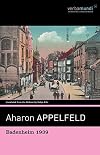
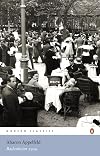
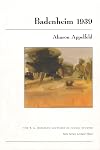
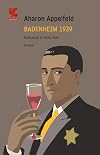
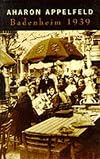
Badenheim 1939
by Aharon Appelfeld
On This Page
Description
A sampling of Jewish middle class life arrives at a resort town near Vienna in 1939 along with the bland inspectors from the "Sanitation department."Tags
Recommendations


































Member Recommendations

Member Reviews
A Japanese proverb states that 'The nail that sticks out gets hammered down'. Now, let's play the perspective game, imbuing some life into the nails and into the hammer. The nails sticking out, whether deliberately or not, the hammer coming down, steady, inevitable, fast or slow, the impact is in the wings and it won't be softened or lessened, it can't, these things don't factor in. Now, what to make of it? What, if anything, can be done?
With that salvo fired, let me say that this book is a bit of an anomaly. But then, so is the author. Aharon Appelfeld is an Israeli author who was born outside of the country in the town of Sadhora which is now a sub-district of another town in Ukraine. Appelfeld writes in Hebrew which, to him, is a show more language he only started to learn when he was 15 after having escaped the collapsing horror that was much of Europe for Jews. What sets Appelfeld apart from his colleagues is what he chooses to write about. Unlike his fellows who write about Israel as it is now, or what it was in the not so distant past, or what it possibly might become in the not too distant future, Appelfeld writes about Jews in the galut/diaspora/exile, specifically in Europe.
Now, there's a joke here. Yair, you're reading a book by an Israeli-Jewish author about Jews in a town near Vienna, Austria in the year 1939...what the hell were you expecting? A farce? A summer romance? Maybe a spot of joy?
Of course not. This book is fecund, but mostly fetid. It's a book of rotting and decay and delusions about excess and decadence and how these things can, somehow, stave off the inevitable. They can't. In an odd but resonant way this book feels like the opposite number of Gabriel Garcia Marquez's '100 Years of Solitude'. Both take great pains to describe the lush details of their respective settings that acts almost as a commentary, or even a near Greek style chorus. But where Marquez shows life in its multifarious faces despite its eventual supplanting of humanity, this book (very much like Lars von Trier's Melancholia which through apparent kismet I watched in the time I read this) shows only the one unreadable expression of death and people's coping, or lack thereof, with it.
You know from page one what's going to happen, where this is going to lead for the characters. And the dialogue is loaded with foreboding to the point of cliche and even black comedy. I wondered as I read what Appelfeld was trying to say with all this. Just by dint of his own experiences I highly doubt he was mocking or gloating, not at all. Similarly, I don't think he was playing into the tired and sagging meta-narrative of all golden roads leading through the woods of exile and into the honey pot of Israel for the Jews. There's a brief mention of a half-crazed prophet warning of the coming doom of the Jews if they don't 'save their souls' who's quickly disregarded as a lecher (a fairly sly reference to, I believe, Zeev Jabotinksy) but for the most part Israel is barely touched upon, even, jarringly absent. Curiously, the one stated religious Jew, the rabbi, is decrepit and jeering, resigned to fate and secured by his assumed superior knowledge but doing nothing to warn, to help, to even comfort or teach others to understand.
And that's what this book seems to be about. Missing pieces, missing halves more specifically. The rabbi is disdainful of the secular and offers them nothing. The mostly secular Jews pay face value, if that, to religion and don't acknowledge it at all, relegating it to an obligated labor well symbolized by the tottering rabbi's being consigned to a wheelchair for the majority of his described time. But the most curious thing Appelfeld does is to imply that these missing halves have no counterparts, that their other halves either stopped existing, never existed, or the gaps separating them have altered both so irrevocably that there is only the path forward, the path of lacking that essential half. Or, as Appelfeld shows us as an alternative, the path of denial, stagnation, and eventually, death.
I rated this book lower than 'The Conversion' because that work better straddled the line between story in a novel and parable in a Jewish meta-narrative. Here, the line dissolves completely in favor of the parable, of the allegory, and suffers for it. The hammering away of Appelfeld's dialogue and descriptions while suffused with melancholy and dread and a grim harbinger of things to come, serve only to drown the characters into near irrelevance. Returning to the initial visual metaphor, do we cry for the nails, scream at the hammer, or question or even rage against the hands holding and controlling everything?
Here, Appelfeld gives us death as inevitability, which as a truism is fairly standard. But where he falters is thinking life is only the deluded and rushed preamble when, in fact, it is the half that gives the other its power, as the latter sweetens the former into something eternal. show less
With that salvo fired, let me say that this book is a bit of an anomaly. But then, so is the author. Aharon Appelfeld is an Israeli author who was born outside of the country in the town of Sadhora which is now a sub-district of another town in Ukraine. Appelfeld writes in Hebrew which, to him, is a show more language he only started to learn when he was 15 after having escaped the collapsing horror that was much of Europe for Jews. What sets Appelfeld apart from his colleagues is what he chooses to write about. Unlike his fellows who write about Israel as it is now, or what it was in the not so distant past, or what it possibly might become in the not too distant future, Appelfeld writes about Jews in the galut/diaspora/exile, specifically in Europe.
Now, there's a joke here. Yair, you're reading a book by an Israeli-Jewish author about Jews in a town near Vienna, Austria in the year 1939...what the hell were you expecting? A farce? A summer romance? Maybe a spot of joy?
Of course not. This book is fecund, but mostly fetid. It's a book of rotting and decay and delusions about excess and decadence and how these things can, somehow, stave off the inevitable. They can't. In an odd but resonant way this book feels like the opposite number of Gabriel Garcia Marquez's '100 Years of Solitude'. Both take great pains to describe the lush details of their respective settings that acts almost as a commentary, or even a near Greek style chorus. But where Marquez shows life in its multifarious faces despite its eventual supplanting of humanity, this book (very much like Lars von Trier's Melancholia which through apparent kismet I watched in the time I read this) shows only the one unreadable expression of death and people's coping, or lack thereof, with it.
You know from page one what's going to happen, where this is going to lead for the characters. And the dialogue is loaded with foreboding to the point of cliche and even black comedy. I wondered as I read what Appelfeld was trying to say with all this. Just by dint of his own experiences I highly doubt he was mocking or gloating, not at all. Similarly, I don't think he was playing into the tired and sagging meta-narrative of all golden roads leading through the woods of exile and into the honey pot of Israel for the Jews. There's a brief mention of a half-crazed prophet warning of the coming doom of the Jews if they don't 'save their souls' who's quickly disregarded as a lecher (a fairly sly reference to, I believe, Zeev Jabotinksy) but for the most part Israel is barely touched upon, even, jarringly absent. Curiously, the one stated religious Jew, the rabbi, is decrepit and jeering, resigned to fate and secured by his assumed superior knowledge but doing nothing to warn, to help, to even comfort or teach others to understand.
And that's what this book seems to be about. Missing pieces, missing halves more specifically. The rabbi is disdainful of the secular and offers them nothing. The mostly secular Jews pay face value, if that, to religion and don't acknowledge it at all, relegating it to an obligated labor well symbolized by the tottering rabbi's being consigned to a wheelchair for the majority of his described time. But the most curious thing Appelfeld does is to imply that these missing halves have no counterparts, that their other halves either stopped existing, never existed, or the gaps separating them have altered both so irrevocably that there is only the path forward, the path of lacking that essential half. Or, as Appelfeld shows us as an alternative, the path of denial, stagnation, and eventually, death.
I rated this book lower than 'The Conversion' because that work better straddled the line between story in a novel and parable in a Jewish meta-narrative. Here, the line dissolves completely in favor of the parable, of the allegory, and suffers for it. The hammering away of Appelfeld's dialogue and descriptions while suffused with melancholy and dread and a grim harbinger of things to come, serve only to drown the characters into near irrelevance. Returning to the initial visual metaphor, do we cry for the nails, scream at the hammer, or question or even rage against the hands holding and controlling everything?
Here, Appelfeld gives us death as inevitability, which as a truism is fairly standard. But where he falters is thinking life is only the deluded and rushed preamble when, in fact, it is the half that gives the other its power, as the latter sweetens the former into something eternal. show less
""You could see that they wanted to die, but Death did not seem to want them yet . . . they had retreated into the bushes and waited for Death, and because Death did not come for them they came out and stood under the light.""
The book has a simple opening line, "Spring returned to Badenheim." On the face of it an occurrence that happens every year but the reader, with the benefit of history, suddenly begins to realise that this is not going to be an ordinary year. Spring, normally a time of rebirth will this year mark the start of something far more sinister.
The novel opens to the sound of country church bells ringing and two Sanitation Department inspectors examining a flow of sewage. As the tourists and musicians gather the town is show more abuzz with activity and joviality but gradually the Sanitation Department begins to exert their influence. The Jews have to register the fact and their rights are gradually curtailed. Posters extolling the virtues of Poland are posted, the pastry shop and the post office are closed and the non-Jews leave the town. Slowly the town fills with other Jews and food supplies dwindle and they realise that they are being held prisoner. Even four dogs who try to escape are forced back inside the town walls by the guards.
Finally the time for deportation arrives and they walk to the rail station in high spirits glad to be free of their confinement. “How easy the transition was—they hardly felt it.”
I find this is a hard book for me to review. Firstly it is the tone. The story features a third-person narrator who seems totally detached from the action, merely reporting the events as they happen in a disquieting matter of fact, understated style. This in turn means that it was written almost as a fairy tale or comic opera yet it represents a tragic period of world history and symbolic events. The book opens with a group of Jewish tourists arriving in an Austrian resort in the spring of 1939 for an annual music festival and culminates in the deportation of these Jews in the autumn of the same year.
Secondly, it is because we read this with the benefit of history. We know about the concentration camps and the gas chambers. We want to scream at them to show some resistance to somehow fight back. Instead we just see a sense of inevitability about it all. Only one man, Peter the pastry shop owner, seems to make some token resistance. But we have got to realise that these people didn't have the benefit of hindsight. They didn't know what was going to happen to them. Part of me questions whether or not I really liked this book but then again it has made me stop and think about the situation that Jews at that time found themselves in and surely that can be no bad thing. show less
The book has a simple opening line, "Spring returned to Badenheim." On the face of it an occurrence that happens every year but the reader, with the benefit of history, suddenly begins to realise that this is not going to be an ordinary year. Spring, normally a time of rebirth will this year mark the start of something far more sinister.
The novel opens to the sound of country church bells ringing and two Sanitation Department inspectors examining a flow of sewage. As the tourists and musicians gather the town is show more abuzz with activity and joviality but gradually the Sanitation Department begins to exert their influence. The Jews have to register the fact and their rights are gradually curtailed. Posters extolling the virtues of Poland are posted, the pastry shop and the post office are closed and the non-Jews leave the town. Slowly the town fills with other Jews and food supplies dwindle and they realise that they are being held prisoner. Even four dogs who try to escape are forced back inside the town walls by the guards.
Finally the time for deportation arrives and they walk to the rail station in high spirits glad to be free of their confinement. “How easy the transition was—they hardly felt it.”
I find this is a hard book for me to review. Firstly it is the tone. The story features a third-person narrator who seems totally detached from the action, merely reporting the events as they happen in a disquieting matter of fact, understated style. This in turn means that it was written almost as a fairy tale or comic opera yet it represents a tragic period of world history and symbolic events. The book opens with a group of Jewish tourists arriving in an Austrian resort in the spring of 1939 for an annual music festival and culminates in the deportation of these Jews in the autumn of the same year.
Secondly, it is because we read this with the benefit of history. We know about the concentration camps and the gas chambers. We want to scream at them to show some resistance to somehow fight back. Instead we just see a sense of inevitability about it all. Only one man, Peter the pastry shop owner, seems to make some token resistance. But we have got to realise that these people didn't have the benefit of hindsight. They didn't know what was going to happen to them. Part of me questions whether or not I really liked this book but then again it has made me stop and think about the situation that Jews at that time found themselves in and surely that can be no bad thing. show less
Aharon Appelfeld's BADENHEIM 1939 (translated from the Hebrew by Dalya Bilu) comes across as an almost surreal parable of how Europe's Jews were quietly rounded up and shipped off to camps. The small fictional resort town in Austria is the setting, and in the Spring of 1939 the town is gradually isolated and sealed off by a mysterious "Sanitation Department" which issues a decree requiring all Jews to "register." And, for the most part, the Jews comply calmly with this order. A symbolic foreshadowing of what is coming can be found in the hotel's aquarium, where "some blue Cambium fishes" had been put in with the other fish.
"For the first few days the blue Cambium fish disported themselves gaily in the water, but one night they suddenly show more fell on the other fish and massacred them horribly. In the morning the floor of the aquarium was full of corpses."
In another scene the hotel guests are served a dark coffee, and one of them remarks, "This isn't coffee, it's myrrh." Myrrh, of course, is a substance often associated with embalming or preparing the dead.
The Jewish guests soon learn that they are to be relocated to Poland, and they gradually come to terms with this too. Over the course of the year Badenheim slowly transforms itself from a luxury resort into an enclosed prison, and the exotic, rich foods run out and are replaced by a thin barley gruel and dry bread; and the multiple characters gradually change too.
And there are many central characters here, perhaps too many to easily keep track of, which is one of my complaints. The mathematician, the school girl, two or three Doctors of various sorts, a couple of aging town prostitutes, a pair of 'readers,' the boy singer, or 'yanuka,' the escapee from a TB sanatorium, the head waiter, the artists and musicians, the pastry cook, the pharmacist, and on and on, to the extent it became difficult to keep them all straight. But I suspect Appelfeld was trying to convey the variety of people - all Jews - who were part of the rounding up that preceded what we now know as the Holocaust. And calling the authorities in Badenheim the "Sanitation Department" may have been an implication that, to these shadowy authorities, the Jews being gathered for shipment to Poland were little more that 'garbage.'
There is in truth very little action in this strange tale, but it does convey a sense of how easily the Jews of Europe were registered, rounded up and sent to the camps. It is a story that will leave readers feeling vaguely uneasy. Despite its brevity (less than 150 pages), BADENHEIM 1939 is not 'light reading.' It is a parable of serious matters and certainly a creditable addition to Holocaust literature.
The words that kept coming to mind as I read this book were: creepy, spooky, ominous, frightening. Showing my provincialism, I suppose. But because of this, I'm not sure I could really recommend the book, except perhaps to students of the Holocaust, or of history in general. (three and a half stars)
- Tim Bazzett, author of the memoir, BOOKLOVER show less
"For the first few days the blue Cambium fish disported themselves gaily in the water, but one night they suddenly show more fell on the other fish and massacred them horribly. In the morning the floor of the aquarium was full of corpses."
In another scene the hotel guests are served a dark coffee, and one of them remarks, "This isn't coffee, it's myrrh." Myrrh, of course, is a substance often associated with embalming or preparing the dead.
The Jewish guests soon learn that they are to be relocated to Poland, and they gradually come to terms with this too. Over the course of the year Badenheim slowly transforms itself from a luxury resort into an enclosed prison, and the exotic, rich foods run out and are replaced by a thin barley gruel and dry bread; and the multiple characters gradually change too.
And there are many central characters here, perhaps too many to easily keep track of, which is one of my complaints. The mathematician, the school girl, two or three Doctors of various sorts, a couple of aging town prostitutes, a pair of 'readers,' the boy singer, or 'yanuka,' the escapee from a TB sanatorium, the head waiter, the artists and musicians, the pastry cook, the pharmacist, and on and on, to the extent it became difficult to keep them all straight. But I suspect Appelfeld was trying to convey the variety of people - all Jews - who were part of the rounding up that preceded what we now know as the Holocaust. And calling the authorities in Badenheim the "Sanitation Department" may have been an implication that, to these shadowy authorities, the Jews being gathered for shipment to Poland were little more that 'garbage.'
There is in truth very little action in this strange tale, but it does convey a sense of how easily the Jews of Europe were registered, rounded up and sent to the camps. It is a story that will leave readers feeling vaguely uneasy. Despite its brevity (less than 150 pages), BADENHEIM 1939 is not 'light reading.' It is a parable of serious matters and certainly a creditable addition to Holocaust literature.
The words that kept coming to mind as I read this book were: creepy, spooky, ominous, frightening. Showing my provincialism, I suppose. But because of this, I'm not sure I could really recommend the book, except perhaps to students of the Holocaust, or of history in general. (three and a half stars)
- Tim Bazzett, author of the memoir, BOOKLOVER show less
The idyllic resort town of Badenheim is not all it appears to be in 1939. Aharon Appelfeld’s novel, Badenheim 1939, is an extremely beautifully written novel, yet between the pages lurks an underlying sense of doom and gloom.
Badenheim is a resort town somewhere in Austria where Jews go to vacation. It is known for its arts, poetry readings and for its music festival which is headed by one Dr. Pappenheim. He has been busy trying to get musicians from Vienna to come to Badenheim to participate in the festival.
This is the first book I have read in 2010, and although slim on pages, it is nonetheless extremely forceful in its message. We know what occurred, we know the horrors, atrocities and defining moments of World War II and the show more Holocaust. The residents and vacationers in Badenheim have no idea what is happening, and quite frankly, don’t seem to want to open their eyes to what is occurring around them.
That is the tragedy within the pages. Appelfeld is masterful in his writing, in depicting the Jews and the situations thrust upon them. He is cognizant, as a survivor himself, what Jews encountered. He has taken Badenheim 1939 to a new level of exploration and insight in portraying characters who are obsessed with their own lives, too absorbed with the vacation season to notice the truth behind the restrictions. show less
Badenheim is a resort town somewhere in Austria where Jews go to vacation. It is known for its arts, poetry readings and for its music festival which is headed by one Dr. Pappenheim. He has been busy trying to get musicians from Vienna to come to Badenheim to participate in the festival.
This is the first book I have read in 2010, and although slim on pages, it is nonetheless extremely forceful in its message. We know what occurred, we know the horrors, atrocities and defining moments of World War II and the show more Holocaust. The residents and vacationers in Badenheim have no idea what is happening, and quite frankly, don’t seem to want to open their eyes to what is occurring around them.
That is the tragedy within the pages. Appelfeld is masterful in his writing, in depicting the Jews and the situations thrust upon them. He is cognizant, as a survivor himself, what Jews encountered. He has taken Badenheim 1939 to a new level of exploration and insight in portraying characters who are obsessed with their own lives, too absorbed with the vacation season to notice the truth behind the restrictions. show less
Badenheim, 1939 (and that's the translator's title) is a book that I think either way went over my head or way under it.
A group of Jews come to Badenheim for a summer music festival at a charming old spa town. Same as every summer.
But this time the spa town that gradually becomes a prison, and then a way station, to who knows where.
The tone of the book is simple as a child's fable; the monsters(Here called only the "Sanitation Department") are largely offstage. The Jews of Badenheim take each blow and each deprivation and shrug and try to deal and try to survive as the walls close in. The author is patient with them, but not loving - he holds them and us at a distance.
We sit wisely in the year 2013, we know what is going to happen. show more Is the book about us, then?
The Jews of Badenheim - - -they don't know what is going to happen. Or do they?
A little bit of Magic Mountain with a touch of Kafka but curiously without the menace or the surrealism of either.
Can't recommend it. The author lived through this and has the right to tell his story - but his story didn't work for me.
Why did he write this? I'll tell you . . . I don't know. show less
A group of Jews come to Badenheim for a summer music festival at a charming old spa town. Same as every summer.
But this time the spa town that gradually becomes a prison, and then a way station, to who knows where.
The tone of the book is simple as a child's fable; the monsters(Here called only the "Sanitation Department") are largely offstage. The Jews of Badenheim take each blow and each deprivation and shrug and try to deal and try to survive as the walls close in. The author is patient with them, but not loving - he holds them and us at a distance.
We sit wisely in the year 2013, we know what is going to happen. show more Is the book about us, then?
The Jews of Badenheim - - -they don't know what is going to happen. Or do they?
A little bit of Magic Mountain with a touch of Kafka but curiously without the menace or the surrealism of either.
Can't recommend it. The author lived through this and has the right to tell his story - but his story didn't work for me.
Why did he write this? I'll tell you . . . I don't know. show less
The story took place right before the Holocaust began, at a Jewish vacation resort. One day, the local authorities shut the place down, but forced those visiting to stay in the resort. Over time, they brought many local Jewish citizens to live within the now guarded gates of the resort.
The people in the resort initially thought they were pretty damn lucky. They were able to remain at their favorite resort for free! Authorities brought in cases of food, medications and other necessities and the 'guests' all had themselves a grand old time. As time went on, they started to get restless and worried. The food stopped coming in and they began to live on the luxury goods being kept in the cellar of the main dining hall. Eventually they were show more fighting one another for food and raiding the stores within the resort.
The story was haunting and uncomfortable to read. Of course you know what's going to happen to these people, so as you read their initial thoughts of excitement at staying in the resort, you're filled with dread. Throughout the story they remained full of hope, even in the last pages as the trains came to take them away to the concentration camps.
I'd recommend this book to those with an interest in history or the Holocaust but it really was a disturbing book that isn't for the faint of heart. show less
The people in the resort initially thought they were pretty damn lucky. They were able to remain at their favorite resort for free! Authorities brought in cases of food, medications and other necessities and the 'guests' all had themselves a grand old time. As time went on, they started to get restless and worried. The food stopped coming in and they began to live on the luxury goods being kept in the cellar of the main dining hall. Eventually they were show more fighting one another for food and raiding the stores within the resort.
The story was haunting and uncomfortable to read. Of course you know what's going to happen to these people, so as you read their initial thoughts of excitement at staying in the resort, you're filled with dread. Throughout the story they remained full of hope, even in the last pages as the trains came to take them away to the concentration camps.
I'd recommend this book to those with an interest in history or the Holocaust but it really was a disturbing book that isn't for the faint of heart. show less
This, according to the book blurb, is the first of Appelfeld's books available in English. There are now a number of others and I have two/three others on my shelves. Badenheim is a summer resort town in Austria, renowned for its music festival. In the beginning, the summer unfolds normally with the arrival of the impresario, Dr. Papenheim and his group of performers: a small group of musicians with their conductor, and the "readers" twins whose passion is Rilke. Added to this is a mix of other middle-class Jews: a famous historian and his neglected wife, a doctor who seduces, impregnates, and marries a much younger woman, two retired prostitutes who live in the town, the owner of the pastry shop and his cook, the owner and headwaiter show more of the hotel where all the visitors stay, and others. The gaiety of the summer season is overshadowed by the inspectors from the "Sanitation Department" who register all the Jews in the town and then close it from contact with the rest of the world: no mail, no papers, no phones, no movement out, but increasing movement in with Jews from other areas brought in temporarily as the group is assembled for transport to Poland. And our principal characters are convinced that going to Poland will be, for many, returning to their homeland or that of their fathers, and will open new opportunities.
There is no violence, no brutality, no manifest animus towards the Jews. There is only the bureaucratic process that now dictates lives, but within which the Jews either ignore, or are ignorant of, their impending fate, simply acquiescing in what is being done, and living in an increasingly unreal world of their own manners and relations. Food supplies run short. Individuals react in different ways to the new stresses, but all seem to live like sleepwalkers or dreamers, focused on their individual concerns and histories and interests, not realizing that the cocoon of misunderstanding or denial within which they live is increasingly fragile and will certainly not shield them from their fate.
Applefeld writes in a very simple, clear manner with little "characterization" of the characters, yet he conveys very well the individuality of these ten or so people, each with his/her own hopes, fears, family histories, professional successes and failures, reputations...the panoply that makes up the sum of an individual plus the connections and relations between and among people that make up a society, large or small. All to be extinguished through a bureaucratic process without reason. It is this contrast that makes Applefeld's depiction so moving. He also touches upon issues that accompanied such developments, like brushstrokes on a tableau each filled with its own tensions and histories: the relations between the Ostjuden and other Jews, the confusion of those who do not consider themselves to be Jews but Austrians first and who cannot understand that they have suddenly be placed outside the community within which they have lived their whole lives, the abandonment of a Jewish wife by her non-Jewish husband, the suicide of those who could not accept the collapse of their world.
When the group is finally led out of Badenheim to the train station, they are delighted with the fine weather, the green fields, the eternal simplicity of the farmer or his wife in the field or the door of their hut watching the group go by, and the chance they have, at the station, to stock-up on everything they have been denied in recent months: papers, books, drinks, food.
And suddenly the sky opened and light broke out of the heavens. The valley in all its glory and the hills scattered about filled with the abundance, and even the trembling, leafless trees standing wretchedly at the edge of the station seemed to breathe a sigh of relief.
...
But their amazement was cut short. An engine, an engine coupled to four filthy freight cars, emerged from the hills an stopped at the station. Its appearance was as sudden as if it had risen from a pit in the ground. "Get in!" yelled invisible voices. And the people were sucked in. Even those who were standing with a bottle of lemonade in their hands, a bar of chocolate, the headwaiter with his dog–they were all sucked in as easlily as grains of wheat poured into a funnel. Nevertheless, Dr.Pappenheim found time to make the following remark: "If the coaches are so dirty it must mean that we have not far to go". show less
There is no violence, no brutality, no manifest animus towards the Jews. There is only the bureaucratic process that now dictates lives, but within which the Jews either ignore, or are ignorant of, their impending fate, simply acquiescing in what is being done, and living in an increasingly unreal world of their own manners and relations. Food supplies run short. Individuals react in different ways to the new stresses, but all seem to live like sleepwalkers or dreamers, focused on their individual concerns and histories and interests, not realizing that the cocoon of misunderstanding or denial within which they live is increasingly fragile and will certainly not shield them from their fate.
Applefeld writes in a very simple, clear manner with little "characterization" of the characters, yet he conveys very well the individuality of these ten or so people, each with his/her own hopes, fears, family histories, professional successes and failures, reputations...the panoply that makes up the sum of an individual plus the connections and relations between and among people that make up a society, large or small. All to be extinguished through a bureaucratic process without reason. It is this contrast that makes Applefeld's depiction so moving. He also touches upon issues that accompanied such developments, like brushstrokes on a tableau each filled with its own tensions and histories: the relations between the Ostjuden and other Jews, the confusion of those who do not consider themselves to be Jews but Austrians first and who cannot understand that they have suddenly be placed outside the community within which they have lived their whole lives, the abandonment of a Jewish wife by her non-Jewish husband, the suicide of those who could not accept the collapse of their world.
When the group is finally led out of Badenheim to the train station, they are delighted with the fine weather, the green fields, the eternal simplicity of the farmer or his wife in the field or the door of their hut watching the group go by, and the chance they have, at the station, to stock-up on everything they have been denied in recent months: papers, books, drinks, food.
And suddenly the sky opened and light broke out of the heavens. The valley in all its glory and the hills scattered about filled with the abundance, and even the trembling, leafless trees standing wretchedly at the edge of the station seemed to breathe a sigh of relief.
...
But their amazement was cut short. An engine, an engine coupled to four filthy freight cars, emerged from the hills an stopped at the station. Its appearance was as sudden as if it had risen from a pit in the ground. "Get in!" yelled invisible voices. And the people were sucked in. Even those who were standing with a bottle of lemonade in their hands, a bar of chocolate, the headwaiter with his dog–they were all sucked in as easlily as grains of wheat poured into a funnel. Nevertheless, Dr.Pappenheim found time to make the following remark: "If the coaches are so dirty it must mean that we have not far to go". show less
Members
- Recently Added By
Lists

Jewish Books
367 works; 24 members

Harold Bloom - The Western Canon: D. The Chaotic Age
833 works; 24 members

Holocaust
100 works; 11 members
Author Information

77+ Works 3,675 Members
Aharon Appelfeld was born in a town near Czernowitz, Romania on February 16, 1932. When he was 8 years old, he and his father endured a forced march to a labor camp in Ukraine. He escaped the camp and spent the next three years as a shepherd working for various peasants and always concealing his Jewish identity. He then joined the Soviet Army as a show more cook's helper. After World War II, he spent months in a refugee camp in Italy before going to Palestine in 1946. He worked on a kibbutz, fought in the 1948 Arab-Israeli war, and studied philosophy at Hebrew University. The Holocaust was the main subject of his books. His first novel, The Skin and the Gown, was published in 1971. His other works include Badenheim 1939, The Age of Wonders, To the Land of the Cattails, The Healer, The Immortal Bartfuss, For Every Sin, and Writing and the Holocaust. He received the Israel Prize for literature, The Prime Minister's Prize for Creative Writing, and two Anne Frank Literary Prizes. He taught Hebrew literature for many years at Ben-Gurion University of the Negev, in Beersheba. He died on January 4, 2018 at the age of 85. (Bowker Author Biography) show less
Some Editions
Awards and Honors
Distinctions
The Guardian Book of the Day (2024-08-12)
Notable Lists
Series
Belongs to Publisher Series
Grote ABC (460)
Common Knowledge
- Canonical title*
- Badenheim 1939
- Original title
- Badenhaym, 'ir nofesh
- Original publication date
- 1978
*Some information comes from Common Knowledge in other languages. Click "Edit" for more information.
Classifications
- Genres
- General Fiction, Fiction and Literature, Historical Fiction
- DDC/MDS
- 892.4 — Literature & rhetoric Literatures of other languages Afro-Asiatic literatures Jewish, Israeli, and Hebrew
- LCC
- PJ5054 .A755 .B3413 — Language and Literature Oriental languages and literatures Oriental philology and literature Hebrew Literature Individual authors and works
- BISAC
Statistics
- Members
- 541
- Popularity
- 55,279
- Reviews
- 14
- Rating
- (3.76)
- Languages
- 14 — Danish, Dutch, English, French, German, Greek, Hebrew, Hungarian, Italian, Norwegian, Polish, Portuguese, Spanish, Turkish
- Media
- Paper, Ebook
- ISBNs
- 33
- ASINs
- 5