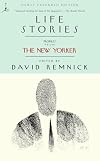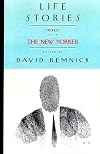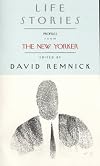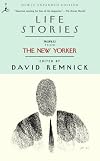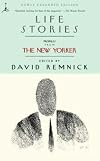
Life Stories: Profiles from the New Yorker
by David Remnick (Editor)
On This Page
Description
An anthology of biographical profiles from "The New Yorker" covers some of the most influential and infamous people of the century, from Ernest Hemingway and Legs Diamond to Adolf Hitler and Edith Wharton.Tags
Recommendations







































Member Reviews
I was going to read the essays on Roseanne and Richard Pryor and call it quits but this whole book is really incredible. Especially and unexpectedly interesting: essays on the Chudnovsky Bros., Anatole Broyard, Ricky Jay, and Heloise. On Anatole Broyard:
"You know, he turned it into a joke. And when you change something basic about yourself into a joke, it spreads, it metastasizes, and so his whole presentation of self became completely ironic. Everything about him was ironic."
Also introduced me to this In Living Color skit which touches some vital nerve for me.
"You know, he turned it into a joke. And when you change something basic about yourself into a joke, it spreads, it metastasizes, and so his whole presentation of self became completely ironic. Everything about him was ironic."
Also introduced me to this In Living Color skit which touches some vital nerve for me.
Biographical essays of 30 people, mostly American, which appeared in The New Yorker magazine from 1920's up to 2000. Some of these are absolutely fascinating and most are very interesting glimpses into the life and soul of another human being. Wonderful to have around and dip into from time to time.
From the 1920's to contemporaries, the New Yorker magazine writers have profiled many figures, ranging from Henry Luce and Isadora Duncan to Richard Pryor and George W. Bush. Here are 28 detailed "Profiles".
From Publishers Weekly: To long-time readers of the New Yorker, one of the reasons to welcome this excellent collection of 43 stories written over the past seven decades will be the recollection of their first encounters with some of the writers who were fresh new voices when their stories set in Manhattan first appeared. Such then-newcomers as Lorrie Moore, Jeffrey Eugenides, Deborah Eisenberg, Anne Beattie and Laurie Colwin portray New York in their distinctive voices. The literary Old Guard is here in solid phalanx too: stories by John Updike, Bernard Malamud, John O'Hara, Elizabeth Hardwick, John Cheever, Peter Taylor and William Maxwell define aspects of their decades with timeless clarity. Holden Morrisey Caulfield makes his debut show more in J. P. Salinger's "A Slight Rebellion Off Madison"(1946); Philip Roth's millionaire author Zuckerman is accosted on Second Avenue in "Smart Money"(1981); one of Isaac Bashevis Singer's innumerable group of displaced Jews and ardent lovers holds forth in "The Cafeteria" (1968) on the Lower East Side. At opposite ends of the emotional spectrum, two entries, Woody Allen's "The Whore of Mensa," (1974) and "Mid-Air" (1984), by Frank Conroy, have become classics. Published this year, Jonathan Franzen's "The Failure" defines the '90s in the city, yet Maeve Brennan's 1966 "I See You, Bianca," a quiet narrative about loss highlighted by "the struggle for space in Manhattan," could have been written today. If Dorothy Parker's wit now seems shrill ("Arrangement in Black and White," 1927 ), and Irwin Shaw's "Sailor Off the Bremen," from the same year, seems mannered, Jean Stafford's "Children Are Bored on Sunday"(1948), still resonates with a peculiarly New York atmosphere. Of course, there are tales from such New Yorker stalwarts as John McNulty, S. J. Perelman, E. B. White and James Thurber. Manhattan as geographical area and emotional landscape takes visible shape as haven and hell, locus of opportunity and of dead end lives.
Copyright 2000 Reed Business Information, Inc. show less
Copyright 2000 Reed Business Information, Inc. show less
Ratings
Members
- Recently Added By
Author Information

David Remnick was born on October 29, 1958 in Hackensack, N.J. and educated at Princeton University. He began his career at the Washington Post in 1982. In 1992, he became a staff writer for the New Yorker. Remnick's book, Lenin's Tomb: The Last Days of the Soviet Empire, won the 1994 Pulitzer Prize in General Non-Fiction. The work deals with the show more last days of the Soviet Union, which Remnick witnessed firsthand as foreign correspondent to Moscow from the Washington Post. Remnick is the author of numerous other works including The Devil Problem (And Other True Stories) published in 1996, Resurrection, The Struggle for a New Russia in 1997, and King of the World: Muhammad Ali and the Rise of an American Hero, published in 1998. His most recent title, The Bridge: The Life and Rise of Barack Obama, was published in 2010. (Bowker Author Biography) David Remnick is the editor of "The New Yorker". He won the Pulitzer Prize in 1994 for "Lenin's Tomb" & is also the author of "King of the World", about Muhammad Ali; "Resurrection", & "The Devil Problem & Other True Stories". He lives in New York City with his wife & three children. (Publisher Provided) show less
All Editions
Series
Belongs to Publisher Series
Common Knowledge
- Canonical title
- Life Stories: Profiles from the New Yorker
- Original publication date
- 2000-02-29
Classifications
Statistics
- Members
- 331
- Popularity
- 95,585
- Reviews
- 4
- Rating
- (3.77)
- Languages
- English
- Media
- Paper, Audiobook, Ebook
- ISBNs
- 8
- ASINs
- 1