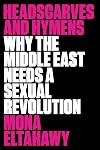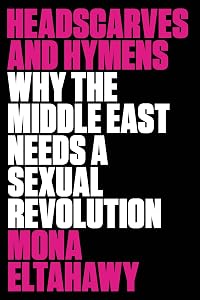
Headscarves and Hymens: Why the Middle East Needs a Sexual Revolution
by Mona Eltahawy
On This Page
Description
"Drawing on her years as a campaigner and commentator on women's issues in the Middle East, [Eltahawy] explains that since the Arab Spring began, women in the Arab world have had two revolutions to undertake: one fought with men against oppressive regimes, and another fought against an entire political and economic system that treats women in countries from Yemen and Saudi Arabia to Egypt, Tunisia, and Libya as second-class citizens ... Her book is a plea for outrage and action on their show more behalf, confronting the 'toxic mix of culture and religion that few seem willing or able to disentangle lest they blaspheme or offend'" -- show lessTags
Recommendations









Member Reviews
Mona Eltahawy's book, Headscarves and Hymens is a manifesto, intended to be a rallying call for feminists in the Arab world. It is a sometimes compelling and frequently disturbing account of the ways in which misogyny leads to the brutalisation of women in the Middle East. And I do mean brutal—there are a number of points where I had to pause in my reading because I was quite literally nauseated by a story which Eltahawy recounted. Almost every single woman in Egypt has been sexually harassed at least once; 15 schoolgirls in Saudi Arabia burned to death in a school because the "morality police" didn't want them to be seen in public without the abaya and headscarf; female genital mutilation is still rampant. Her take-down of what she show more dubs "purity culture"—and its counterpart amongst religious conservatives in the US—is sharp and to-the-point.
However, I'm inclined to think that Eltahawy works better at essay, as opposed to book, length. Those parts of the book in which she gives her first person account of how she was "traumatized into feminism" are compelling and sincere. Yet beyond that, her arguments and examples can be repetitive, particularly as Eltahawy builds her argument less on any kind of ethnographic field work and more on an aggregation of English-language news reports and dry UN human rights reports.
There are also problematic elements of Eltahawy's work. Is a sexual revolution the same thing as a women's rights and/or feminist revolution? The point is never clarified. Her definition of the "they" who hate women is slippery and shifts at several points in the book. She provides the reader little sense of how nationality, sectarianism, social class, geography, or gender (as opposed specifically to femaleness; she doesn't analyse masculinity at all) affect the narrative she is constructing—while Libya and Lebanon, for instance, may have commonalities of faith, language, and culture, they are also markedly different in many ways. Would an author write of a "Christian Europe" that paired, say, England and Italy in such a manner? Eltahawy seems to be arguing for a misogynist pathology that is unique to the Arab Muslim world, but in order to set up that construction she needs to ignore the non-Arab Muslim world and to avoid comparison with other patriarchal cultures. I wasn't wholly convinced.
I'm also dubious about Eltahawy's demand for the niqab (and possibly even the hijab—she is not clear on this point) to be banned. She would claim that for someone like myself (a white atheist westerner from a Catholic background) to defer to a Muslimah about whether she veils is cultural relativism gone wrong. By not supporting the niqab ban in France, I am implicitly supporting the oppression of Muslim women. But I think it's a more complex issue than Eltahawy presents here. Legislating what a woman cannot wear is no more freeing than legislating what she can. (And even on a basic level: if a man is so repressive that he will not let his wife or daughter leave the house without the niqab, do you think he's going to just give in and let her go out in public without the veil, or will things get worse?)
There are many Muslim feminists who choose to veil, and Eltahawy is quite insistent that they're delusional. Veiling, she argues, is uniquely imposed on women as a means of controlling their sexuality and erasing their personhood. I don't think she's entirely wrong here—there are a variety of reasons why I could never see myself adopting a veil, after all—but nor is she entirely right. For instance, she doesn't even begin to engage with Muslim cultures in which the men veil but the women do not (the Tuareg, Hausa, Fulani, etc).
An interesting book, but very much the beginning of a conversation, not the last word. show less
However, I'm inclined to think that Eltahawy works better at essay, as opposed to book, length. Those parts of the book in which she gives her first person account of how she was "traumatized into feminism" are compelling and sincere. Yet beyond that, her arguments and examples can be repetitive, particularly as Eltahawy builds her argument less on any kind of ethnographic field work and more on an aggregation of English-language news reports and dry UN human rights reports.
There are also problematic elements of Eltahawy's work. Is a sexual revolution the same thing as a women's rights and/or feminist revolution? The point is never clarified. Her definition of the "they" who hate women is slippery and shifts at several points in the book. She provides the reader little sense of how nationality, sectarianism, social class, geography, or gender (as opposed specifically to femaleness; she doesn't analyse masculinity at all) affect the narrative she is constructing—while Libya and Lebanon, for instance, may have commonalities of faith, language, and culture, they are also markedly different in many ways. Would an author write of a "Christian Europe" that paired, say, England and Italy in such a manner? Eltahawy seems to be arguing for a misogynist pathology that is unique to the Arab Muslim world, but in order to set up that construction she needs to ignore the non-Arab Muslim world and to avoid comparison with other patriarchal cultures. I wasn't wholly convinced.
I'm also dubious about Eltahawy's demand for the niqab (and possibly even the hijab—she is not clear on this point) to be banned. She would claim that for someone like myself (a white atheist westerner from a Catholic background) to defer to a Muslimah about whether she veils is cultural relativism gone wrong. By not supporting the niqab ban in France, I am implicitly supporting the oppression of Muslim women. But I think it's a more complex issue than Eltahawy presents here. Legislating what a woman cannot wear is no more freeing than legislating what she can. (And even on a basic level: if a man is so repressive that he will not let his wife or daughter leave the house without the niqab, do you think he's going to just give in and let her go out in public without the veil, or will things get worse?)
There are many Muslim feminists who choose to veil, and Eltahawy is quite insistent that they're delusional. Veiling, she argues, is uniquely imposed on women as a means of controlling their sexuality and erasing their personhood. I don't think she's entirely wrong here—there are a variety of reasons why I could never see myself adopting a veil, after all—but nor is she entirely right. For instance, she doesn't even begin to engage with Muslim cultures in which the men veil but the women do not (the Tuareg, Hausa, Fulani, etc).
An interesting book, but very much the beginning of a conversation, not the last word. show less
This is a book of rage and passion.
Ratings
Members
- Recently Added By
Author Information

3+ Works 573 Members
Mona Eltahawy is an author, an activist, a commentator, and one of today's most powerful and important thought leaders on global feminism. Her essays and op-eds have appeared in the New York Times, the Washington Post, The Guardian, Time, NBCNews.com, and New York magazine, among many others. Follow her on Twitter @monaeltahawy.
Awards and Honors
Distinctions
Notable Lists
Common Knowledge
- Canonical title
- Headscarves and Hymens: Why the Middle East Needs a Sexual Revolution
Classifications
- Genres
- Nonfiction, General Nonfiction, Sexuality and Gender Studies, Religion & Spirituality
- DDC/MDS
- 323.3 — Society, government, & culture Political science Civil Rights & Liberties/ Human Rights The state and social groups
- LCC
- HQ1237.5 .M628 .E47 — Social sciences The family. Marriage, Women and Sexuality The Family. Marriage. Women Women. Feminism
- BISAC
Statistics
- Members
- 277
- Popularity
- 117,012
- Reviews
- 3
- Rating
- (3.93)
- Languages
- 8 — Danish, Dutch, English, French, German, Hungarian, Italian, Spanish
- Media
- Paper, Audiobook, Ebook
- ISBNs
- 27
- ASINs
- 3