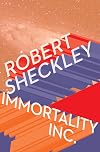
Immortality Inc.
by Robert Sheckley
On This Page
Description
Thomas Blaine awoke in a white bed in a white room and heard someone say, "He's alive now." Then they asked him his name, age, and marital status. Yes, that seemed normal enough--but what was this talk about "death trauma"? Thus was Thomas Blaine introduced to the year 2110, when science had discovered the technique of transferring a man's consciousness from one body to another, when a man's mind could be snatched from the past, as his body was at the point of death, and brought forward into show more a "host body" in this fantastic future world. show lessTags
Recommendations



















Member Reviews
At the moment of his death in 1958, Thomas Blaine is yanked into the year 2110 by a 22nd-century corporation. Or, to be precise, his mind is brought to 2110, because a major scientific discovery of the intervening 152 years is that the mind and body are indeed separate; minds can now be transferred relatively easily from one body to another, giving the very wealthy a form of immortality.
The other big discovery that Blaine has to adjust to is that the existence of an afterlife has been scientifically proven. Not everyone is naturally able to make the transition to that afterlife, but there is technology (again, available mostly to the rich) that will make success nearly certain.
Sheckley's novel is a rather episodic look at the social show more changes that have come about because of those discoveries. it was originally published as a magazine serial, and it feels more like a series of short stories than a cohesive novel. Every two or three chapters, a new set of supporting characters pop up as featured players for an exploration of one of those social changes.
(One of those episodes was loosely adapted into the 1992 movie Freejack, which featured the improbable combination of Emilio Estevez, Anthony Hopkins, and Mick Jagger; it is reportedly not very good.)
The episodes are entertaining, and Sheckley has come up with a series of clever "what might happen if..." moments from his original premise. I would have liked more of a solid throughline, but as a series of linked stories, this was pleasant reading. show less
The other big discovery that Blaine has to adjust to is that the existence of an afterlife has been scientifically proven. Not everyone is naturally able to make the transition to that afterlife, but there is technology (again, available mostly to the rich) that will make success nearly certain.
Sheckley's novel is a rather episodic look at the social show more changes that have come about because of those discoveries. it was originally published as a magazine serial, and it feels more like a series of short stories than a cohesive novel. Every two or three chapters, a new set of supporting characters pop up as featured players for an exploration of one of those social changes.
(One of those episodes was loosely adapted into the 1992 movie Freejack, which featured the improbable combination of Emilio Estevez, Anthony Hopkins, and Mick Jagger; it is reportedly not very good.)
The episodes are entertaining, and Sheckley has come up with a series of clever "what might happen if..." moments from his original premise. I would have liked more of a solid throughline, but as a series of linked stories, this was pleasant reading. show less
My reactions to reading this novel in 1992. Spoilers follow.
Not as funny a novel as I expected from Sheckley but still pleasant enough. Sheckley comes up with a world that has scientifically verified the afterlife and can engineer your soul to make sure it survives. The mind sometimes, very sometimes, survives its separation from the body. When the "scientific afterlife" is discovered, the world goes on a binge of hedonism; everyone attempts to pack of lifetime of pleasureable experiences in, unrestrainted by conventional religious morality (and painful experiences are sought in torture clubs -- lust and pain of every variety are sought). Then the bottom drops out when it's revealed few minds survive death.
However, three corporations show more develop a process (which can be duplicated by twenty years of discipline in Eastern mystic pursuits like yoga) which hardens the mind so it can survive death -- the process is very expensive though. Afterlife insurance is a government policy question; a few policies are given out by grants and lotteries. Hosts can be obtained for the dying who don't want to leave this world. On the open market, this involves killing a body (who's mind has been insured for afterlife) and occupying it with another mind. On the black market, the orginal mind is just killed. Transplant is an illegal procedure where one mind "possesses" another mind and body, inhabits a corner of its consciousness, taps into its skill, talents, emotions, sensations. This is sold as mainly sexual titillation. Experience sex as the other gender, the emotions a pervert feels, even sex as an animal. In one of the best scenes of the book, this is revealed as having much more potential for human freedom and society. Why be constrained to the set of skills just you've developed?
The protagonist of the novel, snatched from 1958, inhabits a body very different -- and not to his liking -- from his old one, with different skills, inclinations. Why, argues an illegal transplant peddler, must a man be constrained to the diseases, skills, hereditary, and early environment that shaped his body? When the protagonist flees hunters through a series of transplants, the possibilities of this argument are intriguingly shown. His "dead" body is shipped separately to avoid detection.
In a fashion typical of the great sociological sf of the fifties, Sheckley, in remarkably smooth, glib prose which, nevertheless, touches on important issues, using an everyman. He is a junior yacht designer who, comically, always seems to find himself as a junior yacht designer no matter where he goes in time and space -- raising a serious point that perhaps we are all "destined" to fill certain niches in life.) It is through his journey we see this world and work out its implications. Some religions contend that the soul and mind are not the same and "scientific hereafter" does not mean the soul's survival is not dependent on traditional moral practices. Other's adopt a Nietzche's dictum of dying at the right time through suicide booths, berserking (killing as many innocent bystanders as possible before the police down you -- this leads to one of the books more comic scenes where the survivors of a berserking criticize the dead berserker's lack of prowess), and Hunts (a person tries to kill as many of his appointed hunters as possible before being killed -- this motif is much like Sheckley's The Tenth Victim and, at one point, Sheckley says a society's games tell a lot about its attitudes toward "life, death, fate and free will").
In the afterlife, before a mind crosses the threshhold, he can send messages on the spiritual switchboard. If the death transition renders the mind insane, it could become a poltergeist, gibbering ghost, haunter, or another creature of out folklore like a demon or werewolf. Beyond the Threshhold, communication with the dead is not possible and hell, nirvana, extinction, or reincarnation may loom. No one knows. Zombies are ghettoized; they result from a mind occupying a body after it has been vacant too long. They have only gross muscular control over it. Sheckley's protagonist learns a lot about his place in life as he tries to get a job, falls in love with one of his rescuers (even though, at story's end, it's revealed she caused his fatal auto accident), and learns why a zombie is hanging around him. He questions his moral assumptions. Sheckley throws in some nice commentary on sf cliches as Thomas Blaine, protagonist, thinks about one kind of future he may inhabit, and the constant complaints on how new artforms will corrupt society. (here "sensories" which give a full-sense drama.) Sheckley's novel provides more food for serious thought than immediately obvious and some comic bits are nice like looking for a job and the technicians who prepare Blaine's mind for the afterlife. This book is interesting in that its notions of transplants shows how little many of sf's concerns change, only the rationalizing instrumentality. show less
Not as funny a novel as I expected from Sheckley but still pleasant enough. Sheckley comes up with a world that has scientifically verified the afterlife and can engineer your soul to make sure it survives. The mind sometimes, very sometimes, survives its separation from the body. When the "scientific afterlife" is discovered, the world goes on a binge of hedonism; everyone attempts to pack of lifetime of pleasureable experiences in, unrestrainted by conventional religious morality (and painful experiences are sought in torture clubs -- lust and pain of every variety are sought). Then the bottom drops out when it's revealed few minds survive death.
However, three corporations show more develop a process (which can be duplicated by twenty years of discipline in Eastern mystic pursuits like yoga) which hardens the mind so it can survive death -- the process is very expensive though. Afterlife insurance is a government policy question; a few policies are given out by grants and lotteries. Hosts can be obtained for the dying who don't want to leave this world. On the open market, this involves killing a body (who's mind has been insured for afterlife) and occupying it with another mind. On the black market, the orginal mind is just killed. Transplant is an illegal procedure where one mind "possesses" another mind and body, inhabits a corner of its consciousness, taps into its skill, talents, emotions, sensations. This is sold as mainly sexual titillation. Experience sex as the other gender, the emotions a pervert feels, even sex as an animal. In one of the best scenes of the book, this is revealed as having much more potential for human freedom and society. Why be constrained to the set of skills just you've developed?
The protagonist of the novel, snatched from 1958, inhabits a body very different -- and not to his liking -- from his old one, with different skills, inclinations. Why, argues an illegal transplant peddler, must a man be constrained to the diseases, skills, hereditary, and early environment that shaped his body? When the protagonist flees hunters through a series of transplants, the possibilities of this argument are intriguingly shown. His "dead" body is shipped separately to avoid detection.
In a fashion typical of the great sociological sf of the fifties, Sheckley, in remarkably smooth, glib prose which, nevertheless, touches on important issues, using an everyman. He is a junior yacht designer who, comically, always seems to find himself as a junior yacht designer no matter where he goes in time and space -- raising a serious point that perhaps we are all "destined" to fill certain niches in life.) It is through his journey we see this world and work out its implications. Some religions contend that the soul and mind are not the same and "scientific hereafter" does not mean the soul's survival is not dependent on traditional moral practices. Other's adopt a Nietzche's dictum of dying at the right time through suicide booths, berserking (killing as many innocent bystanders as possible before the police down you -- this leads to one of the books more comic scenes where the survivors of a berserking criticize the dead berserker's lack of prowess), and Hunts (a person tries to kill as many of his appointed hunters as possible before being killed -- this motif is much like Sheckley's The Tenth Victim and, at one point, Sheckley says a society's games tell a lot about its attitudes toward "life, death, fate and free will").
In the afterlife, before a mind crosses the threshhold, he can send messages on the spiritual switchboard. If the death transition renders the mind insane, it could become a poltergeist, gibbering ghost, haunter, or another creature of out folklore like a demon or werewolf. Beyond the Threshhold, communication with the dead is not possible and hell, nirvana, extinction, or reincarnation may loom. No one knows. Zombies are ghettoized; they result from a mind occupying a body after it has been vacant too long. They have only gross muscular control over it. Sheckley's protagonist learns a lot about his place in life as he tries to get a job, falls in love with one of his rescuers (even though, at story's end, it's revealed she caused his fatal auto accident), and learns why a zombie is hanging around him. He questions his moral assumptions. Sheckley throws in some nice commentary on sf cliches as Thomas Blaine, protagonist, thinks about one kind of future he may inhabit, and the constant complaints on how new artforms will corrupt society. (here "sensories" which give a full-sense drama.) Sheckley's novel provides more food for serious thought than immediately obvious and some comic bits are nice like looking for a job and the technicians who prepare Blaine's mind for the afterlife. This book is interesting in that its notions of transplants shows how little many of sf's concerns change, only the rationalizing instrumentality. show less
This humorous SF novel from 1959 is notable for its cavalier attitude to death. Of course, it makes a pretty standard case that society would naturally break down it there was no POINT to living, especially if you had set up your life insurance... :)
Yes. Life insurance is actually AFTERLIFE insurance. If you can afford the process, you too can live on and get yourself a new body.
Sound familiar, fans of Altered Carbon?
Of course, Sheckley goes into some of the more interesting aspects of this world, including hunting parties to give yourself a proper send-off, to insurance scams, to the whole fish-out-of-water storyline so commonplace in older SF, where we also must go through our own culture shock.
The novel may not be as sophisticated show more as many modern novels, but it IS a lightly humorous adventure, not an all-out social commentary that skewers everything it touches. And that's just fine. :) I still had a good time even if I rolled my eyes at some of the assumptions and story cliches. After all, it WAS 1959. Dames and Gents always seemed to always find those super-standard roles. lol show less
Yes. Life insurance is actually AFTERLIFE insurance. If you can afford the process, you too can live on and get yourself a new body.
Sound familiar, fans of Altered Carbon?
Of course, Sheckley goes into some of the more interesting aspects of this world, including hunting parties to give yourself a proper send-off, to insurance scams, to the whole fish-out-of-water storyline so commonplace in older SF, where we also must go through our own culture shock.
The novel may not be as sophisticated show more as many modern novels, but it IS a lightly humorous adventure, not an all-out social commentary that skewers everything it touches. And that's just fine. :) I still had a good time even if I rolled my eyes at some of the assumptions and story cliches. After all, it WAS 1959. Dames and Gents always seemed to always find those super-standard roles. lol show less
I discovered this novel through the excellent guide "100 Must Read Science Fiction Novels."
One moment Thomas Blaine is crashing into another car and in the next he's in 2110 and trying to survive in a world where you can take out insurance on your mind surviving your bodily death. It's a dated, strange mix of Christian Science and science. I found it readable but not impressive, the book was originally published in 1959 so it contains the echoes of cold war. One of the funniest things was the idea that China would have taken over Mars, more because of the fact that then it was a little more far-fetched than now!
Overally I'm a bit meh about it. While interesting, I didn't regret reading it but I don't think I'd read it again.
Overally I'm a bit meh about it. While interesting, I didn't regret reading it but I don't think I'd read it again.
Interesting novel about a scientific (sort of) afterlife and the impacts it could have on society. I feel like mind-body dichotomy, gendered body image issues and societal impact could all have been handled more thoroughly. Still an enjoyable read but a little too 50s for my taste.
It was a great audio book for gym listening. Fast paced, with a good dose of mid-20th century futuristic charm, cheesy but sweet, without too many literary descriptive adages (which work for books but not for audio books). Not sure if I would have liked it as much if I was reading it, but it served the purpose wonderfully.
Members
- Recently Added By
Lists

S.F. Masterworks (Complete)
229 works; 15 members

Books Read in 2015
3,299 works; 129 members
Author Information

413+ Works 12,678 Members
Some Editions
Awards and Honors
Awards
Notable Lists
Series
Belongs to Publisher Series
Bastei-Lübbe Allgemeine Reihe (13413)
Work Relationships
Is contained in
Common Knowledge
- Canonical title*
- Anonima aldilà
- Original title
- Immortality, Inc.
- Alternate titles
- Freejack; Time Killer
- Original publication date
- 1958 (Galaxy Oct ∙ Nov ∙ Dec) (Galaxy Oct ∙ Nov ∙ Dec); 1959 (Book version) (Book version)
- People/Characters
- Thomas Blaine; Marie Thorne
- Important places
- New York, New York, USA; USA
- Related movies
- Freejack (1992 | IMDb)
- First words
- Afterwards, Thomas Blaine thought about the manner of his dying and wished it had been more interesting.
- Last words
- (Click to show. Warning: May contain spoilers.)All right. I'm ready now, Tom. Let's go.
- Blurbers
- Adams, Douglas
- Original language*
- Englisch
- Disambiguation notice
- Not to be combined with the 1992 Geoff Murphy film Freejack. But, okay to combine with any re-issue of the book Immortality Inc packaged with the movie title Freejack. Variant Titles: Immorality, Inc. and Time Kille... (show all)r
*Some information comes from Common Knowledge in other languages. Click "Edit" for more information.
Classifications
Statistics
- Members
- 587
- Popularity
- 50,053
- Reviews
- 15
- Rating
- (3.52)
- Languages
- 9 — Dutch, English, French, German, Hungarian, Italian, Lithuanian, Portuguese, Romanian
- Media
- Paper, Audiobook, Ebook
- ISBNs
- 31
- ASINs
- 14