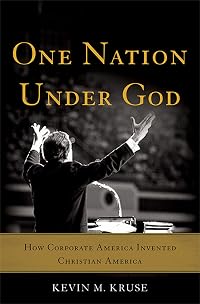
One Nation Under God: How Corporate America Invented Christian America
by Kevin M. Kruse
On This Page
Description
"We're often told that the United States is, was, and always has been a Christian nation. But in One Nation Under God, historian Kevin M. Kruse reveals that the idea of 'Christian America' is an invention--and a relatively recent one at that. As Kruse argues, the belief that America is fundamentally and formally a Christian nation originated in the 1930s when businessmen enlisted religious activists in their fight against FDR's New Deal. Corporations from General Motors to Hilton Hotels show more bankrolled conservative clergymen, encouraging them to attack the New Deal as a program of 'pagan statism' that perverted the central principle of Christianity: the sanctity and salvation of the individual. Their campaign for 'freedom under God' culminated in the election of their close ally Dwight Eisenhower in 1952. But this apparent triumph had an ironic twist. In Eisenhower's hands, a religious movement born in opposition to the government was transformed into one that fused faith and the federal government as never before. During the 1950s, Eisenhower revolutionized the role of religion in American political culture, inventing new traditions from inaugural prayers to the National Prayer Breakfast. Meanwhile, Congress added the phrase 'under God' to the Pledge of Allegiance and made 'In God We Trust' the country's first official motto. With private groups joining in, church membership soared to an all-time high of 69%. For the first time, Americans began to think of their country as an officially Christian nation. During this moment, virtually all Americans--across the religious and political spectrum--believed that their country was 'one nation under God.' But as Americans moved from broad generalities to the details of issues such as school prayer, cracks began to appear. Religious leaders rejected this 'lowest common denomination' public religion, leaving conservative political activists to champion it alone. In Richard Nixon's hands, a politics that conflated piety and patriotism became sole property of the right. Provocative and authoritative, One Nation Under God reveals how the unholy alliance of money, religion, and politics created a false origin story that continues to define and divide American politics to this day"-- "In One Nation Under God, award-winning historian Kevin M. Kruse argues that the story of Christian America begins with the Great Depression, when a coalition of businessmen and religious leaders united in opposition to the New Deal. As Kruse shows, corporations from General Motors and Kraft Foods to J.C. Penney and Hilton Hotels, poured money into the coffers of conservative religious leaders, who in turn used those funds to attack FDR's New Deal administration as a program of "pagan statism" that perverted the central tenet of Christianity: the salvation of the individual"-- show lessTags
Recommendations













Member Reviews
A highly researched investigation into the origins of American civic religion as currently manifest in its emphasis on the "Judeo-Christian" tradition and particularly the theme of "One Nation Under God."
Kruse writes books with explosive subtitles with provocative theses that are laid out with impressive detail and saturated with primary source quotations. While most attempt to make sense of America's "civic deism" beginning in the 1950s, Kruse goes back to the 1930s with the coordination between certain religious leaders who espoused a "Christian libertarianism" and who found the New Deal to be pagan socialism and the corporate titans of the day who were looking for some good PR and image rehabilitation. The story centered on Fifield show more and Vereide and their promotions interweaving "Judeo-Christianity," "freedom of association," "free markets," and the like, and all in contrast to the current government which to them was socialist, pagan, and threatening these values.
By the 1950s they found their man in Eisenhower, who very much was about developing a more religious character to the nation. Kruse lays out exactly how Eisenhower promoted a "civic deism," encouraging religious belief and participation, "whatever it was." Yes, it was critiqued for its hollowness and vacuousness, but the appeal worked. All the forces behind the "Christian libertarianism" of the 30s and 40s supported Eisenhower, and Eisenhower responded with all kinds of appeals for civic religion: America became "one nation under God," in contrast to the godless Communists; Eisenhower promoted the National Prayer Breakfast; all kinds of pageantry was on display, often funded by corporate titans behind the scenes, espousing the strength of America as its faith, with few being confused about the nature of that faith: somewhat Jewish, but very much Christian. The message was sent, and heard loud and clear: to be a good American meant to have a faith in God, particularly in Christianity. Religious participation increased to a heretofore unseen level in America, and one which would never be eclipsed.
And yet Eisenhower was a bit of a "poison pill" for the "Christian libertarians," because he had no interest in dismantling the New Deal state. Instead, the very things the "Christian libertarians" were trying to paint as pagan and socialist, and their skepticism of the government, was instead "baptized" and made part of this "Christian nation" and its ideology. Whereas promoting this civic deistic religion was a "right wing" thing to do in the 30s and 40s, it lost its partisan association in the 50s and became a bipartisan project. Kruse details how "under God" was added to the pledge at this time and the establishment of "In God We Trust" as the national motto.
Kruse then describes the limits of this civic religion as it would become manifest in the 50s and 60s. Generic appeals to being under God were one thing. Gideons pushing the KJV on schoolchildren was perfectly fine to many, but deeply offensive to Jewish people, Catholics, and a few other groups. The imposition of a particular prayer in the state of New York led to the beginning of questioning about prayer and devotional time in schools; it would soon be entirely dismantled. Kruse does well at documenting, in detail, the response to these actions, especially the advancement of a school prayer amendment to the Constitution, and how the fault line developed between the institutional heads who generally spoke for Christian denominations and the "common man" and the "common preacher" who did not maintain the same fears or concerns.
Kruse then compares and contrasts the Eisenhower and Nixon administrations, demonstrating how the latter consciously attempted to turn back the clock, as if 1960-1968 did not exist, with Billy Graham prominent in his activities, a religious service in the East Wing of the White House, and a very deliberate appeal to the conservative religious voter. But Kruse demonstrates well that it was no longer unifying the nation, but a source of division. Kruse ends his main thesis in this period before 1972, but in an epilogue brings the story to the Obama years: the rise of Reagan, the faith talk of Bush I, Clinton, Bush II, and Obama, and all of it coming back to the development and advancement of the civil deistic religion over this period from 1935 to 1955.
There is a lot here worthy of consideration. Kruse does well at showing that while "Christian libertarianism" was one way of looking at Jesus, it was by no means the only one; FDR had a Christian faith, and associated his New Deal work with that faith. One could imagine an America in which the social safety net was understood in Christian terms and lauded and valued as such. It is worth noting that Fifield may have been politically right-wing but theologically was liberal. He rejected those aspects of the Gospel story that did not fit his libertarian and free market conceptions. While today those who are religiously liberal tend to do the opposite, and emphasize Jesus' concern for the oppressed, it's a good reminder that once one is untethered from the text one can go in a host of directions and in the end distort what God has made known in Jesus.
Kruse provides great benefit in providing an often unacknowledged dimension in the explosion of religiosity in the postwar period. No doubt there would have still been a resurgence in faith even if there were not this sustained "marketing" of civic deism by the Eisenhower administration; nevertheless, what Eisenhower wrought has implications which last until today. The message, again, was that a good American goes to church. The driver was not faith but patriotism and citizenship. Throughout faith was secondary to the American project, and it has ever been thus since. To this day America has broad majorities who have faith in God; and yet, when probed, it is evident that faith is not deeply in what God has done in Jesus. It barely knows the substance of what the Bible teaches, but is very strong on the USA. It has advanced the agenda of the USA in whatever the USA has done, especially the agenda favored by conservatives. It does not handle critique of American policy or agendas well. And it certainly has not weathered the demographic battles of recent days well: American Evangelicalism today is not known as much for embodying Jesus as it is the GOP agenda, and has reached its apotheosis with the current executive, who in his life embodies almost everything which Jesus would be against. Such is almost the inevitable conclusion when conservative ideological nationalism is the driver, and faith is in the backseat.
No argument: some who came to the pews because they wanted to be good Americans learned of the Christ, repented, and followed Him faithfully. Many of their children would become immersed in Christianity and would practice it. It wasn't a terrible move. But it benefited the state, and a particular political ideology, more than it benefited the Kingdom of God in Christ, and the latter has suffered because of it.
Highly recommended for consideration. show less
Kruse writes books with explosive subtitles with provocative theses that are laid out with impressive detail and saturated with primary source quotations. While most attempt to make sense of America's "civic deism" beginning in the 1950s, Kruse goes back to the 1930s with the coordination between certain religious leaders who espoused a "Christian libertarianism" and who found the New Deal to be pagan socialism and the corporate titans of the day who were looking for some good PR and image rehabilitation. The story centered on Fifield show more and Vereide and their promotions interweaving "Judeo-Christianity," "freedom of association," "free markets," and the like, and all in contrast to the current government which to them was socialist, pagan, and threatening these values.
By the 1950s they found their man in Eisenhower, who very much was about developing a more religious character to the nation. Kruse lays out exactly how Eisenhower promoted a "civic deism," encouraging religious belief and participation, "whatever it was." Yes, it was critiqued for its hollowness and vacuousness, but the appeal worked. All the forces behind the "Christian libertarianism" of the 30s and 40s supported Eisenhower, and Eisenhower responded with all kinds of appeals for civic religion: America became "one nation under God," in contrast to the godless Communists; Eisenhower promoted the National Prayer Breakfast; all kinds of pageantry was on display, often funded by corporate titans behind the scenes, espousing the strength of America as its faith, with few being confused about the nature of that faith: somewhat Jewish, but very much Christian. The message was sent, and heard loud and clear: to be a good American meant to have a faith in God, particularly in Christianity. Religious participation increased to a heretofore unseen level in America, and one which would never be eclipsed.
And yet Eisenhower was a bit of a "poison pill" for the "Christian libertarians," because he had no interest in dismantling the New Deal state. Instead, the very things the "Christian libertarians" were trying to paint as pagan and socialist, and their skepticism of the government, was instead "baptized" and made part of this "Christian nation" and its ideology. Whereas promoting this civic deistic religion was a "right wing" thing to do in the 30s and 40s, it lost its partisan association in the 50s and became a bipartisan project. Kruse details how "under God" was added to the pledge at this time and the establishment of "In God We Trust" as the national motto.
Kruse then describes the limits of this civic religion as it would become manifest in the 50s and 60s. Generic appeals to being under God were one thing. Gideons pushing the KJV on schoolchildren was perfectly fine to many, but deeply offensive to Jewish people, Catholics, and a few other groups. The imposition of a particular prayer in the state of New York led to the beginning of questioning about prayer and devotional time in schools; it would soon be entirely dismantled. Kruse does well at documenting, in detail, the response to these actions, especially the advancement of a school prayer amendment to the Constitution, and how the fault line developed between the institutional heads who generally spoke for Christian denominations and the "common man" and the "common preacher" who did not maintain the same fears or concerns.
Kruse then compares and contrasts the Eisenhower and Nixon administrations, demonstrating how the latter consciously attempted to turn back the clock, as if 1960-1968 did not exist, with Billy Graham prominent in his activities, a religious service in the East Wing of the White House, and a very deliberate appeal to the conservative religious voter. But Kruse demonstrates well that it was no longer unifying the nation, but a source of division. Kruse ends his main thesis in this period before 1972, but in an epilogue brings the story to the Obama years: the rise of Reagan, the faith talk of Bush I, Clinton, Bush II, and Obama, and all of it coming back to the development and advancement of the civil deistic religion over this period from 1935 to 1955.
There is a lot here worthy of consideration. Kruse does well at showing that while "Christian libertarianism" was one way of looking at Jesus, it was by no means the only one; FDR had a Christian faith, and associated his New Deal work with that faith. One could imagine an America in which the social safety net was understood in Christian terms and lauded and valued as such. It is worth noting that Fifield may have been politically right-wing but theologically was liberal. He rejected those aspects of the Gospel story that did not fit his libertarian and free market conceptions. While today those who are religiously liberal tend to do the opposite, and emphasize Jesus' concern for the oppressed, it's a good reminder that once one is untethered from the text one can go in a host of directions and in the end distort what God has made known in Jesus.
Kruse provides great benefit in providing an often unacknowledged dimension in the explosion of religiosity in the postwar period. No doubt there would have still been a resurgence in faith even if there were not this sustained "marketing" of civic deism by the Eisenhower administration; nevertheless, what Eisenhower wrought has implications which last until today. The message, again, was that a good American goes to church. The driver was not faith but patriotism and citizenship. Throughout faith was secondary to the American project, and it has ever been thus since. To this day America has broad majorities who have faith in God; and yet, when probed, it is evident that faith is not deeply in what God has done in Jesus. It barely knows the substance of what the Bible teaches, but is very strong on the USA. It has advanced the agenda of the USA in whatever the USA has done, especially the agenda favored by conservatives. It does not handle critique of American policy or agendas well. And it certainly has not weathered the demographic battles of recent days well: American Evangelicalism today is not known as much for embodying Jesus as it is the GOP agenda, and has reached its apotheosis with the current executive, who in his life embodies almost everything which Jesus would be against. Such is almost the inevitable conclusion when conservative ideological nationalism is the driver, and faith is in the backseat.
No argument: some who came to the pews because they wanted to be good Americans learned of the Christ, repented, and followed Him faithfully. Many of their children would become immersed in Christianity and would practice it. It wasn't a terrible move. But it benefited the state, and a particular political ideology, more than it benefited the Kingdom of God in Christ, and the latter has suffered because of it.
Highly recommended for consideration. show less
An interesting, easy read. Hard to put down. We all know that big business has teamed up with conservative Christians for political gains-- a continuing force to this day. The main surprise, for me, was that this unholy alliance began during the Great Depression, in the 1930s, to combat Roosevelt's "New Deal" that was putting people back to work. The corporations were bent on suppressing labor rights then, and still are. And social security, Medicare, and Medicaid, if they eventually get their way.
After the 30s, an even bigger religious-political surge occurred in the 50s. I didn't realize how much President Eisenhower promoted this movement. I knew he bowed down to The Family and their highly political Prayer Breakfast, but I thought show more he attended the Prayer Breakfast reluctantly (he was the first president to attend), and that he'd hesitated due to the First Amendment. Not so. He actively brought religion into government again and again, during his eight long years (only one religion, of course).
This unholy alliance of business and their ONE favored religion still dominates our politics today. show less
After the 30s, an even bigger religious-political surge occurred in the 50s. I didn't realize how much President Eisenhower promoted this movement. I knew he bowed down to The Family and their highly political Prayer Breakfast, but I thought show more he attended the Prayer Breakfast reluctantly (he was the first president to attend), and that he'd hesitated due to the First Amendment. Not so. He actively brought religion into government again and again, during his eight long years (only one religion, of course).
This unholy alliance of business and their ONE favored religion still dominates our politics today. show less
Covering the start with Eisenhower overt Presidential Christian religiosity and continuing to the dog-whistle bywords and attestation on through Reagan and beyond, this is the history of "In God We Trust" and how the pulpit became a stop on the hustings. In the history, it is interesting how in Ike's era there seemed a exploitation of a recurrent Great Awakenings to align political inertia that became a pendulum swung too far in later fights over prayer in schools and more.
I hadn't realized how relatively recently the public expression of religion into the civic space happened. I grew up thinking that the "under God" phrase was a traditional part of the Pledge of Allegiance that we recited each morning at school. In reality, that phrase was incorporated when I was a pre-schooler. Similarly, "In God We Trust" was only adopted as the nation's official motto in 1956, replacing the unofficial but traditional "E Pluribus Unum."
The author does a fine job of tracing the forces that worked to introduce these changes. Prominent among them was the dissatisfaction of conservative businessmen with what they viewed as the creeping socialism that they saw FDR's New Deal as introducing. Another major force was the rise show more of mass media evangelistic Christianity--most notably in the person of Billy Graham.
It took the Supreme Court to reinforce separation between church and state. show less
The author does a fine job of tracing the forces that worked to introduce these changes. Prominent among them was the dissatisfaction of conservative businessmen with what they viewed as the creeping socialism that they saw FDR's New Deal as introducing. Another major force was the rise show more of mass media evangelistic Christianity--most notably in the person of Billy Graham.
It took the Supreme Court to reinforce separation between church and state. show less
God I wanted to like this book.
I suppose it was an enlightening bundle of facts.
It has no point of view of course. Or rather it has an NPR point of view which is essentially the same.
It stops way to soon (like nixon time for the well researched stuff) to be of any use today.
If it could have kept up giving the facts up til a few years ago it would at least have been useful.
It is easy to read it and hear about all the awful things the republicans did and think that the author obviously has a point of view against these things he describes but he really doesn't. Any trumpster out there could read this and think boy those republicans should have gone farther.
It is a Vapid book.
I suppose it was an enlightening bundle of facts.
It has no point of view of course. Or rather it has an NPR point of view which is essentially the same.
It stops way to soon (like nixon time for the well researched stuff) to be of any use today.
If it could have kept up giving the facts up til a few years ago it would at least have been useful.
It is easy to read it and hear about all the awful things the republicans did and think that the author obviously has a point of view against these things he describes but he really doesn't. Any trumpster out there could read this and think boy those republicans should have gone farther.
It is a Vapid book.
An educational read that leaves me frustrated that many people don't try to educate themselves. "If you say something enough times, to those saying it, it becomes truth" couldn't be truer.
An interesting book to read in this moment when the religious right is ascendent and so openly devoted to corporate interests.
Members
- Recently Added By
Lists

Chronological 2015
39 works; 1 member

Mo's Reading List
218 works; 1 member
Author Information

6+ Works 1,421 Members
Kevin M. Kruse is Assistant Professor of History at Princeton University
Common Knowledge
- People/Characters
- Dwight D. Eisenhower; Richard M. Nixon
- Important places
- USA
- First words
- The inauguration of Dwight D. Eisenhower was much more than a political ceremony. It was, in many ways, a religious consecration -Introduction
In December 1940, more than five thousand industrialists from across America took part in their yearly pilgrmage to Park Avenue. -Chapter One, "Freedom Under God" - Original language
- English
- Canonical DDC/MDS
- 322.10973
- Canonical LCC
- BR517
Classifications
- Genres
- Religion & Spirituality, History, Nonfiction, Politics and Government, General Nonfiction
- DDC/MDS
- 322.10973 — Society, government, & culture Political science Relation of the state to organized groups and their members Religious organizations and groups Biography And History North America Politics and religion--United States
- LCC
- BR517 — Philosophy, Psychology and Religion Christianity Christianity History By region or country
- BISAC
Statistics
- Members
- 576
- Popularity
- 50,951
- Reviews
- 10
- Rating
- (4.02)
- Languages
- English
- Media
- Paper, Audiobook, Ebook
- ISBNs
- 8
- ASINs
- 5