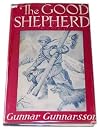
The Good Shepherd
by Gunnar Gunnarsson
On This Page
Description
Every winter, in the days leading up to Christmas, Benedikt walks into the snowy mountains of Iceland to rescue sheep lost in the blizzards. With his dog and his ram by his side, traversing wild snowstorms and crystalline nights, fuelled by endless cups of hot coffee, Benedikt dedicates himself to helping other living beings in need.Tags
Recommendations




















Member Reviews
Gunnar Gunnarsson (1889-1975) was born and raised in poverty, on a farm in northeastern Iceland. (Interestingly, he was born the same year as Þórbergur Þórðarson.)He went to school and achieved fame as a writer in Denmark. He returned to Iceland with his wife and family in the 1930's, and lived there the remainder of his life. Gunnarsson is buried on the island of Videy, so that he (a Lutheran) and his wife Franzisca (a Catholic) could rest together in consecrated ground.
This lovely little book (which could be considered a novella or short story), is beguilingly simple. It tells the story of shepherd Benedikt who has found meaning in the Advent season, for some twenty-seven years, by hiking alone to the high mountains to retrieve show more sheep that had not been found at the autumn in-gathering. Not exactly alone, however, for each year he is accompanied by his faithful friends: his dog Leo ("Pope Leo"), and his bell wether sheep, Gnarly. (To my surprise I learned that the etymology of bell wether is a sheep with a bell around its neck and/or a castrated male sheep.) This year Benedikt's journey is not quite the solitary pilgrimage that he anticipated, for a rough, inconsiderate group of men from a nearby farm join him in order to take advantage of his skill and generosity. A series of raging snowstorms bring Benedikt, Leo and Gnarly to the point of frozen starvation, but throughout the journey Benedikt finds that kindness given returns to him. His musings are philosophical...
" A journey like this is a sort of poem with rhymes and splendid words. In the blood it turned into a poem and, so to speak, you could learn it by heart like a poem. And besides some impulse drove a man back here again and again to see if everything remained unchanged. And it was unchanged--strange and unattainable and at the same time friendly and intimate and indispensable."
On his journey, much of it alone with Leo and Gnarly, Benedikt ponders the mysteries of life and death. He considers the responsibility of love: he must care for his animals not only in their lives, but also their deaths. When the time comes, and his animals are no longer able to function, he will have to end their lives.
"After all, to a certain extent, all animals were sacrificial beasts--but was not all of life a sacrifice? When it was lived in the right manner? Was not this the key to the riddle, that the power of growth is a power within..."
The appealing quality of Benedikt is that he sees beyond himself and understands his connection to simple animals, to other people, to things he can't see or know:
" ...there was the prospect within the next few days of saving a few sheep from death by hunger, and so of being useful to his own parish and, as well, to all mankind and to all the universe."
This is a simple tale...at first I thought might be a children's story. But it speaks more to an older audience: people who have loved, have lost, have hoped, have learned to see beyond themselves. Written at a time when it seemed that the whole world was in danger of holocaust, this short book offered then, and offers now a touching dose of hope. show less
This lovely little book (which could be considered a novella or short story), is beguilingly simple. It tells the story of shepherd Benedikt who has found meaning in the Advent season, for some twenty-seven years, by hiking alone to the high mountains to retrieve show more sheep that had not been found at the autumn in-gathering. Not exactly alone, however, for each year he is accompanied by his faithful friends: his dog Leo ("Pope Leo"), and his bell wether sheep, Gnarly. (To my surprise I learned that the etymology of bell wether is a sheep with a bell around its neck and/or a castrated male sheep.) This year Benedikt's journey is not quite the solitary pilgrimage that he anticipated, for a rough, inconsiderate group of men from a nearby farm join him in order to take advantage of his skill and generosity. A series of raging snowstorms bring Benedikt, Leo and Gnarly to the point of frozen starvation, but throughout the journey Benedikt finds that kindness given returns to him. His musings are philosophical...
" A journey like this is a sort of poem with rhymes and splendid words. In the blood it turned into a poem and, so to speak, you could learn it by heart like a poem. And besides some impulse drove a man back here again and again to see if everything remained unchanged. And it was unchanged--strange and unattainable and at the same time friendly and intimate and indispensable."
On his journey, much of it alone with Leo and Gnarly, Benedikt ponders the mysteries of life and death. He considers the responsibility of love: he must care for his animals not only in their lives, but also their deaths. When the time comes, and his animals are no longer able to function, he will have to end their lives.
"After all, to a certain extent, all animals were sacrificial beasts--but was not all of life a sacrifice? When it was lived in the right manner? Was not this the key to the riddle, that the power of growth is a power within..."
The appealing quality of Benedikt is that he sees beyond himself and understands his connection to simple animals, to other people, to things he can't see or know:
" ...there was the prospect within the next few days of saving a few sheep from death by hunger, and so of being useful to his own parish and, as well, to all mankind and to all the universe."
This is a simple tale...at first I thought might be a children's story. But it speaks more to an older audience: people who have loved, have lost, have hoped, have learned to see beyond themselves. Written at a time when it seemed that the whole world was in danger of holocaust, this short book offered then, and offers now a touching dose of hope. show less
Un racconto che si legge in meno di un'ora sulla spedizione di un uomo, un montone e un cane sulle montagne a dicembre a recuperare le pecore perdute dai greggi.
Bellissimo.
Che lo si interpreti come un racconto di montagna o che lo si legga come un'allegoria cristiana, è veramente scritto bene.
La trama è semplice e non è per quello che va letto, ma proprio per amore della parola scritta. Pare di leggere un Joseph Conrad solo che invece del mare troviamo la montagna come forza della natura che sfida l'uomo.
E oltre al paragone con Conrad, che trovo molto azzeccato, nella postfazione si parla anche di come forse questo breve racconto abbia ispirato Hemingway con "Il vecchio e il mare".
Consigliatissimo.
Bellissimo.
Che lo si interpreti come un racconto di montagna o che lo si legga come un'allegoria cristiana, è veramente scritto bene.
La trama è semplice e non è per quello che va letto, ma proprio per amore della parola scritta. Pare di leggere un Joseph Conrad solo che invece del mare troviamo la montagna come forza della natura che sfida l'uomo.
E oltre al paragone con Conrad, che trovo molto azzeccato, nella postfazione si parla anche di come forse questo breve racconto abbia ispirato Hemingway con "Il vecchio e il mare".
Consigliatissimo.
May 2, 2025Italian
Plutôt qu'un court roman, je qualifierais ce livre de "conte" : c'est poétique, dramatique et joyeux à souhait. La montagne et les glaciers sont magnifiques et terrifiants à la fois, le berger formidable de dévouement et d'entêtement, ses deux compagnons animaux à la limite du merveilleux.
Apr 6, 2026French
Ein Klassiker - lebhaft wird beschrieben, wie ein Überleben auch bei widrigen Wetterverhältnissen möglich ist - wenn man sich in der Natur (und in einem bestimmten Landstrich) gut auskennt. Am Rande wird auch noch ein Einblick in das Alltagsleben auf Island Ende des 19. Jh. gewährt. Die vergleichsweise moderne Sprache (der Übersetzung) kommt dem Lesefluss zu Gute.
Jun 14, 2013German
Ratings
Members
- Recently Added By
Author Information

Novelist, poet, and dramatist, Gunnarsson was prolific in all the genres he chose, including the short story and historical novel. Like many other Icelandic writers, Gunnarsson spent a period in Copenhagen, returning to Iceland in 1939 and writing in both Danish and Icelandic. He is known as a brilliant interpreter of Icelandic life, particularly show more that of its humble people, and as a writer of subtle psychological novels of romantic theme. The Black Cliffs (1939) is one of these, having to do with a young couple's involvement in a sensational murder case. The History of the Family at Borg (1912--14), translated as Guest the One-Eyed (1920), and the autobiographical The Church on the Mountain (1923--28) are Gunnarsson's best-known works. (Bowker Author Biography) show less
All Editions
Some Editions
Series
Belongs to Publisher Series
Reclams Universal-Bibliothek (7328)
Common Knowledge
- Canonical title*
- Advent
- Original title
- Advent im Hochgebirge; Advent
- Alternate titles*
- The Good Shepherd; Advent im Hochgebirge
- Original publication date
- 1937; 1936 (German) (German); 1937 (Danish) (Danish); 1939 (Icelandic) (Icelandic)
- Epigraph
- The good shepherd giveth his life for the sheep. - John 10:11
- First words
- When a holy season approaches men make ready for it, each after his own manner and kind.
- Last words
- (Click to show. Warning: May contain spoilers.)So then this Advent Journey too was ended, the service was finished, and Benedikt again dwelt among men --for a while.
- Original language
- Danish
*Some information comes from Common Knowledge in other languages. Click "Edit" for more information.
Classifications
Statistics
- Members
- 266
- Popularity
- 120,640
- Reviews
- 4
- Rating
- (3.72)
- Languages
- 11 — Dutch, English, Finnish, French, German, Icelandic, Italian, Norwegian (Nynorsk), Portuguese, Spanish, Swedish
- Media
- Paper, Ebook
- ISBNs
- 19
- ASINs
- 11