The Sunshine Crust Baking Factory
by Stacy Wakefield
On This Page
Description
Nominated for the Brooklyn Public Library's Brooklyn Eagles Literary Prize for Fiction"Wakefield wrote an intrepid nonfiction book about modern squatting, Not for Rent (1996), and now vividly fictionalizes the experience, portraying various oddball characters in her charmingly laid-back, dialogue-rich first novel with empathy and insight."
—Booklist
"Wakefield...draws on personal experience for this colorful and entertaining depiction....the sentiment of the nomadic community in New York show more in the '90s comes alive through historical references and Sid's journey as she forges a network of like-minded individuals."
—Publishers Weekly
"A book that Wakefield's characters would love."
—Kirkus Reviews
"The angst and passion of a witty, determined young rebel makes for a saga that is compelling and vivid, and a story that will draw in any young rebel who has dreamed of bucking convention."
—Midwest Book Review
One of The L Magazine's 50 Books You'll Want to Read This Spring and Summer
"The lively novel brings to life the misfits and eccentrics that inhabited the neighborhood decades before The Wyeth Hotel and Blue Bottle opened up."
—GalleyCat
"A good novel...Wakefield's conversational tone keeps the narrative flowing and you really can't help but like Sid because of her optimistic view of squatting (and the world in general)."
—LitReactor
"The residential squatting brought to life in Wakefield's novel is its own kind of political statement, but one that is made in everyday life choices....The characters—at least some of whom are composites of people Wakefield met while squatting—are immediate and rub up against you in familiar ways, especially if you lived through the '90s and knew people who lived this lifestyle."
—KGB Bar Lit Magazine
"The book is a celebration of the do-it-yourself living ethos that allowed many punks to live communally in New York City at the end of the last century, but it is also a cautionary tale about the struggles of trying to get along when living in large groups."
—The Brooklyn Paper
Sid arrives in New York City in 1995 eager to join the anarchist squatting scene. She's got a tattoo, she listens to the right bands...so why would she get a job and rent some tiny shoe-box apartment when she could take over a whole building with a gang of wild young pirates? But the Lower East Side is changing; there are no more empty buildings, the squats are cliquey and full.
Sid teams up with a musician from Mexico and together they find their way across the bridge to Williamsburg, Brooklyn. Packs of wild dogs roam the waterfront and the rough building in which they finally find space is occupied by misfits who don't know anything about the Manhattan squatting scene, Food Not Bombs, Critical Mass, or hardcore punk. But this is Sid's chance and she's determined to make a home for herself—no matter what.
Wakefield spent years living in squatted buildings in Europe and New York and brings firsthand knowledge to Sid's story: how urban homesteaders lived without plumbing or electricity, how they managed their semilegal status, and what they cared about and fought for. With Sid, Wakefield has created a character who belongs to that world and is also entirely relatable. Sid is a resourceful, intrepid young woman with a wry sense of humor; she's great company on our journey into the lost world of New York City's recent past.
. Literature. Fiction. show less
Tags
Recommendations








































Member Reviews
It's 1995 when Sid arrives in New York City determined to follow her dream of joining the thriving NYC squatting scene. She imagines reclaiming a piece of a derelict, abandoned building to have a certain romance to it, and she shows up ready to take her place among the anarchists and punk rockers who have colonized the Lower East Side. Unfortunately, she's a little late to the movement, the established squats of the Lower East Side are full, and it's already midsummer - not much time to make a home she hasn't found yet habitable before winter comes on. It seems the only choice for Sid and the guy she wishes was her boyfriend is to move their search for a squat to Brooklyn where they throw in with a group of different sorts of squatters show more in an old bread factory in Williamsburg.
The Sunshine Crust Baking Factory is a strange and wonderful little book that I really enjoyed. First, it's unique. Wakefield really pulled back the curtain on an interesting time in New York City history that has gone under-explored. Secondly, it almost has the feel of a very compellingly written memoir. There's no clear theme or plot here, no preachy moralizing, just a zoomed in look at a very formative time of a very sympathetic narrator. There's no clear beginning or end, no contrived-seeming progression of events. Wakefield's novel feels very organic, and despite what would seem to be my comments to the contrary, it's a fast and engaging read with an ending that's not exactly final, but is satisfying nonetheless. Sunshine Crust is gritty and real without being gross or off-putting. It features a loveable narrator, one who's interested in falling in love but whose life isn't defined in terms of her love interest(s).
The Sunshine Crust Baking Factory is the sort of book that I wish the New Adult genre had aspired to. Wakefield perfectly captures that time in a young person's life when everything seems possible, when we still believe that with enough courage and sacrifice the lives we imagine for ourselves can become a reality. Sid is perfectly idealistic, not looking to change the world necessarily, but believing that she knows what she wants, and that she can make it happen if she gives it her all. What she gets as she follows her dreams, what we all get, really, is a lot of struggle, a lot of feeling like she doesn't quite measure up to the person she's trying to be, and a lot of loneliness punctuated with a few bright, shining moments where she really does feel like she's arrived where she'd always intended to be. If you ask me, this is what it's really like being a new adult, finding the limits to the life you dreamed of, struggling to figure out who you are, what you're made of, and where you fit in the landscape of the real world when the safety net is torn away. show less
The Sunshine Crust Baking Factory is a strange and wonderful little book that I really enjoyed. First, it's unique. Wakefield really pulled back the curtain on an interesting time in New York City history that has gone under-explored. Secondly, it almost has the feel of a very compellingly written memoir. There's no clear theme or plot here, no preachy moralizing, just a zoomed in look at a very formative time of a very sympathetic narrator. There's no clear beginning or end, no contrived-seeming progression of events. Wakefield's novel feels very organic, and despite what would seem to be my comments to the contrary, it's a fast and engaging read with an ending that's not exactly final, but is satisfying nonetheless. Sunshine Crust is gritty and real without being gross or off-putting. It features a loveable narrator, one who's interested in falling in love but whose life isn't defined in terms of her love interest(s).
The Sunshine Crust Baking Factory is the sort of book that I wish the New Adult genre had aspired to. Wakefield perfectly captures that time in a young person's life when everything seems possible, when we still believe that with enough courage and sacrifice the lives we imagine for ourselves can become a reality. Sid is perfectly idealistic, not looking to change the world necessarily, but believing that she knows what she wants, and that she can make it happen if she gives it her all. What she gets as she follows her dreams, what we all get, really, is a lot of struggle, a lot of feeling like she doesn't quite measure up to the person she's trying to be, and a lot of loneliness punctuated with a few bright, shining moments where she really does feel like she's arrived where she'd always intended to be. If you ask me, this is what it's really like being a new adult, finding the limits to the life you dreamed of, struggling to figure out who you are, what you're made of, and where you fit in the landscape of the real world when the safety net is torn away. show less
Wow, Manhattan was a very different place in the 90s.
My family are mostly New Yorkers, and I know the city pretty well. However, I don't know it from the point of someone coming in from the outside, and I honestly can't comprehend the struggles of trying to make things work in one of the most competitive real estate markets in the world.
The characters of The Sunshine Crust Baking Factory are trying to make it work, and while none of them truly spoke to me, I found the process of them living fascinating. This look at the squatting culture of Manhattan and Brooklyn was revealing, and inspired me to go and do some research. Wakefield got it, and this book gives texture to a way of life that most of us never even realized was going on.
My family are mostly New Yorkers, and I know the city pretty well. However, I don't know it from the point of someone coming in from the outside, and I honestly can't comprehend the struggles of trying to make things work in one of the most competitive real estate markets in the world.
The characters of The Sunshine Crust Baking Factory are trying to make it work, and while none of them truly spoke to me, I found the process of them living fascinating. This look at the squatting culture of Manhattan and Brooklyn was revealing, and inspired me to go and do some research. Wakefield got it, and this book gives texture to a way of life that most of us never even realized was going on.
 This review was written for LibraryThing Early Reviewers.
I always envisioned squatters as people who slept on flea bitten mattresses beneath the broken windows of bombed-out buildings without heat, electricity or running water. Most, I imagined, were probably outlaws of some kind – drug addicts, hustlers and thieves. But several years ago, I read an interview with actress Rosario Dawson who spoke about growing up in a squat on New York’s Lower East Side. Interesting as this tidbit was, the most intriguing part is that her childhood was otherwise relatively normal.
But despite knowing that there might be more to the sqatter lifestyle than I originally imagined, when I cracked the spine on The Sunshine Crust Baking Factory, I pretty much expected something akin to an Irvine Welsh novel with show more piercings and tattoos, hardcore punk music, run-ins with the “pigs,” herculean consumption of narcotics, graphic and unhygienic sex…basically, just a general atmosphere of filth and degradation.
I’m thrilled to report I could not have been more mistaken.
It’s the story of a young woman in mid-1990s New York who decides to brave the mean streets of Williamsburg, Brooklyn to start a squatter community. Of course, the joke is that Williamsburg and its environs are now a yuppie paradise, just as expensive and, arguably, way more fashionable than her aging sister, Manhattan. It certainly illustrates how the lowest people on the totem pole continually get pushed aside in the name of neighborhood improvement. And while this is a big part of the message author Stacy Wakefield is trying to get across, this is so much more than a one note story.
This is an engaging coming of age tale about Sid, a young woman who begins her journey with dreams of being part of something for somewhat shallow and childish reasons (to get into the cool, counterculture scene and to impress a sexy rock musician) and ends up learning the true meaning of friendship, community and love. She’s a unique character - wry, introspective and gritty, convinced she can do anything as well as a guy. Truthfully, all the characters in this novel are both authentic and charming in their own ways. Their trials and tribulations, triumphs and tragedies make for a fast-paced, involving read. Not to mention that I learned quite a bit about how squatting works, in both the legal and practical sense. Oh, and there’s romance.
This novel turned out to be almost completely opposite of what I expected and so much more. A real gem.
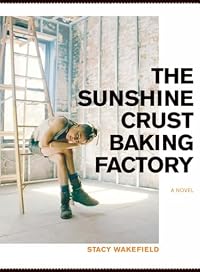
On a side note – Based on her self-perception, the protagonist of this story is likely a plus-sized lady. She frequently refers to how unfashionably full-figured she is compare with the other gals in the squatter community, so at the very least, she isn’t skinny. Therefore, I’m disappointed that the publisher chose a typical “heroin chic” cover girl for the book. Shame on you, Akashic! show less
But despite knowing that there might be more to the sqatter lifestyle than I originally imagined, when I cracked the spine on The Sunshine Crust Baking Factory, I pretty much expected something akin to an Irvine Welsh novel with show more piercings and tattoos, hardcore punk music, run-ins with the “pigs,” herculean consumption of narcotics, graphic and unhygienic sex…basically, just a general atmosphere of filth and degradation.
I’m thrilled to report I could not have been more mistaken.
It’s the story of a young woman in mid-1990s New York who decides to brave the mean streets of Williamsburg, Brooklyn to start a squatter community. Of course, the joke is that Williamsburg and its environs are now a yuppie paradise, just as expensive and, arguably, way more fashionable than her aging sister, Manhattan. It certainly illustrates how the lowest people on the totem pole continually get pushed aside in the name of neighborhood improvement. And while this is a big part of the message author Stacy Wakefield is trying to get across, this is so much more than a one note story.
This is an engaging coming of age tale about Sid, a young woman who begins her journey with dreams of being part of something for somewhat shallow and childish reasons (to get into the cool, counterculture scene and to impress a sexy rock musician) and ends up learning the true meaning of friendship, community and love. She’s a unique character - wry, introspective and gritty, convinced she can do anything as well as a guy. Truthfully, all the characters in this novel are both authentic and charming in their own ways. Their trials and tribulations, triumphs and tragedies make for a fast-paced, involving read. Not to mention that I learned quite a bit about how squatting works, in both the legal and practical sense. Oh, and there’s romance.
This novel turned out to be almost completely opposite of what I expected and so much more. A real gem.
On a side note – Based on her self-perception, the protagonist of this story is likely a plus-sized lady. She frequently refers to how unfashionably full-figured she is compare with the other gals in the squatter community, so at the very least, she isn’t skinny. Therefore, I’m disappointed that the publisher chose a typical “heroin chic” cover girl for the book. Shame on you, Akashic! show less
This review was written for LibraryThing Early Reviewers.You should know that I'm not a big fiction reader. Oh, in my earlier days, i dabbled with London and Poe, Thurber and Dickens, Wells and Conan Doyle, I remember one or three of Christie's, even one lesser known Steinbeck. And while I inhaled Vonnegut, Vidal, Heinlein, Wells, and Kozinski later on, a good biography or history always came first. And second. And third. These days, I am equally comfortable with Leon, Evanovich, Davis, King (as in Laurie R.) and Brown in hand as I am with Tuchman, Ivins, Brands or Irons. So I had to think about this read, "The Sunshine Biscuit Baking Factory," by Stacy Wakefield. The story centers around Sid, a determined young woman who, in the mid-1990s, desires to join the growing New York City squatter show more movement. Sid is by no means a fantasizing romantic, she's aware she'll face new challenges. But sharing a personal and sorrowful alienation with the others who comprise the movement, the community, she wishes to be part of, isn't enough. As in any path, Sid faces obstacles: of gender and sexism, political and economic, social and personal, city-street real and so deep and central that they can only be felt. "Sunshine Biscuit" is a smaller novel, 223 pages, but Ms. Wakefield doesn't skimp on content. There's a lot going on. I read it in three days. Each day I would reflect on what I'd read previously. And I haven't stopped thinking about it since. Which says something about the novel. Admitted, I'm probably not the best person to pen the first review of "Sunshine Biscuit." People attend university to learn about writing; I just know what I like. Ms. Wakefield has authored a thought-provoking and very readable book. show less
This review was written for LibraryThing Early Reviewers.Squatter culture is a new term for me and I was intrigued to view this from a fictional point of view from an author who had actually lived the lifestyle. I was very curious to learn if "homelessness" was synonymous to "squatter".
When the book opened with Sid getting a tattoo (to fit in) and moving to the Lower East Side of NYC with the intent of becoming a squatter by choice, I sat back and thought this will be an interesting point of view! Obviously Sid was choosing to be homeless rather than homeless brought on by unfortunate circumstance. She was aglow with her idealist view of squatter culture, a life commingling with artsy and punk music people while rejecting mainstream lifestyles.
The author has chosen a 1995 NYC setting and in show more doing Sid arrives a day late and a dollar short for immersion into the Manhattan squatter culture. The thousands of abandoned buildings, a result of 20 years of a depressed economic climate were maxed out with squat occupants. Instead of being received with open arms, Sid finds that merging into squat life isn't as easy as she had expected. Sid latches onto the first person to give her the time of day, a punk music artist, Lorenzo. Together they head to Brooklyn where they have been told that there are more opportunities to find a squat home. Her on-going infatuation with Lorenzo throughout the book drove me to distraction. I wanted to scream. Grow up! He just not that into you!
Sid's character was so socially and emotionally immature; although I have to admit she was tenacious and willing to keep seeking her ideal after suffering rejection and hardship time after time. The story rambled from one scene to another with very little variation. I began to think…"second verse, same as the first". The story made me feel miserable, but not from the physical hardships. As someone who lived for months at a time out of a backpack and sleeping in a one-person tent, grunge and fire hydrant water isn't that strange. My point is that I can't imagine going out of my way to try to fit into someone else's life style just to fill my need to belong to a group. Sid never seemed to see that she was being used by her "friends" and housemates.
The one character that stood out to me was Mitch. Mitch was in the squat scene for a long time and perhaps best exemplifies Sid's image of a communal being; a good hard-working person dedicated to free living. The Bakery was Mitch's find and as the more derelict of the squat life filled each floor, the misfits and low-lives continuously banged heads with him. His initial image is that of an angry grouch but as we learn, he really is the better angel in the compound.
The best written part of the story to me was the fire at Rot-Squat and the ensuing drama caused by the city's disregard for the squatters and the destruction of their building.
I wasn't totally disappointed in the book as I was drawn to do further research into squat culture. The subject was so different from my usual genre selections and overall I was very pleased to see a glimpse of life I would never have expected to exist.
I want to thank Edelweiss and Akashic Books for the advanced e-bookcopy in exchange for my review. show less
When the book opened with Sid getting a tattoo (to fit in) and moving to the Lower East Side of NYC with the intent of becoming a squatter by choice, I sat back and thought this will be an interesting point of view! Obviously Sid was choosing to be homeless rather than homeless brought on by unfortunate circumstance. She was aglow with her idealist view of squatter culture, a life commingling with artsy and punk music people while rejecting mainstream lifestyles.
The author has chosen a 1995 NYC setting and in show more doing Sid arrives a day late and a dollar short for immersion into the Manhattan squatter culture. The thousands of abandoned buildings, a result of 20 years of a depressed economic climate were maxed out with squat occupants. Instead of being received with open arms, Sid finds that merging into squat life isn't as easy as she had expected. Sid latches onto the first person to give her the time of day, a punk music artist, Lorenzo. Together they head to Brooklyn where they have been told that there are more opportunities to find a squat home. Her on-going infatuation with Lorenzo throughout the book drove me to distraction. I wanted to scream. Grow up! He just not that into you!
Sid's character was so socially and emotionally immature; although I have to admit she was tenacious and willing to keep seeking her ideal after suffering rejection and hardship time after time. The story rambled from one scene to another with very little variation. I began to think…"second verse, same as the first". The story made me feel miserable, but not from the physical hardships. As someone who lived for months at a time out of a backpack and sleeping in a one-person tent, grunge and fire hydrant water isn't that strange. My point is that I can't imagine going out of my way to try to fit into someone else's life style just to fill my need to belong to a group. Sid never seemed to see that she was being used by her "friends" and housemates.
The one character that stood out to me was Mitch. Mitch was in the squat scene for a long time and perhaps best exemplifies Sid's image of a communal being; a good hard-working person dedicated to free living. The Bakery was Mitch's find and as the more derelict of the squat life filled each floor, the misfits and low-lives continuously banged heads with him. His initial image is that of an angry grouch but as we learn, he really is the better angel in the compound.
The best written part of the story to me was the fire at Rot-Squat and the ensuing drama caused by the city's disregard for the squatters and the destruction of their building.
I wasn't totally disappointed in the book as I was drawn to do further research into squat culture. The subject was so different from my usual genre selections and overall I was very pleased to see a glimpse of life I would never have expected to exist.
I want to thank Edelweiss and Akashic Books for the advanced e-bookcopy in exchange for my review. show less
The Sunshine Crust Baking Factory was one of those wonderful books, that you don't want to put down. The main character, Sid, is a brave forthright young woman who has decided to squat in NYC.
For those who don't know - squatters were young people who moved into abandoned buildings in NYC during the 80s and 90s and turned them into free living spaces. Squatters lived without paying rent, but they paid for their space in hard work, considerable stress, and danger (from the building conditions, the authorities, and often each other). It was not for the fainthearted but there were rewards.
Stacy Wakefield's Sid, is a plucky lady, whose only fear seems to be letting others see her fear. She is well-worth getting to know. The author deftly show more describes the "craziness" of the squatting scene without being exploitative, keeping it real.
My only disappointment was that the ending was a little flat. But then life is like that sometimes.
Read this book -- you won't be disappointed. show less
For those who don't know - squatters were young people who moved into abandoned buildings in NYC during the 80s and 90s and turned them into free living spaces. Squatters lived without paying rent, but they paid for their space in hard work, considerable stress, and danger (from the building conditions, the authorities, and often each other). It was not for the fainthearted but there were rewards.
Stacy Wakefield's Sid, is a plucky lady, whose only fear seems to be letting others see her fear. She is well-worth getting to know. The author deftly show more describes the "craziness" of the squatting scene without being exploitative, keeping it real.
My only disappointment was that the ending was a little flat. But then life is like that sometimes.
Read this book -- you won't be disappointed. show less
This review was written for LibraryThing Early Reviewers.This book was certainly enlightening when it came to the squatter culture. I knew very little to begin with, and probably stereotyped squatters as much as everyone else, so I was pleasantly surprised by how much I learned about them from Wakefield's story.
I was also surprised by how the protagonist's father was fully supportive of his daughter's choice to squat. Not that he should condemn her, but wasn't he worried for her safety? I was definitely worried, and not just because of some of the violence between her and her housemates. Some of the buildings were in dangerous condition and the fact that the main character didn't sustain any injuries or get sick more than once despite toughing out a New York winter seemed incredibly lucky to show more me.
The narrative seems to start in the middle of a story that's already being told, and it kind of ends that way too. I suppose this could be a metaphor for the squatter lifestyle; joining a squat that someone has already started and moving on when it's still going, but the lack of resolution was a little frustrating. show less
I was also surprised by how the protagonist's father was fully supportive of his daughter's choice to squat. Not that he should condemn her, but wasn't he worried for her safety? I was definitely worried, and not just because of some of the violence between her and her housemates. Some of the buildings were in dangerous condition and the fact that the main character didn't sustain any injuries or get sick more than once despite toughing out a New York winter seemed incredibly lucky to show more me.
The narrative seems to start in the middle of a story that's already being told, and it kind of ends that way too. I suppose this could be a metaphor for the squatter lifestyle; joining a squat that someone has already started and moving on when it's still going, but the lack of resolution was a little frustrating. show less
This review was written for LibraryThing Early Reviewers.Members
- Recently Added By
Lists

Chronological 2015
39 works; 1 member
Author Information
6+ Works 65 Members
Awards and Honors
Awards
Classifications
Statistics
- Members
- 32
- Popularity
- 876,638
- Reviews
- 13
- Rating
- (3.46)
- Languages
- English
- Media
- Paper, Ebook
- ISBNs
- 3
- ASINs
- 1