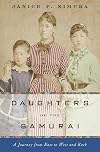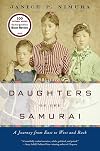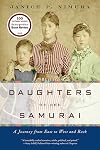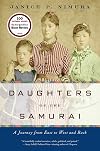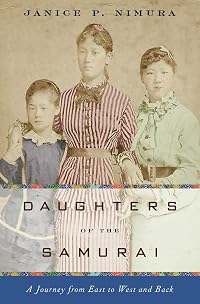
Daughters of the Samurai: A Journey from East to West and Back
by Janice P. Nimura
On This Page
Description
"'Surprising and richly satisfying' (Megan Marshall); 'Beautifully crafted...subtle, polished, and poised' (Stacy Schiff); In 1871, five young girls were sent by the Japanese government to the United States. Their mission: learn Western ways and return to help nurture a new generation of enlightened men to lead Japan. Raised in traditional samurai households during the turmoil of civil war, three of these unusual ambassadors--Sutematsu Yamakawa, Shige Nagai, and Ume Tsuda--grew up as typical show more American schoolgirls. Upon their arrival in San Francisco they became celebrities, their travels feted by newspapers across the nation. The passionate friendships they formed reveal an intimate world of cross-cultural fascination and connection. Ten years later, they returned to Japan--a land grown foreign to them--determined to revolutionize women's education. Based on in-depth archival research in Japan and in the United States, Daughters of the Samurai is beautifully, cinematically written, a fascinating lens through which to view an extraordinary historical moment"--Provided by publisher. show lessTags
Recommendations


























Member Reviews
A rather charming book detailing the lives of a trio of women who, having wound up on the wrong side of the restoration of imperial rule in Japan, were able to take advantage of the opportunity to study in America to rather spectacular affect. While Ume Tsuda's eventual founding of a well-regarded women's college in Tokyo was the most lasting impact, that her compatriots were able to become part of the highest reaches of Japanese society after having fallen so low is also worthy of notice. The author's urge to write this book mostly came from her own needs to understand the stresses of being caught in cross-cultural strain; having married a Japanese man who was all but assimilated into American society before returning to Japan.
This fascinating book brings to light a turning point in Japanese history and the role of women within Japanese culture. Five Japanese girls were selected to go to America in 1871. Each was the daughter of a disgraced samurai family that had supported the old Shogunate. The few Japanese men who had traveled abroad had reported on the stronger presence of women in society and how that seemed to be one of the advantages of western culture. Therefore, these five girls (the youngest at only six) were sent to America to be educated for ten years so that they might return and educate the next generation of Japanese women to be better wives and mothers. Within a year, two of the girls returned to Japan. The book closely follows the highs and show more lows experienced by the remaining three as they became Americans and returned to a country unable to speak Japanese or understand how to adapt in a now-foreign society.
Nimura created an amazing book about three powerful girls who were given an onerous task as children and, as true children of samurai, lived up to the Empress's mandate. It's a fast read and one I highly recommend. show less
Nimura created an amazing book about three powerful girls who were given an onerous task as children and, as true children of samurai, lived up to the Empress's mandate. It's a fast read and one I highly recommend. show less
In 1871, Japan was just starting to open itself up to trading with other countries, and cultural changes were afoot. That year, along with a group to negotiate trade with the U.S. and President Grant, were five girls, daughters of samurai, sent to receive a Western education and then come back to their homeland. Three of these girls - Sutematsu, Shige, and Ume - stayed for over ten years before returning to Japan. This is their story.
While I was interested in the content of the book, I often found myself bored by its execution. Nimura has clearly done her research, and at times seemed to want to pour every bit of it into the narrative, but I kept wondering if there were really enough meat to fill a whole book, overwhelmed as it seemed show more to be by tangents. For example: the first 60 or so pages gave background information on Sutematsu's family in Aizu and what kind of life she probably had as a samurai daughter; much time was spent talking about the men in the expedition and what their dinners and travels and negotiations were like; and a brief biography and background information is provided for nearly every figure introduced in the book far beyond what was perhaps needed for me to place them in context. The first half or so of the book focuses on the eldest of the three, Sutematsu, and the second on the youngest, Ume. I wasn't sure what precipitated the change other than, perhaps, what information was available for a given time period. Nimura quotes extensively from the three young women's correspondence and though she was quick to interpret what they must have been feeling for me, by far this was the most interesting part of the book. show less
While I was interested in the content of the book, I often found myself bored by its execution. Nimura has clearly done her research, and at times seemed to want to pour every bit of it into the narrative, but I kept wondering if there were really enough meat to fill a whole book, overwhelmed as it seemed show more to be by tangents. For example: the first 60 or so pages gave background information on Sutematsu's family in Aizu and what kind of life she probably had as a samurai daughter; much time was spent talking about the men in the expedition and what their dinners and travels and negotiations were like; and a brief biography and background information is provided for nearly every figure introduced in the book far beyond what was perhaps needed for me to place them in context. The first half or so of the book focuses on the eldest of the three, Sutematsu, and the second on the youngest, Ume. I wasn't sure what precipitated the change other than, perhaps, what information was available for a given time period. Nimura quotes extensively from the three young women's correspondence and though she was quick to interpret what they must have been feeling for me, by far this was the most interesting part of the book. show less
Fascinating look at the lives of three Japanese women and how they were influenced by 10 years in America in the 1870s.
This is a story of three Japanese young girls, sent to the United States in the early 1870s to become educated so that after 10 years of learning American ways, they would return to Japan to share what they had learned about the american culture to help modernize Japan. The first half of this book was a challenge. There was too much history of Japan with a huge array of names to slog through. To the average American reader, this history lesson, along with the completely unrecognizable foreign names, made it a very difficult read until later in the book when we finally get a glimpse of the character of these women. But once the women finally emerged, the book kept getting better through to the final pages. The author obviously did a lot show more of research and pieced together their story from what must be a huge collection of corespondents between these women and their close friends in America. I'll give this book 4 stars but new readers need to know not to give up if they find the first half a challenge to stick with. show less
Ratings
Members
- Recently Added By
Lists

historical biographies : great lives, well told
64 works; 4 members

History: Asia
103 works; 1 member
Author Information

2 Works 699 Members
Janice P. Nimura is the winner of a 2017 Public Scholar award from the National Endowment for the Humanities and the author of Daughters of the Samurai: A Journey from East to West and Back, a New York Times Notable Book. She lives in New York City.
Awards and Honors
Notable Lists
Common Knowledge
- Canonical title
- Daughters of the Samurai: A Journey from East to West and Back
- Original publication date
- 2015
- Important places
- Tokyo, Japan; New Haven, Connecticut, USA; Washington, D.C., USA; Poughkeepsie, New York, USA; Vassar College, Poughkeepsie, New York, USA
- Important events
- Meiji era
- Epigraph
- Little Granddaughter, unless the red barbarians
and the children of the gods learn each other's
hearts, the ships may sail and sail, but the two
lands will never be nearer.
- Etsu Inagaki Sugim... (show all)oto, A Daughter of the Samurai, 1926 - Dedication
- For Yoji
- First words
- Of the five girls on their way to America, the middle one in age, Sutematsu Yamakawa, had raveled the farthest, whether the distance was reckoned in miles or memories.
- Last words
- (Click to show. Warning: May contain spoilers.)Tsuda College, as it is known in English, still thrives, with an undergraduate enrollment of twenty-five hundred women studying English, mathematics, computer science, and international studies. They sometimes refer to themselves as "Umakos," and when a final examination or an important job interview looms, many find their way to that quiet, plum-shaded corner of campus to ask Ume for help.
- Blurbers
- Arthur Golden; Megan Marshall; Ruth Ozeki
- Original language
- English
Classifications
Statistics
- Members
- 277
- Popularity
- 116,505
- Reviews
- 5
- Rating
- (3.65)
- Languages
- English
- Media
- Paper, Audiobook, Ebook
- ISBNs
- 5
- ASINs
- 2