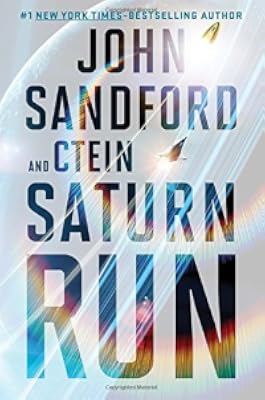
Saturn Run
by John Sandford, Ctein
On This Page
Description
"An extraordinary new thriller of the future from #1 New York Times-bestselling and Pulitzer Prize-winning author John Sandford and internationally known photo-artist and science fiction aficionado Ctein. Over the course of thirty-seven books, John Sandford has proven time and again his unmatchable talents for electrifying plots, rich characters, sly wit, and razor-sharp dialogue. Now, in collaboration with Ctein, he proves it all once more, in a stunning new thriller, a story as audacious show more as it is deeply satisfying. The year is 2066. A Caltech intern inadvertently notices an anomaly from a space telescope--something is approaching Saturn, and decelerating. Space objects don't decelerate. Spaceships do. A flurry of top-level government meetings produces the inescapable conclusion: Whatever built that ship is at least one hundred years ahead in hard and soft technology, and whoever can get their hands on it exclusively and bring it back will have an advantage so large, no other nation can compete. A conclusion the Chinese definitely agree with when they find out. The race is on, and an remarkable adventure begins--an epic tale of courage, treachery, resourcefulness, secrets, surprises, and astonishing human and technological discovery, as the members of a hastily thrown-together crew find their strength and wits tested against adversaries both of this earth and beyond. What happens is nothing like you expect--and everything you could want from one of the world's greatest masters of suspense"-- show lessTags
Recommendations
Member Reviews
Part first-contact sci fi, part political thriller, and entirely fun to read. Sandford, the author of the popular Lucas Davenport suspense series, has found himself a whole new niche in which he will be successful, and the book is a natural for film, to boot.
It's about 50 years in the future and the US and China are still at it. China is building a ship to colonize Mars when a US observer notices an interstellar ship approach the rings of Saturn and park next to a previously unnoticed alien artifact. The US alters the space station and China repurposes its ship, and the race for first contact is on. Political intrigue between the two countries (and ships) is intense and leads to dangerous espionage and a desperate race. What they find show more is enough to change humanity's view of itself in the universe (although, truthfully, that aspect of the story isn't really addressed). The science is interesting (I can't judge whether it's accurate), and the story moves right along through preparations, the journey, and the discoveries made. Characterization is largely ignored here, but in suspense that isn't necessarily a negative. It's the action that's important, and here there is plenty. show less
It's about 50 years in the future and the US and China are still at it. China is building a ship to colonize Mars when a US observer notices an interstellar ship approach the rings of Saturn and park next to a previously unnoticed alien artifact. The US alters the space station and China repurposes its ship, and the race for first contact is on. Political intrigue between the two countries (and ships) is intense and leads to dangerous espionage and a desperate race. What they find show more is enough to change humanity's view of itself in the universe (although, truthfully, that aspect of the story isn't really addressed). The science is interesting (I can't judge whether it's accurate), and the story moves right along through preparations, the journey, and the discoveries made. Characterization is largely ignored here, but in suspense that isn't necessarily a negative. It's the action that's important, and here there is plenty. show less
John Sandford is probably my favorite detective fiction author. His Lucas Davenport series and his Virgil Flowers series are both consistently good. So I was amazed when I found he had co-authored a science fiction novel.
It's a suspense novel set 50 years in the future in the context of a race between the US and China to reach the site amid the rings of Saturn where telescopes had detected the landing (and subsequent departure) of what could only be an alien spacecraft. And it's a good read. The characters are intriguing (the US President is a total bitch) and the action is gripping. What the competing teams of astronauts discover at the site is totally mind blowing.
And the science underlying the technology that underlies the space show more travel appears to be sound. A lengthy appendix documents the propulsion technologies used by the two teams. Whoever co-author Ctein is he seems to know his stuff.
A good read. But still not as good as a fresh Davenport or Flowers book would have been. show less
It's a suspense novel set 50 years in the future in the context of a race between the US and China to reach the site amid the rings of Saturn where telescopes had detected the landing (and subsequent departure) of what could only be an alien spacecraft. And it's a good read. The characters are intriguing (the US President is a total bitch) and the action is gripping. What the competing teams of astronauts discover at the site is totally mind blowing.
And the science underlying the technology that underlies the space show more travel appears to be sound. A lengthy appendix documents the propulsion technologies used by the two teams. Whoever co-author Ctein is he seems to know his stuff.
A good read. But still not as good as a fresh Davenport or Flowers book would have been. show less
After scientists detect a spaceship entering Saturn's orbit, the Chinese and the Americans race to get their own manned crafts to Saturn to find out who the aliens are. The political maneuvering and ultimate question of what the scientific discovery means for the balance of power on earth are covered in the discussions among the characters in a very realistic (and humorous) way. I read this because it is by John Sandford, and I liked it way more than I thought I would. There is a great cast of characters which you would expect in a Sandford novel. I can't judge how accurate the scientific spacy kind of details were, but they fit as far as I could tell.
Just about every enjoyable aspect of 1970s science fiction is dragged out of the cliché cupboard, given a 21st century splash of dazzle and delivered here with dash and panache. There’s stacks of solid science, credibly extended into the realm of speculation without breaking (or even mildly infuriating) the laws of physics, and deftly rendered easily digestible by John Sandford’s superlative story-telling skills.
The fascinating science stuff is attached to a pretty geopolitical problem, and the thrill of maybe meeting aliens for the first time. The authors assemble a credible cast of characters and then ramp up the tension by turning the perilous trip to Saturn into a flat-out race between the American and the Chinese show more nations.
There's precious little new here; all this has been done before, even down to using ion cannons for propulsion. But there are some nifty twists in the narrative and Sandford’s excellent dialogue makes the tense exchanges between staffers, spacemen, engineers, journos, spooks and politicians both rippingly entertaining and entirely believable. His characters behave, pretty much, like real people – even the super-smart science guys and the glossy, ambitious embedded reporters.
I also struggled slightly with how far ahead the novel is set (2066) yet how little progress had been made. Folks are still using ‘slates’ and have ‘wrist wraps’ to alert them; tech which is doable right now. It’s hard to credit that in another half century, tech development will have slowed so much – even allowing for a couple of major future history events which the authors cannily hint at, but never quite explain.
On any level, Saturn Run is a romp. It’s smart, well informed, and constructed to make the pages fly by. Every stage brings an intriguing revelation, and it certainly succeeds in making a slow-motion race (where neither party knows if the other has a lethal trick up a sleeve) utterly gripping. It may not do much new, but it does everything extremely well.
8/10
There's more on this book and similar titles at
https://murdermayhemandmore.wordpress.com/2015/12/26/saturn-run-the-science-of-f... show less
The fascinating science stuff is attached to a pretty geopolitical problem, and the thrill of maybe meeting aliens for the first time. The authors assemble a credible cast of characters and then ramp up the tension by turning the perilous trip to Saturn into a flat-out race between the American and the Chinese show more nations.
There's precious little new here; all this has been done before, even down to using ion cannons for propulsion. But there are some nifty twists in the narrative and Sandford’s excellent dialogue makes the tense exchanges between staffers, spacemen, engineers, journos, spooks and politicians both rippingly entertaining and entirely believable. His characters behave, pretty much, like real people – even the super-smart science guys and the glossy, ambitious embedded reporters.
I also struggled slightly with how far ahead the novel is set (2066) yet how little progress had been made. Folks are still using ‘slates’ and have ‘wrist wraps’ to alert them; tech which is doable right now. It’s hard to credit that in another half century, tech development will have slowed so much – even allowing for a couple of major future history events which the authors cannily hint at, but never quite explain.
On any level, Saturn Run is a romp. It’s smart, well informed, and constructed to make the pages fly by. Every stage brings an intriguing revelation, and it certainly succeeds in making a slow-motion race (where neither party knows if the other has a lethal trick up a sleeve) utterly gripping. It may not do much new, but it does everything extremely well.
8/10
There's more on this book and similar titles at
https://murdermayhemandmore.wordpress.com/2015/12/26/saturn-run-the-science-of-f... show less
I put this in the category of a fun read. It’s not great, I don’t think it’s deeply provocative, but it’s fun.
The authors are very good at making you feel their words. After having read the book, I remembered scenes as if I had actually experienced them, not just read them. And they know how to pull you from chapter to chapter, with tensions and questions to be resolved.
The plot centers around the discovery of an alien spaceship and an alien artifact near Saturn, but alien contact is itself a foil for a cold-war-like story of competition between American and Chinese space programs.
What plays out is not so much an encounter between humans and an alien civilization, or even alien technology, as an encounter between two highly show more charged, or over-charged, nations. It’s the space race revisited, this time with the new incentive of access to alien technology and the huge potential advantage that exclusive access could provide.
That race is the central tension of the book, with characters and cultures displaying themselves through it.
The science is central to the plot — the detailed and thought-out science of propulsion systems, requirements, and limits for space travel. Those requirements and limits have their own roles in the story. The race has repeated tortoise and hare scenarios, given the technology choices made by the competing players. There is even an “Authors’ Note” at the end of the book, providing more details and an account of how the authors reasoned and calculated their way through the technology choices and their implications.
Overall, like I said, it’s a good story. It’s entertaining. The cold war tones are not new, but they seem to have never really died. show less
The authors are very good at making you feel their words. After having read the book, I remembered scenes as if I had actually experienced them, not just read them. And they know how to pull you from chapter to chapter, with tensions and questions to be resolved.
The plot centers around the discovery of an alien spaceship and an alien artifact near Saturn, but alien contact is itself a foil for a cold-war-like story of competition between American and Chinese space programs.
What plays out is not so much an encounter between humans and an alien civilization, or even alien technology, as an encounter between two highly show more charged, or over-charged, nations. It’s the space race revisited, this time with the new incentive of access to alien technology and the huge potential advantage that exclusive access could provide.
That race is the central tension of the book, with characters and cultures displaying themselves through it.
The science is central to the plot — the detailed and thought-out science of propulsion systems, requirements, and limits for space travel. Those requirements and limits have their own roles in the story. The race has repeated tortoise and hare scenarios, given the technology choices made by the competing players. There is even an “Authors’ Note” at the end of the book, providing more details and an account of how the authors reasoned and calculated their way through the technology choices and their implications.
Overall, like I said, it’s a good story. It’s entertaining. The cold war tones are not new, but they seem to have never really died. show less
I thought this would focus more on the science fiction, honestly. And, while there was certainly a lot of science involved, it reads more on the commentary of politics and how it causes harm to individuals and slows the furthering of science/discovery.
I really appreciate all of the work that the author put into making the science in this book plausible. Most of the tech is close enough to what we have now that I can imagine it being in our reach by the time the story is set, and some of it doable now and just hasn't been done. The social progess (and lack thereof) imagined by the story is hard to swallow, but I can understand the authorial decision to basically freeze politics as it exists today except for slowly ramping up corporate power for a few decades.
What hurt the book most for me were the characters. The best characters get the least attention, though maybe if they had more time they'd look worse too. By and large the characters were a poor combination of flat, ridiculous, show more stereotypical, short-sighted, and (in the case of most of the men) hypermasculine.
To illustrate: The story's protagonist is Sandy Darlington. Tall, handsome, athletic: a thrillseeking surfer dude who is heir to an enormous fortune, and he is cooling his heels working as an astronomy intern until he is old enough to inherit his money. Okay, sure, I can suspend my disbelief for that. He's also a talented photographer, videographer, and editor. That's pushing it, but I'll stretch. But, there's a twist, he's secretlyan ex-black-ops supersoldier who is hiding his trauma behind a thin veneer that will inevitably crack, but not enough to prevent him from supersoldiering when needed , and that is a bit too far for me to take him seriously.
More importantly, the depiction of the nation of China and the behavior of its people in this story is offensive. The Chinese characters were even more poorly written and less detailed than the worst of the Americans, and their decisions often come across as horrifically stupid. It reminds me of the depiction of Soviets in forgettable thrillers from the early 1980's.
Overall, I recommend giving this book a pass. show less
What hurt the book most for me were the characters. The best characters get the least attention, though maybe if they had more time they'd look worse too. By and large the characters were a poor combination of flat, ridiculous, show more stereotypical, short-sighted, and (in the case of most of the men) hypermasculine.
To illustrate: The story's protagonist is Sandy Darlington. Tall, handsome, athletic: a thrillseeking surfer dude who is heir to an enormous fortune, and he is cooling his heels working as an astronomy intern until he is old enough to inherit his money. Okay, sure, I can suspend my disbelief for that. He's also a talented photographer, videographer, and editor. That's pushing it, but I'll stretch. But, there's a twist, he's secretly
More importantly, the depiction of the nation of China and the behavior of its people in this story is offensive. The Chinese characters were even more poorly written and less detailed than the worst of the Americans, and their decisions often come across as horrifically stupid. It reminds me of the depiction of Soviets in forgettable thrillers from the early 1980's.
Overall, I recommend giving this book a pass. show less
Members
- Recently Added By
Lists

First Novels
373 works; 17 members

Books Read in 2021
5,361 works; 114 members

Ranking
66 works; 1 member

Books Read in 2024
4,623 works; 126 members

DG hard and slightly less hard science fiction
12 works; 1 member

Books We Resisted Reading
178 works; 110 members
Author Information

118+ Works 90,416 Members
John Sandford was born John Roswell Camp on February 23, 1944 in Cedar Rapids, Iowa. Before entering the U.S. Army and serving in Korea, he received a bachelor's degree in American history from the University of Iowa in 1966. After leaving the service, he received a master's degree in journalism from the University of Iowa. During the 1970s, he show more worked at The Miami Herald, and the St. Paul Pioneer Press. In 1985, he began researching the lives of a farm family caught in the midst of the crisis of American farming. The article, Life on the Land: An American Farm Family, won the Pulitzer Prize for Feature Writing and the American Society of Newspaper Editors Award for Non-Deadline Feature Writing. After winning the Pulitzer Prize, he began writing fiction. His works include the Prey series, the Virgil Flowers series, and The Singular Menace series. He has also written nonfiction works on plastic surgery and art. Sandford's Young Adult novels, Uncaged and Outrage, Books 1 and 2 of The Singular Menace Series co-written with Michelle Cook, made the New York Times Bestseller list in July 2016. (Bowker Author Biography) show less

3+ Works 1,196 Members
Ctein is a photographer and artist. He has a degree in both English and Physics from Caltech and has written nearly 300 articles and manuals on photographic topics for such magazines as Photo Techniques and Camera and Darkroom
Some Editions
Common Knowledge
- Canonical title
- Saturn Run
- Original publication date
- 2015
- People/Characters
- Sanders Heackock Darlington; Naomi Fang-Castro; Rebecca Johannson; David Cowell; Joe Martinez; Edward Fletcher (show all 12); Amanda Santeros; Jacob Vintner; Rebecca Johansson; John Clover; Cassandra Fiorella; Zhang Ming-Hoa
- Dedication
- CTEIN DEDICATES THIS NOVEL TO PAULA BUTLER
SANDFORD DEDICATES IT TO BEN, DAN, AND GABRIEL CURTIS, HIS GRANDSONS - First words
- From ten kilometers out, the Sky Observatory looked like an oversized beer can.
- Last words
- (Click to show. Warning: May contain spoilers.)In two years, the crew would be back on Earth, accompanied by Dr. Rebecca Johansson, the first voyager and the first casualty of the interstellar age, who was finally returning home.
Classifications
Statistics
- Members
- 1,042
- Popularity
- 24,775
- Reviews
- 60
- Rating
- (3.75)
- Languages
- 5 — Czech, English, German, Italian, Korean
- Media
- Paper, Audiobook, Ebook
- ISBNs
- 18
- ASINs
- 11