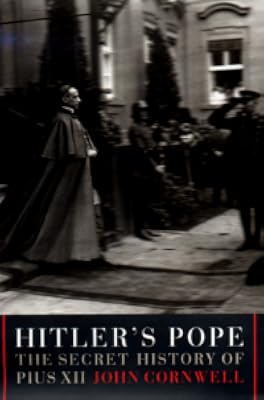
Hitler's Pope: The Secret History of Pius XII
by John Cornwell
On This Page
Description
Examines the papacy of Eugenio Pacelli, Pius XII, pontiff from 1939 to 1958, discussing his failure to speak out against Hitler's actions during World War II, and charging that the Pope's behavior was consistent with his dedication to enhancing his own power and his personal antipathy toward the Jews.Tags
Recommendations










Member Recommendations

Member Reviews
Fascinating account of the rise of Eugenio Pacelli to become Pope, and his reign thereafter. Though narratively focusing on Pacelli, the book is also an account of what can only be described as fascism or authoritarian rule within the Catholic Church, as well as the existence of anti-semitism within the Church. Extraordinarily researched and referenced, if at times a little too meticulously recounted. This corner of World War II world politics has rarely seen the light of day. Pacelli cannot be acquitted as he was, at best, willingly inactive when he could have made a difference, or a knowing collaborator with Hitler, at worst. The book certainly has ample evidence of Pacelli's own anti-semitism and fascistic notions with regard to show more Church rule. Given the length and breadth of his reign, this is necessary reading to understand modern Catholic politics.
4 1/2 bones!!!!!
Highly Recommended show less
4 1/2 bones!!!!!
Highly Recommended show less
The beatification process has begun to make Pius XII (Eugenio Pacelli) a saint. Aside from whatever we might think about how saints are created by the church as an institution, I suspect everyone would agree that any saint should have a reasonably spotless reputation.
John Henry Newman, a famous British convert to Catholicism in the eighteenth century, once wrote that “It is not good for a Pope to live twenty years. It is an anomaly and bears no good fruit; he becomes a god, has no one to contradict him, does not know facts, and does cruel things without meaning it.” The papacy alters a man’s consciousness. He becomes a solitary individual. Paul VI recognized this solitude and penned a note to himself that described this show more loneliness and power, “assume every responsibility for guiding others, even when it seems illogical and perhaps absurd. And to suffer alone. . . Me and God.”
Cornwell, aware of the rumors surrounding Pius’s actions during WWII with regard to the Jewish problem in Germany, decided to do the definitive research into these accusations. He was given unprecedented access to Vatican files. He was sure that Pius would be vindicated. What he discovered surprised and saddened him. The secret files revealed a man obsessed with power who maneuvered with Hitler and the German Catholic Church in such a way that helped to bring Hitler to power. It’s important to remember that the papacy as we know it today is very different from that which preceded the nineteenth century. It is an invention. Prior to the rise of almost instant world-wide communication, power was distributed through great councils and a hierarchy that left much discretion to local control. It was “more a final court of appeal than a uniquely initiating autocracy.”
Pacelli played a key role in strengthening the central authority of the papacy. This was in part a reaction to the oppression the Catholic Church had suffered at the hands of the state in the early nineteenth century. There was also a struggle between those who urged more central authority for the pope and those who were anxious to decentralize and distribute more authority to the bishops. The centralists won at the First Vatican Council of 1870 when the pope was declared “infallible” in matters of faith and morals and the undisputed leader of the church. Pacelli, as a Vatican lawyer, played a substantial role in redrafting the Church’s laws in such a way as to grant future popes “unchallenged domination.” The Code of Canon Law was initiated in 1917 and distributed to Catholic clergy. Pacelli received special dispensation to study at home for his seminary training. Ostensibly, this was because of his nervous stomach’s inability to handle seminary food. Whatever the case, the influence of his mother remained very strong.
Following his ordination, he began work on his doctorate, studying with the Jesuits. This was at the time of the Dreyfus trials in France, and— despite his subsequent pardon and evidence of innocence—Jesuit publications continued to warn of the dangers of Jews: “wherever Jews had been granted citizenship the outcome had been the ruination of Christians.” Anti-Semitism had a long history in the Catholic Church, and it was the sixteenth century pope Paul IV who instituted the ghetto and required Jews to wear a distinctive yellow badge.
In the 1920s, Germany had one of the largest — and best-educated — Catholic populations in the world. As papal nuncio, it was Pacelli’s role to create a pact between the German state and the Church, a pact resisted by Protestants and many Catholics who believed his vision was too authoritarian. Pacelli remained pro-German all his life. He failed to publicly condemn any of the mass killings the Germans had begun. Even the slaughter of Catholic priests in Poland and the handicapped under the euthanasia program were never condemned. Cornwell shows that Pacelli was Hitler’s best ally. Despite appeals from many, including some top German commanders in Italy, he refused to condemn Hitler’s acts, self-righteously concluding that Hitler was preferable to Stalin since Hitler was willing to pay lip service to Christianity. In return, Pius XII received full control of the Church in Germany. Cornwell documents how Pacelli had been fully informed of the “persecution unleashed against the Jews at the very point when he was to enter into substantive negotiations for a concordat with its perpetrators.” Hitler even justified the concordat by suggesting that it would be “especially significant in the urgent struggle against international Jewry.”
It is unclear whether Pacelli understood the wider implications of his diplomatic maneuvers that led to Hitler’s supremacy, but he supported Hitler to the very end, sending Hitler his personal congratulations following the unsuccessful bomb assassination attempt in 1939. His failure to condemn the persecution of the Jews rendered Hitler invaluable aid. Cornwell’s ultimate judgment of Pacelli is that his life was a “fatal combination of high spiritual aspirations in conflict with soaring ambitions for power and control. . . not a portrait of evil but of fatal moral dislocation – a separation of authority from Christian love. The consequences of that rupture were collusion with tyranny and ultimately violence.”
Anti-Semitism alone does not explain Pacelli’s silence, although clearly he regarded the Jews as a contemporary as well as ancient enemy of his church. He placed papal power and the accumulation of even more power to the papacy as the highest value. Cornwell answers in the affirmative to the question he poses, “Was there something in the modern ideology of papal power that encouraged the Holy See to acquiesce in the face of Hitler’s evil, rather than oppose it?”
The move to beatify Pius XII should come to a screeching halt. The sanctification of someone whose moral authority has been documented to be considerably less than holy would render the entire concept of sainthood as meaningless if not foolish – if it isn’t already. If Pius were to be beatified, his policies would be confirmed, “endorsing the modern ideology of papal power and justifying Pacelli’s wartime record.” show less
John Henry Newman, a famous British convert to Catholicism in the eighteenth century, once wrote that “It is not good for a Pope to live twenty years. It is an anomaly and bears no good fruit; he becomes a god, has no one to contradict him, does not know facts, and does cruel things without meaning it.” The papacy alters a man’s consciousness. He becomes a solitary individual. Paul VI recognized this solitude and penned a note to himself that described this show more loneliness and power, “assume every responsibility for guiding others, even when it seems illogical and perhaps absurd. And to suffer alone. . . Me and God.”
Cornwell, aware of the rumors surrounding Pius’s actions during WWII with regard to the Jewish problem in Germany, decided to do the definitive research into these accusations. He was given unprecedented access to Vatican files. He was sure that Pius would be vindicated. What he discovered surprised and saddened him. The secret files revealed a man obsessed with power who maneuvered with Hitler and the German Catholic Church in such a way that helped to bring Hitler to power. It’s important to remember that the papacy as we know it today is very different from that which preceded the nineteenth century. It is an invention. Prior to the rise of almost instant world-wide communication, power was distributed through great councils and a hierarchy that left much discretion to local control. It was “more a final court of appeal than a uniquely initiating autocracy.”
Pacelli played a key role in strengthening the central authority of the papacy. This was in part a reaction to the oppression the Catholic Church had suffered at the hands of the state in the early nineteenth century. There was also a struggle between those who urged more central authority for the pope and those who were anxious to decentralize and distribute more authority to the bishops. The centralists won at the First Vatican Council of 1870 when the pope was declared “infallible” in matters of faith and morals and the undisputed leader of the church. Pacelli, as a Vatican lawyer, played a substantial role in redrafting the Church’s laws in such a way as to grant future popes “unchallenged domination.” The Code of Canon Law was initiated in 1917 and distributed to Catholic clergy. Pacelli received special dispensation to study at home for his seminary training. Ostensibly, this was because of his nervous stomach’s inability to handle seminary food. Whatever the case, the influence of his mother remained very strong.
Following his ordination, he began work on his doctorate, studying with the Jesuits. This was at the time of the Dreyfus trials in France, and— despite his subsequent pardon and evidence of innocence—Jesuit publications continued to warn of the dangers of Jews: “wherever Jews had been granted citizenship the outcome had been the ruination of Christians.” Anti-Semitism had a long history in the Catholic Church, and it was the sixteenth century pope Paul IV who instituted the ghetto and required Jews to wear a distinctive yellow badge.
In the 1920s, Germany had one of the largest — and best-educated — Catholic populations in the world. As papal nuncio, it was Pacelli’s role to create a pact between the German state and the Church, a pact resisted by Protestants and many Catholics who believed his vision was too authoritarian. Pacelli remained pro-German all his life. He failed to publicly condemn any of the mass killings the Germans had begun. Even the slaughter of Catholic priests in Poland and the handicapped under the euthanasia program were never condemned. Cornwell shows that Pacelli was Hitler’s best ally. Despite appeals from many, including some top German commanders in Italy, he refused to condemn Hitler’s acts, self-righteously concluding that Hitler was preferable to Stalin since Hitler was willing to pay lip service to Christianity. In return, Pius XII received full control of the Church in Germany. Cornwell documents how Pacelli had been fully informed of the “persecution unleashed against the Jews at the very point when he was to enter into substantive negotiations for a concordat with its perpetrators.” Hitler even justified the concordat by suggesting that it would be “especially significant in the urgent struggle against international Jewry.”
It is unclear whether Pacelli understood the wider implications of his diplomatic maneuvers that led to Hitler’s supremacy, but he supported Hitler to the very end, sending Hitler his personal congratulations following the unsuccessful bomb assassination attempt in 1939. His failure to condemn the persecution of the Jews rendered Hitler invaluable aid. Cornwell’s ultimate judgment of Pacelli is that his life was a “fatal combination of high spiritual aspirations in conflict with soaring ambitions for power and control. . . not a portrait of evil but of fatal moral dislocation – a separation of authority from Christian love. The consequences of that rupture were collusion with tyranny and ultimately violence.”
Anti-Semitism alone does not explain Pacelli’s silence, although clearly he regarded the Jews as a contemporary as well as ancient enemy of his church. He placed papal power and the accumulation of even more power to the papacy as the highest value. Cornwell answers in the affirmative to the question he poses, “Was there something in the modern ideology of papal power that encouraged the Holy See to acquiesce in the face of Hitler’s evil, rather than oppose it?”
The move to beatify Pius XII should come to a screeching halt. The sanctification of someone whose moral authority has been documented to be considerably less than holy would render the entire concept of sainthood as meaningless if not foolish – if it isn’t already. If Pius were to be beatified, his policies would be confirmed, “endorsing the modern ideology of papal power and justifying Pacelli’s wartime record.” show less
This book is a searing, unsympathetic indictment of Eugenio Pacelli, who became Pope Pius XII during the period of WWII. Pius XII remained conspicuously silent regarding Hitler's "Final Solution" for the Jewish people, even when the Jews of Rome itself were herded into a train and transported to Germany, and Cornwell lays out a pattern of anti-semitism and sympathy for Germany that existed in Pacelli long before his ascension to Peter's throne. As a former Catholic, this book made me feel angry and disappointed in the leadership of the Catholic Church both then and now, and even more furious that Pius XII has already been beatified. Pius XII, if even half of what is outlined in this book is true, was a seriously flawed and all too show more fallible human being, not a potential saint at all. show less
Whether Pope Pius XII, who was Pope during World War II, was complicit in crimes against Jewish people during the Holocaust remains a heated question.
The author presents us with the case that Pius XII was instrumental in the rise to power of the Nazi Party and refused to speak out against the Holocaust and other Axis atrocities leading up to and during World War II. Additionally, Cornwell argues that the future Pope, Eugenio Pacelli, played a significant role in the build up to World War I.
While Cornwell makes a powerful case against Pius XII, further reading on the topic shows other writers who have defended the Pope, arguing that a number of Jewish people have praised his role during WWII protecting Jewish refugees in the Vatican and show more his instruction to churches to assist Jewish people hiding from Axis soldiers. While I recommend reading "Hitler's Pope", it is with the rider that the reader seek out other works that defend the Pope's work during World War II. show less
The author presents us with the case that Pius XII was instrumental in the rise to power of the Nazi Party and refused to speak out against the Holocaust and other Axis atrocities leading up to and during World War II. Additionally, Cornwell argues that the future Pope, Eugenio Pacelli, played a significant role in the build up to World War I.
While Cornwell makes a powerful case against Pius XII, further reading on the topic shows other writers who have defended the Pope, arguing that a number of Jewish people have praised his role during WWII protecting Jewish refugees in the Vatican and show more his instruction to churches to assist Jewish people hiding from Axis soldiers. While I recommend reading "Hitler's Pope", it is with the rider that the reader seek out other works that defend the Pope's work during World War II. show less
Cornwell presents a rather one-sided view of the wartime papacy, and seems to be obsessed with the theme of anti-Semitism, to the detriment of his argument. From the start, he appears determined to condemn Pius' response to the Holocaust. The author himself has admitted since publication that he considers this work to be too damning of Pius. While there is much to be criticised of the papal response, Cornwell leaves little room for consideration of the Pope's other concerns and motivations; his responsibilities to Catholics & the threat posed to the Church by Nazism, possible repercussions of a vocal protest for Holocaust victims, his anti-Communist views, amongst others.
The views expressed in 'Hitler's Pope' have not met with much show more support from within the academic community; it's an interesting read, but verges on polemic in places and shouldn't be read if you're looking for a good overview of this explosively contentious debate. show less
The views expressed in 'Hitler's Pope' have not met with much show more support from within the academic community; it's an interesting read, but verges on polemic in places and shouldn't be read if you're looking for a good overview of this explosively contentious debate. show less
This is a well researched dissection of the diplomatic Career of Egenio Pacelli, who called himself Pius XII. The impression given is that Eugenio was no friend of the Jews. Cornwell's research seems to indicate that Eugenio made an arrangement with the Nazis in the 1930's and carried out his part, which was to keep the involvement of the Roman church as low key as possible when it might involve interfering with the Nazi solution to the Jewish problem. There's a lot of footnotes.
Current opinion, including the author's, holds that Pius was no so pro-Nazi, or anti-semitic as he wrote in this book.
Current opinion, including the author's, holds that Pius was no so pro-Nazi, or anti-semitic as he wrote in this book.
The information in this book should be known! I'll recommend it, for its content, but the writing is really pretty dry. For a shorter, but more eloquent treatment of this sordid tale, I'd recommend [Constantine's Sword: The Church and the Jews, A History] by James Carroll.
The gist of the tale is that an inferred anti-semitism, combined with a relentless drive for papal power, and a myopic self-interest, drove Pius XII into a position of at the very least, inaction and more incriminatingly, shadow compliance with the Nazis in the Holocaust.
It is a sad and sobering tale, and the heavy lifting of the research had to be done, (and has been done well) by John Cornwell, I just wish his prose was a bit more evocative.
The gist of the tale is that an inferred anti-semitism, combined with a relentless drive for papal power, and a myopic self-interest, drove Pius XII into a position of at the very least, inaction and more incriminatingly, shadow compliance with the Nazis in the Holocaust.
It is a sad and sobering tale, and the heavy lifting of the research had to be done, (and has been done well) by John Cornwell, I just wish his prose was a bit more evocative.
Members
- Recently Added By
Lists

Banned Books Week 2014
268 works; 63 members
Author Information

20+ Works 3,125 Members
John Cornwell is Senior Research Fellow at Jesus College, Cambridge, England, and an award-winning journalist and author. His A Thief in the Night: The Death of Pope John Paul I was a world bestseller. He has profiled Pope John Paul II for Vanity Fair and the London Sunday Times magazine and has written on Catholic issues for many publications show more around the world. show less
Awards and Honors
Distinctions
Series
Belongs to Publisher Series
Work Relationships
Common Knowledge
- People/Characters
- Pope Pius XII
- Important places
- Vatican City
- Important events
- World War II (1939 | 1945); Holocaust (1939 | 1945)
- Epigraph
- "All successes [Pacelli believed] could only be attained by papal diplomacy. The system of concordats led him and the Vatican to despise democracy and the parliamentary system...Rigid governments, rigid centralizations, and ... (show all)rigid treaties were supposed to introduce an era of stable order, an era of peace and quiet."
-Heinrich Bruning, German Chancellor 1930-1932
"Pius XII and the Jews...The whole thing is too sad and too serious for bitterness...a silence which is deeply and completely in complicity with all the focus which carry out oppression, injustice, aggression, explotation, war." -Thomas Merton
"The cause of the beatification and canonization of Pope Pius XII, who is rightly venerated by many millions of Catholics, will not be stoopped or delayed by the unjustifiable and calumnious attacks against this great and saintly man." -Father Peter Gumpel, S.J., relator in the cause of Pius XII's canonization - First words
- During the "Holy Year" of 1950, a year in which many millions of pilgrims descended on Rome to show their allegiance to the papacy, Eugenio Pacelli, Pope Pius XII, was seventy-four years of age and still vigorous.
- Last words
- (Click to show. Warning: May contain spoilers.)Having come to the end of y own journey through the life and times of Pacelli, I am convinced that the cumulataive verdict of history shows him to be not a saintly exemplar for future generations, but a deeply flawed human being from whom Catholics, and our relations with other religions, can best profit by expressing our sincere regret.
Classifications
- Genres
- Religion & Spirituality, History, Nonfiction, General Nonfiction, Biography & Memoir
- DDC/MDS
- 282.092 — Religion Christian denominations Roman Catholic Church Catholic Biography And History Biography
- LCC
- BX1378 .C65 — Philosophy, Psychology and Religion Christian Denominations Christian Denominations Catholic Church History
- BISAC
Statistics
- Members
- 1,442
- Popularity
- 16,385
- Reviews
- 19
- Rating
- (3.41)
- Languages
- 9 — Czech, Dutch, English, French, German, Italian, Portuguese, Slovenian, Spanish
- Media
- Paper, Audiobook, Ebook
- ISBNs
- 30
- ASINs
- 12