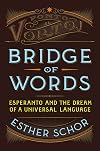
Bridge of Words: Esperanto and the Dream of a Universal Language
by Esther Schor
On This Page
Description
"A rich and passionate biography of a language and the dream of world harmony it sought to realizeIn 1887, Ludwig Lazarus Zamenhof, a Polish Jew, had the idea of putting an end to tribalism by creating a universal language, one that would be equally accessible to everyone in the world. The result was Esperanto, a utopian scheme full of the brilliance, craziness, and grandiosity that characterize all such messianic visions.In this first full history of a constructed language, poet and scholar show more Esther Schor traces the life of Esperanto. She follows the path from its invention by Zamenhof, through its turn-of-the-century golden age as the great hope of embattled cosmopolites, to its suppression by nationalist regimes and its resurgence as a bridge across the Cold War. She plunges into the mechanics of creating a language from scratch, one based on rational systems that would be easy to learn, politically neutral, and allow all to speak to all. Rooted in the dark soil of Europe, Esperanto failed to stem the continent's bloodletting, of course, but as Schor shows, the ideal continues draw a following of modern universalists dedicated to its visionary goal.Rich and subtle, Bridge of Words is at once a biography of an idea, an original history of Europe, and a spirited exploration of the only language charged with saving the world from itself"-- "A history of Esperanto, the utopian "universal language" invented in 1887"-- show lessTags
Recommendations
















Member Reviews
"Happy hour's over. You've had enough; time to go home."
That really was the feeling I came away with from this book. What has author Esther Schor been drinking?
I requested this book from LibraryThing Early Reviewers because I'm interested in languages, and I have a good friend who reads Esperanto. I have a few ideas about universal languages myself. And I'm very interested in the thought processes of L. L. Zamenhof, who created Esperanto.
But what I got wasn't really about a language. Or even about the hopes for a universal language. It's about a bunch of people who let their lives revolve around this language, at least part of the time. It's a strange culture, mostly cooperative, occasionally fractured. It might be a nice thing to be show more part of. But this culture is not about the language. It really isn't. And that makes the title, to me at least, false advertising.
Of course, there is plenty of room for a book about Esperanto culture. I might have found that easier if there hadn't been so many niggles about this book. This is an "advance reader edition," so perhaps some of these will be fixed -- but when you find a misplaced comma in the very first sentence of the preface, it makes you wonder if anyone actually read the thing!
And some of my complaints won't go away once they hire a competent proofreader. The whole thing is laid out as a sort of gigantic outline, but the purpose of an outline is organization, and I just couldn't get it. And then there is the use of asterisks by names. We are told that a name with an asterisk in front of it is a real name, but a name without an asterisk may be:
1. A pseudonym
2. An historical figure you've heard of
3. An historical figure author Schor thinks you should have heard of, but you haven't, so you think it's a pseudonym
4. A real person whose real name is being used, but who was last mentioned so long ago that you have forgotten and think it's a pseudonym.
I ended up feeling as if I needed a dramatis personae. To someone who knew these people, perhaps it's easy to remember who's who. But not for me. And why do all these Esperantists need their names concealed anyway? Are they afraid of the real world? If there is a genuine reason for this, just put the names in quotes, for pity's sake! It's easy, it works every time, and it's clear.
All this gives a faint air of unreality to the whole thing. This is reinforced by the "Coda," in which Schor claims that Esperanto is doing just fine, it didn't have a heyday, and it's still going to be there long into the future. Obviously this is what Esperantists hope. But let's be real.
Zamenhof's goals were laudable. And not just his language; also his cultural goals. And the idea of a universal language is interesting and noble. But getting together for classes with other members of the converted, or visiting them in other countries, isn't going to promote the language.
What this all adds up to is a book that just didn't seem to have a message. It's more of a travel guide than a history. A book about a universal language really should speak to people. This one doesn't. show less
That really was the feeling I came away with from this book. What has author Esther Schor been drinking?
I requested this book from LibraryThing Early Reviewers because I'm interested in languages, and I have a good friend who reads Esperanto. I have a few ideas about universal languages myself. And I'm very interested in the thought processes of L. L. Zamenhof, who created Esperanto.
But what I got wasn't really about a language. Or even about the hopes for a universal language. It's about a bunch of people who let their lives revolve around this language, at least part of the time. It's a strange culture, mostly cooperative, occasionally fractured. It might be a nice thing to be show more part of. But this culture is not about the language. It really isn't. And that makes the title, to me at least, false advertising.
Of course, there is plenty of room for a book about Esperanto culture. I might have found that easier if there hadn't been so many niggles about this book. This is an "advance reader edition," so perhaps some of these will be fixed -- but when you find a misplaced comma in the very first sentence of the preface, it makes you wonder if anyone actually read the thing!
And some of my complaints won't go away once they hire a competent proofreader. The whole thing is laid out as a sort of gigantic outline, but the purpose of an outline is organization, and I just couldn't get it. And then there is the use of asterisks by names. We are told that a name with an asterisk in front of it is a real name, but a name without an asterisk may be:
1. A pseudonym
2. An historical figure you've heard of
3. An historical figure author Schor thinks you should have heard of, but you haven't, so you think it's a pseudonym
4. A real person whose real name is being used, but who was last mentioned so long ago that you have forgotten and think it's a pseudonym.
I ended up feeling as if I needed a dramatis personae. To someone who knew these people, perhaps it's easy to remember who's who. But not for me. And why do all these Esperantists need their names concealed anyway? Are they afraid of the real world? If there is a genuine reason for this, just put the names in quotes, for pity's sake! It's easy, it works every time, and it's clear.
All this gives a faint air of unreality to the whole thing. This is reinforced by the "Coda," in which Schor claims that Esperanto is doing just fine, it didn't have a heyday, and it's still going to be there long into the future. Obviously this is what Esperantists hope. But let's be real.
Zamenhof's goals were laudable. And not just his language; also his cultural goals. And the idea of a universal language is interesting and noble. But getting together for classes with other members of the converted, or visiting them in other countries, isn't going to promote the language.
What this all adds up to is a book that just didn't seem to have a message. It's more of a travel guide than a history. A book about a universal language really should speak to people. This one doesn't. show less
 This review was written for LibraryThing Early Reviewers.
I found this book engaging, perceptive, thoughtful, and (mostly) clear. It's title, __Bridge of Words: Esperanto and the Dream of a Universal Language__ does not promise an Esperanto grammar, or a biography of its creator, L. L. Zamenhof, despite what another Early Reviewer (waltzmn) seems to think. waltzmn is right about the confusing handling of proper names, but unless you are wishing to to look the names up for further research, that confusion doesn't matter. That sort of research is not what the book is about. It is more general; it is about the language, its history, the purposes of Zamenhof, and how the language has and has not accomplished his hopes and dreams. So it surveys also the culture of Esperantists over the past century show more or so, and describes what they do with the language and how it currently fares--not very close to a universal language, partly because it is subject to cultural forces that are still at work upon it--as is every true language. It will take much longer for any aspiring universal language to achieve that goal. That, I think, is the center of the author's thesis. Meanwhile, it is attracting people, and cultures are developing around it. So who knows--maybe, some day. The author, Esther Schor, arranges the book around her explorations of the language and her engagements with current advocates and users, and shows how she herself was drawn into its culture, but without claiming more for the culture than is appropriate. She is an interesting person and this is an interesting book. I like it a lot. show less
This review was written for LibraryThing Early Reviewers.Bridge of Words: Esperanto and the Dream of a Universal language isn't the book about Esperanto you're looking for, if what you're looking for is information about the language. Instead, it's about the idea of a universal language and how the creator of Esperanto believed that a universal language could change the world into a better place. It's about how this language was used to rally anarchists and socialists to fight against national governments. It's about how some governments suppressed the language and persecuted the speakers. It's about how the dream is still alive in a somewhat sad group trying to keep the language alive in the face of universal adoption of English, or maybe Chinese. And it's about the author's use of Esperanto show more and the Esperanto speaking world-wide community to work through her own life issues.
Worth reading? Depends on what you're looking for. I was more interested in reading about the language, so was a bit disappointed. But the human story will touch a lot of readers. show less
Worth reading? Depends on what you're looking for. I was more interested in reading about the language, so was a bit disappointed. But the human story will touch a lot of readers. show less
This review was written for LibraryThing Early Reviewers.I knew next to nothing about Esperanto when I started this book, I just had a vague idea about it. But I was very curious. And happy to say that my curiosity was satisfied many times over. The author, Esther Schor, who herself learned and speaks Esperanto, offers a fair account of the structure of the language (with numerous linguistic details), its history, the biography of its founder L.L. Zamenhof. It was fascinating to read how it came about. The author goes into great detail of what Esperanto actually is and is not (for there are many myths that surround it). I was quite struck by the fact that Esperanto is still alive and being spoken all around the globe by quite a number of devoted followers. And even though "Esperanto show more emerged... as an answer to the Jewish question", it became much more than that. And I think that's what Zamenhof would have wanted. True, it didn't develop into a universal second language, but it didn't die out altogether. show less
This review was written for LibraryThing Early Reviewers.Too much drama-rama, not enough linguistics. Schor's history of Esperanto and its adherents spends an inordinate amount of time on infighting, arguments over agendas, and personality clashes; this is ironic, given the fantasy that converting everyone into Esperanto speakers would usher in world peace and dissolve the tribal bonds of nationalism, sectarianism and chauvinism. While I also didn't completely buy her arguments for the language's importance, I appreciate that she covers the community with sympathy (if with a certain lack of critical distance). And her descriptions of her midlife crisis are both too intrusive and too intermittent (Wait, she's married? Wait, they're separated?!) to mesh well with the rest of her narrative. In show more the end, I learned quite a bit, but less than I wanted to about Esperanto itself. show less
This review was written for LibraryThing Early Reviewers.(Reprinted from the Chicago Center for Literature and Photography [cclapcenter.com]. I am the original author of this essay, as well as the owner of CCLaP; it is not being reprinted illegally.)
I've long had a fascination for Esperanto, the "global second language" that got invented in the late Victorian Age, flourished among the far-left political parties of Early Modernism's Communist era, and had its last big hurrah among the hippies of the countercultural age. (For those who don't know, Esperanto was deliberately designed to be the easiest language to learn in the entire history of the subject, with the goal being that everyone on the planet would eventually know it as a second language to their local primary first language, as a way show more of bringing about true global communication without everyone on the planet having to learn every 25 years the latest "language du jour" of whatever hegemony just happened to be dominating the rest of the world during any particular generation.) And so I had an immediate interest when recently coming across Esther Schor's new examination of the subject, Bridge of Words, which is an engaging hybrid of a book -- every odd-numbered chapter examines a piece of Esperanto's fascinatingly checkered history, while every even-numbered chapter looks at Esperanto as it exists as a still popular and functioning language in the 21st century, taking on everything from the people who choose to learn it and why, to a detailed analysis of the language itself and how exactly it works.
And indeed, this book is chock-full of interesting stuff I never knew before about Esperanto, not least of which was that it was invented in the first place by an Eastern European pre-Nazi Jew who had briefly been a part of the "Zionist" movement that eventually led to the formation of modern Israel; and that the language itself has complicated ties to the 20th-century struggles of Jewish identity, reforming the Yiddish language, and the Utopian Socialism dreams that went so hand-in-hand with such people back in those years. And this is not to mention the life that the language took on for itself away from these subjects as well, including its embrace by the '60s counterculture mentioned before, as well as it being seen as a way in the '50s to counter the xenophobia of Eugene McCarthy's "red scare" Communist witch hunts. So it's a shame, then, that Schor's own writing style often gets in the way of this book being more enjoyable than it currently is; an Ivy League academe and full-time poet, she often gets too high-falutin' in her examination of Esperanto in all its myriad forms, having the tendency in a lot of places of writing in a nearly incomprehensibly academic way that will go over the heads of most general readers (yours truly included). Still very much worth your time, Bridge of Words is nonetheless unfortunately not as good as it could've been, which is why it's getting a score today that doesn't quite reflect the interest that just the subject itself naturally generates on its own.
Out of 10: 8.5 show less
I've long had a fascination for Esperanto, the "global second language" that got invented in the late Victorian Age, flourished among the far-left political parties of Early Modernism's Communist era, and had its last big hurrah among the hippies of the countercultural age. (For those who don't know, Esperanto was deliberately designed to be the easiest language to learn in the entire history of the subject, with the goal being that everyone on the planet would eventually know it as a second language to their local primary first language, as a way show more of bringing about true global communication without everyone on the planet having to learn every 25 years the latest "language du jour" of whatever hegemony just happened to be dominating the rest of the world during any particular generation.) And so I had an immediate interest when recently coming across Esther Schor's new examination of the subject, Bridge of Words, which is an engaging hybrid of a book -- every odd-numbered chapter examines a piece of Esperanto's fascinatingly checkered history, while every even-numbered chapter looks at Esperanto as it exists as a still popular and functioning language in the 21st century, taking on everything from the people who choose to learn it and why, to a detailed analysis of the language itself and how exactly it works.
And indeed, this book is chock-full of interesting stuff I never knew before about Esperanto, not least of which was that it was invented in the first place by an Eastern European pre-Nazi Jew who had briefly been a part of the "Zionist" movement that eventually led to the formation of modern Israel; and that the language itself has complicated ties to the 20th-century struggles of Jewish identity, reforming the Yiddish language, and the Utopian Socialism dreams that went so hand-in-hand with such people back in those years. And this is not to mention the life that the language took on for itself away from these subjects as well, including its embrace by the '60s counterculture mentioned before, as well as it being seen as a way in the '50s to counter the xenophobia of Eugene McCarthy's "red scare" Communist witch hunts. So it's a shame, then, that Schor's own writing style often gets in the way of this book being more enjoyable than it currently is; an Ivy League academe and full-time poet, she often gets too high-falutin' in her examination of Esperanto in all its myriad forms, having the tendency in a lot of places of writing in a nearly incomprehensibly academic way that will go over the heads of most general readers (yours truly included). Still very much worth your time, Bridge of Words is nonetheless unfortunately not as good as it could've been, which is why it's getting a score today that doesn't quite reflect the interest that just the subject itself naturally generates on its own.
Out of 10: 8.5 show less
Would I rate _Bridge of Words_ at 4.5 stars were there other books devoted to the invention and promulgation of Esperanto? Very possibly, no, but this is the book we have. This book suffers from the same issues shared by many other "advance copy" LTER books--namely the lack of a good copy editor to correct the grammar, the spelling, and questionable choices. For instance, I think most readers will find the treatment of names rather confusing.
But this is a biography of a language. Where was it born? Why was it conceived? Who was its father? How many countries did it live in? Was there a mean uncle in the background? Does it still live? Is it healthy after all these years?
I found the answers to these questions interesting. I actually had show more a friend who spoke Esperanto, and this book brought me closer to his memory than I have been in years. Thank you, Ms. Schor. show less
But this is a biography of a language. Where was it born? Why was it conceived? Who was its father? How many countries did it live in? Was there a mean uncle in the background? Does it still live? Is it healthy after all these years?
I found the answers to these questions interesting. I actually had show more a friend who spoke Esperanto, and this book brought me closer to his memory than I have been in years. Thank you, Ms. Schor. show less
This review was written for LibraryThing Early Reviewers.Members
- Recently Added By
Author Information

7+ Works 298 Members
Esther Schor, a poet and professor of English at Princeton University, is the author of Bridge of Words: Esperanto and the Dream of a Universal Language, Strange Nursery: New and Selected Poems, My Last JDate, and Bearing the Dead: The British Culture of Mourning from the Enlightenment to Victoria. Her essays and reviews have appeared in The Times show more Literary Supplement, The New York Times Book Review, The New Republic, and The Forward. show less
All Editions
Common Knowledge
- Original publication date
- 2016
- People/Characters
- L. L. Zamenhof
- Epigraph
- It is not down in any map; true places never are.
Herman Melville, Moby-Dick - Dedication
- al samideanoj pasintaj kaj nuntempaj,
Koran, verdan dankon - First words
- Preface
On the muggy July afternoon when I visited the Okopowa Street Cemetery, the dead Jews who'd slept on while the Nazis packed their descendants into cattle cars bound for Treblinka, were still asleep.
1. Zamenhof's Babel
My friend Michael was reading galleys of his new book, when an email arrrived. - Last words
- (Click to show. Warning: May contain spoilers.)Belan veteron ni ĝuas.
Classifications
- Genres
- Nonfiction, General Nonfiction, History
- DDC/MDS
- 499.99209 — Language Other languages Non-Austronesian languages of Oceania, Austronesian languages, miscellaneous languages Miscellaneous languages Artificial languages Esperanto modified standard subdivisions of Esperanto History, geographic treatment, biography
- LCC
- PM8209 .S36 — Language and Literature Hyperborean, Native American, and artificial languages Hyperborean, Indian, and artificial languages Artificial languages--Universal languages Esperanto
- BISAC
Statistics
- Members
- 120
- Popularity
- 272,670
- Reviews
- 13
- Rating
- (3.26)
- Languages
- English
- Media
- Paper, Ebook
- ISBNs
- 2
- ASINs
- 1