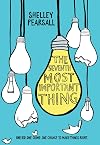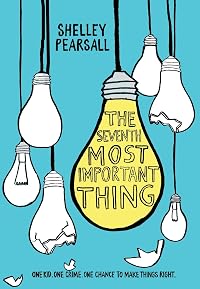
The Seventh Most Important Thing
by Shelley Pearsall
On This Page
Description
"In 1963, thirteen-year-old Arthur is sentenced to community service helping the neighborhood Junk Man after he throws a brick at the old man's head in a moment of rage, but the junk he collects might be more important than he suspects. Inspired by the work of American folk artist James Hampton"--Tags
Recommendations




Member Reviews
Arthur isn't your "ordinary" troublemaker, or juvenile delinquent. On the outside we are described a normal thirteen-year-old boy, who is tall and looks harmless. However, on the inside, it is a different story for this character. We start the book with Arthur throwing a brick at the neighborhood junk man's head because he is wearing his deceased father's helmet. Arthur just got back from juvie, and he thought he would be going right back. That was until Mr. Hampton, the junk man, asked that he do community service for him instead. We then go through Arthur's journey of dealing with grief, how his relationships grow, and his road to redemption.
I wasn't sure how I would like this book. I thought it was going to be boring, and I show more definitely judged a book by its cover. I am so glad it proved me wrong! First of all, the symbolism in this book, I feel as though I could write a whole novel about. The seven important things were all symbols of the stages Arthur needed to go through in order to redeem himself, and to overcome his father's death. I also believe each thing he found could also be linked with the seven deadly sins. When someone is grieving, it can be hard to try and see the light of the situation. It is, however; easy to veer towards the "evil" and not want to change or admit that you aren't ok. In this book Mr. Hampton is like Arthur's angel, guiding him to go down a path of self-reflection and self-love. However, towards the end of the book, Arthur becomes Mr. Hampton's angel by keeping his spirit alive and completing heaven. My favorite message that I took away from this book was that even though something may be broken, and seems to be unable to fix, nothing is every truly broken. Broken pieces, and broken hearts, are what make us human and they tell our own unique stories. I, again, loved how REAL this book was. So many children go through a death of a parent, and so many of them are like Arthur and are unable to cope with how they are feeling. Sometimes we, as teachers, are like Mr. Hampton to so many children and that is POWERFUL. I need to read this again because I have a feeling I will pick-up more and more underlying messages within the book. Can't wait to add this to my library someday! show less
I wasn't sure how I would like this book. I thought it was going to be boring, and I show more definitely judged a book by its cover. I am so glad it proved me wrong! First of all, the symbolism in this book, I feel as though I could write a whole novel about. The seven important things were all symbols of the stages Arthur needed to go through in order to redeem himself, and to overcome his father's death. I also believe each thing he found could also be linked with the seven deadly sins. When someone is grieving, it can be hard to try and see the light of the situation. It is, however; easy to veer towards the "evil" and not want to change or admit that you aren't ok. In this book Mr. Hampton is like Arthur's angel, guiding him to go down a path of self-reflection and self-love. However, towards the end of the book, Arthur becomes Mr. Hampton's angel by keeping his spirit alive and completing heaven. My favorite message that I took away from this book was that even though something may be broken, and seems to be unable to fix, nothing is every truly broken. Broken pieces, and broken hearts, are what make us human and they tell our own unique stories. I, again, loved how REAL this book was. So many children go through a death of a parent, and so many of them are like Arthur and are unable to cope with how they are feeling. Sometimes we, as teachers, are like Mr. Hampton to so many children and that is POWERFUL. I need to read this again because I have a feeling I will pick-up more and more underlying messages within the book. Can't wait to add this to my library someday! show less
I love reading a novel without knowing anything about it and being so surprised where the story takes me! This has a fantastic opening passage where a boy called Arthur throws a brick at a homeless man because he is wearing his deceased father's hat,that his mother threw away! The man breaks his arm, Arthur is arrested but instead of going to jail, Mr. Hampton, the man he hit, does a deal with the judge requesting that Arthur work for him. SPOILER:
It turns out, Mr H collects junk (he isn't homeless) which he turns into a fantastic work of art called Heaven.
Based on a true story: the art work does exist, the story is set in the 60s and looks at the effect of death on a family, the concepts of art and faith, the effects of war and how show more you find friendship in unlikely places. The characters are fantastic- sad, angry Arthur who hates the world that took away his father; insane Mr Hampton who calls everyone a saint but is creating a masterpiece; Squeak, the boy Arthur saves at school from the jocks who stands up in the canteen holding a sign "throw things at me"; Officer Beatrice, Arthur's parole officer, who says "stop" all the time but makes the most delicious food and has a heart of gold and finally the laconic owner of the tattoo parlour, Groovy Jim!
And of course, there is the wonderful cryptic list of important things that Arthur must collect in an old shopping trolley for Mr H. Each a physical object but also a symbol of something important in life!
Loved this novel and will definitely purchase for my Library! show less
It turns out, Mr H collects junk (he isn't homeless) which he turns into a fantastic work of art called Heaven.
Based on a true story: the art work does exist, the story is set in the 60s and looks at the effect of death on a family, the concepts of art and faith, the effects of war and how show more you find friendship in unlikely places. The characters are fantastic- sad, angry Arthur who hates the world that took away his father; insane Mr Hampton who calls everyone a saint but is creating a masterpiece; Squeak, the boy Arthur saves at school from the jocks who stands up in the canteen holding a sign "throw things at me"; Officer Beatrice, Arthur's parole officer, who says "stop" all the time but makes the most delicious food and has a heart of gold and finally the laconic owner of the tattoo parlour, Groovy Jim!
And of course, there is the wonderful cryptic list of important things that Arthur must collect in an old shopping trolley for Mr H. Each a physical object but also a symbol of something important in life!
Loved this novel and will definitely purchase for my Library! show less
Arthur T. Owens is a kid whose life could have really gone off the rails after he makes a bad decision from his grief and throws a rock at an old man in the neighborhood who is wearing his deceased father's hat. Instead of wanting him punished, the Junk Man asks for Arthur to be assigned to him for probation. When he reports for his first day, Arthur finds that he is tasked to find the "Seven Most Important Things" As he continues to do his time, Arthur changes, heals, grows, and thinks about redemption.
Charming.
I really wish I could see the piece of art that the group created!
Charming.
I really wish I could see the piece of art that the group created!
I liked the first half of this book better than the second half, but still an over all better-than-average read. The book opens with Arthur throwing a brick that hits the neighborhood junk man (James) in the head. Then we see him in court getting grilled by the attorney. Then we see James asking the judge to give Arthur an unusual sentence. Instead, of going back to Juvie, he will serve 120 hours of community service doing anything the old man wants him to.
When Arthur shows up the first day, James is nowhere to be found. James has left him a note that lists the "seven most important things." These are the junk items he has to search for in the trash cans around the neighborhood. Arthur doesn't do a very good job finding the items the show more first time. Consequently, he gets a good scolding from his probation officer. She's a no-nonsense kind of lady and I loved her character.
Arthur continues his trash routine ever Saturday. As the story progresses, Arthur develops into a really sympathetic character. He rescues his scrawny little classmate from bullies and gains a new friend in the process. He begins to enjoy his time with James and the tacky, sparkly "Heaven" he is creating with all the junk. But James isn't well and Arthur will have to rise to the challenge in order to fulfill his promise to James.
This is a great story of redemption. Arthur is reeling from his father's death, and in a moment of anger he makes a bad decision. He's really a good kid and he wants to do the right thing. James is like the father figure, passing on his advice to a son. Pearsall's writing is fantastic. She grabbed me on the first page. I loved the scene in the courtroom when Arthur says he threw the brick because of a hat. She is a master at painting a perfect image with straightforward, non-flowery language. She doesn't try to impress the reader with a lot of overdone metaphors. show less
When Arthur shows up the first day, James is nowhere to be found. James has left him a note that lists the "seven most important things." These are the junk items he has to search for in the trash cans around the neighborhood. Arthur doesn't do a very good job finding the items the show more first time. Consequently, he gets a good scolding from his probation officer. She's a no-nonsense kind of lady and I loved her character.
Arthur continues his trash routine ever Saturday. As the story progresses, Arthur develops into a really sympathetic character. He rescues his scrawny little classmate from bullies and gains a new friend in the process. He begins to enjoy his time with James and the tacky, sparkly "Heaven" he is creating with all the junk. But James isn't well and Arthur will have to rise to the challenge in order to fulfill his promise to James.
This is a great story of redemption. Arthur is reeling from his father's death, and in a moment of anger he makes a bad decision. He's really a good kid and he wants to do the right thing. James is like the father figure, passing on his advice to a son. Pearsall's writing is fantastic. She grabbed me on the first page. I loved the scene in the courtroom when Arthur says he threw the brick because of a hat. She is a master at painting a perfect image with straightforward, non-flowery language. She doesn't try to impress the reader with a lot of overdone metaphors. show less
The Seventh Most Important Thing by Shelley Pearsall is about a 13 year old boy named Arthur. Arthur is a troubled boy coping with the loss of his father. In a fit of rage Arthur throws a brick at Mr. Hampton's (junk man) head injuring the elderly junk collector of the neighborhood. Arthur served time in the juvenile justice system, and is sentenced to probation working with Mr. Hampton collecting junk. Arthur does not understand why he is collecting trash until he stumbles into Mr. Hampton's garage. Mr. Hampton has created a piece of art from junk that he refers to as the third heaven. Redemption is the main theme of this book. The reader can identify the theme of redemption throughout the book. Arthur tries to redeem himself to not show more only Mr.Hampton, but the rest of the town. Arthur feels guilty about harming Mr. Hampton, but Mr. Hampton tells Arthur that he saved him. This book paints the picture there is no such thing as just good and bad people. Good people can do bad things just as bad people can do good things. It also stresses that forgiveness is not always given to ones self. I really enjoyed experiencing Arthur's journey to redemption throughout the book. show less
A sweet story about redemption, friendship and art, in which once again Ms. Pearsall takes the kernel of a real event and spins it into an excellent historical fiction novel for middle schoolers. When thirteen year old Arthur is sentenced to do community service with the "Junk Man" whom he had injured with a thrown brick, Arthur is surprised, angry, relieved, and confused all at the same time. He is relieved he doesn't have to spend more time in juvenile lockup; he's really not a bad kid. But he's surprised that Mr. Hampton, the old man against whom he committed the crime, would want his help and not to have him locked away. Arthur reports for his volunteer hours but finds out he is going to be the new "junk man," pushing a rusty old show more shopping cart around the neighborhood to collect the Seven Most Important Things Mr. Hampton requires. What could the old man possibly want with cardboard, lightbulbs, mirrors, foil, and so on? And how is Arthur going to survive this humiliation? What Arthur discovers about Mr. Hampton's Seven Most Important Things surprises him again, as he finds these odd materials are being used for a most important art project, and they are also related to his own life. Mr. Hampton helps Arthur gradually come to terms with his father's recent death and other issues, while Arthur helps Mr. Hampton in many ways too. I loved this story, how it is set in 1963 but could take place just about any time; how the friendship between the older gentleman and the boy unfolds gradually; and that there really was a Mr. James Hampton who created the art that is the core of this story. show less
I was very skeptical of this book starting out. Until Arthur begins working with Hampton I was thinking this was going to be a drag. Thankfully it was not! I really enjoyed this book and I did cry a few times. I think I am probably a little sensitive to this plot because my Fiance's father suddenly died in February of 2017 and the realizations that Arthur is having about family, appreciation for life, and emotional control are things any person who is going through a loss must face. His character development is excellent in this book. We get very little from him during his time of sentencing, when he is still facing some real consequences but from the second day he goes to visit Hampton's garage we begin to see a change. He is observing show more the pieces of life and the moments of life which is so necessary for happiness and self understanding. Hampton, although mentally 'unclear', knows how to deal with the stresses that life can provide and is a willing partner in bringing Arthur back to the light. A few interesting things that I noticed were that the date is mentioned very few times. Other than the fact that someone would never get this type of sentence anymore, the plot rings true across the decades. Another thing is that the location is not mentioned until nearly half way through the book, showing that this is a story that could happen anywhere. Pearsall makes this novel quite interesting by integrating a large range of personalities and ages into one small space. She also does a nice job balancing the biblical elements. There is clearly a necessary connection that needs to be made to Christianity since Hampton is addressing the concept of Heaven but it is so casually done that it can basically been seen as simply having faith. This book also did it for me because of the artist element. I love making found object sculptures and I agree that there is definitely already enough trash in the world, many artists could be doing work like this and saving lots of money while helping bring beauty into all of our lives. I was thrilled to find out that this art is real and someday I would like to see it in person. I am sure the photos that I looked up do not do it justice. show less
Members
- Recently Added By
Author Information

9 Works 2,648 Members
Awards and Honors
Awards
Distinctions
Notable Lists
Classifications
Statistics
- Members
- 614
- Popularity
- 47,744
- Reviews
- 43
- Rating
- (4.16)
- Languages
- English
- Media
- Paper, Audiobook, Ebook
- ISBNs
- 22
- ASINs
- 4