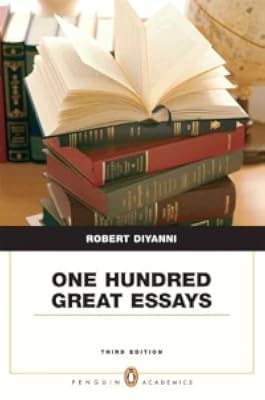
One Hundred Great Essays (Penguin Academics Series) (3rd Edition)
by Robert J. DiYanni
On This Page
Description
One Hundred Great Essays collects one-hundred of the most teachable and rewarding essays used in today's college composition class. The anthology combines classic, commonly taught essays with frequently anthologized contemporary essays by today's most highly regarded writers. The selections are broadly diverse in both subject matter and authorship. Essays have been selected as both models for good writing and useful springboards for student writing. An introductory section discusses the show more qualities of the essay form and offers instruction on how to read essays critically, and shows students how to use the writing process to develop their own essays show lessTags
Recommendations







Member Reviews
In the two years I've been teaching essay writing to high school students, my personal volumes of essays have sprouted a garden of post-it strips and my copier has worked overtime. I usually avoid books with "great" in the title (except for Great Expectations, that is), but for some reason, I picked up One Hundred Great Essays, edited by Robert Diyanni. Reading in the preface that there are two other volumes with equally "great" names (Fifty Great Essays and Twenty-Five Great Essays), I was not encouraged. However, one look at the table of contents convinced me that this book truly offered a one-stop shopping experience for essay readers and writers. While the book's introduction is long-winded and by no means an example of great show more writing (especially the page that rambles on about what good writing is and starts each of six paragraphs with the phrase "Good writing is..."), the essays selected for this volume made me forgive its first 29 pages: two drafts of Thomas Jefferson's Declaration of Independence, Plato, Anna Quindlen, Susan Sontag, EB White, Sigmund Freud, Ralph Ellison, Henry David Thoreau ... 92 more. If nothing else, this books exemplifies what a robust and flexible form the essay truly is. As with short stories and poems, the compactness of the essay's size demands a precision in language. But while we will permit short stories and poems to use literary devices which often obscure rather than clarify their themes, essays demand clarity. The brilliance of great essays comes when clarity and art marry. In addition to this collection's artful selections, it's nice to see brief bio's of the essays' authors included with each selection. When analyzing the content of essays, students frequently fail to take the context of the piece into account. Unfortunately, scholarly-sounding summaries are included after each bio and before the start of each essay. These summaries are great for students who don't want to read the essay but want to sound like they did when called on in class; I will be whiting-out these summaries for my students. It's critical that students learn how to think about essays for themselves and not be spoon-fed the English Department "line" on each essay. And finally, the typical "questions for thought" are tacked on at the end of each essay. Even as a student, I resented these questions because they scream, "Think this way, not that!" Today, I'll be using Annie Dillard's "Living Like Weasels" essay from this collection to teach my students how to use language vividly to hook their readers. Even though a Google search will turn up countless student papers on this essay with these lines quoted, I'll include them here for your reading convenience.
"A weasel is wild. Who knows what he thinks? He sleeps in his underground den his tail draped over his nose. Sometimes he lives in his den for two days without leaving. Outside, he stalks rabbits, mice, muskrats, and birds, killing more bodies than he can eat warm, and often dragging the carcasses home. Obedient to instinct, he bites hie prey at the neck, either splitting the jugular vein at the throat or crunching the brain at the base of the skull, and he does not let go." show less
"A weasel is wild. Who knows what he thinks? He sleeps in his underground den his tail draped over his nose. Sometimes he lives in his den for two days without leaving. Outside, he stalks rabbits, mice, muskrats, and birds, killing more bodies than he can eat warm, and often dragging the carcasses home. Obedient to instinct, he bites hie prey at the neck, either splitting the jugular vein at the throat or crunching the brain at the base of the skull, and he does not let go." show less
I read most of this in April but had to return it before a trip. It's a neat mix of classics and modern works, all worthy examples and interesting in their own right. A few social themes are disproportionately emphasized, especially gender and race issues. Among my favorites of the selection were: Graduation (Angelou), Of Studies (Bacon), Politics and the English Language (Orwell), Notes of a Native Son (Baldwin), Calculated Risks (Cole), Attending a World (Bateson), The Trouble with Wilderness (Cronon), Letter from a Birmingham Jail (King), On Self-Respect (Didion), and The Geography of Imagination (by Davenport).
A really great book for easy digestion reading. The essays span centuries and can really help you find new eras of literature to read. A new edition comes out every few years with new essays. I haven't read them all but I've read 30 or so and have enjoyed all but 1 or 2 that just weren't my style. Definitely a great read for commuting or those who are obsessive about having to finish what you start.
Ratings
Members
- Recently Added By
Author Information

41 Works 1,299 Members
Robert DiYanni received a B.A. from Rutgers University in 1968 and a Ph.D. from the City University of New York in 1976. He has taught at Queens College of the City University of New York, New York University, Harvard University, and Pace University. He has written articles and reviews on various aspects of literature, composition, and pedagogy. show more He has written numerous books including The McGraw-Hill Book of Poetry, Women's Voices, Like Season'd Timber: New Essays on George Herbert, and Modern American Poets: Their Voices and Visions. (Bowker Author Biography) show less
Classifications
- Genre
- Fiction and Literature
- DDC/MDS
- 808.0427 — Literature & rhetoric Literature, rhetoric & criticism Rhetoric and collections of literary texts from more than two literatures Rhetoric and anthologies Handbooks for writers English
- LCC
- PE1417 .O56 — Language and Literature English language English Modern English
- BISAC
Statistics
- Members
- 133
- Popularity
- 246,734
- Reviews
- 3
- Rating
- (3.40)
- Languages
- English
- Media
- Paper
- ISBNs
- 6