On This Page
Description
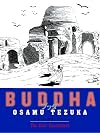
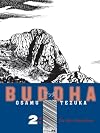
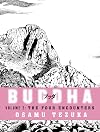
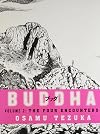
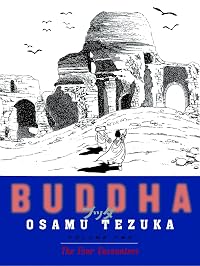
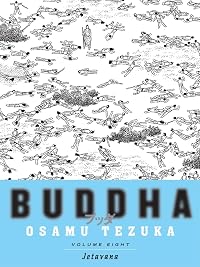
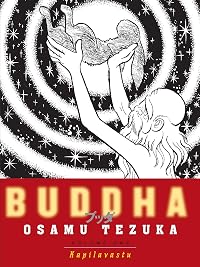
This second volume of the fictional biography of Siddhartha, Gautama Buddha, covers his upbringing and early manhood. Unhappy with the injustice of the caste system, the prince leaves his life of luxury to find a way to fight it. He marries and fathers a child, but unable to live in his luxurious palace, he cuts off his hair and departs into the wilderness to become a monk.Tags
Recommendations































Member Reviews
The first volume of this series focuses on what happened before the birth of Siddartha Gautama, and this one focuses on his childhood and the increasing unhappiness he feels in his pampered life in his father's palace. Through various encounters and events (hence the title of this volume) Siddartha learns more about then world around him, and wants to do something about it. Truly a wonderful and important volume in this incredible series.
In Osamu Tezuka's second volume, our main character is now a fully thinking, speaking and aware of his destiny young man. Well, aware of his destiny as seen through the eyes of those around him. Siddhartha's father still believes in the narrow view of the prophecy - and wishes to groom him simply to be a powerful king. As a sickly child easily bored by royal pursuits and prone to questioning the status quo of the caste system, Siddartha's adolescence is a rocky one. He is not even close to the vision of meditative calm Buddha in this volume - he is an argumentative teen fighting his way towards his true destiny while others race towards revenge tied equally to that destiny. Tezuka gives us a young Buddha that is very human.
This pace in show more this volume is quick, but dense. Several key moments and characters are introduced that are promised more significant encounters later. Even more impressive are the small pockets of Buddhist philosophy that are introduced throughout the story without drawing attention to the lessons. While this book is chiefly about suffering, Tezuka manages to sneak in all sorts of additional bits of doctrine. Demonstrating the nature of time as a construct and the universe as all eternal and now through casual mentions of modern electronics in an ancient story is one of the more clever inclusions.
His drawings, as usual, are amazing. The manga look is ever present, as are the intricate line-drawings that are simply beautiful illustration. show less
This pace in show more this volume is quick, but dense. Several key moments and characters are introduced that are promised more significant encounters later. Even more impressive are the small pockets of Buddhist philosophy that are introduced throughout the story without drawing attention to the lessons. While this book is chiefly about suffering, Tezuka manages to sneak in all sorts of additional bits of doctrine. Demonstrating the nature of time as a construct and the universe as all eternal and now through casual mentions of modern electronics in an ancient story is one of the more clever inclusions.
His drawings, as usual, are amazing. The manga look is ever present, as are the intricate line-drawings that are simply beautiful illustration. show less
Continuing the manga series, B&W throughout. Fictionalised story of Siddhartha on his path to becoming Buddha. He witnesses social injustice in his own kingdom, and sees Migalia dressing as a male to fight for love. He meditates on top of a high building and decides to leave...we actually the story is much better told than that. Recommended read, full of tragedy and humour, with superb manga illustrations.
After my favorable experience with volume one in this series, I decided to make the commitment of continuing on and this second story, The Four Encounters, did not disappoint!
As I mentioned in my review of Kapilavastu, a challenge I needed to overcome was my initial ambivalence to the graphic artwork style. With that impression overcome and accepted, the multiple layers of story-line and characters were much easier to enjoy and remember.
Occasionally, there are some character dialog choices that are a little jarring (nothing explicit or sexual) because they would be considered modern expressions. For example, a character exclaims "Right on!" or "Yowza!" Granted, the stories are also geared to younger readers, so I understand the reason show more for utilizing vernacular, but to this adult reader it never ceases to catch my ear!
Looking forward to continuing my slow walk through Tezuka's interesting and thought-provoking work... show less
As I mentioned in my review of Kapilavastu, a challenge I needed to overcome was my initial ambivalence to the graphic artwork style. With that impression overcome and accepted, the multiple layers of story-line and characters were much easier to enjoy and remember.
Occasionally, there are some character dialog choices that are a little jarring (nothing explicit or sexual) because they would be considered modern expressions. For example, a character exclaims "Right on!" or "Yowza!" Granted, the stories are also geared to younger readers, so I understand the reason show more for utilizing vernacular, but to this adult reader it never ceases to catch my ear!
Looking forward to continuing my slow walk through Tezuka's interesting and thought-provoking work... show less
Excellent. Fascinating, beautiful. I can imagine the cartoony characters might take a little getting used to, particularly with the juxtaposition with the beautiful, beautiful detailed backgrounds. But, hey, get used to it. Personally I could have done with a few fewer of the Asterixy jokes, but I can deal. Really looking forward to all the remaining volumes.
This series of eight graphic novels tells the story of Buddha's life through the stories of surrounding characters based both on actual historical figures and fictional ones. Told in the Japanese manga style it has a specific style and humour, and the themes are very mature including violence and nudity.
Well, we finally get to the young Buddha, and at this juncture he is not very likable. Of course his father is worse. Tezuka is still setting up the story, and you may find yourself getting a little impatient, but take it all one page at a time. Reading this is part of the experience.
Members
- Recently Added By
Author Information

Some Editions
Awards and Honors
Series

Work Relationships
Is contained in
Common Knowledge
- Canonical title
- Buddha, Volume 2: The Four Encounters
- Original publication date
- 1974
- People/Characters
- Buddha; Bandaka; Tatta; Migaila; Yashodara; Suddhôdana (show all 10); Prasenajit; Naradatta; Rahula; Devadatta
- Important places
- Kapilavastu
- Important events
- 5th century BCE
- First words
- What is one man's life compared to the eternity of time and space?
- Last words
- (Click to show. Warning: May contain spoilers.)Devadatta, son of Bandaka, would meet his father's archival Siddhartha in 20 years' time...and cause him terrible misfortune. But no one knows this yet.
- Original language
- Japanese
- Disambiguation notice
- This is the English translation which has different material from the original Japanese volume.
Second volume of an 8-volume set. 415 pages.
Classifications
- Genres
- Graphic Novels & Comics, Teen
- DDC/MDS
- 741.5 — Arts & recreation Drawing & decorative arts Drawing Comic books, graphic novels, fotonovelas, cartoons, caricatures, comic strips
- LCC
- PN6790 .J34 .B83 — Language and Literature Literature (General) Literature (General) Collections of general literature Comic books, strips, etc.
- BISAC
Statistics
- Members
- 761
- Popularity
- 36,752
- Reviews
- 13
- Rating
- (4.21)
- Languages
- 7 — Dutch, English, French, Indonesian, Japanese, Norwegian (Bokmål), Portuguese (Portugal)
- Media
- Paper, Ebook
- ISBNs
- 13
- ASINs
- 1